We assume cognition (thinking, memory, and emotion) is only possible for humans and a few other species. This assumption is wrong.
Bacteria detect chemical gradients and remember previous exposures. Plants learn from experience and communicate through fungal networks. Crows fashion tools and teach solutions to other crows. Rats choose to rescue drowning companions even when food rewards are offered as alternatives.
These are not anthropomorphic projections. They represent measurable cognitive capacities distributed throughout the tree of life. The biosphere is not a collection of mindless resources surrounding islands of human intelligence. It is a vast network of thinking beings processing information at scales from molecular to planetary.
This recognition transforms how we understand human compassion toward animals. When we rescue stranded dogs or tend injured birds, we are not projecting emotions onto empty vessels. We are recognizing fellow participants in an ancient cognitive community. Our empathy reflects biological inheritance, not cultural overlay.
Human cognition is extraordinary—but it is an elaboration of capacities found throughout life, not a break from them. We are not the sole possessors of mind. We are participants in something far larger.
Cognition is everywhere in all creatures. But what about us? Human cognition is an extraordinary elaboration of the capacities found throughout the biosphere. Our ability for symbolic language and cultural evolution has allowed us to accumulate and transmit knowledge across generations. This has transformed our species from one among many into a planetary force that is reshaping Earth systems (Henrich 2016; Steffen et al. 2011).
This unique cognitive power, however, presents a paradox.
The same intelligence that allows us to understand the intricate workings of the biosphere has also given us the technology to disrupt it (Steffen et al. 2015).
We suffer from a cognitive gap between our technological capacity and our ecological wisdom. We are brilliant at solving immediate, short-term problems but our cognitive biases make it difficult to address slow-moving, long-term crises like climate change. Biases like temporal discounting (valuing the present far more than the future) might have been essential during our early evolution, but they are now proving to be a critical flaw in our ability to act sustainably (Wagner 2010; van der Leeuw 2020).
If we are not the sole possessors of mind, but merely participants in a broader cognitive community, do we have any responsibility to the other thinking beings?
Acknowledging this shared cognitive heritage is a crucial step. It moves us away from a framework of human domination and toward one of stewardship and reciprocity (Leopold 1949). Indigenous knowledge systems have long embodied this perspective. Many of them emphasize interdependence and respect for all living things (Kimmerer 2013). The challenge for humanity is to evolve our culture and our ethics to match the power of our intellect. We need to learn to use our unique cognitive gifts to ensure the long-term viability of our extraordinary, thinking planet (Bai et al. 2016).
References
Bai, X., et al. 2016. Plausible and desirable futures in the Anthropocene: A new research agenda. Global Environmental Change 39: 351-362.
Henrich, J. 2016. The secret of our success: How culture is driving human evolution, domesticating our species, and making us smarter. Princeton University Press, Princeton, 447 p.
Kimmerer, R. W. 2013. Braiding sweetgrass: Indigenous wisdom, scientific knowledge and the teachings of plants. Milkweed Editions, Minneapolis, 408 p.
Leopold, A. 1949. A Sand County Almanac. Oxford University Press, New York, 226 p.
Steffen, W., et al. 2011. The Anthropocene: conceptual and historical perspectives. Philosophical Transactions of the Royal Society A 369(1938): 842-867.
Steffen, W., et al. 2015. The trajectory of the Anthropocene: The Great Acceleration. The Anthropocene Review 2(1): 81-98.
van der Leeuw, S. 2020. The archaeology of innovation: The embodiment of mind. Oxford University Press, Oxford, 368 p.
Wagner, G. 2010. But will the planet notice? How smart economics can save the world. Hill and Wang, New York, 256 p.
(This article is part of a series, The Thinking Planet, exploring the universal nature of cognition in the living world. Concepts and examples are drawn from “Silent Earth: Adaptations for Life in a Devastated Biosphere.”)
So far in the series, we’ve established that cognition is a universal feature of life. But does it matter for the planet as a whole? According to Silent Earth, the answer is a resounding yes. The cognitive abilities of organisms are not just interesting quirks; they are a vital force that contributes to the stability and resilience of the entire biosphere (Elmqvist et al. 2003).
This is the value of cognition, beyond the direct, utilitarian services we often measure (Costanza et al. 1997):
Adaptation and Resilience: Cognition is a primary tool for adaptation. When species can learn and modify their behavior based on experience, they are better able to cope with environmental change. This cognitive flexibility enhances the resilience of entire ecosystems, as their inhabitants can adjust to new challenges (Folke et al. 2004).
Structuring Ecosystems Through Emotion: The emotional responses of animals have a powerful effect on the landscape. The “ecology of fear” created by predators is a cognitive phenomenon (Estes et al. 2011). Prey animals that are afraid will alter their foraging patterns, which in turn allows vegetation to recover. The resulting trophic cascade, famously seen with the reintroduction of wolves in Yellowstone, stabilizes the entire ecosystem (Ripple and Beschta 2004).
Powering Ecosystem Services: Many ecosystem services we depend on are underpinned by cognition. Crop pollination relies on the ability of bees to learn and remember which flowers provide the best food rewards, which enhances their foraging efficiency (Chittka et al. 1999) and supports global agricultural productivity (Klein et al. 2007).
Cooperative Strategies: Collective cognition allows for cooperative strategies that enhance ecosystem health. The mycorrhizal networks connecting trees allow them to share resources and communicate about stress, improving the resilience of the entire forest, especially during environmental challenges like drought (Simard et al. 2012; Madouh and Quoreshi 2023).
A biosphere full of cognitive agents is fundamentally more robust and stable (Cardinale et al. 2012). Cognition allows for the adaptation, feedback, and cooperation that help maintain the delicate balance of our living planet.
But there’s one cognitive agent whose intelligence has had an outsized—and often destructive—impact. In my final post, I’ll explore the paradox of human cognition and its role in shaping the planet’s future.
(This article is part of a series, The Thinking Planet, exploring the universal nature of cognition in the living world. All concepts and examples are drawn from an analysis of my comprehensive work, “Silent Earth: Adaptations for Life in a Devastated Biosphere.”)
While plants and microbes show us that a brain isn’t required for cognition, the animal kingdom reveals an explosive diversity of minds shaped by evolution. Silent Earth details how different ecological challenges have produced a stunning array of cognitive solutions.
Insects, with their tiny brains, accomplish remarkable feats. Honeybees communicate the location of resources through a symbolic dance language and even display a conceptual understanding of zero (Chittka and Niven 2009; Howard et al. 2018).
Birds like the New Caledonian crow manufacture complex tools with features designed for specific tasks, a skill demonstrating causal understanding (Emery and Clayton 2004). Western scrub-jays exhibit episodic-like memory, remembering what food they hid, where, and when (Clayton and Dickinson 1999).
Octopuses represent a fascinating case of convergent evolution. Separated from vertebrates by over 500 million years, they have independently evolved puzzle-solving abilities, tool use, and the capacity to recognize individual humans (Godfrey-Smith 2016; Hochner et al. 2006).
But cognition isn’t just an individual affair. Silent Earth highlights the power of collective cognition, where complex problem-solving emerges from the interaction of many individuals.
Ant colonies act as a “superorganism,” creating efficient transport networks between the nest and food sources without any centralized control or leader (Deneubourg et al. 1990; Gordon 2010).
Fish schools display distributed vigilance. An evasive maneuver by a few fish on the edge of the group can propagate rapidly through the entire school, allowing fish far from the initial detection to respond to a threat they haven’t personally seen (Couzin and Krause 2003; Rosenthal et al. 2015).
From the specialized mind of a tool-making crow to the emergent intelligence of an ant colony, the biosphere is a showcase of cognitive diversity. There is no single ladder of intelligence with humans at the top, but rather a rich tapestry of minds, each a unique solution to the challenge of living (Shettleworth 2010).
In the next post, I will explore why this “thinking planet” is so important and how the cognitive abilities of all these organisms contribute to a more stable and resilient world.
References
Chittka, L., and Niven, J. E. 2009. Are bigger brains better? Current Biology 19(21): R995-R1008.
Clayton, N. S., and Dickinson, A. 1999. Episodic-like memory in scrub jays. Philosophical Transactions of the Royal Society B: Biological Sciences 354(1387): 1481-1495.
Couzin, I. D., and Krause, J. 2003. Self-organization and collective behavior in vertebrates. Advances in the Study of Behavior 32: 1-75.
Deneubourg, J. L., et al. 1990. The blind leading the blind: Modeling chemically mediated army ant raid patterns. Journal of Insect Behavior 3(5): 719-725.
Emery, N. J., and Clayton, N. S. 2004. The mentality of crows: Convergent evolution of intelligence in corvids and apes. Science 306(5703): 1903-1907.
Godfrey-Smith, P. 2016. Other minds: The octopus, the sea, and the deep origins of consciousness. Farrar, Straus and Giroux, New York, 272 p.
Gordon, D. M. 2010. Ant encounters: Interaction networks and colony behavior. Princeton University Press, Princeton, 185 p.
Hochner, B., et al. 2006. The octopus: a model for a comparative analysis of the evolution of learning and memory mechanisms. The Biological Bulletin 210(3): 308-317.
Howard, S. R., et al. 2018. Numerical ordering of zero in honeybees. Science 360(6393): 1124-1126.
Rosenthal, S. B., et al. 2015. Revealing the unseen majority: ULV-based assessment of plankton reveals profound impacts of kleptoparasites on crustacean zooplankton. Limnology and Oceanography 60(5): 1591-1604.
Shettleworth, S. J. 2010. Cognition, evolution, and behavior. 2nd ed. Oxford University Press, Oxford, 720 p.
(This article is part of a series, The Thinking Planet, exploring the universal nature of cognition in the living world. All concepts and examples are drawn from an analysis of my comprehensive work, “Silent Earth: Adaptations for Life in a Devastated Biosphere.”)
When we think of intelligence, we picture a brain. But the biosphere operates on a much broader set of rules. As we learned in the last post, cognition is a fundamental property of life, and some of its most surprising forms are found where we least expect them.
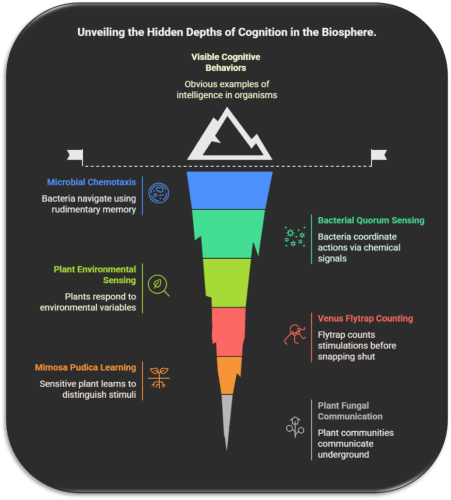
The book Silent Earth reveals that even the simplest organisms demonstrate sophisticated cognitive behaviors that belie their microscopic dimensions.
Microorganisms like the E. coli bacterium navigate their world through chemotaxis, a process that requires a form of rudimentary memory where they compare current conditions with those experienced moments before (Adler 1966; Vladimirov and Sourjik 2009).
Bacteria also engage in collective social behaviors through “quorum sensing.” They release chemical signals to sense their population density, allowing them to coordinate actions like forming biofilms or producing light only when their numbers are great enough to be effective (Fuqua et al. 1994; Waters and Bassler 2005).
Plants, too, are far from passive. They are constantly sensing and responding to dozens of environmental variables, from light quality and soil moisture to the chemical signatures of herbivores (Trewavas 2014; Karban 2015).
The Venus flytrap exhibits a stunning example of non-neural information processing. It counts the number of times its trigger hairs are touched, snapping shut only after two stimulations within about 20 seconds to distinguish prey from random debris (Böhm et al. 2016).
Plants also possess a form of memory. The sensitive plant Mimosa pudica can “learn” to distinguish harmful from harmless stimuli, maintaining this discrimination for weeks (Gagliano et al. 2016).
Perhaps most astonishingly, entire plant communities communicate through underground fungal networks, sending warning signals about herbivore attacks or sharing resources between different species (Simard et al. 2012; Song et al. 2019).
These examples show that cognition isn’t limited to organisms with nervous systems. It is a universal toolkit for survival, evolved in countless forms across the living world.
Next time, I’ll explore the more familiar, yet no less incredible, minds of the animal kingdom and discover how intelligence can emerge from the actions of a crowd.
References
Adler, J. 1966. Chemotaxis in bacteria. Science 153(3737): 708-716.
Böhm, J., et al. 2016. The Venus flytrap Dionaea muscipula counts trigger hairs to trap insects. Current Biology 26(3): 286-295.
Fuqua, C., et al. 1994. Quorum sensing in bacteria: The LuxR-LuxI family of cell density-responsive transcriptional regulators. Journal of Bacteriology 176(9): 269-275.
Gagliano, M., et al. 2016. Learning by association in the sensitive plant Mimosa pudica. Oecologia 175(1): 63-72.
Karban, R. 2015. Plant sensing and communication. University of Chicago Press, Chicago, 240 p.
Simard, S. W., et al. 2012. Net transfer of carbon between ectomycorrhizal tree species in the field. Nature 388(6642): 579-582.
Song, Y., et al. 2019. Belowground chemical signaling in plants. Journal of Integrative Plant Biology 61(7): 810-826.
Trewavas, A. 2014. Plant behaviour and intelligence. Oxford University Press, Oxford, 304 p.
Vladimirov, N., and Sourjik, V. 2009. Chemotaxis of Escherichia coli in a natural environment. PLoS ONE 4(5): e5512.
Waters, C. M., and Bassler, B. L. 2005. Quorum sensing: Cell-to-cell communication in bacteria. Annual Review of Cell and Developmental Biology 21: 319-346.
We think of our planet as being divided into two camps: humans, with our complex intelligence, and then everything else, running on simple instinct. But what if that division is wrong? What if the ability to sense, process information, and respond to it is not a rare gift but a fundamental characteristic of life itself?
In the book Silent Earth, I argue the biosphere is defined by the ubiquity of cognition. Not that a bacterium or a plant “thinks” like a human. Rather, it suggests that every living thing, to survive, must perform a crucial task: acquire information from its environment and respond adaptively (Trewavas 2014). This capacity for information processing—whether it happens in a brain or through the elegant molecular pathways of a single cell—is cognition.
When we look through this lens, the world transforms. We no longer see a planet of mindless automata but a global community of cognitive agents, each actively interpreting and shaping its world (De Waal 2009). This perspective challenges us to move beyond our human-centered view of intelligence and recognize the diverse and astounding ways that life knows itself and its surroundings.
In the next post, I’ll dive into the world of this hidden intelligence, exploring the remarkable cognitive abilities of the life forms we most often overlook: plants and microbes.
References
De Waal, F. B. 2009. The age of empathy: Nature’s lessons for a kinder society. Harmony Books, New York, 291 p.
Trewavas, A. 2014. Plant behaviour and intelligence. Oxford University Press, Oxford, 304 p.




 GarryRogers Nature Conservation