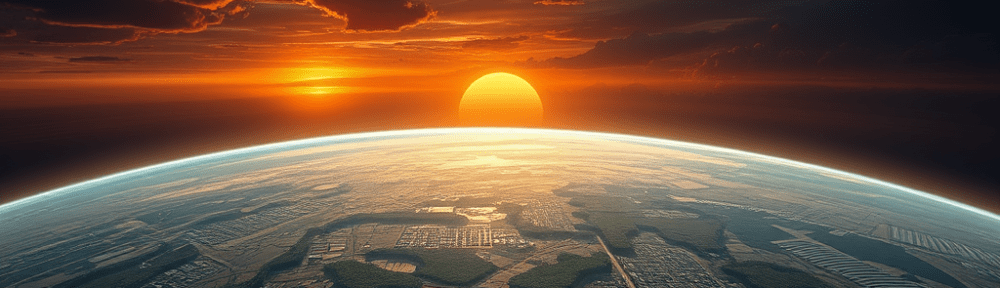
For centuries, human civilization has expanded in a stable environment with limitless resources. That era is over. The resources were limited and our actions have become the dominant force of change on Earth, initiating a new geological epoch: the Anthropocene. The biosphere is now declining at an accelerating rate, not from a single cause, but from a cascade of interconnected human pressures.
The Great Acceleration
Since the mid-20th century, human activity has intensified around the globe. This period, known as the “Great Acceleration,” saw unprecedented growth in consumption, waste, and environmental destruction. The change in Earth’s systems has become too rapid for natural repairs and too extensive for human restoration. We have pushed our planet beyond its limits.
Key Drivers of Decline
Multiple human activities are interacting to destabilize the biosphere. Military facilities, training, and intelligence operations are the greatest sources of biosphere impact. Their destruction of nature tops all the other activities. The others are familiar to us all.
- Climate Change: Human-induced climate change is the most pervasive threat. The primary driver is the emission of greenhouse gases from burning fossil fuels and land-use. Atmospheric CO₂ concentrations are higher than at any point in at least 800,000 years. This is causing lethal heat waves, altered weather patterns, ocean acidification, and sea-level rise.
- Habitat Destruction: The conversion of natural landscapes for farms, cities, and resource extraction is a primary driver of biodiversity loss. Globally, 75% of Earth’s ice-free land shows signs of human alteration. In the Amazon, cattle ranching and agriculture are destroying the rainforest.
- Resource Exploitation: Our consumption is depleting Earth’s finite resources.
Livestock production is a major driver of land and water degradation globally.
Overfishing has severely impacted 34% of global fish stocks, disrupting marine food webs.
Freshwater scarcity is expanding, with key aquifers being depleted faster than they can recharge.
- Pollution: Human activities have released a flood of contaminants into the environment.
Agricultural runoff creates vast “dead zones” in coastal waters.
Plastic pollution now permeates every ecosystem, from the deepest ocean trenches to Arctic snow.
Light and noise pollution disrupt the behavior of countless species.
Systemic Consequences
These individual pressures combine to create systemic crises that threaten the entire biosphere.
- Biodiversity Loss: We are now amid Earth’s sixth mass extinction event. Current extinction rates are hundreds to thousands of times higher than the natural background rate. This loss is not just about iconic species; it is an unraveling of the complex web of life that creates ecosystem stability.
- Cascading Effects & Tipping Points: The biosphere does not respond to stress with dull boring style, but rather in abrupt shifts as interconnected systems collapse abruptly when they reach critical thresholds or tipping points.
This diagnosis is grim. The next section, Charting the Path Forward, explores the transformative adaptations required for long term survival.
 GarryRogers Nature Conservation