

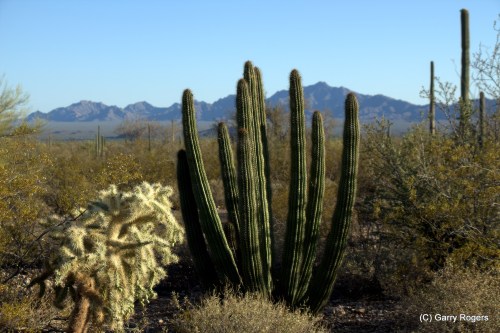
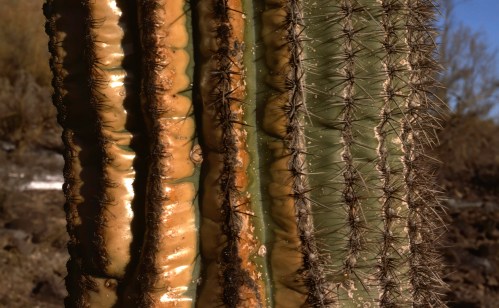
Fig. 2. Saguaro and palo verde at Organ Pipe National Monument. Fire kills most saguaro (Rogers 1985). Thus, unscared100-year-old saguaro show this site might not have burned for over 100 years (photo © GR 2016)
Fires in North American deserts are increasing and destroying desert ecosystems (Turner et al. 2020). The “Sonoran Desert Fire History” project, begun in 1974 by Garry Rogers and Jeff Steele, is concerned with the mechanisms of post-fire recovery by Sonoran Desert plant communities. Our goal is to repeat the original observations in the original plots and quantify 50 years of vegetation recovery through analysis of species density, cover, richness, and diversity.

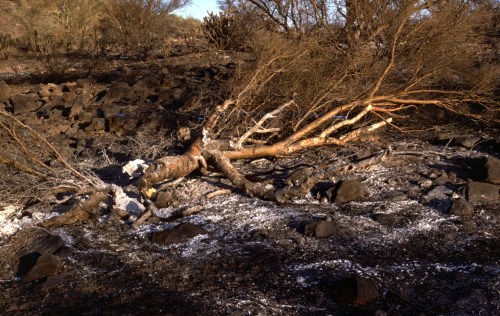
In 1979, Rogers and Steele repeated the observations they made immediately following fires in 1974. They were looking for adaptations in Sonoran Desert plants that would indicate fire had regularly occurred in the past. However, they found almost no species traits that indicated fire adaptations (Rogers and Steele 1980).
The Problem is Growing
Highly flammable introduced invasive weeds have spread across North American deserts. Fire frequency is increasing, and piece by piece, the desert ecosystem is becoming a desert weedland dominated by invasive grasses and other introduced herbs (Wilder et al. 2021).

Methods
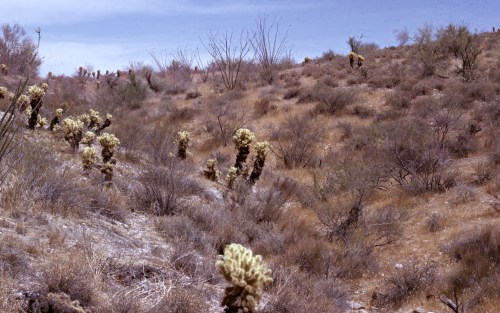
To document post-fire recovery for individual species and the plant community, researchers will repeat observations of the plots and transects laid out in 1974. They will calculate species and community recovery since the last fire (1980 at the Dead Man Wash site and 1984 at the Saguaro site). Then they will estimate recovery time for individual species and the community. The study sites include 16 large plots (total of 2700m²) and 14 transects (total of 5000m).
With help from contributors, Garry Rogers and Jeff Steele will conduct field observations in the fall of 2024. Data analysis and dissemination of findings will be complete early in 2025.
Desert Fire Ecology Relates to Global Environmental Problems
The “Sonoran Desert Fire History” project intersects with several major problems, particularly those related to climate change, biodiversity and land use, overpopulation and waste management, water scarcity, and pollution and health.
Climate Change Mitigation and Adaptation
Deserts historically have low fire frequencies due to sparse vegetation, but this is changing due to climate change, the spread of invasive species, and human activities. These changes lead to dryer more continuous fuel beds, and more frequent accidental ignitions.
Over Population and Waste Management
While the project does not directly address overpopulation and waste management, the increasing frequency and intensity of desert fires can be indirectly linked to these issues. Overpopulation leads to more human ignitions; land development and urbanization can contribute to the spread of flammable invasive species.
Water Scarcity
Desert ecosystems play an important role in the hydrological cycle. Vegetation recovery after fires is essential to block soil erosion and increase water retention.
Conclusion
The Sonoran Desert fire history project will give fire ecologists and managers information useful in choosing species and sites to protect from future fires and species to plant after fires. Moreover, the project contributes to our understanding of several global environmental problems, especially those related to climate change, biodiversity, and land use. Its findings can inform broader efforts to mitigate these challenges, demonstrating the interconnectedness of local ecological studies and global environmental issues.
Administration
This project is managed by the Agua Fria Open Space Alliance, Inc. (AFOSA).
References
Rogers, G. and J. Steele. 1980. Sonoran Desert fire ecology: Adaptive strategies of
perennial plant species. Pages 15-19 in M. A. Stokes and J. H. Dieterich,
technical coordinators. Proceedings of the fire history workshop. U. S. Forest
Service, General Technical Report RM-81.
Rogers, G. 1985. Mortality of burned Cereus giganteus. Ecology 66: 630-632.
Rogers, G. 2020. Desert Conservation and Management: Biodiversity Threats
from Invasive Weeds. In: Goldstein, M.I., DellaSala, D.A. (Eds.), Encyclopedia of
the World’s Biomes, vol. 2. Elsevier, pp. 213–221.
Turner, et al. 2010. Repeat photography and low elevation fire responses in the
Southwestern United States. Pages 223-244 in R. H. Webb, D. E. Boyer, and R.
M. Turner, eds. Repeat photography methods and applications in the natural
sciences. Island Press, Washington, DC. 530 p.
Wilder, B. T. et al. 2021. Grassification and fast-evolving fire connectivity and risk in
the Sonoran Desert, United States. Frontiers in Ecology and Evolution 9: 1-20.
 GarryRogers Nature Conservation