
We humans view ourselves as uniquely equipped with minds. We think, therefore we are—but what if thinking isn’t uniquely ours? What if the entire biosphere participates in cognitive processes, from bacteria sensing chemicals to plants learning from experience to animals with empathy? This foundational recognition transforms our understanding of nature and our place within it.
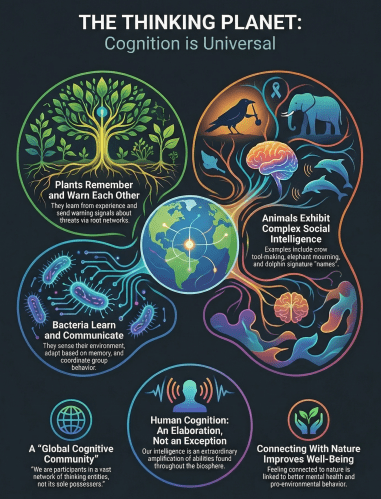
The conventional view positions humans as the sole possessors of genuine cognition, with other organisms operating merely on instinct or programmed responses. This perspective, however, crumbles under empirical scrutiny. As Rogers argues in his series The Thinking Planet, “the biosphere is not mindless. Every living thing acquires information from its environment and responds adaptively” (Rogers 2025a). This claim is not philosophical speculation but observable fact.
Evidence Across the Tree of Life
Consider bacterial chemotaxis. Single-celled organisms detect chemical gradients in their environment and move toward nutrients or away from toxins. They demonstrate memory through adaptation rates that change based on previous exposure. Bacteria communicate through quorum sensing, releasing and detecting signaling molecules to coordinate group behavior (Rogers 2025a). These are not preprogrammed mechanical responses but flexible, adaptive information processing.
Plants display even more sophisticated cognitive capacities. Research shows that plants learn from experience, remember past environmental conditions, and change future behavior accordingly. The sensitive plant Mimosa pudica, when repeatedly dropped without harm, ceases its defensive leaf-folding response—a clear demonstration of habituation learning (Gagliano et al. 2014). Plants communicate through root networks and fungal mycorrhizal connections, sharing nutrients and even warning signals about herbivore attacks (Gorzelak et al. 2015).
The animal kingdom reveals cognition’s full spectrum. Honeybees use symbolic dance language to communicate location and quality of food sources—abstract representation of spatial information (Riley et al. 2005). Crows fashion tools, solve multi-step problems, and teach solutions to other crows (Rutz et al. 2016). Elephants show self-awareness, mourn their dead, and maintain complex social knowledge spanning decades (Byrne et al. 2009). Dolphins use signature whistles as names, recognize themselves in mirrors, and cooperate in sophisticated hunting strategies (Janik 2013).
These examples are not anthropomorphic projections. They represent measurable cognitive capacities: learning, memory, communication, problem-solving, social cognition, and even elements of what we might call consciousness.
Reframing the Biosphere
This recognition reframes the biosphere as what Rogers terms a “global cognitive community” (Rogers 2025a). Rather than a collection of mindless resources surrounding islands of human intelligence, the living Earth emerges as a vast network of thinking entities, processing information at scales from molecular to ecosystem-level.
The implications extend beyond academic taxonomy. If cognition pervades the biosphere, then the documented instances of animal-to-animal compassion—elephants comforting dying companions, dolphins rescuing swimmers, rats choosing to save drowning cage-mates over food rewards—are not anomalies requiring special explanation (Bartal et al. 2011; Plotnik and de Waal 2014). They represent expressions of cognitive capacities distributed throughout life itself.
Human cognition, in this framework, is not a qualitative break from nature but “an extraordinary elaboration of the capacities found throughout the biosphere” (Rogers 2025f). Our symbolic language and cultural evolution have amplified these universal capacities, allowing us to accumulate and transmit knowledge across generations. This has transformed us “from one among many into a planetary force that is reshaping Earth systems” (Rogers 2025f).
The Ethical Shift
Recognizing universal cognition carries profound ethical weight. If we are “not the sole possessors of mind, but merely participants in a broader cognitive community” (Rogers 2025f), then our moral framework must shift. The anthropocentric view—positioning human interests as paramount and nature as resource—becomes not just philosophically questionable but empirically wrong.
Indigenous knowledge systems have long maintained this perspective. As ethnobotanist Robin Wall Kimmerer writes, plants are not objects but subjects, not “it” but “she” or “he,” not resources but relatives (Kimmerer 2013). What Western science dismisses as primitive anthropomorphism turns out to be sophisticated recognition of biological reality.
Research confirms the practical benefits of this shift. Studies show that stronger connections to nature correlate with increased well-being, enhanced meaning in life, and improved mental health (Lumber et al. 2017; Pritchard et al. 2020). Individuals who feel more connected to nature engage in more pro-environmental behavior, creating a positive feedback loop between human-nature connection and environmental protection (Mackay and Schmitt 2019; Rosa et al. 2018).
Human Cognition: Elaboration, Not Exception
The biophilia hypothesis, proposed by E.O. Wilson, posits an “innately emotional affiliation of human beings to other living organisms” (Wilson 1984). This isn’t cultural overlay but genetic heritage, evolved over millennia when success depended on reading nature’s signals. Animals and plants provided food, clothing, and served as environmental sentinels. Our attraction to other living things, our capacity for empathy across species boundaries, reflects our deep participation in the biosphere’s cognitive community.
Neurobiological research supports this connection. The discovery of spindle cells in cetacean brains—in regions linked to social organization, empathy, and intuition, previously thought exclusive to humans and great apes, suggests shared cognitive architecture (Bekoff 2010). Studies showing that mice wince watching other mice receive shocks, and that rats choose to save drowning companions even when food rewards are offered, demonstrate that empathy is not uniquely human but part of broader mammalian heritage (Langford et al. 2006; Bartal et al. 2011).
Importantly, human empathy for animals decreases with evolutionary divergence time, suggesting we more easily recognize anthropomorphic signals in species closer to us (Martin et al. 2019). This reveals both the universality of the compassion response and its modulation by perceived similarity.
Foundation for Transformation
Understanding the biosphere as cognitive community provides foundation for the essays that follow. It explains why humans possess innate compassion for other living things—we recognize, at some level, fellow thinking beings. It also illuminates why this compassion alone has failed to prevent environmental catastrophe. Recognizing individual animal minds differs from understanding systemic ecological relationships and humanity’s role within them.
Rogers notes that human cognition represents “an extraordinary elaboration” of universal capacities (Rogers 2025f). This elaboration has granted us symbolic language, abstract reasoning, and technological prowess. But it has also created what we might call “The Human Paradox,” the subject of our next essay, where the same intelligence that allows us to understand the biosphere has given us the technology to disrupt it.
The question becomes: Can we harness our extraordinary cognitive elaboration to transcend our cognitive limitations? Can we move from seeing ourselves as separate from and superior to nature toward recognizing ourselves as participants in an ancient, vast, thinking web of life?
The recognition that cognition is universal, not exceptional, transforms the environmental crisis from a technical problem requiring clever solutions to an identity crisis requiring fundamental transformation of how we understand ourselves and our relationship with the living world.
References
Bartal, I. B. A., Decety, J., & Mason, P. (2011). Empathy and pro-social behavior in rats. Science, 334(6061), 1427-1430.
Bekoff, M. (2010). The compassionate animal. Greater Good Magazine. https://greatergood.berkeley.edu/article/item/the_compassionate_animal
Byrne, R. W., Bates, L. A., & Moss, C. J. (2009). Elephant cognition in primate perspective. Comparative Cognition & Behavior Reviews, 4, 1-15.
Gagliano, M., Renton, M., Depczynski, M., & Mancuso, S. (2014). Experience teaches plants to learn faster and forget slower in environments where it matters. Oecologia, 175(1), 63-72.
Gorzelak, M. A., Asay, A. K., Pickles, B. J., & Simard, S. W. (2015). Inter-plant communication through mycorrhizal networks mediates complex adaptive behaviour in plant communities. AoB Plants, 7, plv050.
Janik, V. M. (2013). Cognitive skills in bottlenose dolphin communication. Trends in Cognitive Sciences, 17(4), 157-159.
Kimmerer, R. W. (2013). Braiding Sweetgrass: Indigenous Wisdom, Scientific Knowledge and the Teachings of Plants. Milkweed Editions.
Langford, D. J., Crager, S. E., Shehzad, Z., Smith, S. B., Sotocinal, S. G., Levenstadt, J. S., … & Mogil, J. S. (2006). Social modulation of pain as evidence for empathy in mice. Science, 312(5782), 1967-1970.
Lumber, R., Richardson, M., & Sheffield, D. (2017). Beyond knowing nature: Contact, emotion, compassion, meaning, and beauty are pathways to nature connection. PLoS ONE, 12(5), e0177186.
Mackay, C. M., & Schmitt, M. T. (2019). Do people who feel connected to nature do more to protect it? A meta-analysis. Journal of Environmental Psychology, 65, 101323.
Martin, J. S., Massen, J. J., Šlipogor, V., Bugnyar, T., Jaeggi, A. V., & Koski, S. E. (2019). The ERC-Advanced Grant ‘Explore’ Project on interspecies empathy: Methodological and theoretical framework. Scientific Reports, 9, 18107.
Plotnik, J. M., & de Waal, F. B. M. (2014). Asian elephants (Elephas maximus) reassure others in distress. PeerJ, 2, e278.
Pritchard, A., Richardson, M., Sheffield, D., & McEwan, K. (2020). The relationship between nature connectedness and eudaimonic well-being: A meta-analysis. Journal of Happiness Studies, 21(3), 1145-1167.
Riley, J. R., Greggers, U., Smith, A. D., Reynolds, D. R., & Menzel, R. (2005). The flight paths of honeybees recruited by the waggle dance. Nature, 435(7039), 205-207.
Rogers, G. (2025a). More than instinct—Uncovering nature’s hidden cognition. GarryRogers Nature Conservation. https://garryrogers.com/2025/06/29/
Rogers, G. (2025f). The human paradox—Our place in the cognitive web. GarryRogers Nature Conservation. https://garryrogers.com/2025/07/29/
Rosa, C. D., Profice, C. C., & Collado, S. (2018). Nature experiences and adults’ self-reported pro-environmental behaviors: The role of connectedness to nature and childhood nature experiences. Frontiers in Psychology, 9, 1055.
Rutz, C., Klump, B. C., Komarczyk, L., Leighton, R., Kramer, J., Wischnewski, S., … & St Clair, J. J. (2016). Discovery of species-wide tool use in the Hawaiian crow. Nature, 537(7620), 403-407.
Wilson, E. O. (1984). Biophilia. Harvard University Press.
 GarryRogers Nature Conservation