The Innocence of Ignorance: A New Perspective on Environmentalism

How Can We Love What We Destroy?

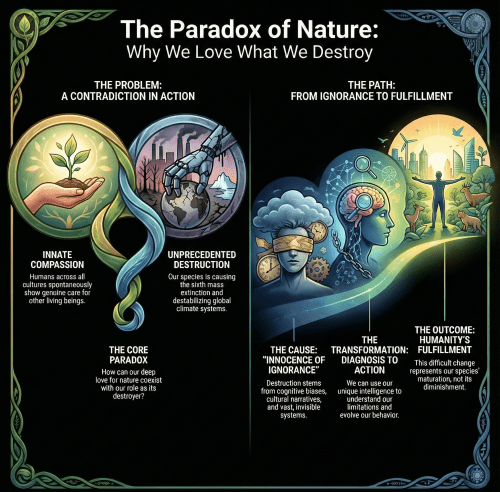
A man stops traffic to carry a turtle across the road. A woman spends her savings rehabilitating injured raptors. Children organize to save species they will never encounter in the wild.

These acts of compassion are not rare. They appear everywhere, spontaneously, across cultures. Something in us responds to other living beings with genuine care.

Yet our species is dismantling the biosphere with unprecedented speed. We are driving what scientists call the sixth mass extinction. We are altering climate systems that took millions of years to stabilize. We are simplifying ecosystems beyond the point at which they could recover their former complexity.

How do these two realities coexist in the same creature?

I have spent several years exploring this question, drawing on peer-reviewed research in biological conservation, evolutionary psychology, cognitive science, and environmental science. The result is a nine-part essay series called The Innocence of Ignorance.

The series argues that most humans bear no malicious intent toward nature. Our destruction flows from ignorance, but not simple ignorance. It is ignorance maintained by cognitive biases shaped for ancestral societies and environments, by cultural narratives celebrating dominance, and by systems too vast to see from within.

The essays trace a path from diagnosis to transformation. They examine why our intelligence became dangerous, what thermodynamic and ecological realities constrain our choices, and what it would mean to mature from planetary destroyer to plain member and citizen of Earth’s community.

The essays are not a counsel of despair. Humans possess something unique: the capacity to understand our own limitations and consciously evolve our behavior. The transformation soon to be forced upon us will be difficult. It will be painful. But it represents not humanity’s diminishment, it represents our fulfillment.
The Great Simplification is the Mechanism. The Initiation is the Meaning.

We stand at the terminal edge of the Holocene. By now, those of us paying attention to the data know that the era of “green growth” and technological salvation is a delusion. We are beginning to understand what systems theorist Nate Hagens calls “The Great Simplification”—the inevitable thermodynamic correction that occurs as our civilization’s energy subsidy, the “Carbon Pulse,” begins to fade.

Hagens has done the essential work of diagnosing the physics of our predicament. He has shown us the economic machinery of the descent. But as I walked the transects of the Sonoran Desert, watching the Saguaro forests vanish not into “nothing,” but into “weeds,” I realized that physics is only half the story.

The Great Simplification explains what is happening to us. It does not explain who we must become to survive it.

From Mechanics to Maturity

I have released a new document, “The Manifesto of the Initiation,” to bridge this gap. If Hagens provides the anatomy of the collapse, this Manifesto provides the soul of the descent.

The central premise is that the collapse of industrial civilization is not merely a failure to be avoided; it is a necessary evolutionary bottleneck—an Initiation.

Drawing on fifty years of ecological field data from the Arizona desert, the Manifesto argues that humanity is currently trapped in a state of “Industrial Adolescence.” We have exhibited all the classic pathologies of youth: omnipotence fantasies, immediate gratification, and a rebellion against limits. We believed we could bargain with biology.

The ecological data I present in the Manifesto—the “Sonoran Fractal”—proves that nature does not bargain. Just as the complex Saguaro ecosystem is being replaced by hardy, generalist weeds to survive the new climate, our civilization is being forced to shed its “Cathedrals” of complexity.

Why You Should Read It

While “The Great Simplification” asks how we might bend rather than break, “The Manifesto of the Initiation” asks a different question: How do we die well as a civilization so that we may be reborn as a mature species?

It is a guide for moving from:

  • Despair to Resoluteness.
  • Planetary Disruptor to Earth System Steward.
  • Sentience (feeling) to Sapience (wisdom).

We cannot save the world we knew. That world was built on a debt to nature that is now being called in. But we can curate the seeds for the world that is coming. We can stop being the “Black Knight” of the galaxy, denying our wounds, and finally grow up.

I invite you to read the full text. It is not a comforting document, but I believe it is an honest one.

[Link: “The Manifesto of the Initiation”]