
One-Hour Lecture Outline
Class Goal: To give writers a practical toolkit for creating, deepening, and understanding their characters, moving them from flat ideas to dynamic, believable people.
- Part 1: Introduction – Why Character is Everything (10 minutes)
- The Premise: “Plot is what happens, character is why we care.” Readers will forgive a simple plot if they love the characters, but they will abandon a brilliant plot if the characters feel false or shallow.
- Introduce the “3 Cs: “Today, we’re not going to just “invent” a character. We’re going to learn three core principles for discovering them: Complexity, Contradiction, and Craving.”
- Part 2: The First C – Complexity (15 minutes)
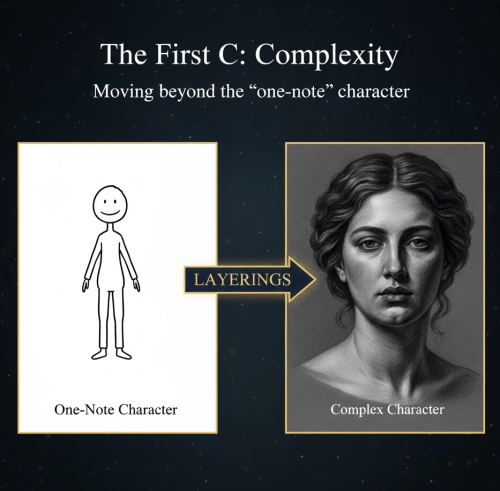
- Concept: Moving beyond the “one-note” character. A hero isn’t just “brave.” A villain isn’t just “evil.” Complexity comes from layering.
- The “Sacred Flaw”: Introduce this powerful idea. Often, a character’s greatest strength is also the source of their deepest flaw. (e.g., A detective’s brilliant focus makes him a terrible father; a shy person’s quietness makes them incredibly observant).
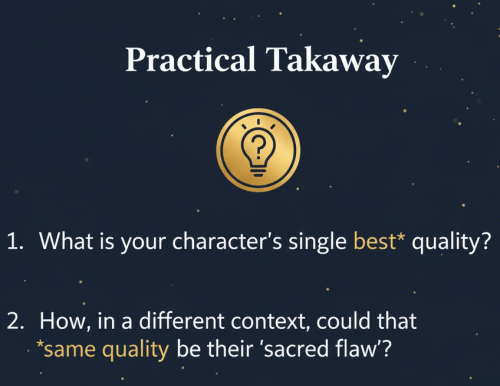
- Practical Takeaway: Ask the audience to think of their character. Now, what is their single best quality? And how, in a different context, could that same quality be their “sacred flaw”?
- Part 3: The Second C – Contradiction (15 minutes)
- Concept: This is what makes a character feel real. Humans are messy. We are walking contradictions. A character who is only consistent is boring and predictable.
- Examples: A tough-as-nails CEO who secretly collects snow globes. A disciplined soldier who has a chaotic, messy personal life. A priest who doubts his faith.
- Practical Takeaway: A 3-minute “micro-exercise.” Write one “truth” about your character (“My character is…”) and then add a “but…” that contradicts it. (e.g., “My character is a ruthless lawyer, but she donates 30% of her income to an animal shelter.”)
- Part 4: The Third C – Craving (15 minutes)
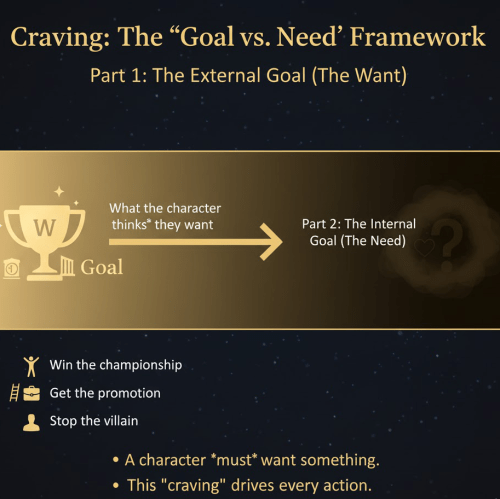
- Concept: This is the engine of your story. A character must want something. This “craving” or “goal” drives their every action.
- The “Goal vs. Need” Framework: This is a classic that benefits everyone.
- The External Goal (The Want): What the character thinks they want. (e.g., “To win the championship,” “To get the promotion,” “To stop the villain.”)
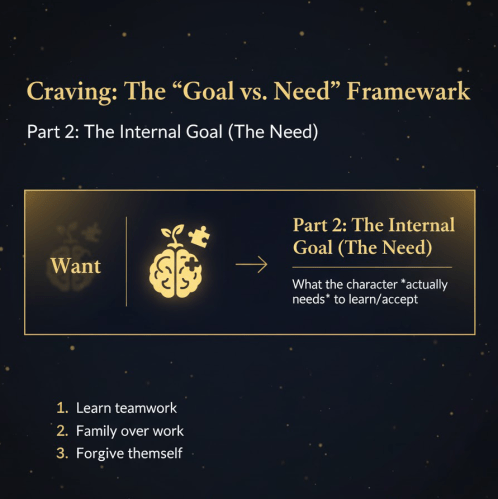
- The Internal Goal (The Need): What the character actually needs to learn or accept to become a whole person. (e.g., “To learn the value of teamwork,” “To realize their family is more important than work,” “To forgive themself.”)
- Practical Takeaway: Great stories are born when the Want and the Need are in conflict. (e.g., “A character wants revenge, but needs to learn to forgive.”) This is the heart of a “character arc.”
- Part 5: Conclusion & Q+A (5-10 minutes)
- Recap: “So, don’t just ‘make’ a character. Discover them. Find their Complexity (their sacred flaw), their Contradiction (their human messiness), and their Craving (their want vs. their need).”
Slides







 GarryRogers Nature Conservation