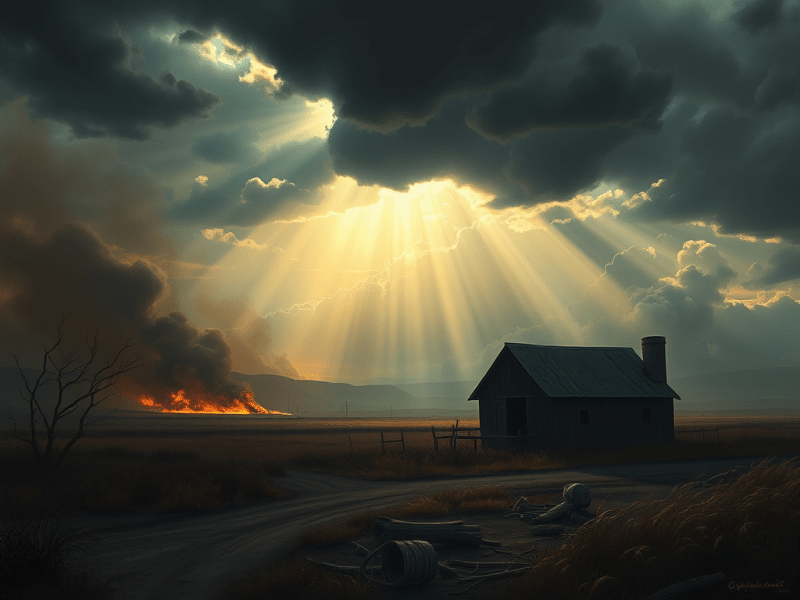
Mind boggled scanning all the climate solutions at this website aware climate is only one part of our problem. Insuring survival of significant portions of the biosphere 500 years from now is our challenge. Dwelling on the difficulty generates fantasies like “Love in Eternal Gardens.”
Category Archives: Adaptation
Field Guide to the Anthropocene
Watching the natural world change can be deeply saddening. Many of us feel a sense of grief or anxiety about the loss of species, the changing seasons, and the degradation of familiar landscapes. But paying attention—bearing witness—is a powerful act. It connects us to reality, helps us process grief, and can motivate meaningful action. Our project is to create “A Field Guide to the Anthropocene” (or similar title). This guide will blend ecological knowledge with simple observation techniques. It will help everyday people notice the environmental changes happening in their own communities, understand what they mean, and navigate the complex emotions that arise. It concerns learning to see clearly, grieve honestly, and find purpose in bearing witness to our changing planet.
The Refugia Playbook – A Strategy for Local Resilience
Our planet’s life support systems are failing, and we cannot fully restore what is being lost. But hope is not gone. We can focus on protecting refugia: special places that resist environmental damage and can act as lifeboats for biodiversity. Think of them as safe harbors—pockets of stability for plants and animals facing fire, heat, or drought. The goal of this project is to create a practical Refugia Playbook. This guide will help local communities identify, protect, and manage these vital areas in their own backyards. It is a hands-on strategy for building ecological resilience from the ground up, giving nature—and us—a fighting chance for recovery. Learn more about how we plan to develop this crucial tool.
Introducing “Biosphere Collapse: Causes and Solutions”

Our planet’s life-support system is in trouble. For centuries, we have treated the biosphere as an infinite resource. We have used its soils, forests, and waters. We have filled its air and oceans with waste. Now, the bill is coming due.
The signs are all around us. We have pushed the Earth beyond its safe operating limits (Richardson et al. 2023). The systems that kept our climate stable for millennia are beginning to break down. This is not a distant problem for future generations. It is a present reality. The window for simple fixes has closed.
My new book, Biosphere Collapse: Causes and Solutions, confronts this reality directly. It argues that we must shift our focus from preserving and restoring the past to preserving a future. The book moves beyond describing the problem. It offers a clear, structured framework for the necessary transformation of our civilization.
The framework organizes the required changes into four levels of increasing difficulty. It starts with straightforward technical solutions, like managing fisheries. It moves to restructuring entire economic sectors, like energy and agriculture. It then addresses systemic drivers like urbanization. Finally, it tackles the deepest challenge: shifting our core beliefs about progress and growth.
The book makes a pragmatic case for preparation. Profound change is difficult in times of comfort. It often takes a crisis to create the political will for action. As climate-related disasters become more common, they will create windows of opportunity. Biosphere Collapse advocates developing detailed blueprints that communities, towns, and nations can have ready to implement when those windows open.
This is a book about facing hard truths. But it is also a book about agency and hope. It outlines a path forward, one that combines technical knowledge, political strategy, and a deeper ethical relationship with the living world.
To learn more about this essential framework, please read the full executive summary on our new website page.
Bibliography
Richardson, K., et al. 2023. Earth beyond six of nine planetary boundaries. Science Advances 9: eadh2458.
Recent Blog Posts:
Manifesto of the Initiation
Here is a short explanation of the title. It breaks down the metaphor used in the text to clarify that “Initiation” refers to a rite of passage rather than a beginning. The title reframes the collapse of industrial civilization not as a meaningless end, but as a necessary rite of passage for humanity. It argues…
Announcing My New Novel: The Long Fire Season
I am pleased to announce the release of my new novel, The Long Fire Season. For years, I have written about the technical realities of biosphere collapse and the necessity of adaptation. Now, I am exploring those themes through the most powerful lens available to us: the human heart. Love in the Time of Nature’s…
The Great Simplification is the Mechanism. The Initiation is the Meaning.
We stand at the terminal edge of the Holocene. By now, those of us paying attention to the data know that the era of “green growth” and technological salvation is a delusion. We are beginning to understand what systems theorist Nate Hagens calls “The Great Simplification”—the inevitable thermodynamic correction that occurs as our civilization’s energy…
3: Rights of Nature – Should Rivers Have a Lawyer?
(This article is part of a six-post reality-check. Concepts and examples are drawn from “Silent Earth: Adaptations for Life in a Devastated Biosphere.”)
When a forest is cleared or a river is polluted, who speaks for them? For centuries, our legal systems have treated nature as property—a resource to be owned, used, and exploited. But what if nature had rights of its own?
This is not a mere metaphor. In a groundbreaking move, Ecuador’s 2008 constitution enshrined the Rights of Nature, recognizing that nature has the “right to exist, persist, maintain and regenerate its vital cycles” (Kauffman and Martin 2017). Following this, New Zealand granted legal personhood to the Whanganui River in 2017, and appointed guardians to act on its behalf and protect its interests as a living, integrated whole (Hutchison 2019).
This shift from nature as “property” to nature as a “rights-bearing entity” raises complex questions. Who has the standing to represent an ecosystem in court? How do we balance the rights of a river against the rights of a community that depends on it? Implementing these legal conditions is still evolving, but they represent a fundamental rethinking of environmental protection.
By recognizing the intrinsic value and legal standing of the natural world, we open up entirely new avenues for its defense. This approach invites us to move beyond our role as masters of the Earth and toward a more just relationship as members of a wider ecological community. Related Resources

References
Hutchison, A. 2019. The Whanganui River as a legal person. Alternative Law Journal 44(1): 16-20.
Kauffman, C. M., and Martin, P. L. 2017. Can rights of nature make development more sustainable? Why some Ecuadorian lawsuits succeed and others fail. World Development 92: 130-142.
Silent Earth Review
“Silent Earth” has received a five-star “must read🏆” review on Reedsy. Blending scientific depth and practical foresight, this book is both a wake-up call and a guide for navigating environmental collapse.
Synopsis

Silent Earth is a technical reference for civil engineers, land-use and urban planners, and city administrators. It covers a broad range of topics and should serve as a springboard for specialists wishing to learn more about adapting to climate change and biosphere decline.
As the Earth’s living systems deteriorate at an unprecedented rate, human societies face the urgent challenge of adapting to an increasingly unstable environment. Physical Geographer Garry Rogers offers a clear-eyed examination of our options, arguing that while complete restoration of the biosphere is no longer feasible, strategic adaptation remains possible. Drawing on extensive research, Rogers outlines practical approaches for communities to maintain essential functions as ecosystem services decline. While large-scale adaptation efforts face significant barriers, this groundbreaking work shows how planners and administrators can implement effective strategies to enhance resilience in a transforming world. Essential reading for navigating our environmental future. Ideal for policymakers, scholars, environmentalists, and engaged citizens, Silent Earth challenges readers to envision a future where, even amidst biosphere decline, adaptation and innovation can pave the way for survival.
Garry Rogers’ Silent Earth: Adaptations for Life in a Devastated Biosphere explores the escalating degradation of Earth’s biosphere, offering strategies for human adaptation. It points to the realistic inevitability of this need to adjust, as humanity is facing the consequences of irreversible damage already done. Rogers goes beyond the simple dialogue of climate change, expanding and examining the interconnected impact of the entire biosphere, from current impacts such loss of biodiversity to coral reef bleaching.
In Section IV, Rogers draws upon research to emphasize that as soon as 2030 we are on the brink, and that we urgently need to act not only to prevent further destruction, but also to prepare for survival:
The cumulative and synergistic effects of human impacts are pushing ecosystems closer to tipping points. Feedback loops and shifting ecosystem boundaries are accelerating environmental change, while these effects interact in complex ways, amplifying their individual impacts. As we approach 2030, addressing these interconnected challenges will require an integrated approach to conservation and climate action to mitigate the far-reaching impacts on biodiversity and ecosystem stability.
The strength of Silent Earth lies in Section V, which presents a blueprint for adaptation. Rogers proposes various strategies from water management to cultural and governance reforms. His emphasis on grassroots action and local resilience is both pragmatic and empowering, especially given his acknowledgment of the political and societal inertia that is likely to hinder adaptation on a wider scale.
Silent Earth is thoroughly researched, intellectually stimulating, and well-cited. Rogers excels in synthesizing vast amounts of ecological, social, and technological data into a cohesive narrative.
Silent Earth is a valuable resource for those interested in interdisciplinary approaches to global challenges. It’s an important and thought-provoking read for anyone seeking to understand and address the complex realities of ecological decline.