Life on Mars?!

Learning about Mars

Curiosity

Mars Rover Curiosity

As Mars rover Curiosity gets closer to determining that life existed on Mars, people are getting excited.  Some hope that we will find a few of the last surviving pockets of the planet’s microorganisms.  Fascinating!  Should we invest more in the space program?  Oh, sorry; that was stupid.  Everyone knows we have to save life on Earth first.

Reports from around the world are describing the progress of a great environmental catastrophe.  Earth’s wild animals and plants are dying.  Efforts by the world’s governments and conservation organizations have failed to stop the accelerating catastrophe.  According to a January 2013 report by the AZ Game & Fish Department, more than half of the state’s native vertebrate species are imperiled.  Sadly, the status of the great majority of smaller species is unknown. Continue reading

Invasive Species

Invasive Species:  Our Accidental Attack On Nature

The story of invasive species and their alteration of native habitats is one of the most disappointing tales to be told of human interaction with nature. It is full of surprises, unsolved mysteries, scientific research, and reactive management that too often exemplifies the adage, “too little too late.” This post summarizes the main elements of the plot and its conclusion. It begins about 500 years ago when people started crossing the oceans and taking boatloads of new species to North America and other parts of the world. Some of the new species invaded native habitats, replaced the natives, and became permanent residents. Of all the things people have done to the wildlife and wildlife habitat of the Agua Fria River Basin—road and building construction, ranching, logging, hunting, farming, fertilizing, recreation, burning, and water use—the most destructive has been the accidental introduction of invasive plants and animals.

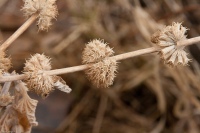
Horehound (Marrubium vulgare) seeds.  This Asian invader is common in the arid uplands of central Arizona.

Horehound (Marrubium vulgare) seeds. This Asian invader is common in the arid uplands of central Arizona.

The photo shows the dry seeds of Horehound (Marubium vulgare).  The seeds have small hooks that catch on clothing and animal fur. Horehound is a small perennial shrub that forms pure stands when native vegetation is removed by livestock. The seeds often create persistent mats in animal fur, and they are irritating when they get in your socks. Cattle will eat a little Horehound when the plants are young, but they don’t eat enough to prevent the plant’s spread.

Continue reading

Loggerhead Shrike

Loggerhead Shrikes (Lanius ludovicianus) are fairly common in the Agua Fria River Basin, but the one shown here is the first one I have photographed.  This fellow was quite curious about me, and while I stood talking to him, fluttered to within about ten feet, then perched nearby while I tried for a good camera angle.

Male and female shrikes share the same white,  gray, and black plumage, and both parents feed their young.  This big-headed little bird hunts insects and small lizards, mammals, and birds from fences, trees, and shrubs.  Shrikes have strong beaks but relatively weak talons.  When they make a catch they carry their prey to a thorny tree or shrub, impale it, and tear it asunder with their powerful beaks.  If prey is plentiful, some will be left impaled for later use.  These ‘left overs’ are perhaps used to mark territory and attract females.

Loggerhead Shrikes have declined throughout the United States, especially in the Midwest and Northeast.  Breeding bird surveyors (Corman and Wise-Gervais 2005) found the bird nesting throughout Arizona, but according to Sauer et al. (1995), there has been a measurable decline.  Roads, pesticides, and other threats are discussed by Julie Craves (2007).   Shrikes prefer open woodland and shrubland with abundant perches and thorny plants.  As these habitat types fade away due to the spread of invasive weeds and the increase in wildfires, shrikes will become scarce.  But until the chaparral is burnt out and the megapolitans arrive with their bulldozers, you can see these unusual little birds just about anywhere in the upper Agua Fria River Basin.

References (Look for additional references in the earlier post on Arizona Birds)

Corman, T.E., and C. Wise-Gervais. 2005. Arizona breeding bird atlas. University of New Mexico Press, Albuquerque, NM.  636 p.

Craves, J.  2007.  Species profile: Masked predator, Loggerhead Shrike.  Birdwatching.  August 22, 2007.  Online in the bird profiles section at:  http://www.birdwatchingdaily.com.  (On the BirdWatchingDaily website go to ‘getting started–bird profiles–August 2007 edition.)

Sauer, J.R., S. Orsillo, and B.G. Peterjohn.  1995.  Geographic patterns and population trends of breeding and wintering Loggerhead Shrikes in North America.  Proceedings of the Western Foundation of Vertebrate Zoology 6: 128-141.