Abstract
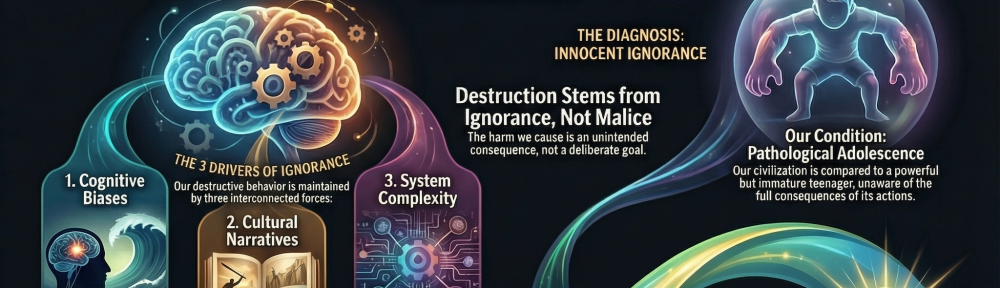
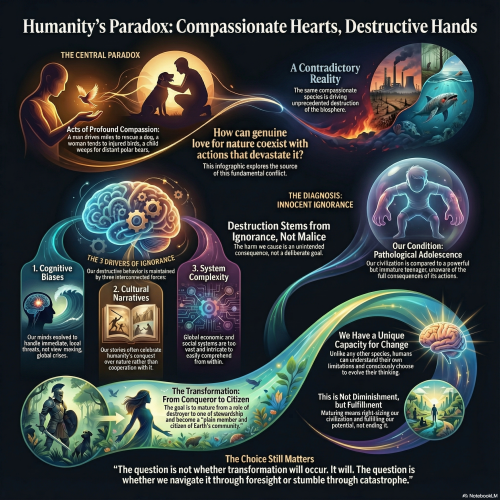
This essay explores the apparent paradox of human behavior toward the biosphere: while humans frequently show innate compassion and kindness toward animals and nature, they simultaneously take part in unprecedented environmental destruction. Drawing on peer-reviewed research in evolutionary psychology, environmental ethics, and cognitive science, alongside insights from Rogers’ (2025) Manifesto of the Initiation and his Thinking Planet series on universal cognition, I argue that most humans are indeed innocent of intentional harm to the biosphere. Human compassion toward animals is not uniquely human but an elaboration of cognitive capacities present throughout the biosphere—from bacterial chemotaxis to plant learning to animal empathy. This innocence, however, does not absolve humanity of moral responsibility. Rather, it reflects a developmental state characterized by cognitive biases, shifting baselines, and a fundamental lack of ecological consciousness—what the Manifesto terms “pathological industrial adolescence.” The transition from unwitting destroyer to mature “plain member and citizen of the biosphere” requires what Rogers terms “cognitive adaptation”—a fundamental transformation of consciousness regarding humanity’s place within the living Earth’s cognitive community. Uniquely, humans possess the metacognitive capacity to understand and overcome their own cognitive limitations, offering hope that deliberate cultural evolution toward ecological wisdom remains possible.
Donate
Make a one-time donation
Make a monthly donation
Make a yearly donation
Choose an amount
Or enter a custom amount
Your contribution is appreciated.
Your contribution is appreciated.
Your contribution is appreciated.
DonateDonate monthlyDonate yearly GarryRogers Nature Conservation