Manifesto of the Initiation

Here is a short explanation of the title. It breaks down the metaphor used in the text to clarify that “Initiation” refers to a rite of passage rather than a beginning.

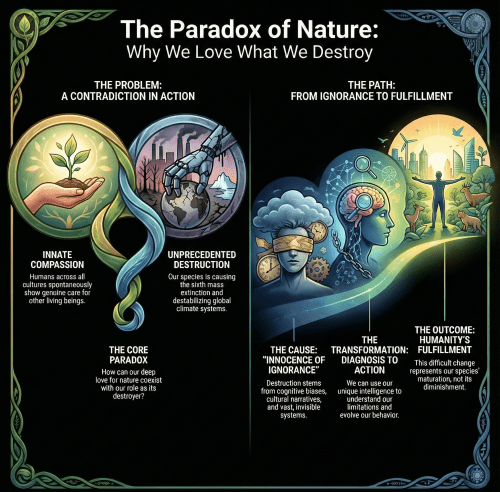
The title reframes the collapse of industrial civilization not as a meaningless end, but as a necessary rite of passage for humanity. It argues that humans are behaving as adolescents: obsessed with immediate gratification, a false sense of invincibility, and growth, the accumulation of material wealth.

Therefore, the “Initiation” refers to the painful evolutionary bottleneck we have entered. Just as a tribal initiation forces a child to endure an ordeal to become an adult, the climate and biosphere crises are the “initiatory ordeals” required to strip humanity of its illusions.

The goal of our initiation is a shift in consciousness: moving us from the role of planetary conqueror to that of a mature, responsible member of the biosphere. We are not dying; we are being forced to grow up.

In short: The biosphere collapse is the harsh lesson (the Initiation) required to transform humanity from reckless adolescence into mature sapience.

The Great Simplification is the Mechanism. The Initiation is the Meaning.

We stand at the terminal edge of the Holocene. By now, those of us paying attention to the data know that the era of “green growth” and technological salvation is a delusion. We are beginning to understand what systems theorist Nate Hagens calls “The Great Simplification”—the inevitable thermodynamic correction that occurs as our civilization’s energy subsidy, the “Carbon Pulse,” begins to fade.

Hagens has done the essential work of diagnosing the physics of our predicament. He has shown us the economic machinery of the descent. But as I walked the transects of the Sonoran Desert, watching the Saguaro forests vanish not into “nothing,” but into “weeds,” I realized that physics is only half the story.

The Great Simplification explains what is happening to us. It does not explain who we must become to survive it.

From Mechanics to Maturity

I have released a new document, “The Manifesto of the Initiation,” to bridge this gap. If Hagens provides the anatomy of the collapse, this Manifesto provides the soul of the descent.

The central premise is that the collapse of industrial civilization is not merely a failure to be avoided; it is a necessary evolutionary bottleneck—an Initiation.

Drawing on fifty years of ecological field data from the Arizona desert, the Manifesto argues that humanity is currently trapped in a state of “Industrial Adolescence.” We have exhibited all the classic pathologies of youth: omnipotence fantasies, immediate gratification, and a rebellion against limits. We believed we could bargain with biology.

The ecological data I present in the Manifesto—the “Sonoran Fractal”—proves that nature does not bargain. Just as the complex Saguaro ecosystem is being replaced by hardy, generalist weeds to survive the new climate, our civilization is being forced to shed its “Cathedrals” of complexity.

Why You Should Read It

While “The Great Simplification” asks how we might bend rather than break, “The Manifesto of the Initiation” asks a different question: How do we die well as a civilization so that we may be reborn as a mature species?

It is a guide for moving from:

  • Despair to Resoluteness.
  • Planetary Disruptor to Earth System Steward.
  • Sentience (feeling) to Sapience (wisdom).

We cannot save the world we knew. That world was built on a debt to nature that is now being called in. But we can curate the seeds for the world that is coming. We can stop being the “Black Knight” of the galaxy, denying our wounds, and finally grow up.

I invite you to read the full text. It is not a comforting document, but I believe it is an honest one.

[Link: “The Manifesto of the Initiation”]

3: Rights of Nature – Should Rivers Have a Lawyer?

(This article is part of a six-post reality-check. Concepts and examples are drawn from “Silent Earth: Adaptations for Life in a Devastated Biosphere.”)

When a forest is cleared or a river is polluted, who speaks for them? For centuries, our legal systems have treated nature as property—a resource to be owned, used, and exploited. But what if nature had rights of its own?

This is not a mere metaphor. In a groundbreaking move, Ecuador’s 2008 constitution enshrined the Rights of Nature, recognizing that nature has the “right to exist, persist, maintain and regenerate its vital cycles” (Kauffman and Martin 2017). Following this, New Zealand granted legal personhood to the Whanganui River in 2017, and appointed guardians to act on its behalf and protect its interests as a living, integrated whole (Hutchison 2019).

This shift from nature as “property” to nature as a “rights-bearing entity” raises complex questions. Who has the standing to represent an ecosystem in court? How do we balance the rights of a river against the rights of a community that depends on it? Implementing these legal conditions is still evolving, but they represent a fundamental rethinking of environmental protection.

By recognizing the intrinsic value and legal standing of the natural world, we open up entirely new avenues for its defense. This approach invites us to move beyond our role as masters of the Earth and toward a more just relationship as members of a wider ecological community. Related Resources

References

Hutchison, A. 2019. The Whanganui River as a legal person. Alternative Law Journal 44(1): 16-20.

Kauffman, C. M., and Martin, P. L. 2017. Can rights of nature make development more sustainable? Why some Ecuadorian lawsuits succeed and others fail. World Development 92: 130-142.

#WildforLife – Backed by Stars, UN Campaign Seeks to Mobilize Millions to End Illegal Trade in Wildlife

GR.–Publicity campaigns work best when we design them to appeal to the correct audience.  Is the typical customer for poached animals and their body parts likely to respond to celebrity messages?  It seems unlikely that the poachers will.  Nevertheless, celebrities will draw attention to the issue, and though they might not evoke a response among the customers, they might create public attitudes that can indirectly influence customers.  And for the public, knowing a problem exists is a great step toward solution.

Ban Ki-moon, Gisele Bündchen, Yaya Touré and Ian Somerhalder among those aiming to spur action to protect endangered species

UN, Nairobi, Wednesday, 25 May 2016.–“The United Nations, backed by A-list celebrities from across the globe, today launched an unprecedented campaign against the illegal trade in wildlife, which is pushing species to the brink of extinction, robbing countries of their natural heritage and profiting international criminal networks.

“Each year, thousands of wild animals are illegally killed, often by organized criminal networks motivated by profit and greed,” said Secretary-General Ban Ki-moon. “I call on all Governments and people everywhere to support the new United Nations campaign, Wild for Life, which aims to mobilize the world to end this destructive trade. Preserving wildlife is crucial for the well-being of people and planet alike.”

“#WildforLife, launched today at the second United Nations Environment Assembly (UNEA-2) in Nairobi in front of environment ministers from every corner of the planet, aims to mobilize millions of people to make commitments and take action to end the illegal trade.”  Continue reading:  Backed by Stars, Unprecedented UN Campaign Seeks to Mobilize Millions to End Illegal Trade in Wildlife

Save

Citizen Science Volunteers find Wolverines

Citizen science wildlife monitoring project finds continued evidence of wolverines in Bitterroot National Forest.

Kylie Paul.–This spring, we wrapped up another exciting field season for our Wolverine Watchers! This data collection program, in partnership with the Bitterroot National Forest, set up monitoring stations for medium-sized carnivores of the Northern Rockies. We were particularly looking for wolverines and fishers, and hoped to also find Canada lynx.

Well, what a year! With more than 140 volunteers tallying well over 2,000 volunteer hours, we gathered more than 12,000 photos of wildlife in the mountains and creek bottoms of the Bitterroot National Forest, south of Missoula. We found 20 different species, including some of the ones we were most eager to see! We found black bear, bobcat, a variety of bird species, deer mouse, flying squirrel, marten, moose, mountain lion, red fox, red squirrel, snowshoe hare, western striped skunk, wolf and wolverine. Here are some great shots from the remote cameras:

Also, one of our volunteers is a photographer, so he set up a fancy camera set that has a trigger and flash system near one of our monitoring stations and got an AMAZING photo of one of our favorite individual wolverines!  Continue reading:  Citizen Science Volunteers find Wolverines

Save

Trophy hunting of grizzly bears to continue in British Columbia – The Globe and Mail

Justine Hunter, VICTORIA — The Globe and Mail

“British Columbia is cracking down on the use of sheep and goats as pack animals for big game hunters in its latest set of hunting and trapping regulations. But the contentious trophy hunting of grizzly bears will continue unchanged.

“The provincial ministry responsible for hunting produced updated regulations on Monday, and although it has rejected a proposal to increase the number of grizzly hunting permits for resident hunters in the Peace River region, environmentalists are disappointed that the status quo remains in place.

“The major changes include additional record-keeping requirements for butchers, and a new ban on bringing domesticated sheep or goats along on big game hunts to act as beasts of burden because of fears that the animals may pass on disease to wildlife. The report did not say whether this was a common practice. Steve Thomson, the Minister of Forests, Lands and Natural Resource Operations, says in the report released Monday his major concern in wildlife management right now is around the declining moose population, and he promised a new BC Moose Tracker app that will allow people to record moose sightings.”  Continue reading: Trophy hunting of grizzly bears to continue in British Columbia – The Globe and Mail

Save

The eco guide to population growth [not] | Environment | The Guardian

GR:  The article below contains an argument for more people on the planet.  It uses one of the standard homocentric arguments to justify population growth:  A genus among the new people will solve all our problems.  Some of the article’s contents are so biased they are painful to read.  “The shelves are wrapped in certified zero-deforestation leather from Brazil . . . .” and “. . . I’m in love with Timothy Han’s new scent, which features fairly traded Brazilian cedarwood.”  Google “controlling population growth” for more arguments.  One thing you will learn is that controlling growth is extremely difficult.  And with the current economic benefits of more consumers and workers for wealthy investors, it is impossible.

Lucy Siegle, Sunday 12 June 2016.–“The regularity with which I’m contacted by population worriers – people who think it’s pointless discussing green energy, climate change and ethical pensions when the elephant in the room is actually the new human in the room – is impressive. They say that the planet needs fewer people. End of.

“The numbers are indeed eye catching. Today there are 7 billion humans alive (twice the number who were alive in 1965) – and each hour we add 10,000 more. By 2050, UN demographers predict, there will be at least 9 billion of us putting a strain on life-sustaining resources.

“Some experts suggest we’re at “peak farmland”, – meaning the predictions of cleric Thomas Malthus, who published his population theory in 1798, are coming to fruition. Malthus suggested that our global population would outpace food supplies until war, disease and famine arrived to halt the party.I prefer to be Pollyanna-ish about it: rather than fearing more people, let’s believe that the new ones will make a difference, fix the energy gap, work out how to develop sustainable protein sources and so on [emphasis by me].”  Continue reading:   The eco guide to population growth | Environment | The Guardian

Save

Save

Air pollution now major contributor to stroke, global study finds | Science | The Guardian

GR:  Air pollution harms all species of plants and animals.  Fortunately, the most toxic concentrations are in human cities and homes where animal numbers are lower.

Science editor.–Scientists say finding is alarming, and shows that harm caused by air pollution to the lungs, heart and brain has been underestimated

Air pollution has become a major contributor to stroke for the first time, with unclean air now blamed for nearly one third of the years of healthy life lost to the condition worldwide.

In an unprecedented survey of global risk factors for stroke, air pollution in the form of fine particulate matter ranked seventh in terms of its impact on healthy lifespan, while household air pollution from burning solid fuels ranked eighth.

Source: Air pollution now major contributor to stroke, global study finds | Science | The Guardian

Save

Anti-wildlife, pro-hunting act reaches U.S. Senate; you can help stop it | Examiner.com

Lisa Blanck–These are some of the animals who will be affected – you can help stop this!Courtesy: Mark Kolbe, John Moore, Bill Pugliano/Getty ImagesEarlier this year the Sportsmen’s Heritage and Recreational Enhancement (SHARE) Act (H.R. 2406) passed the US House of Representatives. The sponsor of this bill is Senator Lisa Murkowski, (R-AK), who first introduced it in September, 2015. The SHARE Act is an outright assault on animal welfare and conservation. Having passed the House, it now has reached the floor of the Senate, and, knowing it is extremely controversial, some of members of Congress are trying to bury it within another seemingly harmless Bill. They have attached this extreme anti-wildlife bill as an amendment to the Energy Policy Modernization Act (S.2012). If this bill is passed, the damage to wildlife and conservation will be dramatic and far-reaching.

The Animal Welfare Institute is fighting the passing of this bill, which would be a clear assault on wildlife worldwide. On May 20 they contacted members and humanitarians to ask for their help. Now you can make your voice heard and help stop it by simply clicking on this link and navigating to the “Contact Your Legislators” box to send an email to your State Senator. By simply typing in your address, the name of your senator will pop up. You can even personalize your letters in a box provided by AWI, who will then forward your email for you.

What will the SHARE Act do, should it be passed into legislation? Here’s a quick list:  Anti-wildlife, pro-hunting act reaches U.S. Senate; you can help stop it | Examiner.com

GR:  Thanks to Jim Robertson, ExposingTheBigGame for first reporting on this story.

Save