Avian Botulism Stimulated by Global Warming?

GarryRogersRegarding the bird deaths, there is a good chance that global warming will increase incidents such as this since warm weather triggers production of the toxin by bacteria in the soil and warm water. Outbreaks decline with rain and cooler weather.

Eli Spiritweaver's avatarEarth Report

65-Year-Old Bird Hatches Her 30th Baby

Ew160226b

The world’s oldest known wild bird has become a mother yet again at the age of 65, according to the U.S. Fish and Wildlife Service.

The Laysan albatross, known as Wisdom, was first tagged in 1956 and has been monitored as she has reared more than 30 chicks and flown over 3 million miles during her lifetime.

Wisdom is currently raising her chick Kukini, which means “messenger” in Hawaiian, on Midway atoll in the central Pacific.

Her mate, Akeakamai, or “lover of wisdom,” was sitting on the nest when the chick hatched on February 1.

New Zealand – Botulism Among Wetland Birds

Hundreds of birds in a South Auckland wetland have been killed in a botulism outbreak.

The Department of Conservation and Fish and Game are working with the Pukorokoro Miranda Shorebird Centre to contain the outbreak.

The wetland is home to tens of…

View original post 29 more words

Environmentalists sue for more rules to protect sage grouse

BILLINGS, Mont. (AP) — “Environmental groups sued Thursday to force the Obama administration to impose more restrictions on oil and gas drilling, grazing and other activities blamed for the decline of greater sage grouse across the American West.

“A sweeping sage grouse conservation effort that the government announced last September is riddled with loopholes and will not be enough to protect the bird from extinction, according to the lawsuit filed in U.S. District Court in Idaho.

“It follows several legal challenges against the same rules from the opposite end of the political spectrum. Mining companies, ranchers and officials in Utah, Idaho and Nevada argue that the administration’s actions will impede economic development.

“The ground-dwelling sage grouse, known for their elaborate mating ritual, range across a 257,000-square-mile region spanning 11 states.  From: bigstory.ap.org

GR:  Once again, private funding is required to force a public agency to do its job.  Human land use has already damaged much of the sage grouse habitat.  This lawsuit is particularly important, because protecting the bird’s full range will protect the remnants of habitat needed by it and many other species.

One of the first human land uses that will have to end is cattle grazing.  More lawsuits paid by private citizens will likely be required, but destructive grazing has already diminished the carrying capacity of the land so much that the number of cattle has declined substantially.  Wildlife has declined even more.  The reduced cattle production will dampen the desires of the livestock industry and their public government officials to fight to retain the right to continue the destruction.  One day, sage grouse and other members of its ecosystem might be safe at home on the range.

AZGFD.gov Sunday is last day to hunt Arizona’s quail

PHOENIX — “With nothing but sunshine and spring-like temperatures in the weather forecast for this weekend, there’s really no excuse for hunters not to get out in the field and chase quail one last time.
“The season for the state’s three main species – Gambel’s, scaled and Mearns’ – ends Sunday, Feb. 7. The general bag limit is 15 quail per day in the aggregate, of which no more than eight may be Mearns’ quail. The general possession limit is 45 quail in the aggregate, of which no more than 15 Gambel’s, scaled or California quail in the aggregate may be taken in any one day. The 45-quail possession limit may include 24 Mearns’ quail, of which no more than eight may be taken in any one day.”  azgfd.net

GR:  Many of these beautiful birds will die over the next 72 hours.  Shouldn’t killers be given psychiatric treatment rather than living targets?

Making Friends With Crows

GR:  Here’s an excellent DIY post for all you biophiliacs.  We have ravens (also corvids) around Coldwater Farm, but they will probably respond just as the crows do.

Feeding and watching wildlife can be worthwhile, but can lead to problems. Here are two links to the laws and advice concerning wildlife in Arizona:  FAQ (covers laws),   Living With Wildlife (covers individual species).

Crow“It’s a lot of fun to feel like you have wild friends, and feeding birds is a great way to connect with nature.  I’ve been asked many times how to make friends with local corvids, crows in particular.  While this post is mostly aimed at American crows in North America, it’s applicable to most corvids.  However, please be aware of local laws regarding feeding birds.

“The best way to get on a crow’s good side is through their stomach.  Unsalted peanuts in-shell work wonders (i.e. crow crack).  The best thing you can do is put out peanuts consistently and don’t look directly at the birds when you do so (at least initially).  Be conspicuous about you being the one to drop the food, but do not throw the food toward the crows or look at them initially, but do make sure they are in the area.  Then, go back inside.  It may take them no time at all to come to your food, or it may take them a while before they trust it.  Crows are very neophobic and suspicious, and even if it’s a food they love, they will be careful simply because it came from a human.  (I suspect if you live in an area with high traffic or restaurants nearby, they will take less time to come to your offering than if you live in a quiet, low-traffic suburban area.)”  From:  The Corvid Blog By Jennifer Campbell-Smith

Where Have All the Goldfinches Gone?

Lesser Goldfinches (Spinus psaltria) Decline

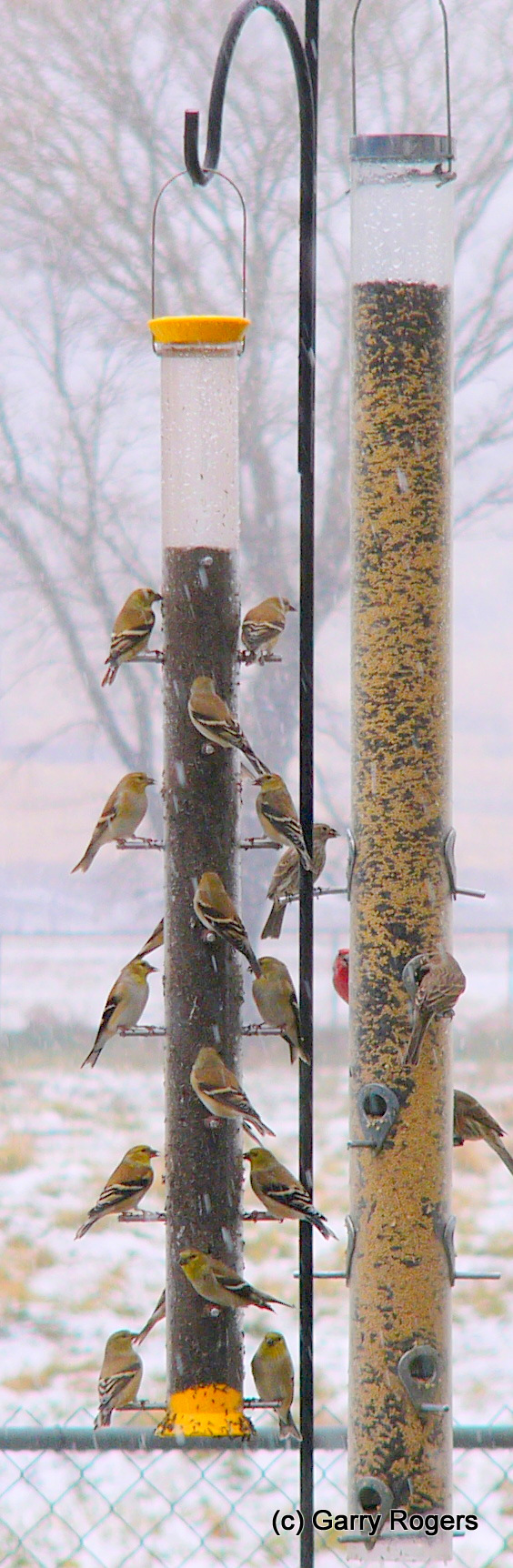
1-B0000254These fussy little birds have been common around my Lesser Goldfinchhouse for years.  I feed them thistle seeds, let Barnyard Grass (usually considered a weed) grow in patches, and I plant lots of native sunflowers. Through summer the finches switch between pecking thistle-seeds and nibbling sunflower leaves, and later they add Barnyard Grass and sunflower seeds. Dozens of birds were always present most of the year, but they have almost disappeared over the past two years.

Photo above:  (December, 2004) I fed goldfinches with this thistle seed feeder (on the left) for several years, but it was so hard to clean I switched to a bag made by my friend Sheila.

In winter the five-pound bag of thistle seeds would last three days.

In winter the birds would empty a five-pound bag of thistle seeds in three days (March, 2007)

Last year (2014), birds visited the thistle bag, but they never emptied it. They pecked only a few sunflower leaves.  No birds came during fall and winter.  This year (2015), I saw goldfinches on the thistle bag only once, and they pecked no leaves.

The Arizona Game and Fish Department ranks Lesser Goldfinches as “common, widespread, and abundant.”  However, this might be changing.  The birds prefer disturbed weedy areas, but the deluge of herbicides sprayed on pastures, crops, yards, and roadsides has wiped out much of this habitat.  Like Monarch Butterflies, the Goldfinches may turn out to be unintended victims of Monsanto’s war on nature.

The editor of my hometown newsletter agreed to run a short note asking if anyone else had noticed a Lesser Goldfinch decline.  The town staff must have considered the note inappropriate.  They removed it, leaving an empty space in its place.

I washed the thistle-seed bag and filled it with fresh seeds. I hope the Goldfinches return and fill the empty spaces on my feeders and sunflowers.

If you have noticed changes in your goldfinch population, please add a comment.

As demand for African timber soars, birds pay the ultimate price

Tropical forests are home to more of the world’s terrestrial biodiversity than any other habitat, but are increasingly threatened by the impact of human activities. Illegal logging, in particular, poses a severe and increasing threat to tropical forests worldwide. But, until now, its impact on tropical wildlife has not been quantified.

A new study co-authored by scientists at Drexel University, published in the most recent issue of Biological Conservation, reveals the devastating impact of illegal logging on bird communities in the understory layer of Ghana’s Upper Guinea rain forests, one of the world’s 25 “biodiversity hotspots” where the most biologically rich ecosystems are most threatened.

Researchers found that the level of legal and illegal logging increased more than 600 percent between 1995 and 2010 — six times greater than the maximum sustainable rate. They also discovered that the abundance of forest understory bird species declined more than 50 percent during the same period. Species richness, or the number of different understory bird species represented, also showed declining trends. The bird communities showed no evidence of post-logging recovery.

“The numbers don’t lie and they don’t have a political agenda. These numbers are shocking,” said . . . .   More at:  www.sciencedaily.com

GR:  Logging has to stop, but how do we do it?  We need massive social changes right now if our wildlife are to survive.

Federal Judge Voids Permits for Searchlight Wind Project

November 2, 2015 – Searchlight NV – Last Friday, U.S. District Court Judge Miranda Du vacated the federal permits for construction of the Searchlight Wind Project in Southern Nevada. Judge Du found that environmental analyses prepared by the Bureau of Land Management (BLM) and U.S. Fish & Wildlife Service (USFWS) inadequately evaluated the dangers that the industrial-scale wind project would pose to desert wildlife. She cited data missing from the agency surveys, inadequate assessment of potential threats to golden eagles, desert tortoises, and bats, and the need for additional explanation of the agencies’ conclusions. If the developer, Apex Clean Energy, wants to proceed with the project, the BLM would need to prepare a new Environmental Impact Statement to address the deficiencies she identified. The USFWS would also have to prepare a new Biological Opinion. This important decision will protect eagles nesting near the project site, the highest-density desert tortoise habitat in Nevada, the viewshed from adjacent parks and tribal sacred areas, as well as property values, recreation, and tourism near the town of Searchlight.

Basin & Range Watch, a grass roots group which works for desert protection and renewable energy alternatives such as rooftop solar, and one of the conservationist plaintiffs, called for the Searchlight area to be a solar and wind energy exclusion zone in their comments on the Bureau of Land Management. . . . more at:  www.basinandrangewatch.org

GR:  BLM and FWS act the way they do because they know that businesses control politicians who in turn control their agency’s budgets and jobs.  Protecting resources is less important to them than protecting their itty bitty empires.  Click here for more about Basin and Range Watch.