Manifesto of the Initiation

Here is a short explanation of the title. It breaks down the metaphor used in the text to clarify that “Initiation” refers to a rite of passage rather than a beginning.

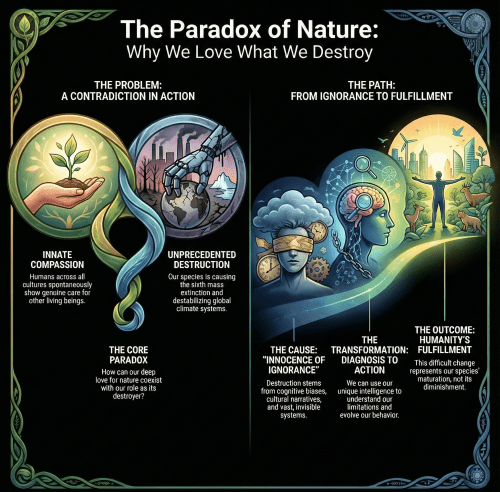
The title reframes the collapse of industrial civilization not as a meaningless end, but as a necessary rite of passage for humanity. It argues that humans are behaving as adolescents: obsessed with immediate gratification, a false sense of invincibility, and growth, the accumulation of material wealth.

Therefore, the “Initiation” refers to the painful evolutionary bottleneck we have entered. Just as a tribal initiation forces a child to endure an ordeal to become an adult, the climate and biosphere crises are the “initiatory ordeals” required to strip humanity of its illusions.

The goal of our initiation is a shift in consciousness: moving us from the role of planetary conqueror to that of a mature, responsible member of the biosphere. We are not dying; we are being forced to grow up.

In short: The biosphere collapse is the harsh lesson (the Initiation) required to transform humanity from reckless adolescence into mature sapience.

Announcing My New Novel: The Long Fire Season

I am pleased to announce the release of my new novel, The Long Fire Season. For years, I have written about the technical realities of biosphere collapse and the necessity of adaptation. Now, I am exploring those themes through the most powerful lens available to us: the human heart.

Love in the Time of Nature’s Decline

The Long Fire Season is a multi-generational saga that asks a fundamental question: When the maps no longer match the territory, how do we find our way home?

The story begins in a Bureau of Land Management dispatch center in Reno, Nevada. It introduces Mia Allen, a land-use planner tracking the decline of the biosphere, and Sam Powell, a fire dispatcher coordinating the response to a burning world. Their romance ignites not through instant infatuation, but through shared competence in the face of disaster.

More Than a Romance

This book is a fictional exploration of the concepts I laid out in Biosphere Collapse and The Manifesto of the Initiation. It visualizes the transition from our current industrial “adolescence” toward a mature, resilient future.

Spanning six decades, the narrative follows Mia and Sam as they navigate:

  • The “Great Simplification”: As complex global systems fracture, the couple must learn to rely on local resilience and community.
  • From “Roar” to “Quiet”: The story chronicles the shift from the industrial noise of the 21st century to the “Quiet Earth” of 2090.
  • Becoming Seed Carriers: Ultimately, Mia and Sam transform from reactive responders into “Seed Carriers”—elders who preserve knowledge and history for a future they will not see.

Why This Story Matters Now

We are living through an initiation. The floods, fires, and heat domes we face are not random; they are the ordeals required to shatter our illusions of control. I wrote this book to show that while we may not be able to save the world as it was, we can save the love that allows us to survive what comes next.

Ready to Enter the Long Fire Season?

Click below to read the full synopsis, meet the characters, and find links to other books in the Earth in Transition Series.

Field Guide to the Anthropocene

Watching the natural world change can be deeply saddening. Many of us feel a sense of grief or anxiety about the loss of species, the changing seasons, and the degradation of familiar landscapes. But paying attention—bearing witness—is a powerful act. It connects us to reality, helps us process grief, and can motivate meaningful action. Our project is to create “A Field Guide to the Anthropocene” (or similar title). This guide will blend ecological knowledge with simple observation techniques. It will help everyday people notice the environmental changes happening in their own communities, understand what they mean, and navigate the complex emotions that arise. It concerns learning to see clearly, grieve honestly, and find purpose in bearing witness to our changing planet.

The Biosphere Integrity Metric (BIM)

How healthy is our planet’s life support system? Shockingly, we lack a clear, real-time indicator. Current measures often tell us about extinctions after they happen. We need a “check engine” light for the biosphere. Our proposed Biosphere Integrity Metric (BIM) aims to be just that. It measures the flow of energy through life’s web and how human activities disrupt it. As a first step, we are developing a Satellite-Derived Primary Production Pressure Index (SPPPI) using global satellite data. This proxy metric will provide an urgently needed early warning of human pressure on the base of the food web. While not the full picture, it is a vital start. Read on to learn how this metric works and why developing the full BIM, integrating ground truth data, is our ultimate goal.

Silent Earth Review

“Silent Earth” has received a five-star “must read🏆” review on Reedsy. Blending scientific depth and practical foresight, this book is both a wake-up call and a guide for navigating environmental collapse.

Synopsis

Silent Earth is a technical reference for civil engineers, land-use and urban planners, and city administrators. It covers a broad range of topics and should serve as a springboard for specialists wishing to learn more about adapting to climate change and biosphere decline.

As the Earth’s living systems deteriorate at an unprecedented rate, human societies face the urgent challenge of adapting to an increasingly unstable environment. Physical Geographer Garry Rogers offers a clear-eyed examination of our options, arguing that while complete restoration of the biosphere is no longer feasible, strategic adaptation remains possible. Drawing on extensive research, Rogers outlines practical approaches for communities to maintain essential functions as ecosystem services decline. While large-scale adaptation efforts face significant barriers, this groundbreaking work shows how planners and administrators can implement effective strategies to enhance resilience in a transforming world. Essential reading for navigating our environmental future. Ideal for policymakers, scholars, environmentalists, and engaged citizens, Silent Earth challenges readers to envision a future where, even amidst biosphere decline, adaptation and innovation can pave the way for survival.

Garry Rogers’ Silent Earth: Adaptations for Life in a Devastated Biosphere explores the escalating degradation of Earth’s biosphere, offering strategies for human adaptation. It points to the realistic inevitability of this need to adjust, as humanity is facing the consequences of irreversible damage already done. Rogers goes beyond the simple dialogue of climate change, expanding and examining the interconnected impact of the entire biosphere, from current impacts such loss of biodiversity to coral reef bleaching.

In Section IV, Rogers draws upon research to emphasize that as soon as 2030 we are on the brink, and that we urgently need to act not only to prevent further destruction, but also to prepare for survival:

The cumulative and synergistic effects of human impacts are pushing ecosystems closer to tipping points. Feedback loops and shifting ecosystem boundaries are accelerating environmental change, while these effects interact in complex ways, amplifying their individual impacts. As we approach 2030, addressing these interconnected challenges will require an integrated approach to conservation and climate action to mitigate the far-reaching impacts on biodiversity and ecosystem stability.

The strength of Silent Earth lies in Section V, which presents a blueprint for adaptation. Rogers proposes various strategies from water management to cultural and governance reforms. His emphasis on grassroots action and local resilience is both pragmatic and empowering, especially given his acknowledgment of the political and societal inertia that is likely to hinder adaptation on a wider scale.

Silent Earth is thoroughly researched, intellectually stimulating, and well-cited. Rogers excels in synthesizing vast amounts of ecological, social, and technological data into a cohesive narrative.

Silent Earth is a valuable resource for those interested in interdisciplinary approaches to global challenges. It’s an important and thought-provoking read for anyone seeking to understand and address the complex realities of ecological decline.

Reviewed by: Brittney Banning

Latest Posts

The Other Wolverine Who Rivaled X-Men for Fame – Defenders of Wildlife Blog

Wolverine. By Robert Carleton.

GR:  The pointless killing of this special individual from a rare species indicates just how total is our threat to nature.

M56 never made it to the silver screen, but he fascinated millions, trekking hundreds of miles and bringing much-needed attention to the plight of wolverines.

Source: The Other Wolverine Who Rivaled X-Men for Fame – Defenders of Wildlife Blog

“His movements were first recorded in Wyoming in 2008. He took off in 2009, heading south for hundreds of miles. He traveled across inhospitable lands looking for a place he might fit in and finally settled in Colorado. He wandered around Colorado for years, then headed north once again, possibly up to Montana. He trekked east across flat lands and found himself in North Dakota.

“This is no tale of a wandering, fugitive human, following some wanderlust or trying to find a job. This is M56. He’s a wolverine, the largest (and arguably the toughest) member of the weasel family. These fearless scavengers are incredible — they can drive grizzly bears and wolves away from carcasses, and have been documented climbing 5,000 vertical feet in the middle of winter in less than two hours. M56 was an ambassador for his species, captivating the entire state of Colorado with hope of a reestablished wolverine population, and inspiring all who learned of his immense travels and ability to traverse unlikely habitat. Sadly, wolverine M56’s remarkable life and unbelievable journey ended a few weeks ago near Alexander, North Dakota, where he was killed by a ranch hand who didn’t recognize what M56 was and thought he could threaten livestock.”

Biodiversity Day – May 22

A Day for Biodiversity

Biodiversity Day - 2016The United Nations has declared that May 22 is Biodiversity Day.  The goal this year is to publicize biodiversity.  After studying the text of the UN Convention on Biodiversity, I believe that the UN is doing little or nothing for biodiversity.  I have studied plants and animals for many years.  What I’ve seen, and what others report, is that all of nature is in steep decline.  Humans are the cause.  I fear that people might be led to believe that the United Nations is taking effective action to protect biodiversity.  It is not.

The theme of the UN Convention on Biodiversity is sustainable development.  It’s text has lofty goals with vague strategies for their attainment.  The text makes clear the Convention’s desire for acceptance by even the most growth oriented government.  Each Article begins with phrases such as:  “Each Contracting Party shall, in accordance with its particular conditions and capabilities. . . .” and this:  “Each Contracting Party shall, as far as possible and as appropriate. . . .”  Since human desires are the conditions that define what is appropriate, the phrases prohibit no “contractor” from full-bore growth and development if they say that these are needed to provide jobs and improved standards of living.

This is the UN’s definition of the Convention:

Signed by 150 government leaders at the 1992 Rio Earth Summit, the Convention on Biological Diversity is dedicated to promoting sustainable development. Conceived as a practical tool for translating the principles of Agenda 21 into reality, the Convention recognizes that biological diversity is about more than plants, animals and micro organisms and their ecosystems – it is about people and our need for food security, medicines, fresh air and water, shelter, and a clean and healthy environment in which to live (United Nations).

Biodiversity is definitely not about the needs of only one species.  It is a general term that gives equal importance to all species.  By placing humans ahead of all other species, the Convention’s definition replaces biological validity with the human bias that is destroying the Earth.

This year’s meeting focus is on promoting biodiversity. The meetings never do much more than report on small achievements.  They serve as an opportunity to search for funding for their development-friendly activities and they let governments reward their environmental managers with a two-week vacation in an international resort.

Homo sapiens’ unrelenting rape of the Earth and the rapid decline of biodiversity is taking us toward the greatest mass extinction of all time.  No one has found an effective means to stop this.  In 1992, the United Nations decided to formalize their support for continued devastation by sugar-coating human impacts with the term “sustainable.” A genuine Biodiversity Day would focus on curtailing human:

  • Population growth
  • Habitat destruction
  • Material aspirations

Over and over, our leading biologists call for emergency responses to our impacts on the Earth.  This blog has more than a thousand well-reasoned warnings and suggestions related to biodiversity.  However, biodiversity decline continues.  What do we do?  Even as our impacts grow beyond the hope of remediation, our environmental managers lay by the pool sipping rum punch, eying the pretty young servers, and discussing funding proposals and plans for more meetings.

What can we do for biodiversity?

I intend to look for ways to oppose development, call for population control, live a simpler life, and learn more about plants and animals.

Alexander von Humboldt (1769-1859)

Humboldt’s Importance

Alexander von Humboldt was the most influential man of his age.  His contributions helped unify our understanding of nature and how human alterations could lead to dangerous changes.  Heads of government, scientists, engineers, artists, and authors were inspired by and consulted with him on a range of topics. Around the world, there are more cities, parks, mountains, and rivers named for Humboldt than anyone else that ever lived.

 Dr. Ulloa Ulloa (front, left) and field assistants at the Humboldt statue on Chimborazo in 2009.

Dr. Ulloa Ulloa (front, left) and field assistants at the Humboldt statue on Chimborazo in 2009.

Humboldt’s strengths were his curiosity, his tireless desire to record his experiences, his ability to see connections, and his ability to write about objective facts with lyrical prose.  He described nature as a web of life, noting and mapping the plant and animal changes with elevation on Mount Chimborazo in Ecuador a century before C. Hart Merriam mapped life zones in central Arizona.  He invented isotherms, the lines on maps connecting areas of equal temperatures, and he warned that human destruction of nature was having widespread consequences.  He described the drop in stream flow, lake level, and general climate change resulting from cutting forests and diverting streams for monoculture farming.  Humboldt influenced and inspired Goethe, Darwin, Hooker, Bolivar, Thoreau, Muir, and many more.  Without Humboldt’s books, Darwin might never have gone to sea, South America might have remained a slave-holding Spanish colony for another century, and nature conservation might have lagged even farther behind human alteration of the land.

Humboldt1805-chimborazo-live zones

Humboldt’s zonal flora and fauna map of Chimborazo.

I am delighted to report that my grandson born in October, 2014 bears the name Alexander.  Alex’s birthplace is just 15 miles west of my home in Humboldt, AZ.

The essay introduced below provides links to some the books by and about Humboldt.  The one by Andrea Wulf is one of my all-time favorite biographical works.

Humboldt and Bonpland’s Essai sur la géographie des plantes and its significance

By: Randy Smith, Image Technician | Metadata Librarian. Peter H. Raven Library, Missouri Botanical Garden

“Over 210 years after Alexander von Humboldt and Aimé Bonpland’s work titled Essai sur la géographie des plantes was published, climate science, book conservation, and botanical research have converged around this 1805 work. This book was digitized and made available in 2008 by the Missouri Botanical Garden for the Biodiversity Heritage Library.

Modern science meets historic data

“In 2015, scientists published a paper detailing their findings as they retraced the path that Humboldt and Bonpland took on their ascent up the dormant volcano, Chimborazo, in Ecuador. The paper, “Strong upslope shifts in Chimborazo’s vegetation over two centuries since Humboldt,” utilized the data and map contained in Essai sur la géographie des plantes and presented modern data from the same locations as detailed in Essai to reveal the effects of climate change on the volcano.

“As Stephen T. Jackson writes in the 2009 book, Essay on the geography of plants, the significance of Humboldt and Bonpland’s work describing their ascent up Chimborazo lies in the detailed data they collected at various elevations. Jackson and historian Andrea Wulf have noted that while most people have forgotten Humboldt, his significance in unifying early scientific disciplines into an inter-connected web of life cannot be understated. Measurements taken on Chimborazo include light intensity, temperature, barometric pressure, and gravitational force. Descriptions of the flora and fauna at various levels of Chimborazo were described and illustrated on the map contained with Essai sur la géographie des plantes.”  Continue reading.

Invasive Species and the Bighorn Sheep Die-off in Montana Mountains, Nevada

Invasive Species

GarryRogersGR: Human-introduced animals, plants, and disease organisms have destroyed many species and ecosystems. This aspect of the human impact on nature became a global disaster in the 1500’s as we began crossing the oceans. In the lands we reached, we rampaged about with no thought of the seeds stuck to our boots or the diseases carried by our livestock. Then we developed nature. We cut the soil and filled it with pipes and wires and then we entombed its microorganism ecosystem with pavement. We damned streams, dried up springs, cut the forests, stripped the land with cattle and sheep, and we poisoned the water and air. Now comes our grand slam: We’ve added sufficient greenhouse gasses to the atmosphere to give our climate warmer temperatures, droughts, fires, and stronger storms.

How do we react to all that we’ve done? In the current time of competition between oil producers, for example, the temptation to burn more of the cheaper gasoline doesn’t horrify us, no, we call the lower prices a consumer blessing. Fuels Supplied

And so, in all that we do, our species appears to be striving for maximum destruction of earth ecosystems. Here are a few essays I wrote about how this works with invasive plants.

The following article is by Ken Cole on the Wildlife News website (February 19, 2016).

Bighorn sheep by Ken Cole

Bighorn sheep photo copyright by Ken Cole

“On Sunday and Monday, February 14-15, 2016, USDA Wildlife Services took to the skies and shot the remaining 24 bighorn sheep in the Montana Mountains of northwest Nevada at the request of Nevada Department of Wildlife.

“While the exact source of the disease outbreak is not known, it is not surprising that the bighorn sheep in this area are suffering this fate because there are two domestic sheep grazing allotments – the Bilk Creek allotment and the Wilder-Quinn allotment – in the middle of this area and BLM ignored the disease threat that they pose to bighorn sheep.

“In 2012 the BLM began the permit renewal process for one of the allotments – the Bilk Creek allotment – and Western Watersheds Project submitted comments notifying them of our concern about the risk that domestic sheep posed to bighorn sheep in this area. It is well know that domestic sheep are carriers of pathogens that result in deadly pneumonia to bighorn sheep and that even just one nose-to-nose contact between these related species can result in a disease outbreak that commonly kills up to 90% of a herd and kills the offspring of the remaining animals for up to a decade.

“In 2013 the BLM issued the Final Environmental Assessment that dismissed those concerns . . . . ”  Read more at:  http://www.thewildlifenews.com/2016/02/19/bighorn-sheep-die-off-in-montana-mountains-nevada-is-it-any-wonder.