Manifesto of the Initiation

Here is a short explanation of the title. It breaks down the metaphor used in the text to clarify that “Initiation” refers to a rite of passage rather than a beginning.

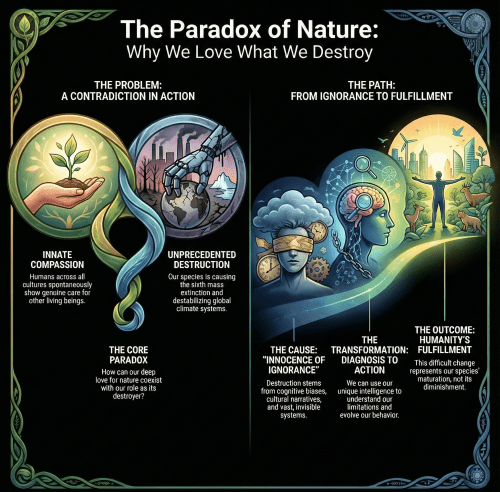
The title reframes the collapse of industrial civilization not as a meaningless end, but as a necessary rite of passage for humanity. It argues that humans are behaving as adolescents: obsessed with immediate gratification, a false sense of invincibility, and growth, the accumulation of material wealth.

Therefore, the “Initiation” refers to the painful evolutionary bottleneck we have entered. Just as a tribal initiation forces a child to endure an ordeal to become an adult, the climate and biosphere crises are the “initiatory ordeals” required to strip humanity of its illusions.

The goal of our initiation is a shift in consciousness: moving us from the role of planetary conqueror to that of a mature, responsible member of the biosphere. We are not dying; we are being forced to grow up.

In short: The biosphere collapse is the harsh lesson (the Initiation) required to transform humanity from reckless adolescence into mature sapience.

Announcing My New Novel: The Long Fire Season

I am pleased to announce the release of my new novel, The Long Fire Season. For years, I have written about the technical realities of biosphere collapse and the necessity of adaptation. Now, I am exploring those themes through the most powerful lens available to us: the human heart.

Love in the Time of Nature’s Decline

The Long Fire Season is a multi-generational saga that asks a fundamental question: When the maps no longer match the territory, how do we find our way home?

The story begins in a Bureau of Land Management dispatch center in Reno, Nevada. It introduces Mia Allen, a land-use planner tracking the decline of the biosphere, and Sam Powell, a fire dispatcher coordinating the response to a burning world. Their romance ignites not through instant infatuation, but through shared competence in the face of disaster.

More Than a Romance

This book is a fictional exploration of the concepts I laid out in Biosphere Collapse and The Manifesto of the Initiation. It visualizes the transition from our current industrial “adolescence” toward a mature, resilient future.

Spanning six decades, the narrative follows Mia and Sam as they navigate:

  • The “Great Simplification”: As complex global systems fracture, the couple must learn to rely on local resilience and community.
  • From “Roar” to “Quiet”: The story chronicles the shift from the industrial noise of the 21st century to the “Quiet Earth” of 2090.
  • Becoming Seed Carriers: Ultimately, Mia and Sam transform from reactive responders into “Seed Carriers”—elders who preserve knowledge and history for a future they will not see.

Why This Story Matters Now

We are living through an initiation. The floods, fires, and heat domes we face are not random; they are the ordeals required to shatter our illusions of control. I wrote this book to show that while we may not be able to save the world as it was, we can save the love that allows us to survive what comes next.

Ready to Enter the Long Fire Season?

Click below to read the full synopsis, meet the characters, and find links to other books in the Earth in Transition Series.

The Great Simplification is the Mechanism. The Initiation is the Meaning.

We stand at the terminal edge of the Holocene. By now, those of us paying attention to the data know that the era of “green growth” and technological salvation is a delusion. We are beginning to understand what systems theorist Nate Hagens calls “The Great Simplification”—the inevitable thermodynamic correction that occurs as our civilization’s energy subsidy, the “Carbon Pulse,” begins to fade.

Hagens has done the essential work of diagnosing the physics of our predicament. He has shown us the economic machinery of the descent. But as I walked the transects of the Sonoran Desert, watching the Saguaro forests vanish not into “nothing,” but into “weeds,” I realized that physics is only half the story.

The Great Simplification explains what is happening to us. It does not explain who we must become to survive it.

From Mechanics to Maturity

I have released a new document, “The Manifesto of the Initiation,” to bridge this gap. If Hagens provides the anatomy of the collapse, this Manifesto provides the soul of the descent.

The central premise is that the collapse of industrial civilization is not merely a failure to be avoided; it is a necessary evolutionary bottleneck—an Initiation.

Drawing on fifty years of ecological field data from the Arizona desert, the Manifesto argues that humanity is currently trapped in a state of “Industrial Adolescence.” We have exhibited all the classic pathologies of youth: omnipotence fantasies, immediate gratification, and a rebellion against limits. We believed we could bargain with biology.

The ecological data I present in the Manifesto—the “Sonoran Fractal”—proves that nature does not bargain. Just as the complex Saguaro ecosystem is being replaced by hardy, generalist weeds to survive the new climate, our civilization is being forced to shed its “Cathedrals” of complexity.

Why You Should Read It

While “The Great Simplification” asks how we might bend rather than break, “The Manifesto of the Initiation” asks a different question: How do we die well as a civilization so that we may be reborn as a mature species?

It is a guide for moving from:

  • Despair to Resoluteness.
  • Planetary Disruptor to Earth System Steward.
  • Sentience (feeling) to Sapience (wisdom).

We cannot save the world we knew. That world was built on a debt to nature that is now being called in. But we can curate the seeds for the world that is coming. We can stop being the “Black Knight” of the galaxy, denying our wounds, and finally grow up.

I invite you to read the full text. It is not a comforting document, but I believe it is an honest one.

[Link: “The Manifesto of the Initiation”]

The Refugia Playbook – A Strategy for Local Resilience

Our planet’s life support systems are failing, and we cannot fully restore what is being lost. But hope is not gone. We can focus on protecting refugia: special places that resist environmental damage and can act as lifeboats for biodiversity. Think of them as safe harbors—pockets of stability for plants and animals facing fire, heat, or drought. The goal of this project is to create a practical Refugia Playbook. This guide will help local communities identify, protect, and manage these vital areas in their own backyards. It is a hands-on strategy for building ecological resilience from the ground up, giving nature—and us—a fighting chance for recovery. Learn more about how we plan to develop this crucial tool.

Alexander von Humboldt (1769-1859)

Humboldt’s Importance

Alexander von Humboldt was the most influential man of his age.  His contributions helped unify our understanding of nature and how human alterations could lead to dangerous changes.  Heads of government, scientists, engineers, artists, and authors were inspired by and consulted with him on a range of topics. Around the world, there are more cities, parks, mountains, and rivers named for Humboldt than anyone else that ever lived.

 Dr. Ulloa Ulloa (front, left) and field assistants at the Humboldt statue on Chimborazo in 2009.

Dr. Ulloa Ulloa (front, left) and field assistants at the Humboldt statue on Chimborazo in 2009.

Humboldt’s strengths were his curiosity, his tireless desire to record his experiences, his ability to see connections, and his ability to write about objective facts with lyrical prose.  He described nature as a web of life, noting and mapping the plant and animal changes with elevation on Mount Chimborazo in Ecuador a century before C. Hart Merriam mapped life zones in central Arizona.  He invented isotherms, the lines on maps connecting areas of equal temperatures, and he warned that human destruction of nature was having widespread consequences.  He described the drop in stream flow, lake level, and general climate change resulting from cutting forests and diverting streams for monoculture farming.  Humboldt influenced and inspired Goethe, Darwin, Hooker, Bolivar, Thoreau, Muir, and many more.  Without Humboldt’s books, Darwin might never have gone to sea, South America might have remained a slave-holding Spanish colony for another century, and nature conservation might have lagged even farther behind human alteration of the land.

Humboldt1805-chimborazo-live zones

Humboldt’s zonal flora and fauna map of Chimborazo.

I am delighted to report that my grandson born in October, 2014 bears the name Alexander.  Alex’s birthplace is just 15 miles west of my home in Humboldt, AZ.

The essay introduced below provides links to some the books by and about Humboldt.  The one by Andrea Wulf is one of my all-time favorite biographical works.

Humboldt and Bonpland’s Essai sur la géographie des plantes and its significance

By: Randy Smith, Image Technician | Metadata Librarian. Peter H. Raven Library, Missouri Botanical Garden

“Over 210 years after Alexander von Humboldt and Aimé Bonpland’s work titled Essai sur la géographie des plantes was published, climate science, book conservation, and botanical research have converged around this 1805 work. This book was digitized and made available in 2008 by the Missouri Botanical Garden for the Biodiversity Heritage Library.

Modern science meets historic data

“In 2015, scientists published a paper detailing their findings as they retraced the path that Humboldt and Bonpland took on their ascent up the dormant volcano, Chimborazo, in Ecuador. The paper, “Strong upslope shifts in Chimborazo’s vegetation over two centuries since Humboldt,” utilized the data and map contained in Essai sur la géographie des plantes and presented modern data from the same locations as detailed in Essai to reveal the effects of climate change on the volcano.

“As Stephen T. Jackson writes in the 2009 book, Essay on the geography of plants, the significance of Humboldt and Bonpland’s work describing their ascent up Chimborazo lies in the detailed data they collected at various elevations. Jackson and historian Andrea Wulf have noted that while most people have forgotten Humboldt, his significance in unifying early scientific disciplines into an inter-connected web of life cannot be understated. Measurements taken on Chimborazo include light intensity, temperature, barometric pressure, and gravitational force. Descriptions of the flora and fauna at various levels of Chimborazo were described and illustrated on the map contained with Essai sur la géographie des plantes.”  Continue reading.

2015 poaching stats: what do they mean?

GR:  We can’t seem to put the brakes on for wildlife or habitat. Our population growth and our homocentric lack of concern for other species is devastating nature.

White-Rhino

Tisha Wardlow's avatarFight for Rhinos

South Africa DEA (Department of Environmental Affairs) has released the “official” 2015 rhino poaching statistics – 1175. This is a decrease from 2014 which was 1215.

Reason for optimism?

Keep in mind the following: Kruger is the size of Israel, not all carcasses are recovered in a timely manner, or at all.  The statistics also do NOT include the following:

  • poaching survivors (like Hope)
  • orphans whose mothers are killed, but they are NOT rescued and do not survive alone
  • unborn baby rhinos

While the DEA pat themselves on the back for a “decline” in numbers, reality is this month, there have already been 37 poached at the time of this post, and the orphanages are seeing no shortage of rescued orphans.

In fact there had been a 10% INCREASE in poaching activity in Kruger National Park, where the majority of poachings occurred.

Instead of taking the numbers as a fact, we must look at them as only an…

View original post 28 more words

Blogging for the Earth

Blogging about Nature:  Introducing Garry Rogers on the League of Bloggers for a Better World

GarryRogers

Garry Rogers

My blog posts are about nature, about wildlife and its habitat (posts). They are expressions of my concerns for natural conditions and events.

During the past year, 2015, lethal heat waves and storms, decline of the great iconic species of elephants, lions, and rhinos, whittling away of the tropical rain forests, and massive clouds of air and water pollution made it clear that humanity is changing the Earth.

More than just the great species, we are eliminating many other species hundreds or perhaps thousands of times more quickly than ever achieved by meteorites, volcanic eruptions, or natural climate change.

Total extinction of a species usually happens after decades of decline.  In 2014, the World Wildlife Fund and other organizations carried out an exhaustive analysis of more than 10,000 wildlife studies (download the report).  They wanted to know how wild plants and animals were holding up against human activities. They learned that from 1970 to 2014, just 44 years, the total number of animals on Earth declined by more than 50%!  Rates of decline vary across species groups.  Birds, for instance declined by 40%.  Other groups, especially those dependent on freshwater, have declined by 70%.

What evolution took billions of years to produce, we humans are destroying in a tick of geologic time.  We are changing the planet so quickly, that not by migration, and certainly not by natural selection, can plants and animals cope. If we continue our activities at their current rate, in only a few centuries, we will turn the Earth into a factory farm of cities, farms, feedlots, and roads with only the tiniest fraction of our native creatures surviving on the fringes.

I often write brief comments without listing my sources. I am always happy to respond to requests for explanations.


Civic Disobedience and Climate Change

On July 30, the whole world watched as 13 Greenpeace activists dangled from ropes tied to the St. John’s bridge in Portland, Ore., red and yellow streamers catching the wind. They were blocking the exit of the Fennica, Shell’s ice breaker headed to the Arctic to facilitate drilling. These young activists hung there for 40 hours in makeshift platforms and slings during some of the hottest days on record, before the police and Coast Guard brought them down. One hundred feet below them, filling the river with their colorful small boats, were Portland’s “kayactivists” from the local Climate Action Coalition — some were experienced paddlers, others kayaking for the very first time. On shore stood over 500 people, cheering and chanting “Stop that boat!” Some were moved to tears by this unprecedented spectacle and by the courage of the protesters.  Sourced through Scoop.it from: www.huffingtonpost.com

GR:  Civil disobedience must often be disagreeable and even unlawful.  The term implies an argument with existing practices and laws.  Whistleblowing, marching, and gathering are essential to maintain a healthy democracy.

Human rights and welfare are the common focus of civil disobedience, but some, like the Greenpeace activists in the photo, believe that animal and ecosystem rights are equally important reasons for civil disobedience.  This is usually justified by arguing that humans cannot survive without healthy ecosystems occupied by healthy animal and plant populations.  There is another, rarer, form of this justification:  Nature, consisting of air, rocks, water, soil, animals, and plants has inherent importance unrelated to humans, not because of how humans benefit from nature, but because nature has equal rights to exist.

Sightings of Australia’s common birds are declining

Sightings of some of Australia’s most common birds, including those that have inspired folk songs and become mascots of football teams, are decreasing in parts of Australia, according to a major report on the health of the country’s bird population.

Among the species for which fewer sightings have been recorded are the laughing kookaburra, magpie and willie wagtail.

Released by Environment Minister Greg Hunt on the eve of Thursday’s Threatened Species Summit at Melbourne Zoo, the State of Australia’s Birds 2015 report’s surprise finding was that it was the country’s “common birds” that weren’t faring so well.

Sourced through Scoop.it from: www.theage.com.au

GR:  This is being reported around the world, and not just for birds; most species are declining.