As a biogeographer with decades-long interest in Earth’s ecosystems, I have grave concerns for the future of our planet’s biosphere. Human activities are pushing the living systems of Earth to the brink of collapse. It is prudent to consider and plan for the worst-case scenarios that may develop.
The biosphere – the thin layer of life encompassing our planet – is under assault. Our activities are disrupting every level of biological organization, from genes to ecosystems. The general response of the biosphere to these impacts is one of simplification, homogenization, and collapse (Bland et al. 2018, McGuire 2022).
Soil degradation is widespread (Amundson et al. 2015), and at the microbial level, we’re seeing alarming shifts in soil and marine microbiomes. The overuse of antibiotics and agricultural chemicals is creating resistant superbugs while decimating beneficial microorganisms. In the oceans, warming and acidification are disrupting phytoplankton communities, the base of marine food webs (Bijma et al. 2013, Gronniger et al. 2022). The consequences ripple up through entire ecosystems.
Plant communities are struggling to adapt to transforming climatic conditions (Franklin et al. 2016, Pausas and Bond 2020). We’re witnessing widespread forest dieback events, from the Amazon to the boreal forests. Drought-stressed trees are succumbing to pests and diseases at unprecedented rates. Losing these carbon sinks further accelerates climate change in a vicious feedback loop.
Animal populations are in freefall. The current extinction rate is estimated to be 100 to 1000 times higher than the background rate. Large mammals, apex predators, and specialist species are especially vulnerable, but smaller creatures are also susceptible (Wagner et al. 2021). The cascading effects of these losses are reshaping entire ecosystems (Ceballos et al. 2010, De Vos et al. 2015, Stork 2010).
Perhaps most alarmingly, we are seeing the collapse of entire biomes. Coral reefs, for instance, may be largely gone within a few decades because of ocean warming and acidification. The Arctic tundra is rapidly transforming as permafrost thaws, releasing massive amounts of stored carbon and methane.
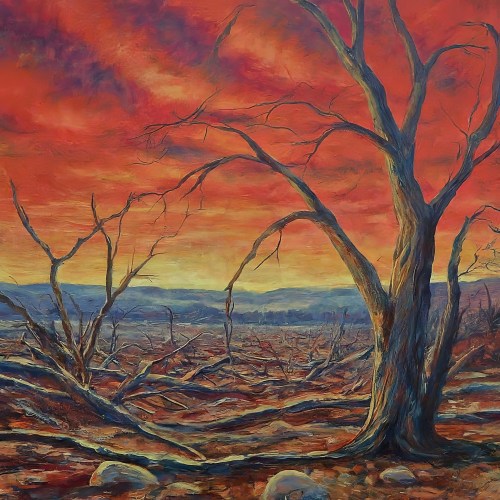
A worst-case scenario may occur as a cascading series of tipping points lead to a “Hothouse Earth” (Dakos et al. 2019, McGuire 2022, Moore 2018, Munson et al. 2018, Ritchie et al. 2021, Schroeder and Storm 2020, Selkoe et al. 2015, Steffen et al. 2018). In this future, large parts of the Earth will become uninhabitable for most large animals, including humans. Vast swathes of the tropics will become too hot for trees, transforming into barren wastelands. The collapse of major ecosystems like the Amazon rainforest or the Antarctic ice sheets will trigger abrupt, irreversible changes to the Earth system (Chen et al. 2020, Wang et al. 2020).
We will see a dramatic simplification of the biosphere. Complex ecosystems will give way to hardier, generalist species (D’Antonio and Vitousek 1992). Biodiversity will plummet, with devastating consequences for ecosystem services we take for granted – from air pollination to water purification (Cardinale et al. 2012, Isbell et al. 2015, Tekalign et al. 2017).
With increased acidification and heat, the oceans will become dominated by jellyfish and algae as higher trophic levels collapse (Doney at al. 2020, Poloczanska et al. 2016). On land, invasive species and hardy generalists will thrive in the disturbed landscapes (Franklin et al. 2016). The Earth’s biological systems could reach a new, much less diverse and productive equilibrium that would persist for millions of years.
The trajectory we are on leads to an impoverished, unstable biosphere that may be incapable of supporting complex human civilizations (https://garryrogers.com/2024/07/15/worst-case-climate-change-scenario/).
The window for avoiding the worst outcomes is about to close. We need immediate, drastic action to reduce our impact on the planet’s living systems. Without it, we risk pushing the biosphere beyond tipping points from which recovery, on any timeframe meaningful to our species, may be impossible (Dakos et al. 2019). I honestly do not expect that we will take action.
Biosphere decline has been developing for decades and it is no longer news. It’s time we start planning our role in the diminished human civilization that is coming (https://garryrogers.com/2024/07/25/can-we-survive-climate-change/).
References
Amundson, R., Berhe, A. A. Hopmans, J. W., Olson, C., Sztein, A. E., and Sparks, D. L. 2015. Soil and human security in the 21st century. Science 348: 6235. Link
Bijma, J., Pörtner, H. O., Yesson, C., & Rogers, A. D. 2013. Climate change and the oceans–What does the future hold? Marine Pollution Bulletin, 74: 494-505. Link
Bland, L. M., Rowland, J. A., Regan, T. J., Keith, D. A., Wittkuhn, R. S., Nicholson, E., …, & Chisholm, L. A. 2018. Developing a standardized definition of ecosystem collapse for risk assessment. Frontiers in Ecology and the Environment, 16: 392-402. Link
Cardinale, B. J., et al. 2012. Biodiversity loss and its impact on humanity. Nature, 486: 59-67. Link
Ceballos, G., Ehrlich, P. R., & Dirzo, R. 2010. The sixth extinction crisis: loss of animal populations and species. Journal of Cosmology, 2010: 1-20. Link
Chen, Z., Wang, W., Yu, Z., Xia, J., & Zhang, Y. 2020. The collapse points of increasing trend of vegetation rain-use efficiency under droughts. Environmental Research Letters, 15: 124002. Link
Dakos, V., Matthews, B., Hendry, A. P., Levine, J., & Loeuille, N. 2019. Ecosystem tipping points in an evolving world. Nature Ecology & Evolution, 3: 145-153. Link
D’Antonio, C. M., & Vitousek, P. M. 1992. Biological invasions by exotic grasses, the grass/fire cycle, and global change. Annual review of ecology and systematics, 23: 63-87.
De Vos, J. M., Joppa, L. N., Gittleman, J. L., Stephens, P. R., & Pimm, S. L. 2015. Estimating the normal background rate of species extinction. Conservation Biology, 29: 452-462. Link
Doney, S. C., Busch, D. S., Cooley, S. R., & Kroeker, K. J. 2020. The impacts of ocean acidification on marine ecosystems and reliant human communities. Annual Review of Environment and Resources, 45: 83-112.
Franklin, J., Serra-Diaz, J. M., Syphard, A. D., & Regan, H. M. 2016. Big data for forecasting the impacts of global change on plant communities. Global Ecology and Biogeography, 25: 1207-1218. Link
Gronniger, J. L., Wang, Z., Brandt, G. R., & Rochman, F. F. 2022. Rapid changes in coastal ocean microbiomes uncoupled with shifts in environmental variables. Environmental Microbiology, 24: 34-45. Link
Isbell, F., Tilman, D., Polasky, S., & Loreau, M. 2015. The biodiversity‐dependent ecosystem service debt. Ecology Letters, 18: 119-134. Link
McGuire, B. 2022. Hothouse Earth: An Inhabitant’s Guide. Link
Moore, J. C. 2018. Predicting tipping points in complex environmental systems. Proceedings of the National Academy of Sciences, 115: 1478-1481. Link
Munson, S. M., Reed, S. C., Peñuelas, J., McDowell, N. G., Xu, C., & Sala, A. 2018. Ecosystem thresholds, tipping points, and critical transitions. New Phytologist, 219: 7-12. Link
Pausas, J. G., & Bond, W. J. 2020. Alternative biome states in terrestrial ecosystems. Trends in Plant Science, 25: 90-100. Link
Poloczanska, E. S., Burrows, M. T., Brown, C. J., García Molinos, J., Halpern, B. S., Hoegh-Guldberg, O., …, & Richardson, A. J. 2016. Responses of marine organisms to climate change across oceans. Frontiers in Marine Science, 3: 62. Link
Ritchie, P. D. L., Clarke, J. J., Cox, P. M., & Huntingford, C. 2021. Overshooting tipping point thresholds in a changing climate. Nature, 592: 517-521. Link
Schroeder, E., & Storm, S. 2020. Economic growth and carbon emissions: The road to “hothouse earth” is paved with good intentions. International Journal of Political Economy, 49: 73-91. Link
Selkoe, K. A., et al. 2015. Principles for managing marine ecosystems prone to tipping points. Ecosystem Health and Sustainability, 1: 1-18. Link
Steffen, W., et al. 2018. Trajectories of the Earth System in the Anthropocene. Proceedings of the National Academy of Sciences, 115: 8252-8259.
Stork, N. E. 2010. Re-assessing current extinction rates. Biodiversity and Conservation, 19: 363-371. Link
Tekalign, M., Van Meerbeek, K., Aerts, R., Muys, B., & Honnay, O. 2017. Effects of biodiversity loss and restoration scenarios on tree-related ecosystem services. Journal of Applied Ecology, 54: 1153-1162. Link
Wagner, D. L., Grames, E. M., Forister, M. L., Berenbaum, M. R., & Stopak, D. 2021. Insect decline in the Anthropocene: Death by a thousand cuts. Proceedings of the National Academy of Sciences, 118(2).
Wang, Y., Shipley, B., Lauer, D., & Shi, P. 2020. Plant biomes demonstrate that landscape resilience today is the lowest it has been since end‐Pleistocene megafaunal extinctions. Global Change Biology, 26: 56-65. Link
 GarryRogers Nature Conservation
Questions? Suggestions?