(This article is part of a series, The Thinking Planet, exploring the universal nature of cognition in the living world. All concepts and examples are drawn from an analysis of my comprehensive work, “Silent Earth: Adaptations for Life in a Devastated Biosphere.”)
When we think of intelligence, we picture a brain. But the biosphere operates on a much broader set of rules. As we learned in the last post, cognition is a fundamental property of life, and some of its most surprising forms are found where we least expect them.
The book Silent Earth reveals that even the simplest organisms demonstrate sophisticated cognitive behaviors that belie their microscopic dimensions.
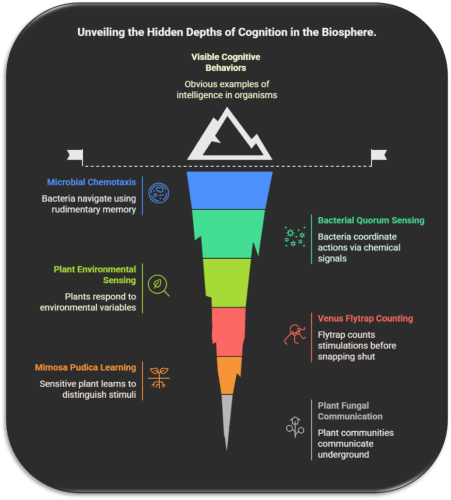
- Microorganisms like the E. coli bacterium navigate their world through chemotaxis, a process that requires a form of rudimentary memory where they compare current conditions with those experienced moments before (Adler 1966; Vladimirov and Sourjik 2009).
- Bacteria also engage in collective social behaviors through “quorum sensing.” They release chemical signals to sense their population density, allowing them to coordinate actions like forming biofilms or producing light only when their numbers are great enough to be effective (Fuqua et al. 1994; Waters and Bassler 2005).
Plants, too, are far from passive. They are constantly sensing and responding to dozens of environmental variables, from light quality and soil moisture to the chemical signatures of herbivores (Trewavas 2014; Karban 2015).
- The Venus flytrap exhibits a stunning example of non-neural information processing. It counts the number of times its trigger hairs are touched, snapping shut only after two stimulations within about 20 seconds to distinguish prey from random debris (Böhm et al. 2016).
- Plants also possess a form of memory. The sensitive plant Mimosa pudica can “learn” to distinguish harmful from harmless stimuli, maintaining this discrimination for weeks (Gagliano et al. 2016).
- Perhaps most astonishingly, entire plant communities communicate through underground fungal networks, sending warning signals about herbivore attacks or sharing resources between different species (Simard et al. 2012; Song et al. 2019).
These examples show that cognition isn’t limited to organisms with nervous systems. It is a universal toolkit for survival, evolved in countless forms across the living world.
Next time, I’ll explore the more familiar, yet no less incredible, minds of the animal kingdom and discover how intelligence can emerge from the actions of a crowd.
References
Adler, J. 1966. Chemotaxis in bacteria. Science 153(3737): 708-716.
Böhm, J., et al. 2016. The Venus flytrap Dionaea muscipula counts trigger hairs to trap insects. Current Biology 26(3): 286-295.
Fuqua, C., et al. 1994. Quorum sensing in bacteria: The LuxR-LuxI family of cell density-responsive transcriptional regulators. Journal of Bacteriology 176(9): 269-275.
Gagliano, M., et al. 2016. Learning by association in the sensitive plant Mimosa pudica. Oecologia 175(1): 63-72.
Karban, R. 2015. Plant sensing and communication. University of Chicago Press, Chicago, 240 p.
Simard, S. W., et al. 2012. Net transfer of carbon between ectomycorrhizal tree species in the field. Nature 388(6642): 579-582.
Song, Y., et al. 2019. Belowground chemical signaling in plants. Journal of Integrative Plant Biology 61(7): 810-826.
Trewavas, A. 2014. Plant behaviour and intelligence. Oxford University Press, Oxford, 304 p.
Vladimirov, N., and Sourjik, V. 2009. Chemotaxis of Escherichia coli in a natural environment. PLoS ONE 4(5): e5512.
Waters, C. M., and Bassler, B. L. 2005. Quorum sensing: Cell-to-cell communication in bacteria. Annual Review of Cell and Developmental Biology 21: 319-346.
 GarryRogers Nature Conservation
Garry,
I have always been so fascinated with these fairly new discoveries in botony, etc., and just finished watching the documentary on Amazon Prime called “Intelligent Trees” directed by Julia Dordel with Suzanne Simard and Peter Wohlleben hosting. I’ve already watched it twice. I’m sure I’ll watch it a third time. 😁 That being said, humans need to continually adapt to their planet and natural environment if we living entities are going to coexist and thrive… both helping each other rather than one species destroying other living organic entities.
Great post! Thank you. 🥰
LikeLike
Professor, thank you for the Intelligent Trees reference.
LikeLiked by 1 person
You are most welcome Garry. I’m sure you will enjoy it as well. ;)
LikeLike