Unknown's avatar

About GarryRogers

Dr. Garry Rogers is a biogeographer of the ecocentric view that all of nature has intrinsic value. He is concerned for ecocide and the growing possibility that by 2050 global warming will become self perpetuating.

4: Preserving the Blueprint – The Urgent Mission to Save Knowledge

(This article is part of a six-post reality-check. Concepts and examples are drawn from “Silent Earth: Adaptations for Life in a Devastated Biosphere.”)

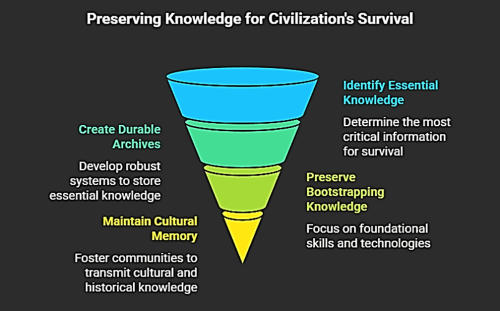
In times of crisis, we focus on saving lives and priceless artifacts. But what about the most vital asset for the long-term survival of our civilization: our accumulated knowledge? As the biosphere degrades and the risk of social disruption grows, the mission to preserve the blueprint of our knowledge becomes a critical imperative.

Our current knowledge systems are fragile. Digital archives are vulnerable to energy loss, hardware degradation, and format obsolescence. At the same time, physical libraries are threatened by environmental disasters (Morrow 2020). This has spurred innovative projects like The Long Now Foundation’s Manual for Civilization, which seeks to create a durable, multi-format library of essential information (Brand 2018).

But it’s not enough to save data. We must preserve what author Lewis Dartnell calls “bootstrapping knowledge.” This is the foundational instructions needed to rebuild basic technologies and access more complex information (Dartnell 2016). Without the ability to make a simple motor or generate electricity, a digital library of all human knowledge would be a useless artifact.

Also important is the preservation of cultural and historical memory, which provides the social cohesion necessary to navigate collapse and recovery. This requires a focus on living knowledge communities and practical skills transmitted through apprenticeship (Marchand 2016). This will be difficult, but safeguarding this blueprint is an essential investment in the potential for a future rebirth.

References

Brand, S. 2018. The manual for civilization. Long Now Foundation Press, San Francisco, 324 p.

Dartnell, L. 2016. The knowledge: How to rebuild civilization in the aftermath of a cataclysm. Penguin Press, New York, 352 p.

Marchand, T. H. J. 2016. Craftwork as problem solving: Ethnographic studies of design and making. Routledge, London, 286 p.

Morrow, J. 2020. Knowledge persistence in unstable times. Library Quarterly 90(2): 154-173.

4: The Value of Thought — How a Thinking Planet Creates a Stable World

(This article is part of a series, The Thinking Planet, exploring the universal nature of cognition in the living world. Concepts and examples are drawn from “Silent Earth: Adaptations for Life in a Devastated Biosphere.”)

So far in the series, we’ve established that cognition is a universal feature of life. But does it matter for the planet as a whole? According to Silent Earth, the answer is a resounding yes. The cognitive abilities of organisms are not just interesting quirks; they are a vital force that contributes to the stability and resilience of the entire biosphere (Elmqvist et al. 2003).

This is the value of cognition, beyond the direct, utilitarian services we often measure (Costanza et al. 1997):

  • Adaptation and Resilience: Cognition is a primary tool for adaptation. When species can learn and modify their behavior based on experience, they are better able to cope with environmental change. This cognitive flexibility enhances the resilience of entire ecosystems, as their inhabitants can adjust to new challenges (Folke et al. 2004).
  • Structuring Ecosystems Through Emotion: The emotional responses of animals have a powerful effect on the landscape. The “ecology of fear” created by predators is a cognitive phenomenon (Estes et al. 2011). Prey animals that are afraid will alter their foraging patterns, which in turn allows vegetation to recover. The resulting trophic cascade, famously seen with the reintroduction of wolves in Yellowstone, stabilizes the entire ecosystem (Ripple and Beschta 2004).
  • Powering Ecosystem Services: Many ecosystem services we depend on are underpinned by cognition. Crop pollination relies on the ability of bees to learn and remember which flowers provide the best food rewards, which enhances their foraging efficiency (Chittka et al. 1999) and supports global agricultural productivity (Klein et al. 2007).
  • Cooperative Strategies: Collective cognition allows for cooperative strategies that enhance ecosystem health. The mycorrhizal networks connecting trees allow them to share resources and communicate about stress, improving the resilience of the entire forest, especially during environmental challenges like drought (Simard et al. 2012; Madouh and Quoreshi 2023).

A biosphere full of cognitive agents is fundamentally more robust and stable (Cardinale et al. 2012). Cognition allows for the adaptation, feedback, and cooperation that help maintain the delicate balance of our living planet.

But there’s one cognitive agent whose intelligence has had an outsized—and often destructive—impact. In my final post, I’ll explore the paradox of human cognition and its role in shaping the planet’s future.

3: Rights of Nature – Should Rivers Have a Lawyer?

(This article is part of a six-post reality-check. Concepts and examples are drawn from “Silent Earth: Adaptations for Life in a Devastated Biosphere.”)

When a forest is cleared or a river is polluted, who speaks for them? For centuries, our legal systems have treated nature as property—a resource to be owned, used, and exploited. But what if nature had rights of its own?

This is not a mere metaphor. In a groundbreaking move, Ecuador’s 2008 constitution enshrined the Rights of Nature, recognizing that nature has the “right to exist, persist, maintain and regenerate its vital cycles” (Kauffman and Martin 2017). Following this, New Zealand granted legal personhood to the Whanganui River in 2017, and appointed guardians to act on its behalf and protect its interests as a living, integrated whole (Hutchison 2019).

This shift from nature as “property” to nature as a “rights-bearing entity” raises complex questions. Who has the standing to represent an ecosystem in court? How do we balance the rights of a river against the rights of a community that depends on it? Implementing these legal conditions is still evolving, but they represent a fundamental rethinking of environmental protection.

By recognizing the intrinsic value and legal standing of the natural world, we open up entirely new avenues for its defense. This approach invites us to move beyond our role as masters of the Earth and toward a more just relationship as members of a wider ecological community. Related Resources

References

Hutchison, A. 2019. The Whanganui River as a legal person. Alternative Law Journal 44(1): 16-20.

Kauffman, C. M., and Martin, P. L. 2017. Can rights of nature make development more sustainable? Why some Ecuadorian lawsuits succeed and others fail. World Development 92: 130-142.

3: The Animal Kingdom’s Diverse Minds and the Power of the Crowd

(This article is part of a series, The Thinking Planet, exploring the universal nature of cognition in the living world. All concepts and examples are drawn from an analysis of my comprehensive work, “Silent Earth: Adaptations for Life in a Devastated Biosphere.”)

While plants and microbes show us that a brain isn’t required for cognition, the animal kingdom reveals an explosive diversity of minds shaped by evolution. Silent Earth details how different ecological challenges have produced a stunning array of cognitive solutions.

  • Insects, with their tiny brains, accomplish remarkable feats. Honeybees communicate the location of resources through a symbolic dance language and even display a conceptual understanding of zero (Chittka and Niven 2009; Howard et al. 2018).
  • Birds like the New Caledonian crow manufacture complex tools with features designed for specific tasks, a skill demonstrating causal understanding (Emery and Clayton 2004). Western scrub-jays exhibit episodic-like memory, remembering what food they hid, where, and when (Clayton and Dickinson 1999).
  • Octopuses represent a fascinating case of convergent evolution. Separated from vertebrates by over 500 million years, they have independently evolved puzzle-solving abilities, tool use, and the capacity to recognize individual humans (Godfrey-Smith 2016; Hochner et al. 2006).

But cognition isn’t just an individual affair. Silent Earth highlights the power of collective cognition, where complex problem-solving emerges from the interaction of many individuals.

  • Ant colonies act as a “superorganism,” creating efficient transport networks between the nest and food sources without any centralized control or leader (Deneubourg et al. 1990; Gordon 2010).
  • Fish schools display distributed vigilance. An evasive maneuver by a few fish on the edge of the group can propagate rapidly through the entire school, allowing fish far from the initial detection to respond to a threat they haven’t personally seen (Couzin and Krause 2003; Rosenthal et al. 2015).

From the specialized mind of a tool-making crow to the emergent intelligence of an ant colony, the biosphere is a showcase of cognitive diversity. There is no single ladder of intelligence with humans at the top, but rather a rich tapestry of minds, each a unique solution to the challenge of living (Shettleworth 2010).

In the next post, I will explore why this “thinking planet” is so important and how the cognitive abilities of all these organisms contribute to a more stable and resilient world.

References

Chittka, L., and Niven, J. E. 2009. Are bigger brains better? Current Biology 19(21): R995-R1008.

Clayton, N. S., and Dickinson, A. 1999. Episodic-like memory in scrub jays. Philosophical Transactions of the Royal Society B: Biological Sciences 354(1387): 1481-1495.

Couzin, I. D., and Krause, J. 2003. Self-organization and collective behavior in vertebrates. Advances in the Study of Behavior 32: 1-75.

Deneubourg, J. L., et al. 1990. The blind leading the blind: Modeling chemically mediated army ant raid patterns. Journal of Insect Behavior 3(5): 719-725.

Emery, N. J., and Clayton, N. S. 2004. The mentality of crows: Convergent evolution of intelligence in corvids and apes. Science 306(5703): 1903-1907.

Godfrey-Smith, P. 2016. Other minds: The octopus, the sea, and the deep origins of consciousness. Farrar, Straus and Giroux, New York, 272 p.

Gordon, D. M. 2010. Ant encounters: Interaction networks and colony behavior. Princeton University Press, Princeton, 185 p.

Hochner, B., et al. 2006. The octopus: a model for a comparative analysis of the evolution of learning and memory mechanisms. The Biological Bulletin 210(3): 308-317.

Howard, S. R., et al. 2018. Numerical ordering of zero in honeybees. Science 360(6393): 1124-1126.

Rosenthal, S. B., et al. 2015. Revealing the unseen majority: ULV-based assessment of plankton reveals profound impacts of kleptoparasites on crustacean zooplankton. Limnology and Oceanography 60(5): 1591-1604.

Shettleworth, S. J. 2010. Cognition, evolution, and behavior. 2nd ed. Oxford University Press, Oxford, 720 p.

2: The Technosphere – Earth’s New, Unruly ‘Kingdom’

(This article is part of a six-post reality-check. Concepts and examples are drawn from “Silent Earth: Adaptations for Life in a Devastated Biosphere.”)

For billions of years, the Earth’s surface was governed by the slow, elegant cycles of the biosphere. But now, a new planetary system has emerged, one of human origin: the technosphere. Coined by geologist Peter Haff, this concept describes the interconnected global network of all our technology—our cities, roads, power grids, and digital networks (Haff 2014). Its physical mass, a staggering 30 trillion tons of concrete, plastic, and metal, now rivals or even exceeds the total mass of all living things on the planet (Zalasiewicz et al. 2017).

This new kingdom has a complex, almost parasitic relationship with its parent. The technosphere depends utterly on the biosphere for energy, raw materials, and waste cycling, yet its very operation disrupts those sustaining systems. Agriculture is a primary example of this hybrid reality, where biological processes are co-opted and amplified by technological intervention, transforming the landscape (Foley et al. 2005).

Now, some propose to use the technosphere to manage the biosphere through geoengineering. These proposals to manipulate Earth’s climate systems carry immense promise and equally immense, uncertain risks (Lawrence et al. 2018).

The emergence of the technosphere as a dominant geological force requires a profound shift in perspective. We are no longer simply a species living within nature; we are the architects and unwitting subjects of a new planetary layer, and we have only just understood its unruly dynamics.

References

Foley, J. A., et al. 2005. Global consequences of land use. Science 309(5734): 570-574.

Haff, P. 2014. Technology as a geological phenomenon: implications for human well-being. Geological Society, London, Special Publications 395(1): 301-309.

Lawrence, M. G., et al. 2018. Evaluating climate geoengineering proposals in the context of the Paris Agreement temperature goals. Nature Communications 9(1): 3734.

Zalasiewicz, J., et al. 2017. The technosphere: its composition, structure, and dynamics. The Anthropocene Review 4(1): 9-28.

2: The Brains in the Soil — The Hidden Intelligence of Plants and Microbes

(This article is part of a series, The Thinking Planet, exploring the universal nature of cognition in the living world. All concepts and examples are drawn from an analysis of my comprehensive work, “Silent Earth: Adaptations for Life in a Devastated Biosphere.”)

When we think of intelligence, we picture a brain. But the biosphere operates on a much broader set of rules. As we learned in the last post, cognition is a fundamental property of life, and some of its most surprising forms are found where we least expect them.

The book Silent Earth reveals that even the simplest organisms demonstrate sophisticated cognitive behaviors that belie their microscopic dimensions.

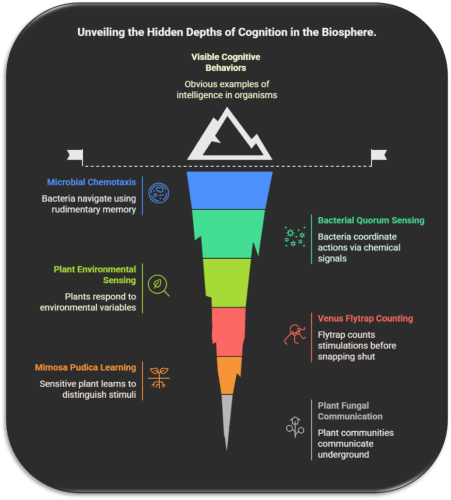
  • Microorganisms like the E. coli bacterium navigate their world through chemotaxis, a process that requires a form of rudimentary memory where they compare current conditions with those experienced moments before (Adler 1966; Vladimirov and Sourjik 2009).
  • Bacteria also engage in collective social behaviors through “quorum sensing.” They release chemical signals to sense their population density, allowing them to coordinate actions like forming biofilms or producing light only when their numbers are great enough to be effective (Fuqua et al. 1994; Waters and Bassler 2005).

Plants, too, are far from passive. They are constantly sensing and responding to dozens of environmental variables, from light quality and soil moisture to the chemical signatures of herbivores (Trewavas 2014; Karban 2015).

  • The Venus flytrap exhibits a stunning example of non-neural information processing. It counts the number of times its trigger hairs are touched, snapping shut only after two stimulations within about 20 seconds to distinguish prey from random debris (Böhm et al. 2016).
  • Plants also possess a form of memory. The sensitive plant Mimosa pudica can “learn” to distinguish harmful from harmless stimuli, maintaining this discrimination for weeks (Gagliano et al. 2016).
  • Perhaps most astonishingly, entire plant communities communicate through underground fungal networks, sending warning signals about herbivore attacks or sharing resources between different species (Simard et al. 2012; Song et al. 2019).

These examples show that cognition isn’t limited to organisms with nervous systems. It is a universal toolkit for survival, evolved in countless forms across the living world.

Next time, I’ll explore the more familiar, yet no less incredible, minds of the animal kingdom and discover how intelligence can emerge from the actions of a crowd.

References

Adler, J. 1966. Chemotaxis in bacteria. Science 153(3737): 708-716.

Böhm, J., et al. 2016. The Venus flytrap Dionaea muscipula counts trigger hairs to trap insects. Current Biology 26(3): 286-295.

Fuqua, C., et al. 1994. Quorum sensing in bacteria: The LuxR-LuxI family of cell density-responsive transcriptional regulators. Journal of Bacteriology 176(9): 269-275.

Gagliano, M., et al. 2016. Learning by association in the sensitive plant Mimosa pudica. Oecologia 175(1): 63-72.

Karban, R. 2015. Plant sensing and communication. University of Chicago Press, Chicago, 240 p.

Simard, S. W., et al. 2012. Net transfer of carbon between ectomycorrhizal tree species in the field. Nature 388(6642): 579-582.

Song, Y., et al. 2019. Belowground chemical signaling in plants. Journal of Integrative Plant Biology 61(7): 810-826.

Trewavas, A. 2014. Plant behaviour and intelligence. Oxford University Press, Oxford, 304 p.

Vladimirov, N., and Sourjik, V. 2009. Chemotaxis of Escherichia coli in a natural environment. PLoS ONE 4(5): e5512.

Waters, C. M., and Bassler, B. L. 2005. Quorum sensing: Cell-to-cell communication in bacteria. Annual Review of Cell and Developmental Biology 21: 319-346.

Writing 2

Here’s the next romance story:

Fire Season: Love in the Time of Climate Change

Francis Ralph Graham

Controlled Burns (Fall 2023)

The video call shattered into blocks for the third time in ten minutes. Sam’s face froze mid-sentence, his eyelids locked at half-blink as he described that morning’s precipitation gauges in Sector Nine. The screech of digital static crackled through Mia’s headphones. She shifted her laptop on the gray laminate table in the graduate lounge. Around her, other students hunched over laptops: one pecked desperately at her keyboard, another leaned on a stack of textbooks, muttering under his breath as he wrestled with code.

Sam’s image finally snapped back into focus, he wore a frayed flannel shirt and rubbed his eyes with a forearm dusted in chalky white from fieldwork. Behind him sat a pile of battered field notebooks, pages riffled from coffee spills and other insults. Above the notebooks hung a whiteboard scribbled in tidy rows of differential equations, though Mia couldn’t parse more than the occasional Greek letter.

“—sorry, you cut out after ‘soil moisture content,’” she said, nodding at the stack of data sheets pinned to his board.

Sam sighed, sliding a hand through his hair. “Those numbers from sector seven still don’t make sense,” he said, shifting to bring a printed graph closer to the camera. The colored lines clashed sharply, red and burnt orange dominating where tender greens should have peaked. “Post-fire recovery ought to show at least some native grass establishment by now. Instead it’s cheatgrass in a solid blanket, with Russian thistle poking up like little skeleton fingers. It’s as if the native seed bank got wiped out overnight.”

Mia flicked open her research binder. The rings protested with a metallic creak as she flipped to a page of August photographs—sun-bleached plots lined with wooden stakes, each one tagged with faded neon tape. “That’s what I’m seeing in the overgrazed pastures,” she said. “Those perennial bunchgrasses that usually punch back after fire? They’re flatlined. My advisor’s been breathing down my neck about sampling methods—says my transects might be biased.”

Above Mia, the lounge’s fluorescent lights sputtered—two flickers shy of a blackout. The hum of printers and the occasional groan from someone stuck on a stubborn equation created an atmosphere dense with academic tension.

“Dr. Martinez has scheduled my thesis defense for December fifteenth,” Sam said, leaning back in his creaky office chair. The back squeaking in protest. “I’m rewriting my conclusions for the third time. How can I defend data that flies in the face of years of recovery models?”

Mia watched Sam’s hand slide over his hair—a gesture she’d come to recognize over six weeks of nightly calls since they’d parted for grad school. Despite the three-hour drive between campuses and the pixilation that made his expressions flicker, these conversations had become an addiction.

“Mrs. Chen said the BLM office called again yesterday,” Mia added. “Diana wants updates on timelines because they’re setting next year’s grazing rotations. They want to add our preliminary data to their monitoring results to plan resource allocations.”

Sam’s features shifted, a frown giving way to a heavier weight. He exhaled slowly. “Morrison emailed me this morning: twelve major fires since we left the field in August. Twelve. The season was supposed to taper off by now, but they’re running full suppression orders day and night.”

Mia leaned forward, her chair creaking. “I actually… miss being out there,” she said softly. “All that stress, the long days, but it felt… essential.”

“I dream about the dispatch radio at night,” Sam confessed, gaze drifting past his camera into a dim corner of his apartment. “I wake up half-convinced I need to assign air tankers or log weather bulletins.”

Their old routine—late nights, shared worry, colliding research—felt almost tangible in the empty lounge. Mia recognized the ebb and flow of academic life: spurts of calm followed by crushing deadlines.

“Can I ask you something?” she said, shifting in her chair. “Do you ever wonder if we’re training for careers that might not exist when we graduate?”

Sam was silent for a long beat. Behind him, a roommate passed, careful not to disturb the fragile bubble of concentration. When he spoke, his voice was low. “I think about that every day. Range management, fire suppression—they all assume stable conditions, predictable seasons, and decent funding. But after what we saw this summer…” He trailed off, recalling nights spent reorganizing project plans around sudden monsoon storms or surprise heatwaves.

Mia exhaled, leaning back against the cool edge of the table. “Dr. Hoffman brought up adaptive management in our methods class. Maybe that’s what we’re supposed to learn—not just follow textbooks, but invent solutions as conditions change.”

A wheezy clank sounded as the building’s furnace kicked on, rattling the ductwork above them.

“I’ve been thinking about your livestock research,” Sam said, leaning forward until his chin nearly touched his desk. “The permit modifications you analyzed—what if rest-rotation systems aren’t enough? Maybe we need entirely new grazing strategies. Cattle behavior changes on stressed landscapes; maybe we should factor that in.”

Mia felt that familiar spark of discovery swarm through her. “Right. Traditional stocking rates assume normal precipitation patterns, but those patterns aren’t normal anymore. Ranchers are already destocking. If we push rest periods further, they won’t survive.”

Her laptop battery icon blinked an ominous yellow. The charger was buried in her backpack. She glanced at Sam, torn between keeping their connection alive and recharging for tonight’s own data crunch.

“I should let you go soon,” Sam said, noticing her tense glance. “But would you want to meet halfway this weekend? Cedar Flats has a coffee barn with decent Wi-Fi. We could spread our binders out on a real table for once.”

Mia’s heart lifted. “Yes. I’d love that.”

Saturday morning found them in a converted storage barn filled with mismatched armchairs and local landscape paintings. The air smelled of pine smoke and sage as they unloaded binders, maps, and laptops from their packs. Sam claimed a broad table by a dusty bay window, and Mia unzipped an old leather portfolio to reveal a stack of color photographs tagged with sticky notes in neon pink.

“I brought the aerial shots Morrison sent,” Sam said, arranging them next to her grazing transect images. “See how your overgrazed parcels look from above?”

Their coffee arrived in heavy ceramic mugs. Outside, a crisp breeze sent golden leaves drifting across the gravel parking lot.

Mia sorted her photos in chronological order: May’s emerald shoots, July’s thinning clumps, September’s dusty bare earth. Sam leaned over, running a fingertip along each stake flag in the image. “Fine fuel loads must be skyrocketing as invasive annuals fill the void, laying down a tinder-dry blanket.”

She pointed at a graph on her laptop: monthly precipitation bars overlaying temperature curves. “Total rainfall was only fifteen percent below average, but look at the distribution—June and July barely registered a drop. Most of it came before the summer heat peaked.”

“Timing trumps totals,” Sam said. “The earlier rain helps the invasives.”

The coffee shop owner, a paint-spattered woman with silver hair tucked under a bandana, refilled their mugs. “You folks mapping the drought?” she asked, peering at their spread of charts and photos.

“We’re studying vegetation responses,” Mia replied, voice bright. “Do you have the corn fields up the valley—any chance you’d share planting records?”

The woman nodded. “He’s been grumbling that the old calendar’s useless—earlier springs, false frosts, rain out of sync. Here’s our phone number.”

After she moved on, Sam met Mia’s eyes. “We should interview them and other farmers. Their schedules would show how adaptation actually happens on the ground.”

Mia tapped her pen against a timeline they were sketching. “And that’s exactly the gap the BLM needs to fill—collaborative, adaptive strategies that account for drought, grazing, fire risk… the cascade of stress factors.”

They spent the next two hours weaving their separate findings into a joint narrative: how invaders fuel greater fire danger, how shifting precipitation undermines rest-rotation systems, and how local planting and grazing shifts are true adaptive management.

Brunch crowds filed in—weekend cyclists, couples sipping lattes, elderly couples thumbing through the menu. Through the window, October’s palette gleamed: maples aflame with early color, frost-shriveled marigolds clinging to stubborn life.

As they packed up, Sam’s voice softened. “These calls, this… collaboration—talking with you is the best part of my day. You help turn my raw data into meaning.”

Mia felt warmth bloom. “Mine too. Even when I’m drowning in papers, I know we’ll figure it out together.”

They lingered on the porch, reluctant to reenter their solitary thesis grind. Sam’s expression grew serious. “What if we propose a joint BLM project next summer? Integrate our findings and test new grazing-and-fire management models on the ground.”

Mia’s breath caught. “You mean go back out there, side by side?”

Sam nodded. “Professional partnership. And…” He hesitated, then met her gaze firmly. “Something more.”

She smiled. “Something more.”

The drive back threaded through cattle-peppered pastures and hills scarred by recent burns—subjects of their research and the source of the uncertainty they both felt. That evening, back at her desk under the flickering lounge lights, Mia spread out her materials again. Everything was the same—and utterly transformed.

Her phone buzzed. “Made it back safe. Missing our call already.” –Sam

She tapped back, “Me too. Let’s meet tonight?”

At nine, Sam’s face reappeared on her screen, the glow from his apartment lamps softening his features. “Tell me about that cascade model,” he said with a grin that made her heart quicken, “and then… let’s talk next steps.” Outside, frost glazed the lounge windows, but inside, armed with shared data, shared purpose, and something more, Mia felt ready for whatever came next.
1: The Harsh Reality – Why Full Restoration Is No Longer an Option

(This article is part of a six-post reality-check. Concepts and examples are drawn from “Silent Earth: Adaptations for Life in a Devastated Biosphere.”)

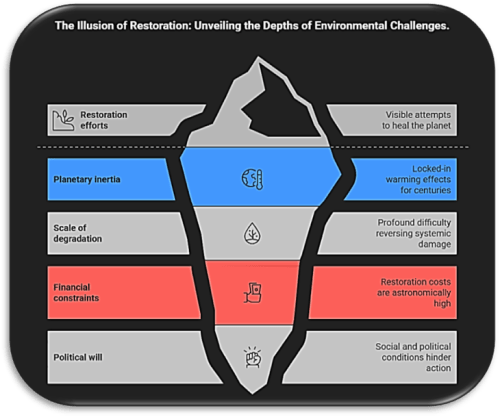
In the grand narrative of our species, we have arrived at a pivotal, sobering moment. The Earth’s biosphere, a delicate and complex tapestry woven over eons, now bears the deep imprint of our civilization. A noble and understandable impulse urges us to restore the planet to its former glory, yet a clear-eyed look at the evidence suggests this may be beyond our grasp. The inertia of our planetary systems is immense; even if all greenhouse gas emissions ceased today, significant warming is already locked in and would persist for centuries as a new equilibrium is slowly reached (King et al. 2024).

The sheer scale of the challenge is written upon our landscapes and in our waters. Consider the Chesapeake Bay, once North America’s largest and most productive estuary. Despite decades of concerted effort and billions of dollars in investment, its ecological health remains precarious, a testament to the profound difficulty of reversing systemic degradation (Rust and Blum 2018). Look to the Amazon, the lungs of our planet, where the cost to restore even a fraction of what has been lost is estimated in the hundreds of billions of dollars (Lennox et al. 2018). The financial and political will for such an undertaking on a global scale is simply not present.

The very social and political conditions that hinder restoration are the same ones that will impede large-scale adaptation. It is time, therefore, to pivot our focus toward achievable survival strategies. This is not a message of despair, but a necessary recalibration based on the evidence before us. We must learn to navigate a new world, one where our role is not to restore the past, but to thoughtfully and ethically adapt to the future we have created.

References

King, A. D., et al. 2024. Exploring climate stabilisation at different global warming levels in ACCESS-ESM-1.5. Earth System Dynamics 15: 1353-1383.

Lennox, G. D., et al. 2018. Second rate or a second chance? Assessing biomass and biodiversity recovery in regenerating Amazonian forests. Global Change Biology 24(12): 5680-5694.

Rust, S., and Blum, S. 2018. Chesapeake Bay: A journey to restoration. USA Today. https://www.usatoday.com/pages/interactives/news/chesapeake-bay-a-journey-to-restoration/

1, More Than Instinct—Uncovering Nature’s Hidden Cognition

(This article is part of a series of 5 posts, The Thinking Planet, exploring the universal nature of cognition in the living world. All concepts and examples are drawn from an analysis of my comprehensive work, “Silent Earth: Adaptations for Life in a Devastated Biosphere.”)

We think of our planet as being divided into two camps: humans, with our complex intelligence, and then everything else, running on simple instinct. But what if that division is wrong? What if the ability to sense, process information, and respond to it is not a rare gift but a fundamental characteristic of life itself?

In the book Silent Earth, I argue the biosphere is defined by the ubiquity of cognition. Not that a bacterium or a plant “thinks” like a human. Rather, it suggests that every living thing, to survive, must perform a crucial task: acquire information from its environment and respond adaptively (Trewavas 2014). This capacity for information processing—whether it happens in a brain or through the elegant molecular pathways of a single cell—is cognition.

When we look through this lens, the world transforms. We no longer see a planet of mindless automata but a global community of cognitive agents, each actively interpreting and shaping its world (De Waal 2009). This perspective challenges us to move beyond our human-centered view of intelligence and recognize the diverse and astounding ways that life knows itself and its surroundings.

In the next post, I’ll dive into the world of this hidden intelligence, exploring the remarkable cognitive abilities of the life forms we most often overlook: plants and microbes.

References

De Waal, F. B. 2009. The age of empathy: Nature’s lessons for a kinder society. Harmony Books, New York, 291 p.

Trewavas, A. 2014. Plant behaviour and intelligence. Oxford University Press, Oxford, 304 p.