A Special Rhino

“As if timing his arrival to perfectly coincide with 2012-13 as International Year of the Rhino, Sumatran rhino calf “Andatu” was born at the Sumatran Rhino Sanctuary in the wee hours of 23 J…”

Source: fightforrhinos.com

GR:  Here is an opportunity to pick up a holiday gift and help rhinos.

5 Reasons Not to Eat Fish

5. Seals and sea lions are scapegoated and shot by commercial fishermen and their lackeys who blame the marine mammals for dwindling fish populations. It’s the same “all here for us” mentality that…

Go to the source for reasons 1 – 4.

Photo by Jim Robertson

Source: exposingthebiggame.wordpress.com

GR:  Marine and freshwater creatures are declining due to pollution and over use.  Extended health of Earth water systems requires a balance.  In simplest terms, this means that every 200 pounds of fish taken from the ocean should be replaced by 200 pounds of human.  Of course, the oceans, lakes, and streams can recover from small disturbances, from small pollution and small harvest.  No one believes our impact is small.  Another reason not to eat fish is to give the life of our water systems a chance to recover a healthy balance.


Police Nab 230 Elephant Tusks In Mombasa

“Police in Mombasa today morning impounded ivory worth millions of shillings.The ivory, which consisted of some 230 pieces of elephant tasks weighing three tonnes were found in a motor vehicle yard in Tudor estate.

“Police, who were acting on a tip-off, conducted a night operation which saw the manger of the yard Abdulkalim Sadiq, arrested. Mombasa police boss Geoffrey Mayiek, who led the operation, said the consignment was packed in sacks ready for shipment out of the country via the Mombasa port.

“Police and Kenya Wildlife Services officers suspect the tusks were from at least 114 elephants from different national parks in the country including the Tsavo national park.”

See on allafrica.com

Help save the grasslands – Prescott, Arizona

A consortium of government agencies wants to hear from the public about its plan to try to protect and restore Central Arizona’s dwindling grasslands.

The meeting is in Prescott, AZ on Thursday, June 5.

“The health of these grasslands is critical for a number of species,” said Dee Kephart, habitat specialist for the Game and Fish Department’s Region 3 office.

The agencies signed the grasslands strategy in 2010 and update it every year so they can work together on common goals. The strategy covers about 750,000 acres and uses pronghorn antelope as an indicator species about the health of local grasslands.

“Pronghorn are an ideal species to examine because they are so closely tied to this type of habitat,” Kephart said. “They are heavily dependant on their eyesight, so open spaces are critical.”

North America’s central grasslands are considered one of the most threatened ecosystems on the continent and in the world, the strategy notes.

See on www.prescottaz.com


Happy Weekend: The Return of the Prodigal Elephant

This clip shows a beautiful bull elephant named Ely.  A young Amboseli male elephant, Ely gained international notoriety in the early 1990’s when he was born crippled to his even more famous mother, Echo, heroine of three BBC TV films and a recent Animal Planet series. He overcame his affliction, grew to a healthy young pre-teen, but then in 2001 he disappeared. Had he succumbed to a Maasai spear or a poacher’s bullet? Or had he just ‘gone independent’ earlier than his fellow bulls? This January, some nine years later, overjoyed researchers learned the truth when the prodigal returned to the heart of Amboseli National Park. The clip, taken by Cynthia Moss with co-workers Soila Sayialel and Norah Njiraini, shows him wandering casually through a post-rains elephant congregation, testing young females and hanging around as though he’d never left.

Story from Elephantopia.

See on elephantopia.org

How Swaziland Protects its Wildlife

Both black rhino and white rhino were absent from Swaziland for nearly 70 years until in 1965, when the first pair of white rhinos returned to Mlilwane Wildlife Sanctuary.  Black rhino were reintroduced into Swaziland in 1986. Since 1992, just three rhinos have been killed by poachers in Swaziland (two in 2011, and one recently in 2014). According to the International Union for Conservation of Nature, Swaziland’s rhino protection is unmatched by any other country.

See on www.nikela.org

Plans for new Hong Kong zoo condemned by Animals Asia Foundation

The South China Morning Post reports on the response of David Neale, Animal Welfare Director, Animals Asia Foundation, to a suggestion that Hong Kong needs another zoo.

“For generations we have wilfully destroyed natural habitats and caused a global species crisis,” said Neale.  “In an attempt to rectify this appalling situation, we convince ourselves it is okay to keep wild animals in captivity so that we can ‘educate’ people about the threats to their survival, with the belief that displaying animals in unnatural environments and, in a number of cases, training them to perform for our entertainment, will help to reverse this downward spiral.

“This approach needs a fundamental shift if we are to prevent the further destruction of habitats and loss of species we are currently experiencing. Children must learn about nature and the need to protect it by experiencing nature for themselves, and this experience must be within the natural environment and not within the confines of a concrete and wire enclosure.

“Hong Kong is home to almost 3,000 varieties of flowering plants, and more than 2,000 moth, 110 dragonfly and 230 butterfly species. It is home to many native birds, reptiles, amphibians and mammals.

“This includes two resident cetaceans, the Chinese white dolphin and the finless porpoise.

“As educators we should foster empathy and respect for this rich array of native wildlife, and use this empathy and respect as a springboard for our children to learn about other non-native species.

“We must ensure our children are aware of their presence and the threats they face. Our children can then think about the choices they can make to help to protect and conserve these species within their natural environment.

“Having another zoo in Hong Kong would create the opposite scenario, teaching children that it is acceptable to keep animals outside their natural habitats, and for us to manage individual animals’ lives so that we are able to view them for our own pleasure and entertainment.

“Animals Asia Foundation is opposed to the development of another zoo in Hong Kong. It urges the government to ensure that all schoolchildren have access to humane education opportunities that develop a connection with the native wildlife of Hong Kong, ensuring that the next generation can find the necessary solutions to the current national and international biodiversity crisis which has been created by this one.”

See on http://www.wildlifeextra.com
Earth Riparian System Deterioration: A California Example

Kevin Franck:  “Bear ecology in riparian habitats, rebuilding riparian ecosystems, Using biomimetics or biomimicry to replicate nature. Lessons from San Jacinto River Valley, Juan Bautista de Anza discovery of San Jacinto Rive Valley, Beavers in the San Jacinto Mountains, man made versus natural systems, Army Corps of Engineers blunders, Beaver engineering and benefits, importance of Bears in nature, The Grizzly Maze, Mazestone in Hemet California, Pedro Font writings, Father Francisco Garcès mentions Bears in San Jacinto River bottom, Chaparral Biologist Richard Halsey, Bear tunnels in chaparral, Bear labyrinth tunnels in riparian food foraging areas,

So much has been lost in the human assault on nature that recovery seems unlikely until after we are gone.  But read Kevin Franck’s post and stay tuned for his promised conclusion for ideas on what we can do.

See on creating-a-new-earth.blogspot.se

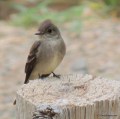
Drought and Shrinking Western Wood Peewee Habitat

Western Wood Peewee (Contopus sordidulus) Takes Over West Lawn

A new visitor to my lawn this spring, a Western Wood Peewee, has begun capturing the aerial insects on the west side of the house.  Two pairs of Black Phoebes (Sayornis nigricans) patrolled the yards last year.  Until four years ago, my pastures were irrigated and there was only one Phoebe pair in the yard.  Others hunted over the pastures and ponds.  Peewees sometimes perched on the pasture fence, but I never saw one in the yard before this year.  Now the pastures are all dry and some crowding is inevitable, but will three flycatcher families be too many?

The Western and Eastern Wood Peewees are very similar.  Both have relatively short legs and dull eye rings, but their songs are distinctive.  Of course the WWP is best :).

This Peewee is ranked S5 by the Arizona Game and Fish Department, meaning that it is not in danger of extinction.  As the regional drought continues, however, this and many other species that prefer riparian areas may begin to decline.  Read more about Arizona bird conservation status.