Drought, fire management and land use changes have led to denser forests in California

20130817-FS-UNK-0002“A team of researchers with members from several institutions in the U.S. has found that compared to the beginning of the last century, California’s forests are more dense, with fewer large trees, more small growth and are a much bigger risk for fires. In their paper published in Proceedings of the National Academy of Sciences, the researchers describe how they compared forest surveys over the past century and the changes they noted and what it might mean for the future of forest management in the state.
“In the past, before people arrived, fires, generally due to lightening strikes would start, and burn thousands of acres before dying natural deaths. That would allow for new growth, which would eventually lead to tall tree growth. Now, whenever a fire starts, it is put out as quickly as possible to protect homes and businesses in the area. The result is highly with dry small —the perfect conditions for fires to start and spread very quickly. The researchers also found that oak trees have grown more numerous while pine populations have declined—another result of the drier climate.”
Read more at: http://phys.org/news/2015-01-drought-denser-forests-california.html#jCp

GR:  The researchers need to test their assumption that fire prevention and suppression have been effective.  Even though fire-fighting budgets are growing, fire size is increasing.

It is interesting that large trees are fewer now.  Could that be because of logging?  And the spread of oak trees, is that influenced by logging or cattle grazing?  The research conclusions seem to suggest that things are going to get back to what the researchers consider normal now that fires are becoming larger and more frequent. All that small growth that is preventing large trees will get burned up.

Even in restored forests, extreme weather strongly influences wildfire’s impacts

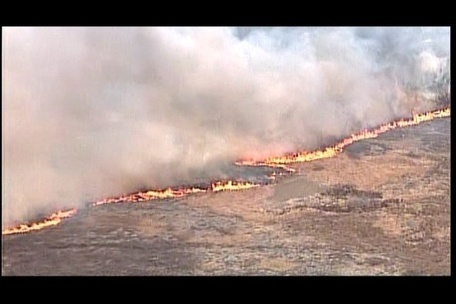
The 2013 Rim Fire, the largest wildland fire ever recorded in the Sierra Nevada region, is still fresh in the minds of Californians, as is the urgent need to bring forests back to a more resilient condition.

Source: phys.org

GR:  We have hypothesized for many years that fire is a natural, even a necessary, part of stable forests/shrublands.  But here we have a test that falsifies the hypothesis.  Perhaps we shouldn’t apply a single hypothesis to spatiotemporally complex forests and fires.

Why aren’t there more tests?  Should we be checking on the results of controlled and accidental fires to see if the results match our predictions?

For Arizona and New Mexico, Climate Change Produces Winter Fires

See on Scoop.itGarry Rogers Nature Conservation News (#EcoSciFi)

(500 acre wildfire burns near Isleta in New Mexico on February 19th. Image source: KOAT) It’s late winter in Arizona and New Mexico. Or at least that’s what the calendar says. During this time of y…

Garry Rogers insight:

Drought alone can increase fire frequency and size.  In AZ and NM, the continuing increase of fine fuel from alien weeds adds to the drought impact. 

See on robertscribbler.wordpress.com

Disturbance and Invasive Plants

By Garry Rogers

Disturbance and Invasive Plants:  Introduction

Wild Horses and Weeds

Wild Horses on a Former Great Basin Shrubland Destroyed by Livestock Grazing, Invasive Plants, and Fire.

In the invasive plant literature, disturbance refers to an event that removes plants and alters the soil surface.  “Disturbance is believed to be the major factor favoring plant introductions” (Radosevich et al. 2007:  58).  Without disturbance, invasive plants would find no openings to become established and begin to spread and replace native species.

It is important to understand the nature and origin of disturbance that leads to plant invasions, because, as with global warming, it is often profitable to deny human responsibility for invasions so that a disturbance activity can continue. Continue reading

Desert Habitat: Soil Microorganisms

By Garry Rogers

The Role of Soil Microorganisms in Desert Ecosystems

There would be no life on the land if there was no soil.

“When you thrust a shovel into the soil or tear off a piece of coral, you are, godlike, cutting through an entire world. You have crossed a hidden frontier known to very few. Immediately close at hand, around and beneath our feet, lies the least explored part of the planet’s surface. It is also the most vital place on Earth for human existence” (Wilson, 2010).

Biological Soil Crusts

1-Gt Basin Lower Valleys-003

Biological Soil Crust (Brown stipplescale) growing in a rocky area in the Great Basin Desert.

In sunny desert environments, various species of algae, cyanobacteria, microfungi, lichens, and bryophytes form thin crusts over the surface of the ground.  The crusts protect the soil from erosion, enrich its composition, and enhance plant growth.  The crusts are among the most important components of desert ecosystems.

Biological soil crusts (BSCs) are quite fragile.  If they are damaged, soils lose moisture and nutrients and become susceptible to erosion and invasion by alien plants.  BSCs are susceptible to considerable damage by livestock (e.g., Brotherson et al. 1983). Recovery of BSCs at some sites can occur within 20 years (Anderson et al. 1982), but most studies have concluded that longer periods are required (e.g., Jeffries and Klopatec 1987), and that full recovery can require centuries (Belnap 1993). Continue reading

Forest Threats Include Global Warming, Weeds, and Fire

Forest Threats Include Warming Climate, Spreading Weeds, and Increasing Wildfire

Humans have spread weeds to new habitats across Earth.  Most weed species grow well in sunny habitats typical of desert regions.  The weeds increase the quantity and continuity of fuel and they recover quickly after a fire.  Thus, they allow accidental and lightening caused fires to grow larger and become more frequent.  Anyone who follows the effects of a desert fire for a few years will see that many native plants recover too slowly to persist under the new weed-accelerated fire regime (Rogers and Steele 1980).

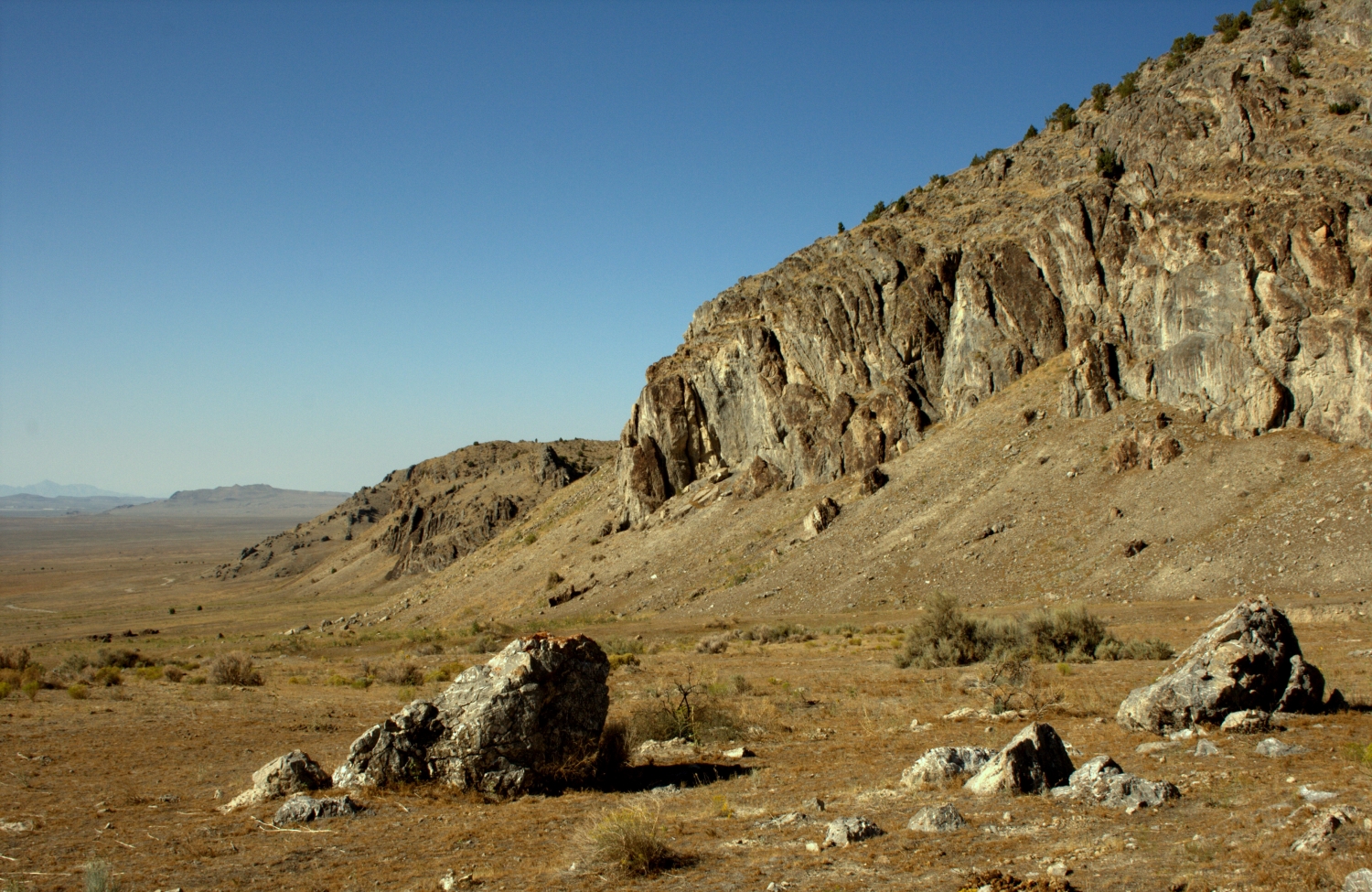
1901.  Cedar Mountains by G. K. GilbertThis pair of photographs from the Great Basin Desert illustrates what recurring fire can do in the desert.  (Click on the images for a larger view.)  The first photo was taken in 1901 by geologist G. K. Gilbert (USGS Photo Library).  It shows fairly even cover by the small native shrubs dominating the vegetation of the area.  In 1901 there was no travel in this area except by horseback or wagon.  Gilbert was fond of the horse, named her Sally, and included her in many of his documentary photos.

2008.  Cedar Mountains by Garry RogersThe second photo was taken in 2008 and shows that as far as the eye can see, most of the shrubs are gone.  They have been replaced by fire tolerant non-native weeds.  This area burns so frequently now that the U. S. Bureau of Land Management stewards of the land have begun burning the land themselves to help prevent surprise fires that disrupt traffic on the nearby interstate highway.

The second photo is presented below in color and larger size to give a clearer view of the extent of the barren weed/fire landscape.

2008.  Cedar Mountains by Garry Rogers (color)

Forest threats include more than just warming climate.  Some climate models predict increased forest fire occurrence as climate warms (Smithwick et al. 2013:  2).  It is likely, however, that fire prone weeds will increase.  Invasive weeds do poorly in the shade of mature trees.  As domestic livestock, loggers, and drought continue to disturb forest soils and remove the shade cast by tall trees, weeds will increase.  As has happened in lower, drier habitats we may lose many native forest species.

References

Rogers, G. 1982.  Then and now:  A photographic history of vegetation change in the central Great Basin Desert.  University of Utah Press, Salt Lake City, UT.  152 p.

Rogers, G., and J. Steele.  1980.  Sonoran desert fire ecology.  Pages 15-19 in  Proceedings of the fire history workshop, USDA Forest Service GTR-RM81. 142 p.

Smithwick, E.A.H., et al.  2013.  Climate, fire and carbon:  Tipping points and landscape vulnerability in the greater Yellowstone ecosystem.  JFSP Project No. 09-3-01-47.

Go back

Your message has been sent

Warning
Warning
Warning
Warning

Warning.

Climate Change: Disaster Courtesy of US Congress

Congressional Climate Change Deniers

U. S. congressional representatives of major energy and development interests continue their long war on climate change. Their chief strategy, deny it, question it, deny its importance, etc.

Oil Refinery Smog

Oil Refineries Create Serious Health Problems in Davis County Utah. Contribute to Climate Change.

The Salt Lake Tribune (March 19, 2013) reports that Republican Chris Stewart, brand new Congressman from Davis County, Utah, and chairman of the House environmental subcommittee,says, “”I’m not as convinced as a lot of people are that man-made climate change is the threat they think it is,” he told The Salt Lake Tribune. “I think it is probably not as immediate as some people do.”

For his 2012 political campaign, Stewart received more than $40,000 from donors associated with the oil and gas industry (Center for Responsive Politics, CRP).  Republicans like Stewart aren’t the only ones to represent big oil.  According to CRP, Democrats that voted in favor of oil company legislation have taken money too.

U. S. land and disaster management agencies prepare

Climate Change Will Increase the Intensity and Frequency of Forest Fires

In a December, 2012 report, the U. S. Forest Service describes what is coming as a result of climate change.  According to the report, the main short-term effects on the national forests will come from the increased intensity and frequency of disturbances. Continue reading

Garry Rogers’ Nonfiction Page is Up!

My nonfiction page was just published.  It includes some of my work on wildlife and invasive plants.

Invasive species of animals and plants in the Great Basin Desert

The photo shows invasive animals (wild horses) surviving on invasive weeds and sunflower buds.  Ranchers remove the cows when the forage reaches this condition.  They will bring them back next spring.

Invasive Species

Invasive Species:  Our Accidental Attack On Nature

The story of invasive species and their alteration of native habitats is one of the most disappointing tales to be told of human interaction with nature. It is full of surprises, unsolved mysteries, scientific research, and reactive management that too often exemplifies the adage, “too little too late.” This post summarizes the main elements of the plot and its conclusion. It begins about 500 years ago when people started crossing the oceans and taking boatloads of new species to North America and other parts of the world. Some of the new species invaded native habitats, replaced the natives, and became permanent residents. Of all the things people have done to the wildlife and wildlife habitat of the Agua Fria River Basin—road and building construction, ranching, logging, hunting, farming, fertilizing, recreation, burning, and water use—the most destructive has been the accidental introduction of invasive plants and animals.

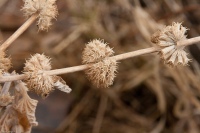
Horehound (Marrubium vulgare) seeds.  This Asian invader is common in the arid uplands of central Arizona.

Horehound (Marrubium vulgare) seeds. This Asian invader is common in the arid uplands of central Arizona.

The photo shows the dry seeds of Horehound (Marubium vulgare).  The seeds have small hooks that catch on clothing and animal fur. Horehound is a small perennial shrub that forms pure stands when native vegetation is removed by livestock. The seeds often create persistent mats in animal fur, and they are irritating when they get in your socks. Cattle will eat a little Horehound when the plants are young, but they don’t eat enough to prevent the plant’s spread.

Continue reading