We assume cognition (thinking, memory, and emotion) is only possible for humans and a few other species. This assumption is wrong.
Bacteria detect chemical gradients and remember previous exposures. Plants learn from experience and communicate through fungal networks. Crows fashion tools and teach solutions to other crows. Rats choose to rescue drowning companions even when food rewards are offered as alternatives.
These are not anthropomorphic projections. They represent measurable cognitive capacities distributed throughout the tree of life. The biosphere is not a collection of mindless resources surrounding islands of human intelligence. It is a vast network of thinking beings processing information at scales from molecular to planetary.
This recognition transforms how we understand human compassion toward animals. When we rescue stranded dogs or tend injured birds, we are not projecting emotions onto empty vessels. We are recognizing fellow participants in an ancient cognitive community. Our empathy reflects biological inheritance, not cultural overlay.
Human cognition is extraordinary—but it is an elaboration of capacities found throughout life, not a break from them. We are not the sole possessors of mind. We are participants in something far larger.
I am pleased to announce the release of my new novel, The Long Fire Season. For years, I have written about the technical realities of biosphere collapse and the necessity of adaptation. Now, I am exploring those themes through the most powerful lens available to us: the human heart.
Love in the Time of Nature’s Decline
The Long Fire Season is a multi-generational saga that asks a fundamental question: When the maps no longer match the territory, how do we find our way home?
The story begins in a Bureau of Land Management dispatch center in Reno, Nevada. It introduces Mia Allen, a land-use planner tracking the decline of the biosphere, and Sam Powell, a fire dispatcher coordinating the response to a burning world. Their romance ignites not through instant infatuation, but through shared competence in the face of disaster.
More Than a Romance
This book is a fictional exploration of the concepts I laid out in Biosphere Collapse and The Manifesto of the Initiation. It visualizes the transition from our current industrial “adolescence” toward a mature, resilient future.
Spanning six decades, the narrative follows Mia and Sam as they navigate:
The “Great Simplification”: As complex global systems fracture, the couple must learn to rely on local resilience and community.
From “Roar” to “Quiet”: The story chronicles the shift from the industrial noise of the 21st century to the “Quiet Earth” of 2090.
Becoming Seed Carriers: Ultimately, Mia and Sam transform from reactive responders into “Seed Carriers”—elders who preserve knowledge and history for a future they will not see.
Why This Story Matters Now
We are living through an initiation. The floods, fires, and heat domes we face are not random; they are the ordeals required to shatter our illusions of control. I wrote this book to show that while we may not be able to save the world as it was, we can save the love that allows us to survive what comes next.
Ready to Enter the Long Fire Season?
Click below to read the full synopsis, meet the characters, and find links to other books in the Earth in Transition Series.
The core truth of our time is stark: “Our planet’s life-support system, the biosphere, is in a state of severe and irreversible decline”. This thesis, presented in the new book Biosphere Collapse: Causes and Solutions , has just received a major validation, earning a coveted five-star review from Dr. Paul Knobloch at Reader Views.
The review confirms that the book is an essential, timely, and credible contribution to the global conversation on humanity’s future.
The Core Message: A Shift in Worldview
Knobloch immediately recognized the uncompromising nature of the book’s premise. However, the reviewer highlights that this is not a message of “doom and gloom”. Instead, it is a plan for transformation, offering a clear “path forward”.
The book’s blueprint for survival involves a “hierarchy of transformation difficulty” consisting of four critical levels of change:
Level 1: Limiting Direct Extraction. These are the most technically straightforward changes, aimed at curbing activities like hunting and fishing.
Level 2: Transforming Production. This requires restructuring entire global sectors like agriculture and energy.
Level 3: Changing Systemic Drivers. This involves coordinating action across multiple institutions and scales to tackle root problems such as urbanization and deforestation.
Level 4: Shifting Core Beliefs. The final and most difficult step requires fundamentally rethinking our beliefs about economic growth, consumption, and humanity’s place in nature.
Beyond Human-Centric Solutions
The review emphasizes that a truly effective solution must move past theories focused strictly on human activity. This is the essence of the book’s call for Ecocentrism. Knobloch quotes the book’s direct definition: “Earth’s biosphere is a complex, interconnected system in which all species play a role, making their existence valuable beyond their utility to humans”.
Ultimately, survival requires accepting that we are merely “one ingredient in a bigger ecological and even cosmic network”.
Rigor and Accessibility
The comprehensive 5-star rating confirms that the book successfully navigates the complex space between rigorous science and accessible prose. The overall program evaluation for the book awarded the highest rating of 5 for:
Clarity and Organization: The central idea is clearly introduced, and the structure is organized logically.
Credibility: The information is backed by “credible sources, research, or the author’s firsthand experience”.
Readability and Style: The prose is “clean, jargon-free (or defines technical terms), and easy to digest”.
The book offers both an exhaustive review of existing literature and a decisive plan for action. As the reviewer concludes, this is a much-needed addition to the critical issues surrounding climate disaster and planetary health.
Read more about the ideas presented in the book and the ongoing work to address global environmental challenges on the Biosphere Collapse book page.
Our planet’s life support systems are failing, and we cannot fully restore what is being lost. But hope is not gone. We can focus on protecting refugia: special places that resist environmental damage and can act as lifeboats for biodiversity. Think of them as safe harbors—pockets of stability for plants and animals facing fire, heat, or drought. The goal of this project is to create a practical Refugia Playbook. This guide will help local communities identify, protect, and manage these vital areas in their own backyards. It is a hands-on strategy for building ecological resilience from the ground up, giving nature—and us—a fighting chance for recovery. Learn more about how we plan to develop this crucial tool.
Our planet’s life-support system is in trouble. For centuries, we have treated the biosphere as an infinite resource. We have used its soils, forests, and waters. We have filled its air and oceans with waste. Now, the bill is coming due.
The signs are all around us. We have pushed the Earth beyond its safe operating limits (Richardson et al. 2023). The systems that kept our climate stable for millennia are beginning to break down. This is not a distant problem for future generations. It is a present reality. The window for simple fixes has closed.
My new book, Biosphere Collapse: Causes and Solutions, confronts this reality directly. It argues that we must shift our focus from preserving and restoring the past to preserving a future. The book moves beyond describing the problem. It offers a clear, structured framework for the necessary transformation of our civilization.
The framework organizes the required changes into four levels of increasing difficulty. It starts with straightforward technical solutions, like managing fisheries. It moves to restructuring entire economic sectors, like energy and agriculture. It then addresses systemic drivers like urbanization. Finally, it tackles the deepest challenge: shifting our core beliefs about progress and growth.
The book makes a pragmatic case for preparation. Profound change is difficult in times of comfort. It often takes a crisis to create the political will for action. As climate-related disasters become more common, they will create windows of opportunity. Biosphere Collapse advocates developing detailed blueprints that communities, towns, and nations can have ready to implement when those windows open.
This is a book about facing hard truths. But it is also a book about agency and hope. It outlines a path forward, one that combines technical knowledge, political strategy, and a deeper ethical relationship with the living world.
To learn more about this essential framework, please read the full executive summary on our new website page.
Bibliography
Richardson, K., et al. 2023. Earth beyond six of nine planetary boundaries. Science Advances 9: eadh2458.
Three principles define the shift from adolescence to maturity, from destroyer to steward. Ecocentricity means rejecting the view that nature exists for human utility. It means recognizing intrinsic value throughout the biosphere. Rivers have worth independent of irrigation potential. Forests matter beyond timber value. Species deserve protection not for ecosystem services but because they exist.…
Humans possess something no other species has: the capacity to think about our own thinking. We can identify our biases and design systems to counteract them. We can study collapsed civilizations and extract lessons applicable today. We can model futures and change course before critical impacts. We can consciously direct cultural evolution rather than stumbling…
We refused to mature through foresight. Now we must mature through catastrophe. This is not punishment. It is pedagogy. The floods, fires, famines, and extinctions are initiatory ordeals—the only teachers capable of piercing frameworks that voluntary learning could not penetrate. Developmental psychology reveals the pattern. Adolescents often require painful experiences to accept realities they have…
(This article is the last of a six-post reality-check. Concepts and examples are drawn from “Silent Earth: Adaptations for Life in a Devastated Biosphere.”)
Across this series, we have journeyed from the stark physical reality of a wounded planet to the deep, inner landscape of human grief. We have explored the rise of a new geological force in our Technosphere, the radical rethinking of our legal systems through Rights of Nature, the urgent mission to preserve our knowledge, and the profound sorrow of solastalgia.
This journey from the external world to the internal may seem like a shift in focus, but it reveals the fundamental truth of the Anthropocene: the crisis of the biosphere is inseparable from the crisis of our own consciousness. The crucial question is no longer just what technology we can invent, but what kind of beings we choose to become. Can we, armed with knowledge of our own minds, do a better job?
The evidence presented in Silent Earth suggests the path is difficult. Our species is hobbled by cognitive biases that were once adaptive but are now perilous. We discount the future, we are overly optimistic about risk, and we struggle to grasp the slow, cascading nature of complex system collapse (Frederick et al. 2002). These are the mental roadblocks that have led us to this precipice.
Yet, our cognitive toolkit also contains the seeds of a solution. We are, to our knowledge, the only species on this planet capable of understanding its own cognitive flaws. We are the only species that can study its own history, anticipate distant futures, and consciously choose to evolve its culture.
This is the final and most essential adaptation. It is a cognitive adaptation.
It means recognizing that our sprawling Technosphere is the physical result of an extractive mindset. It means understanding that the call for Rights of Nature is a legal manifestation of our yearning for a more just relationship. It means acknowledging that our mission to preserve knowledge is our foresight battling our shortsightedness, and our ecological grief is the pain of a bond that has been broken.
To do a better job is to use this self-knowledge to consciously steer our cultural evolution. It is to build governance systems that account for our cognitive biases, to foster economic models that value long-term stability over short-term gain, and to cultivate an ethic of stewardship rooted not in dominance, but in humility.
As the great conservationist Aldo Leopold urged, we must make the journey from “conqueror of the land-community to plain member and citizen of it” (Leopold 1949). In a deteriorating biosphere, this is no longer just a poetic ideal. It is the most pragmatic and necessary survival strategy we have left. The ultimate test of human intelligence will be whether we can learn to live wisely on the only home we have ever known.
References
Albrecht, G., et al. 2007. Solastalgia: the distress caused by environmental change. Australasian Psychiatry 15(sup1): S95-S98.
Brand, S. 2018. The manual for civilization. Long Now Foundation Press, San Francisco, 324 p.
Cunsolo, A., and Ellis, N. R. 2018. Ecological grief as a mental health response to climate change-related loss. Nature Climate Change 8(4): 275-281.
Dartnell, L. 2016. The knowledge: How to rebuild civilization in the aftermath of a cataclysm. Penguin Press, New York, 352 p.
Frederick, S., Loewenstein, G., and O’Donoghue, T. 2002. Time discounting and time preference: A critical review. Journal of Economic Literature 40(2): 351-401.
Haff, P. 2014. Technology as a geological phenomenon: implications for human well-being.
Geological Society, London, Special Publications 395(1): 301-309.
Hutchison, A. 2019. The Whanganui River as a legal person. Alternative Law Journal 44(1): 16-20.
Kauffman, C. M., and Martin, P. L. 2017. Can rights of nature make development more sustainable? Why some Ecuadorian lawsuits succeed and others fail. World Development 92: 130-142.
Leopold, A. 1949. A Sand County Almanac. Oxford University Press, New York, 226 p.
Zalasiewicz, J., et al. 2017. The technosphere: its composition, structure, and dynamics. The Anthropocene Review 4(1): 9-28.
(This article is part of a six-post reality-check. Concepts and examples are drawn from “Silent Earth: Adaptations for Life in a Devastated Biosphere.”)
Earth’s environmental changes are not just an external, physical phenomenon. They have powerful effects on our inner, psychological landscape. As the world we know changes, many of us are experiencing distress that, until recently, had no name.
Philosopher Glenn Albrecht coined the term solastalgia to describe the feeling of homesickness caused by the negative transformation of the environment (Albrecht et al. 2007). It’s the pain of seeing a beloved forest logged, a familiar river run dry, or a vibrant reef turn white. This is accompanied by ecological grief, a deep sadness in response to experienced or anticipated environmental losses (Cunsolo and Ellis 2018).
These are not abstract concepts. They are the lived reality for people around the world. Researchers have documented the grief of Inuit communities as they witness the decline of caribou herds (Cunsolo et al. 2020). Conservation professionals report experiencing significant emotional distress as they conduct their work.
This emotional toll can lead to a dangerous feedback loop. As people lose direct, positive interactions with nature, their emotional connection weakens, reducing their motivation to protect it. This can lead to further loss (Soga and Gaston 2016).
By acknowledging these genuine emotions, we can address the mental health dimensions of biosphere decline. It’s time to explore our inner landscape response to our changing planet,
References
Albrecht, G., et al. 2007. Solastalgia: the distress caused by environmental change. Australasian Psychiatry 15(sup1): S95-S98.
Cunsolo, A., and Ellis, N. R. 2018. Ecological grief as a mental health response to climate change-related loss. Nature Climate Change 8(4): 275-281.
Cunsolo, A., et al. 2020. You can never replace the caribou: Inuit experiences of ecological grief from caribou declines. Cultural Geographies 27(4): 599-616.
Soga, M., and Gaston, K. J. 2016. Extinction of experience: the loss of human–nature interactions. Frontiers in Ecology and the Environment 14(2): 94-101.
As climate disasters escalate, novel tech is revolutionizing crisis response. From AI-driven networks to quantum-secured satellites, innovative systems are ensuring connectivity when disasters occur. #ResilientTech #ClimateReady
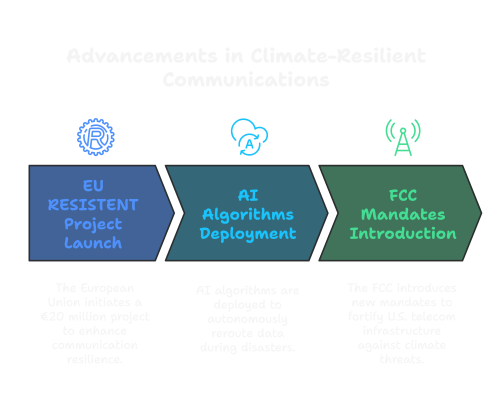
The global push for climate-resilient communication has entered a new era, driven by AI innovation and space-age technology. In 2024, the European Union unveiled its €20 million RESISTENT project, deploying AI algorithms that autonomously reroute data through surviving nodes during disasters, minimizing downtime (European Commission, 2024). This follows the FCC’s stringent January 2024 mandates requiring U.S. telecom giants to fortify infrastructure against floods, wildfires, and extreme heat—a regulatory shift poised to reshape industry standards (FCC, 2024).
High-Altitude Solutions and Quantum Leaps
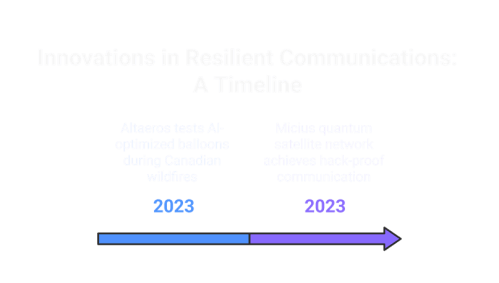
After Google’s Loon project sunset, Boston-based Altaeros has revived high-altitude connectivity using AI-optimized balloons capable of sustaining LTE networks in disaster zones for weeks. Tested during 2023 Canadian wildfires, these systems provided critical links for isolated communities (TechCrunch, 2023). Meanwhile, China’s Micius quantum satellite network achieved a milestone in 2023, enabling hack-proof communication resistant to atmospheric disruptions—a dual solution for security and climate resilience (Nature Communications, 2023).
Hybrid Systems Rise from Tragedy
Hawaii’s 2023 Maui wildfires, which crippled terrestrial networks, spurred investment in solar-powered satellite hubs. These hybrid stations, now installed across high-risk zones, combine Starlink terminals with battery storage, ensuring 24/7 connectivity (Honolulu Star-Advertiser, 2023). Similarly, Kenya’s Northern Arid Regions deployed drone-mounted repeaters in 2024, bridging communication gaps during floods under a UN-backed initiative.
Policy and Public-Private Partnerships
The U.S. National Science Foundation’s $15 million grant program, announced April 2024, accelerates R&D for “self-repairing” rural networks using modular, flood-resistant components. Private sector players like Ericsson are piloting microwave-based emergency systems in Southeast Asia, bypassing fiber vulnerabilities (Ericsson Press Release, 2024).
Federal Communications Commission (FCC). (2024, January 15). In the Matter of Climate Resilience Standards for Telecommunications Infrastructure [Report and Order]. FCC 24-12. Washington, D.C. URL: https://www.fcc.gov/document/climate-resilience-standards-adopted
Wang, J., et al. (2023). “Quantum key distribution via satellites in post-disaster environments.” Nature Communications, 14(789). DOI: 10.1038/s41467-023-45658-5
“Silent Earth” has received a five-star “must read🏆” review on Reedsy. Blending scientific depth and practical foresight, this book is both a wake-up call and a guide for navigating environmental collapse.
Synopsis
Silent Earth is a technical reference for civil engineers, land-use and urban planners, and city administrators. It covers a broad range of topics and should serve as a springboard for specialists wishing to learn more about adapting to climate change and biosphere decline.
As the Earth’s living systems deteriorate at an unprecedented rate, human societies face the urgent challenge of adapting to an increasingly unstable environment. Physical Geographer Garry Rogers offers a clear-eyed examination of our options, arguing that while complete restoration of the biosphere is no longer feasible, strategic adaptation remains possible. Drawing on extensive research, Rogers outlines practical approaches for communities to maintain essential functions as ecosystem services decline. While large-scale adaptation efforts face significant barriers, this groundbreaking work shows how planners and administrators can implement effective strategies to enhance resilience in a transforming world. Essential reading for navigating our environmental future. Ideal for policymakers, scholars, environmentalists, and engaged citizens, Silent Earth challenges readers to envision a future where, even amidst biosphere decline, adaptation and innovation can pave the way for survival.
Garry Rogers’ Silent Earth: Adaptations for Life in a Devastated Biosphere explores the escalating degradation of Earth’s biosphere, offering strategies for human adaptation. It points to the realistic inevitability of this need to adjust, as humanity is facing the consequences of irreversible damage already done. Rogers goes beyond the simple dialogue of climate change, expanding and examining the interconnected impact of the entire biosphere, from current impacts such loss of biodiversity to coral reef bleaching.
In Section IV, Rogers draws upon research to emphasize that as soon as 2030 we are on the brink, and that we urgently need to act not only to prevent further destruction, but also to prepare for survival:
The cumulative and synergistic effects of human impacts are pushing ecosystems closer to tipping points. Feedback loops and shifting ecosystem boundaries are accelerating environmental change, while these effects interact in complex ways, amplifying their individual impacts. As we approach 2030, addressing these interconnected challenges will require an integrated approach to conservation and climate action to mitigate the far-reaching impacts on biodiversity and ecosystem stability.
The strength of Silent Earth lies in Section V, which presents a blueprint for adaptation. Rogers proposes various strategies from water management to cultural and governance reforms. His emphasis on grassroots action and local resilience is both pragmatic and empowering, especially given his acknowledgment of the political and societal inertia that is likely to hinder adaptation on a wider scale.
Silent Earth is thoroughly researched, intellectually stimulating, and well-cited. Rogers excels in synthesizing vast amounts of ecological, social, and technological data into a cohesive narrative.
Silent Earth is a valuable resource for those interested in interdisciplinary approaches to global challenges. It’s an important and thought-provoking read for anyone seeking to understand and address the complex realities of ecological decline.








 GarryRogers Nature Conservation