GarryRogers Nature Conservation

Wild Plants & Animals Advocate

GarryRogers Nature Conservation

As the Population of Humans Doubles, the Number of Animals Halves

Human Population Growth Wipes Out Wildlife

It’s unbelievable to me that in the year 2014—going on ’15—the media still does hyperbolic backflips every time some celebrity gets pregnant or decides it might be fun to become a daddy, as if human reproduction is some mysterious miracle we should all be awed by. Well, there’s only so much awe I can take before something becomes truly awful–especially in light of the fact that every new human born equates to less biodiversity for everyone.

Read more at: exposingthebiggame.wordpress.com

GR:  I have to repeat the author’s closing statement:  “Across the land you can hear the battle cry: Out of the way, animals, we’ve got diapers and baby carriages to buy.”

The Ghost in the GMO Machine – Cascadia TimesCascadia Times

While independent research shows that Chlorpyrifos, a Dow Chemical insecticide used in Kaua‘i’s GMO fields, can cause significant harm to children nearby, Dow is intent on convincing the EPA otherwise.

Source: times.org

GR:  Of course, other species are harmed as well, making it unacceptable to use these pesticides and the GMOs bred for compatibility.  About 40 years ago, we switched our course from controlling population to supporting its continued growth.  Thus, we encouraged the research that has produced the GMOs. By following this path, we abandoned any hope of preserving healthy ecosystems.  Now over half of our wild animals are gone, and we continue along on the road to massive extinctions and destruction of Earth ecosystems.

Office of the Auditor General of Canada—Mitigating Climate Change

Canada Falls to the Energy Industry

GR:  The evidence suggests that the world’s 15th largest economy has succumbed to greed and has placed profit above the health of the land.

“Overall, we found that federal departments have made unsatisfactory progress in each of the four areas examined. Despite some advances since our 2012 audit, timelines for putting measures in place to reduce greenhouse gas emissions have not been met and departments are not yet able to assess whether measures in place are reducing emissions as expected” (Office of the Auditor General of Canada).

Why we did this audit

Scientists have documented the effects of climate change in all regions of our planet. For example, the Earth’s atmosphere is warming, sea levels are rising, the oceans are becoming warmer and more acidic, the Arctic ice cap is shrinking, and some weather extremes are becoming more frequent. In Canada, the effects include the loss of glaciers and the resulting impacts on water supplies on the Prairies, changes to water levels in the Great Lakes–St. Lawrence watershed, increasing risks from coastal storms, and more frequent heat waves.

According to the Intergovernmental Panel on Climate Change, these changes are attributable to human activities that result in emissions of greenhouse gases. Efforts to coordinate international action on greenhouse gases began in 1992 with the adoption of the United Nations Framework Convention on Climate Change. Despite these efforts, emissions have risen and are projected to rise further. The Government of Canada has recognized the need to urgently combat climate change and has made commitments and allocated funds to reduce emissions.

Source: www.oag-bvg.gc.ca


Saving Caribbean Coral Reefs

Coral reefGR:  This post describes other threats to coral reefs beside increasing acidification.  The story includes an opportunity for citizen naturalists to help save Caribbean reefs.

By Jensi Sartin

“Beautiful Caribbean reefs have been a tourist attraction for decades, if not centuries. They teem with life, holding an amazing variety of fantastical fish and other sea creatures. But at the current rate, Caribbean reefs will be lost within 20 years. Worse, the damage is largely the result of our own actions.

“This dire news comes from the Status and Trends of Caribbean Coral Reefs: 1970-2012an extensive report from the International Union for Conservation of Nature (IUCN). The report explains that the direct threats from overfishing and land-based pollution are combining dramatically with the longer term effects of climate change to destroy a vital natural resource that lies just a short flight from the United States.

“IUCN used data from 35,000 surveys conducted at 90 Caribbean locations since 1970, and showed that reefs have declined by more than 50% since the 1970s. Its stark conclusion should give us all pause and another last chance to reflect back on whether our strategies to save our reefs are still effective—or a priority.”

Read more and learn how you can take part.

Ocean Acidification: The Complete Loss of Tropical Coral Reefs By 2050 to 2100

GR: This post is about CO2 and ocean acidification. Other blog posts about plastic in the oceans, overfishing, garbage dumping, and toxic runoff suggest that the cost of the human impact on oceans will be far greater than the trillion dollars estimated by the UN Convention on Biological Diversity. Those costs are based on short-term factors. Species extinction is permanent. Recovery of biodiversity will take millennia. Some would say that causing the loss of a single species is unacceptable. So once again, I have to say that we must push harder. Sign those petitions, take time for the rallies and marches, send letters, make phone calls, join local groups, and enter local politics.

The following from Robert Scribbler.

“Ecosystems that have thrived and developed over millions of years are being smashed down by human activities in just a few decades. It is a very sad state of affairs that hopefully we can turn around before it is too late.” — Ken Caldeira of Stanford University.

“One trillion dollars. That’s the economic impact a new UN study found resulting from the world’s oceans becoming 170 percent more acidic by 2100 under an inexorable and ongoing human carbon emission.

“It’s a rapidly ramping acidity that is being driven by an ever-rising level of CO2 in the Earth’s atmosphere. An emission that is already setting the stage for a first wave of mass extinction in the world ocean — starting now and hitting high gear once global CO2 levels reach about 500 parts per million (this year, global CO2 levels topped off at 401 parts per million and under current and planned emissions are likely to hit 500 ppm within about 30 years).

“At issue is the vulnerability of coral reefs and many other species with calcareous skeletons and shells to rapid acidification. In the deep geological past, we’ve seen mass extinctions in many of these species due to rapid rises in ocean acidity. Events such as the Permian and PETM extinctions all showed terrible losses of species due to ocean acidification alone.

“But the pace at which humans are increasing ocean acidification has never been seen before in the geological record. So the blow that is coming to many of the animals we rely on is worse than anything that happened in Earth’s past.
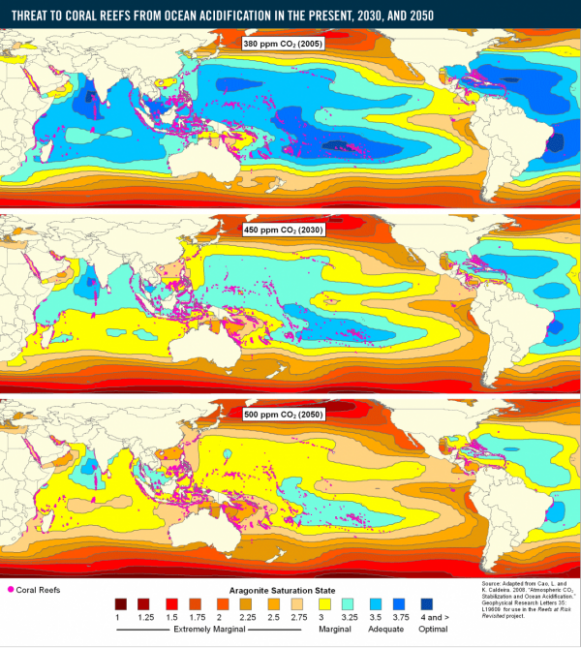
Ocean Acification Through 2050

“(Ocean acidification and related impacts to coral reefs through 2050 [500 ppm CO2].  Image source: Threat to Coral Reefs From Ocean Acidification.)”

Read more . . . .
The WWFs report on the shockingly rapid decline in wildlife should surely move us to action | Michelle Nijhuis

We must all take responsibility for combating climate change.

Source: www.theguardian.com

GR:  This will not happen. First, the few that profit from the industries causing the problems feel insulated and protected from the consequences.  Second, the governments and political leaders hope the wealthy will give them enough of the wealth to achieve the same protection.

How I feel about climate change

Our free society has lost its footing. Bad things are happening and we can’t seem to right the wrongs. Let’s hope the frustration we feel doesn’t drive Professor Bradshaw to an antisocial solution like his double on “Breaking Bad.”

CJAB's avatarConservationBytes.com

pissed offAngry. Furious. Livid. And a just little bit sad.

Well, I’m not pissed off with ‘climate change’ per se – that would be ridiculous. I am extremely pissed off with those who are doing their damnedest to prevent society from doing anything meaningful about it.

The reason I’m thinking and writing about this at the moment because last week I was approached by Joe Duggan of The Australian National University who has put together a rather clever and engaging website. The point of the website is simple – demonstrate to people that those studying climate-change science are human beings with feelings; we are not autistic, empirical automatons that conspire to ruin your day. We measure, we model and we analyse, but we’re also very much affected personally by what we observe every day in our careers.

So I grabbed a pen (not something I do very often, and my finger joints complained…

View original post 362 more words

Research Shows Great Barrier Reef Coral Is Failing

As pointed out before, CO2 emissions do more than affect the atmosphere.

Drawing from NOAA PMEL Carbon Program

Drawing from NOAA PMEL Carbon Program

“When seawater absorbs carbon dioxide (CO2), chemical reactions cut seawater pH, carbonate ion concentration, and saturation states of biologically important calcium carbonate minerals. Calcium carbonate minerals are the building blocks for the skeletons and shells of many marine organisms. In areas where most life now congregates in the ocean, the seawater is supersaturated with calcium carbonate minerals. This means there are abundant building blocks for organisms to build their skeletons and shells. However, continued ocean acidification is causing many parts of the ocean to become unsaturated and some organisms will have difficulty producing and maintaining their shells” (NOAA).

The following article by   focuses on the Great Barrier Reef.
Lizard Island: A sharp decline in calcium carbonate.

“The skeleton hand of ocean acidification has been found at work near one of Australia’s most exotic tropical destinations, Lizard Island on the Great Barrier Reef.

“Scientists surveying a reef flat just south of the resort island, off Cooktown, have measured a near 40 per cent calcium carbonate decline.”

Read more at “The Age.”

Global biodiversity targets won’t be met by 2020, scientists say

World leaders are failing in their pledge to cut the rate at which wildlife lose their homes, according to the the first ever progress report on targets to halt biodiversity loss by the end of the decade. Conservationist called the lack of action a…

Source: nuzzel.com

We’re doing the best we can, but its one step forward, two steps backward.  Shameful, embarrassing, suicidal.