The satellite data says our forests are healthy. But in my new novel, Love in Eternal Gardens, Dr. Sarah Chen knows the numbers are lying. The green on the screen is just a curated façade; the real collapse has already begun.
When ancient organisms wake beneath the Antarctic ice, they trigger a planetary reset. Humanity faces a choice: extinction or a radical transformation into a collective planetary consciousness.
Sarah resists. She becomes a Memory Keeper. She fights to preserve the jagged edges of human individuality. Her partner, Tom, chooses a different path. He disperses his consciousness into the physics of the new Earth to remain with her.
This is a story about ecological reckoning, the architecture of grief, and a love that survives the rewriting of reality.
Watching the natural world change can be deeply saddening. Many of us feel a sense of grief or anxiety about the loss of species, the changing seasons, and the degradation of familiar landscapes. But paying attention—bearing witness—is a powerful act. It connects us to reality, helps us process grief, and can motivate meaningful action. Our project is to create “A Field Guide to the Anthropocene” (or similar title). This guide will blend ecological knowledge with simple observation techniques. It will help everyday people notice the environmental changes happening in their own communities, understand what they mean, and navigate the complex emotions that arise. It concerns learning to see clearly, grieve honestly, and find purpose in bearing witness to our changing planet.
How healthy is our planet’s life support system? Shockingly, we lack a clear, real-time indicator. Current measures often tell us about extinctions after they happen. We need a “check engine” light for the biosphere. Our proposed Biosphere Integrity Metric (BIM) aims to be just that. It measures the flow of energy through life’s web and how human activities disrupt it. As a first step, we are developing a Satellite-Derived Primary Production Pressure Index (SPPPI) using global satellite data. This proxy metric will provide an urgently needed early warning of human pressure on the base of the food web. While not the full picture, it is a vital start. Read on to learn how this metric works and why developing the full BIM, integrating ground truth data, is our ultimate goal.
Our planet’s life support systems are failing, and we cannot fully restore what is being lost. But hope is not gone. We can focus on protecting refugia: special places that resist environmental damage and can act as lifeboats for biodiversity. Think of them as safe harbors—pockets of stability for plants and animals facing fire, heat, or drought. The goal of this project is to create a practical Refugia Playbook. This guide will help local communities identify, protect, and manage these vital areas in their own backyards. It is a hands-on strategy for building ecological resilience from the ground up, giving nature—and us—a fighting chance for recovery. Learn more about how we plan to develop this crucial tool.
I am pleased to announce the release of The Maplewood Journals. The story chronicles a community’s fight for survival in a world being reshaped by environmental decline.
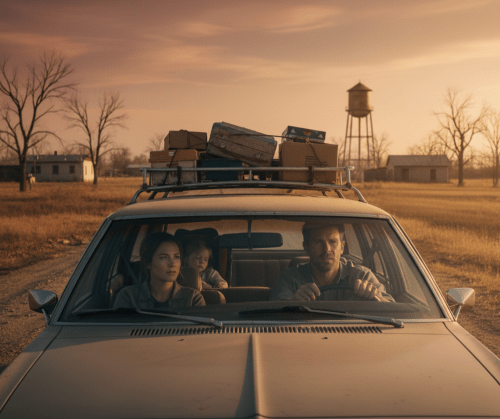
The story begins as James Holden arrives in the small town of Maplewood with his wife Emily and daughter Sophie. He is the new Town Manager, hired fresh out of college.
James quickly discovers the town has a serious problem, it is running out of water. As the story continues, the water problem is followed by others including catastrophic storms and fires. While James Holden is a central figure, the town of Maplewood itself is the true protagonist. The narrative is a multi-generational saga. It shows residents learning to adapt through community action.
The history of Maplewood and its journey into a new environmental reality is reconstructed from journals, newspaper clippings, and official records. The story’s principal resource is the personal journal of James Holden.
I wanted to understand what happens when the environmental crises we read about in the news become the lived reality of a community.–Garry Rogers
This is not a story of despair. It is a testament to human ingenuity and the power of group action. The narrative explores themes of leadership, loss, and adaptation. It is a tale of the struggle to forge a meaningful future in an uncertain world.
Our planet’s life-support system is in trouble. For centuries, we have treated the biosphere as an infinite resource. We have used its soils, forests, and waters. We have filled its air and oceans with waste. Now, the bill is coming due.
The signs are all around us. We have pushed the Earth beyond its safe operating limits (Richardson et al. 2023). The systems that kept our climate stable for millennia are beginning to break down. This is not a distant problem for future generations. It is a present reality. The window for simple fixes has closed.
My new book, Biosphere Collapse: Causes and Solutions, confronts this reality directly. It argues that we must shift our focus from preserving and restoring the past to preserving a future. The book moves beyond describing the problem. It offers a clear, structured framework for the necessary transformation of our civilization.
The framework organizes the required changes into four levels of increasing difficulty. It starts with straightforward technical solutions, like managing fisheries. It moves to restructuring entire economic sectors, like energy and agriculture. It then addresses systemic drivers like urbanization. Finally, it tackles the deepest challenge: shifting our core beliefs about progress and growth.
The book makes a pragmatic case for preparation. Profound change is difficult in times of comfort. It often takes a crisis to create the political will for action. As climate-related disasters become more common, they will create windows of opportunity. Biosphere Collapse advocates developing detailed blueprints that communities, towns, and nations can have ready to implement when those windows open.
This is a book about facing hard truths. But it is also a book about agency and hope. It outlines a path forward, one that combines technical knowledge, political strategy, and a deeper ethical relationship with the living world.
To learn more about this essential framework, please read the full executive summary on our new website page.
Bibliography
Richardson, K., et al. 2023. Earth beyond six of nine planetary boundaries. Science Advances 9: eadh2458.
The adolescent brain possesses adult capacities for reasoning and manipulation but lacks mature judgment. The adolescent believes themselves invincible, resists external constraints, and prioritizes immediate desires over long-term consequences. Industrial civilization exhibits these same symptoms. Omnipotence fantasies drive our faith in technological salvation. We will engineer our way out of climate change. We will replace…
Bacteria detect chemical gradients and remember previous exposures. Plants learn from experience and communicate through fungal networks. Crows fashion tools and teach solutions to other crows. Rats choose to rescue drowning companions even when food rewards are offered as alternatives. These are not anthropomorphic projections. They represent measurable cognitive capacities distributed throughout the tree of…
We assume cognition (thinking, memory, and emotion) is only possible for humans and a few other species. This assumption is wrong. Bacteria detect chemical gradients and remember previous exposures. Plants learn from experience and communicate through fungal networks. Crows fashion tools and teach solutions to other crows. Rats choose to rescue drowning companions even when…
(This article is the last of a six-post reality-check. Concepts and examples are drawn from “Silent Earth: Adaptations for Life in a Devastated Biosphere.”)
Across this series, we have journeyed from the stark physical reality of a wounded planet to the deep, inner landscape of human grief. We have explored the rise of a new geological force in our Technosphere, the radical rethinking of our legal systems through Rights of Nature, the urgent mission to preserve our knowledge, and the profound sorrow of solastalgia.
This journey from the external world to the internal may seem like a shift in focus, but it reveals the fundamental truth of the Anthropocene: the crisis of the biosphere is inseparable from the crisis of our own consciousness. The crucial question is no longer just what technology we can invent, but what kind of beings we choose to become. Can we, armed with knowledge of our own minds, do a better job?
The evidence presented in Silent Earth suggests the path is difficult. Our species is hobbled by cognitive biases that were once adaptive but are now perilous. We discount the future, we are overly optimistic about risk, and we struggle to grasp the slow, cascading nature of complex system collapse (Frederick et al. 2002). These are the mental roadblocks that have led us to this precipice.
Yet, our cognitive toolkit also contains the seeds of a solution. We are, to our knowledge, the only species on this planet capable of understanding its own cognitive flaws. We are the only species that can study its own history, anticipate distant futures, and consciously choose to evolve its culture.
This is the final and most essential adaptation. It is a cognitive adaptation.
It means recognizing that our sprawling Technosphere is the physical result of an extractive mindset. It means understanding that the call for Rights of Nature is a legal manifestation of our yearning for a more just relationship. It means acknowledging that our mission to preserve knowledge is our foresight battling our shortsightedness, and our ecological grief is the pain of a bond that has been broken.
To do a better job is to use this self-knowledge to consciously steer our cultural evolution. It is to build governance systems that account for our cognitive biases, to foster economic models that value long-term stability over short-term gain, and to cultivate an ethic of stewardship rooted not in dominance, but in humility.
As the great conservationist Aldo Leopold urged, we must make the journey from “conqueror of the land-community to plain member and citizen of it” (Leopold 1949). In a deteriorating biosphere, this is no longer just a poetic ideal. It is the most pragmatic and necessary survival strategy we have left. The ultimate test of human intelligence will be whether we can learn to live wisely on the only home we have ever known.
References
Albrecht, G., et al. 2007. Solastalgia: the distress caused by environmental change. Australasian Psychiatry 15(sup1): S95-S98.
Brand, S. 2018. The manual for civilization. Long Now Foundation Press, San Francisco, 324 p.
Cunsolo, A., and Ellis, N. R. 2018. Ecological grief as a mental health response to climate change-related loss. Nature Climate Change 8(4): 275-281.
Dartnell, L. 2016. The knowledge: How to rebuild civilization in the aftermath of a cataclysm. Penguin Press, New York, 352 p.
Frederick, S., Loewenstein, G., and O’Donoghue, T. 2002. Time discounting and time preference: A critical review. Journal of Economic Literature 40(2): 351-401.
Haff, P. 2014. Technology as a geological phenomenon: implications for human well-being.
Geological Society, London, Special Publications 395(1): 301-309.
Hutchison, A. 2019. The Whanganui River as a legal person. Alternative Law Journal 44(1): 16-20.
Kauffman, C. M., and Martin, P. L. 2017. Can rights of nature make development more sustainable? Why some Ecuadorian lawsuits succeed and others fail. World Development 92: 130-142.
Leopold, A. 1949. A Sand County Almanac. Oxford University Press, New York, 226 p.
Zalasiewicz, J., et al. 2017. The technosphere: its composition, structure, and dynamics. The Anthropocene Review 4(1): 9-28.
(This article is part of a six-post reality-check. Concepts and examples are drawn from “Silent Earth: Adaptations for Life in a Devastated Biosphere.”)
Earth’s environmental changes are not just an external, physical phenomenon. They have powerful effects on our inner, psychological landscape. As the world we know changes, many of us are experiencing distress that, until recently, had no name.
Philosopher Glenn Albrecht coined the term solastalgia to describe the feeling of homesickness caused by the negative transformation of the environment (Albrecht et al. 2007). It’s the pain of seeing a beloved forest logged, a familiar river run dry, or a vibrant reef turn white. This is accompanied by ecological grief, a deep sadness in response to experienced or anticipated environmental losses (Cunsolo and Ellis 2018).
These are not abstract concepts. They are the lived reality for people around the world. Researchers have documented the grief of Inuit communities as they witness the decline of caribou herds (Cunsolo et al. 2020). Conservation professionals report experiencing significant emotional distress as they conduct their work.
This emotional toll can lead to a dangerous feedback loop. As people lose direct, positive interactions with nature, their emotional connection weakens, reducing their motivation to protect it. This can lead to further loss (Soga and Gaston 2016).
By acknowledging these genuine emotions, we can address the mental health dimensions of biosphere decline. It’s time to explore our inner landscape response to our changing planet,
References
Albrecht, G., et al. 2007. Solastalgia: the distress caused by environmental change. Australasian Psychiatry 15(sup1): S95-S98.
Cunsolo, A., and Ellis, N. R. 2018. Ecological grief as a mental health response to climate change-related loss. Nature Climate Change 8(4): 275-281.
Cunsolo, A., et al. 2020. You can never replace the caribou: Inuit experiences of ecological grief from caribou declines. Cultural Geographies 27(4): 599-616.
Soga, M., and Gaston, K. J. 2016. Extinction of experience: the loss of human–nature interactions. Frontiers in Ecology and the Environment 14(2): 94-101.
Cognition is everywhere in all creatures. But what about us? Human cognition is an extraordinary elaboration of the capacities found throughout the biosphere. Our ability for symbolic language and cultural evolution has allowed us to accumulate and transmit knowledge across generations. This has transformed our species from one among many into a planetary force that is reshaping Earth systems (Henrich 2016; Steffen et al. 2011).
This unique cognitive power, however, presents a paradox.
The same intelligence that allows us to understand the intricate workings of the biosphere has also given us the technology to disrupt it (Steffen et al. 2015).
We suffer from a cognitive gap between our technological capacity and our ecological wisdom. We are brilliant at solving immediate, short-term problems but our cognitive biases make it difficult to address slow-moving, long-term crises like climate change. Biases like temporal discounting (valuing the present far more than the future) might have been essential during our early evolution, but they are now proving to be a critical flaw in our ability to act sustainably (Wagner 2010; van der Leeuw 2020).
If we are not the sole possessors of mind, but merely participants in a broader cognitive community, do we have any responsibility to the other thinking beings?
Acknowledging this shared cognitive heritage is a crucial step. It moves us away from a framework of human domination and toward one of stewardship and reciprocity (Leopold 1949). Indigenous knowledge systems have long embodied this perspective. Many of them emphasize interdependence and respect for all living things (Kimmerer 2013). The challenge for humanity is to evolve our culture and our ethics to match the power of our intellect. We need to learn to use our unique cognitive gifts to ensure the long-term viability of our extraordinary, thinking planet (Bai et al. 2016).
References
Bai, X., et al. 2016. Plausible and desirable futures in the Anthropocene: A new research agenda. Global Environmental Change 39: 351-362.
Henrich, J. 2016. The secret of our success: How culture is driving human evolution, domesticating our species, and making us smarter. Princeton University Press, Princeton, 447 p.
Kimmerer, R. W. 2013. Braiding sweetgrass: Indigenous wisdom, scientific knowledge and the teachings of plants. Milkweed Editions, Minneapolis, 408 p.
Leopold, A. 1949. A Sand County Almanac. Oxford University Press, New York, 226 p.
Steffen, W., et al. 2011. The Anthropocene: conceptual and historical perspectives. Philosophical Transactions of the Royal Society A 369(1938): 842-867.
Steffen, W., et al. 2015. The trajectory of the Anthropocene: The Great Acceleration. The Anthropocene Review 2(1): 81-98.
van der Leeuw, S. 2020. The archaeology of innovation: The embodiment of mind. Oxford University Press, Oxford, 368 p.
Wagner, G. 2010. But will the planet notice? How smart economics can save the world. Hill and Wang, New York, 256 p.




 GarryRogers Nature Conservation