2: The Technosphere – Earth’s New, Unruly ‘Kingdom’

(This article is part of a six-post reality-check. Concepts and examples are drawn from “Silent Earth: Adaptations for Life in a Devastated Biosphere.”)

For billions of years, the Earth’s surface was governed by the slow, elegant cycles of the biosphere. But now, a new planetary system has emerged, one of human origin: the technosphere. Coined by geologist Peter Haff, this concept describes the interconnected global network of all our technology—our cities, roads, power grids, and digital networks (Haff 2014). Its physical mass, a staggering 30 trillion tons of concrete, plastic, and metal, now rivals or even exceeds the total mass of all living things on the planet (Zalasiewicz et al. 2017).

This new kingdom has a complex, almost parasitic relationship with its parent. The technosphere depends utterly on the biosphere for energy, raw materials, and waste cycling, yet its very operation disrupts those sustaining systems. Agriculture is a primary example of this hybrid reality, where biological processes are co-opted and amplified by technological intervention, transforming the landscape (Foley et al. 2005).

Now, some propose to use the technosphere to manage the biosphere through geoengineering. These proposals to manipulate Earth’s climate systems carry immense promise and equally immense, uncertain risks (Lawrence et al. 2018).

The emergence of the technosphere as a dominant geological force requires a profound shift in perspective. We are no longer simply a species living within nature; we are the architects and unwitting subjects of a new planetary layer, and we have only just understood its unruly dynamics.

References

Foley, J. A., et al. 2005. Global consequences of land use. Science 309(5734): 570-574.

Haff, P. 2014. Technology as a geological phenomenon: implications for human well-being. Geological Society, London, Special Publications 395(1): 301-309.

Lawrence, M. G., et al. 2018. Evaluating climate geoengineering proposals in the context of the Paris Agreement temperature goals. Nature Communications 9(1): 3734.

Zalasiewicz, J., et al. 2017. The technosphere: its composition, structure, and dynamics. The Anthropocene Review 4(1): 9-28.

2: The Brains in the Soil — The Hidden Intelligence of Plants and Microbes

(This article is part of a series, The Thinking Planet, exploring the universal nature of cognition in the living world. All concepts and examples are drawn from an analysis of my comprehensive work, “Silent Earth: Adaptations for Life in a Devastated Biosphere.”)

When we think of intelligence, we picture a brain. But the biosphere operates on a much broader set of rules. As we learned in the last post, cognition is a fundamental property of life, and some of its most surprising forms are found where we least expect them.

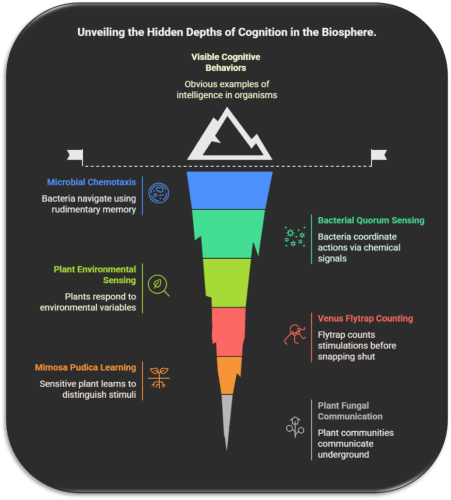
The book Silent Earth reveals that even the simplest organisms demonstrate sophisticated cognitive behaviors that belie their microscopic dimensions.

  • Microorganisms like the E. coli bacterium navigate their world through chemotaxis, a process that requires a form of rudimentary memory where they compare current conditions with those experienced moments before (Adler 1966; Vladimirov and Sourjik 2009).
  • Bacteria also engage in collective social behaviors through “quorum sensing.” They release chemical signals to sense their population density, allowing them to coordinate actions like forming biofilms or producing light only when their numbers are great enough to be effective (Fuqua et al. 1994; Waters and Bassler 2005).

Plants, too, are far from passive. They are constantly sensing and responding to dozens of environmental variables, from light quality and soil moisture to the chemical signatures of herbivores (Trewavas 2014; Karban 2015).

  • The Venus flytrap exhibits a stunning example of non-neural information processing. It counts the number of times its trigger hairs are touched, snapping shut only after two stimulations within about 20 seconds to distinguish prey from random debris (Böhm et al. 2016).
  • Plants also possess a form of memory. The sensitive plant Mimosa pudica can “learn” to distinguish harmful from harmless stimuli, maintaining this discrimination for weeks (Gagliano et al. 2016).
  • Perhaps most astonishingly, entire plant communities communicate through underground fungal networks, sending warning signals about herbivore attacks or sharing resources between different species (Simard et al. 2012; Song et al. 2019).

These examples show that cognition isn’t limited to organisms with nervous systems. It is a universal toolkit for survival, evolved in countless forms across the living world.

Next time, I’ll explore the more familiar, yet no less incredible, minds of the animal kingdom and discover how intelligence can emerge from the actions of a crowd.

References

Adler, J. 1966. Chemotaxis in bacteria. Science 153(3737): 708-716.

Böhm, J., et al. 2016. The Venus flytrap Dionaea muscipula counts trigger hairs to trap insects. Current Biology 26(3): 286-295.

Fuqua, C., et al. 1994. Quorum sensing in bacteria: The LuxR-LuxI family of cell density-responsive transcriptional regulators. Journal of Bacteriology 176(9): 269-275.

Gagliano, M., et al. 2016. Learning by association in the sensitive plant Mimosa pudica. Oecologia 175(1): 63-72.

Karban, R. 2015. Plant sensing and communication. University of Chicago Press, Chicago, 240 p.

Simard, S. W., et al. 2012. Net transfer of carbon between ectomycorrhizal tree species in the field. Nature 388(6642): 579-582.

Song, Y., et al. 2019. Belowground chemical signaling in plants. Journal of Integrative Plant Biology 61(7): 810-826.

Trewavas, A. 2014. Plant behaviour and intelligence. Oxford University Press, Oxford, 304 p.

Vladimirov, N., and Sourjik, V. 2009. Chemotaxis of Escherichia coli in a natural environment. PLoS ONE 4(5): e5512.

Waters, C. M., and Bassler, B. L. 2005. Quorum sensing: Cell-to-cell communication in bacteria. Annual Review of Cell and Developmental Biology 21: 319-346.

Writing 2

Here’s the next romance story:

Fire Season: Love in the Time of Climate Change

Francis Ralph Graham

Controlled Burns (Fall 2023)

The video call shattered into blocks for the third time in ten minutes. Sam’s face froze mid-sentence, his eyelids locked at half-blink as he described that morning’s precipitation gauges in Sector Nine. The screech of digital static crackled through Mia’s headphones. She shifted her laptop on the gray laminate table in the graduate lounge. Around her, other students hunched over laptops: one pecked desperately at her keyboard, another leaned on a stack of textbooks, muttering under his breath as he wrestled with code.

Sam’s image finally snapped back into focus, he wore a frayed flannel shirt and rubbed his eyes with a forearm dusted in chalky white from fieldwork. Behind him sat a pile of battered field notebooks, pages riffled from coffee spills and other insults. Above the notebooks hung a whiteboard scribbled in tidy rows of differential equations, though Mia couldn’t parse more than the occasional Greek letter.

“—sorry, you cut out after ‘soil moisture content,’” she said, nodding at the stack of data sheets pinned to his board.

Sam sighed, sliding a hand through his hair. “Those numbers from sector seven still don’t make sense,” he said, shifting to bring a printed graph closer to the camera. The colored lines clashed sharply, red and burnt orange dominating where tender greens should have peaked. “Post-fire recovery ought to show at least some native grass establishment by now. Instead it’s cheatgrass in a solid blanket, with Russian thistle poking up like little skeleton fingers. It’s as if the native seed bank got wiped out overnight.”

Mia flicked open her research binder. The rings protested with a metallic creak as she flipped to a page of August photographs—sun-bleached plots lined with wooden stakes, each one tagged with faded neon tape. “That’s what I’m seeing in the overgrazed pastures,” she said. “Those perennial bunchgrasses that usually punch back after fire? They’re flatlined. My advisor’s been breathing down my neck about sampling methods—says my transects might be biased.”

Above Mia, the lounge’s fluorescent lights sputtered—two flickers shy of a blackout. The hum of printers and the occasional groan from someone stuck on a stubborn equation created an atmosphere dense with academic tension.

“Dr. Martinez has scheduled my thesis defense for December fifteenth,” Sam said, leaning back in his creaky office chair. The back squeaking in protest. “I’m rewriting my conclusions for the third time. How can I defend data that flies in the face of years of recovery models?”

Mia watched Sam’s hand slide over his hair—a gesture she’d come to recognize over six weeks of nightly calls since they’d parted for grad school. Despite the three-hour drive between campuses and the pixilation that made his expressions flicker, these conversations had become an addiction.

“Mrs. Chen said the BLM office called again yesterday,” Mia added. “Diana wants updates on timelines because they’re setting next year’s grazing rotations. They want to add our preliminary data to their monitoring results to plan resource allocations.”

Sam’s features shifted, a frown giving way to a heavier weight. He exhaled slowly. “Morrison emailed me this morning: twelve major fires since we left the field in August. Twelve. The season was supposed to taper off by now, but they’re running full suppression orders day and night.”

Mia leaned forward, her chair creaking. “I actually… miss being out there,” she said softly. “All that stress, the long days, but it felt… essential.”

“I dream about the dispatch radio at night,” Sam confessed, gaze drifting past his camera into a dim corner of his apartment. “I wake up half-convinced I need to assign air tankers or log weather bulletins.”

Their old routine—late nights, shared worry, colliding research—felt almost tangible in the empty lounge. Mia recognized the ebb and flow of academic life: spurts of calm followed by crushing deadlines.

“Can I ask you something?” she said, shifting in her chair. “Do you ever wonder if we’re training for careers that might not exist when we graduate?”

Sam was silent for a long beat. Behind him, a roommate passed, careful not to disturb the fragile bubble of concentration. When he spoke, his voice was low. “I think about that every day. Range management, fire suppression—they all assume stable conditions, predictable seasons, and decent funding. But after what we saw this summer…” He trailed off, recalling nights spent reorganizing project plans around sudden monsoon storms or surprise heatwaves.

Mia exhaled, leaning back against the cool edge of the table. “Dr. Hoffman brought up adaptive management in our methods class. Maybe that’s what we’re supposed to learn—not just follow textbooks, but invent solutions as conditions change.”

A wheezy clank sounded as the building’s furnace kicked on, rattling the ductwork above them.

“I’ve been thinking about your livestock research,” Sam said, leaning forward until his chin nearly touched his desk. “The permit modifications you analyzed—what if rest-rotation systems aren’t enough? Maybe we need entirely new grazing strategies. Cattle behavior changes on stressed landscapes; maybe we should factor that in.”

Mia felt that familiar spark of discovery swarm through her. “Right. Traditional stocking rates assume normal precipitation patterns, but those patterns aren’t normal anymore. Ranchers are already destocking. If we push rest periods further, they won’t survive.”

Her laptop battery icon blinked an ominous yellow. The charger was buried in her backpack. She glanced at Sam, torn between keeping their connection alive and recharging for tonight’s own data crunch.

“I should let you go soon,” Sam said, noticing her tense glance. “But would you want to meet halfway this weekend? Cedar Flats has a coffee barn with decent Wi-Fi. We could spread our binders out on a real table for once.”

Mia’s heart lifted. “Yes. I’d love that.”

Saturday morning found them in a converted storage barn filled with mismatched armchairs and local landscape paintings. The air smelled of pine smoke and sage as they unloaded binders, maps, and laptops from their packs. Sam claimed a broad table by a dusty bay window, and Mia unzipped an old leather portfolio to reveal a stack of color photographs tagged with sticky notes in neon pink.

“I brought the aerial shots Morrison sent,” Sam said, arranging them next to her grazing transect images. “See how your overgrazed parcels look from above?”

Their coffee arrived in heavy ceramic mugs. Outside, a crisp breeze sent golden leaves drifting across the gravel parking lot.

Mia sorted her photos in chronological order: May’s emerald shoots, July’s thinning clumps, September’s dusty bare earth. Sam leaned over, running a fingertip along each stake flag in the image. “Fine fuel loads must be skyrocketing as invasive annuals fill the void, laying down a tinder-dry blanket.”

She pointed at a graph on her laptop: monthly precipitation bars overlaying temperature curves. “Total rainfall was only fifteen percent below average, but look at the distribution—June and July barely registered a drop. Most of it came before the summer heat peaked.”

“Timing trumps totals,” Sam said. “The earlier rain helps the invasives.”

The coffee shop owner, a paint-spattered woman with silver hair tucked under a bandana, refilled their mugs. “You folks mapping the drought?” she asked, peering at their spread of charts and photos.

“We’re studying vegetation responses,” Mia replied, voice bright. “Do you have the corn fields up the valley—any chance you’d share planting records?”

The woman nodded. “He’s been grumbling that the old calendar’s useless—earlier springs, false frosts, rain out of sync. Here’s our phone number.”

After she moved on, Sam met Mia’s eyes. “We should interview them and other farmers. Their schedules would show how adaptation actually happens on the ground.”

Mia tapped her pen against a timeline they were sketching. “And that’s exactly the gap the BLM needs to fill—collaborative, adaptive strategies that account for drought, grazing, fire risk… the cascade of stress factors.”

They spent the next two hours weaving their separate findings into a joint narrative: how invaders fuel greater fire danger, how shifting precipitation undermines rest-rotation systems, and how local planting and grazing shifts are true adaptive management.

Brunch crowds filed in—weekend cyclists, couples sipping lattes, elderly couples thumbing through the menu. Through the window, October’s palette gleamed: maples aflame with early color, frost-shriveled marigolds clinging to stubborn life.

As they packed up, Sam’s voice softened. “These calls, this… collaboration—talking with you is the best part of my day. You help turn my raw data into meaning.”

Mia felt warmth bloom. “Mine too. Even when I’m drowning in papers, I know we’ll figure it out together.”

They lingered on the porch, reluctant to reenter their solitary thesis grind. Sam’s expression grew serious. “What if we propose a joint BLM project next summer? Integrate our findings and test new grazing-and-fire management models on the ground.”

Mia’s breath caught. “You mean go back out there, side by side?”

Sam nodded. “Professional partnership. And…” He hesitated, then met her gaze firmly. “Something more.”

She smiled. “Something more.”

The drive back threaded through cattle-peppered pastures and hills scarred by recent burns—subjects of their research and the source of the uncertainty they both felt. That evening, back at her desk under the flickering lounge lights, Mia spread out her materials again. Everything was the same—and utterly transformed.

Her phone buzzed. “Made it back safe. Missing our call already.” –Sam

She tapped back, “Me too. Let’s meet tonight?”

At nine, Sam’s face reappeared on her screen, the glow from his apartment lamps softening his features. “Tell me about that cascade model,” he said with a grin that made her heart quicken, “and then… let’s talk next steps.” Outside, frost glazed the lounge windows, but inside, armed with shared data, shared purpose, and something more, Mia felt ready for whatever came next.
1: The Harsh Reality – Why Full Restoration Is No Longer an Option

(This article is part of a six-post reality-check. Concepts and examples are drawn from “Silent Earth: Adaptations for Life in a Devastated Biosphere.”)

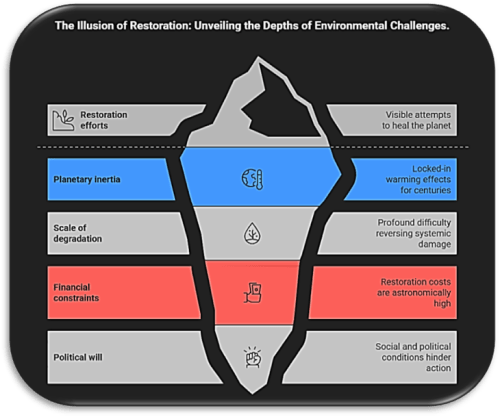
In the grand narrative of our species, we have arrived at a pivotal, sobering moment. The Earth’s biosphere, a delicate and complex tapestry woven over eons, now bears the deep imprint of our civilization. A noble and understandable impulse urges us to restore the planet to its former glory, yet a clear-eyed look at the evidence suggests this may be beyond our grasp. The inertia of our planetary systems is immense; even if all greenhouse gas emissions ceased today, significant warming is already locked in and would persist for centuries as a new equilibrium is slowly reached (King et al. 2024).

The sheer scale of the challenge is written upon our landscapes and in our waters. Consider the Chesapeake Bay, once North America’s largest and most productive estuary. Despite decades of concerted effort and billions of dollars in investment, its ecological health remains precarious, a testament to the profound difficulty of reversing systemic degradation (Rust and Blum 2018). Look to the Amazon, the lungs of our planet, where the cost to restore even a fraction of what has been lost is estimated in the hundreds of billions of dollars (Lennox et al. 2018). The financial and political will for such an undertaking on a global scale is simply not present.

The very social and political conditions that hinder restoration are the same ones that will impede large-scale adaptation. It is time, therefore, to pivot our focus toward achievable survival strategies. This is not a message of despair, but a necessary recalibration based on the evidence before us. We must learn to navigate a new world, one where our role is not to restore the past, but to thoughtfully and ethically adapt to the future we have created.

References

King, A. D., et al. 2024. Exploring climate stabilisation at different global warming levels in ACCESS-ESM-1.5. Earth System Dynamics 15: 1353-1383.

Lennox, G. D., et al. 2018. Second rate or a second chance? Assessing biomass and biodiversity recovery in regenerating Amazonian forests. Global Change Biology 24(12): 5680-5694.

Rust, S., and Blum, S. 2018. Chesapeake Bay: A journey to restoration. USA Today. https://www.usatoday.com/pages/interactives/news/chesapeake-bay-a-journey-to-restoration/

1, More Than Instinct—Uncovering Nature’s Hidden Cognition

(This article is part of a series of 5 posts, The Thinking Planet, exploring the universal nature of cognition in the living world. All concepts and examples are drawn from an analysis of my comprehensive work, “Silent Earth: Adaptations for Life in a Devastated Biosphere.”)

We think of our planet as being divided into two camps: humans, with our complex intelligence, and then everything else, running on simple instinct. But what if that division is wrong? What if the ability to sense, process information, and respond to it is not a rare gift but a fundamental characteristic of life itself?

In the book Silent Earth, I argue the biosphere is defined by the ubiquity of cognition. Not that a bacterium or a plant “thinks” like a human. Rather, it suggests that every living thing, to survive, must perform a crucial task: acquire information from its environment and respond adaptively (Trewavas 2014). This capacity for information processing—whether it happens in a brain or through the elegant molecular pathways of a single cell—is cognition.

When we look through this lens, the world transforms. We no longer see a planet of mindless automata but a global community of cognitive agents, each actively interpreting and shaping its world (De Waal 2009). This perspective challenges us to move beyond our human-centered view of intelligence and recognize the diverse and astounding ways that life knows itself and its surroundings.

In the next post, I’ll dive into the world of this hidden intelligence, exploring the remarkable cognitive abilities of the life forms we most often overlook: plants and microbes.

References

De Waal, F. B. 2009. The age of empathy: Nature’s lessons for a kinder society. Harmony Books, New York, 291 p.

Trewavas, A. 2014. Plant behaviour and intelligence. Oxford University Press, Oxford, 304 p.

Transportation Adaptation to Climate Change

Without radical climate-change adaptations, movement of people and goods will soon become severely limited. Recent studies estimate that climate-related damage to transportation infrastructure could exceed $1 trillion by 2050. #ClimateAdaptation #TransportResilience

Transforming Transportation for a Changing World

The accelerating deterioration of Earth’s biosphere demands fundamental changes in how we approach transportation. From coastal infrastructure threatened by rising seas to rail lines buckling under extreme heat, our existing transportation systems face mounting challenges that require innovative solutions and comprehensive adaptation strategies.

Climate Impacts on Infrastructure

The scale of climate impacts on transportation infrastructure is staggering. Research by the American Society of Civil Engineers projects that climate-related damages will surpass $1 trillion by 2050 (ASCE 2021). Coastal transportation networks are particularly vulnerable, with studies indicating that up to 60% of coastal infrastructure will face risks from sea-level rise and storm surges by 2100 (Dawson et al. 2016).

Heat impacts present another critical challenge. Extreme temperatures cause rail buckling and road surface degradation, leading to billions in annual repair costs. Chinowsky et al. (2019) estimate that heat-related damage to transportation infrastructure will become a major economic burden by mid-century.

Innovative Materials and Design Solutions

To address these challenges, engineers are developing climate-resilient materials and adaptive design approaches. The Arizona Department of Transportation’s pioneering use of rubber-modified asphalt demonstrates the potential of advanced materials to enhance infrastructure stability (Rodezno et al. 2020).

The Netherlands offers another inspiring example with their innovative floating roads concept, enabling transportation infrastructure to adjust to changing water levels (Rijkswaterstaat 2018). Such flexible design approaches will become increasingly crucial as environmental conditions become more volatile.

Alternative Transportation Methods

Diversifying transportation options strengthens system resilience. Electric and hydrogen-powered vehicles represent a crucial step toward reducing fossil fuel dependence while integrating with renewable energy systems. Norway’s rapid transition to electric vehicles demonstrates the feasibility of large-scale transportation electrification (Norwegian EV Association 2021).

Active transportation infrastructure, particularly walking and cycling networks, provides low-carbon mobility options that remain functional during energy disruptions. Copenhagen’s extensive bicycle infrastructure network exemplifies climate-resilient urban transportation (City of Copenhagen 2019).

Supply Chain Adaptations

The resilience of supply chains becomes increasingly critical as environmental conditions deteriorate. Distributed storage facilities and flexible routing systems enhance supply chain stability. Amazon’s network of fulfillment centers illustrates the potential of distributed logistics (Hoberg and Alicke 2019).

Local production and shorter supply chains reduce vulnerability to transportation disruptions. The concept of “smart specialization” in regional economies can enhance stability while maintaining efficiency (Foray 2018).

Urban and Rural Considerations

Urban transportation systems require focused adaptation due to high population density and infrastructure concentration. Transit-oriented development reduces transportation vulnerability while improving accessibility. Singapore’s integration of land use and transportation planning serves as a model for resilient urban mobility (Meng et al. 2018).

Rural areas face unique challenges, including dispersed populations and limited resources. Queensland, Australia’s flood-resistant road design guidelines offer valuable insights for rural adaptation (Queensland Government 2019). Alternative access methods, such as small aircraft and autonomous vehicles, become vital for remote areas.

Emergency Transportation Planning

As environmental disruptions increase, emergency transportation planning becomes critical. Florida’s evacuation planning system provides valuable lessons for large-scale population movements (Florida Division of Emergency Management 2021). The United Nations Humanitarian Response Depot network highlights the importance of pre-positioned transportation resources (UNHRD 2020).

Conclusion

Reviewing the literature on transportation adaptation gives one the same old “too little too late” feeling. The 200-year minimum planning period is not being applied. If it were, the worst-case prospects would generate much stronger preparations. (I included more discussion of this issue in Silent Earth (Rogers 2025). The Kindle version is free on Amazon today and tomorrow.)

References

ASCE. 2021. Infrastructure report card: Transportation. American Society of Civil Engineers, Reston.

City of Copenhagen. 2019. Copenhagen bicycle account 2018. Technical and Environmental Administration, Copenhagen.

Chinowsky P, et al. 2019. Infrastructure adaptation to climate change: Dynamic adaptation pathways for road infrastructure. Climate Risk Management 23: 76-93.

Dawson D, et al. 2016. On the potential for climate change impacts on marine infrastructure. Proceedings of the Institution of Civil Engineers 169(4): 167-178.

Florida Division of Emergency Management. 2021. State of Florida comprehensive emergency management plan. Florida Division of Emergency Management, Tallahassee.

Foray D. 2018. Smart specialization strategies and industrial modernization in European regions—theory and practice. Cambridge Journal of Economics 42(6): 1505-1520.

Hoberg K, Alicke K. 2019. Five lessons for supply chains from the COVID-19 crisis. McKinsey & Company, New York.

Meng M, et al. 2018. Transit-oriented development in an urban rail transportation corridor. Transportation Research Part B 118: 231-247.

Norwegian EV Association. 2021. Norwegian EV policy. Norwegian EV Association, Oslo.

Queensland Government. 2019. Flood Resistant Road Design Guidelines. Department of Transport and Main Roads.

Rijkswaterstaat. 2018. Floating Roads: Innovation in Dutch Water Management. Ministry of Infrastructure and Water Management.

Rodezno MC, et al. 2020. Development of a nanomaterial for use in pavements to reduce the urban heat island effect. Transportation Research Record 2674(10): 617-627.

Rogers, G. 2025. Silent Earth: Adaptations for life in a devasted biosphere. Coldwater Press, Humboldt, AZ. 452 p.

UNHRD. 2020. Annual Report 2020. United Nations Humanitarian Response Depot, Geneva.

Writing

When I started writing fiction, I read books, articles, blog posts, and Internet commentaries on writing techniques. I joined local writer groups and writing circles, and I followed hundreds of writers and groups on the Internet. I created an elaborate backstory for a world like Earth except that human-like intelligence was always present in all higher organisms. After I published the first novels, I repeated what I had learned about writing in blog posts and school lectures and learned even more from readers and writers. Recently, I started compiling a series of methods books that would bring the techniques together in focused narratives. I began with a general guide (“Writer’s Primer”). Then, acknowledging AFOSA’s focus on nature conservation, I assembled a methods booklet for nature writing (“Life on Land”). After that, I began on genre methods booklets. One of them covers romance short stories. To taste my own medicine, I decided to practice romance short story techniques with a series of stories about a romance set amidst our climate-change disaster. This is the first story.

Fire Season: Love in the Time of Climate Change

Francis Ralph Graham

First Smoke (Summer 2023)

The coffee maker in the university geography department sputtered its last drops as Mia Allen checked her watch. Eight forty-seven on a Tuesday morning in late May, and she was running behind schedule for what Professor Martinez had called “the most important meeting of your graduate career.” Her hands trembled slightly as she reached for her backpack—too much caffeine, not enough breakfast, and the weight of knowing this interview could determine whether her summer comprised meaningful fieldwork or scrambling for a last-minute retail job.

The department secretary, Mrs. Chen, looked up from sorting mail with the patient smile that suggested she’d witnessed countless nervous students over her thirty years behind that desk. Her fingers moved through envelopes with practiced efficiency, separating the urgent federal correspondence from routine university mail—each envelope representing someone’s career trajectory.

“Deep breaths, dear. Dr. Martinez doesn’t bite, despite what the undergraduates claim.” Mrs. Chen paused, holding up a thick envelope marked with the Bureau of Land Management logo. “Though I suppose you’re more worried about the BLM position than facing Ricardo.”

Mia nodded, throat too tight for words. Two years of coursework in biogeography, climatology, and land-use analysis had led to this moment. Through the department’s windows, she could see maintenance crews already watering the campus landscaping despite the early hour—drought restrictions meant only morning irrigation was permitted.

The hallway stretched before her, lined with bulletin boards displaying conference announcements and research opportunities. A faded poster from last year’s American Association of Geographers meeting caught her eye: Climate Change Adaptation in Western Rangelands. The photograph showed cracked earth and struggling sagebrush beneath an impossibly blue sky, edges curling where tape had lost its grip to repeated temperature fluctuations.

Dr. Martinez’s office door stood slightly ajar, voices drifting through the gap. Mia recognized her advisor’s accented English mixed with another voice—deeper, more hesitant. She knocked twice and waited, hearing her pulse in her ears.

“Come in, come in.” Dr. Martinez gestured toward an empty chair beside another student, a young man with sun-lightened brown hair and calloused hands that spoke of work beyond classroom walls. His worn boots showed scuff marks that suggested actual field experience rather than fashion choices.

“Mia Allen, meet Samuel Powell. You’ll be working together this summer if everything goes according to plan.”

Samuel—Sam, she corrected herself after catching his quick grimace at the formal name—half-rose from his chair. When he extended his hand, she noticed the constellation of small scars across his knuckles, evidence of outdoor labor. His palm was warm and surprisingly gentle for its obvious strength, the contact lasting a moment longer than strictly professional courtesy required.

“Sam’s thesis examines post-fire invasive species succession,” Dr. Martinez continued, settling behind his desk with the measured movements of someone who’d conducted hundreds of these meetings. Papers rustled as he organized their files, each sound sharp in the morning quiet. “Your livestock grazing research complements his work perfectly. Both projects examine human-induced vegetation changes, though from different angles.”

Mia studied Sam’s profile as he turned toward their advisor. Something in his posture suggested complete focus, the intensity of someone who’d fought for this opportunity. His clothes—faded jeans, a button-down shirt that had seen better days—reminded her of home, of the practical approach to life that came from understanding consequences.

A siren wailed in the distance, growing louder before fading toward the hospital. Sam’s shoulders tensed momentarily at the sound, an unconscious reaction that made Mia wonder what experiences had shaped that response.

“The BLM district office has requested two graduate assistants for the summer,” Dr. Martinez continued, his voice cutting through the external noise. “They’re facing unprecedented challenges this fire season. Three major blazes already, and we’re barely into June. Early snowmelt, record-breaking spring temperatures, fuel moisture content approaching critical levels two months ahead of typical patterns.”

Through the office window, Mia could see students moving between classes with the unhurried pace of those whose biggest worry was upcoming finals. The contrast struck her—here they sat discussing real-world crises while twenty feet away someone complained loudly about a broken vending machine.

“The positions involve split duties,” Dr. Martinez said, pulling out two thick folders. The paper stock felt substantial, official in a way that made Mia’s pulse quicken. “Mia, you’ll work primarily with the land-use planning office under Diana Walsh. Expect long days reviewing grazing permits, conducting field surveys, learning how policy translates to ground-truth conditions.”

He handed her a folder marked with the Bureau’s logo, its weight representing months of preparation condensed into a single opportunity. Sam received his folder with similar reverence, though she noticed his thumb worrying the corner as Dr. Martinez spoke.

“Sam, you’ll be assigned to fire dispatch operations under Jack Morrison. Real-time decision making, resource allocation, communications coordination. Some office work, yes, but during active fires, you’ll be gathering information that directly affects firefighter safety.”

The weight of actual responsibility settled between them like shared understanding. This wasn’t academic theory—their analysis and recommendations would affect real landscapes, real livelihoods, potentially real lives.

Dr. Martinez leaned forward, his expression growing serious. “Dr. Hoffman will conduct your final interviews this afternoon. She’s worked with BLM for fifteen years and knows exactly what they need. Be prepared to discuss your research and your field experience.”

Mia’s stomach tightened. Field experience meant the required summer mapping course and various research trips, but nothing approaching the intensity Dr. Martinez described. She glanced at Sam, wondering if his confidence came from more extensive outdoor work or if he was simply better at hiding nervousness.

“Questions before you prepare for this afternoon?”

Sam cleared his throat, the sound rough. “Dr. Martinez, the fire assignment—what will I be doing?” He paused, fingers drumming once against his chair arm before stilling.

“Jack Morrison runs one of the safest operations in the region,” Dr. Martinez replied. “You won’t be fighting fires, Sam. Your job is information gathering and communication. But you’ll be close enough to understand why this work matters.”

Outside, another siren began its urgent wail, this one heading toward the mountains where smoke had been visible yesterday evening. Both students turned toward the window instinctively.

“Both of you will,” Dr. Martinez finished.

They left the office together, walking down the hallway as other students hurried past with the energy of those anticipating summer break. Mia felt suspended between her old life as a graduate student and whatever was coming next. The fluorescent lighting seemed harsh after the windows in Dr. Martinez’s office, artificial and insufficient.

“Coffee?” Sam asked as they reached the main lobby, then immediately looked uncertain. “I mean, if you want to compare notes before the interview. I know nothing about Dr. Hoffman except that she apparently reduces grown graduate students to tears during field methods.”

Mia laughed despite her nervousness, the sound echoing off the lobby’s hard surfaces. “I survived her Introduction to Soil Science course. Barely. She has this way of asking questions that makes you wonder if you know anything.”

The student union’s coffee shop bustled with end-of-semester energy. They found a small table near the windows, settling across from each other and the folders Dr. Martinez had given them. Around them, conversations flowed with summer plans, internships, and the universal student concerns for finals week stress.

Sam opened his folder, immediately closing it again. His fingers drummed against the table surface—a nervous habit, she realized. “So,” he said, “livestock grazing research. That sounds like you actually know what you’re doing in the field.”

“My family runs cattle,” Mia said, surprising herself with the admission. She usually downplayed her agricultural background among academics who sometimes viewed practical experience with suspicion. “Small operation compared to most in the west, but I grew up understanding how livestock interact with landscape.” She paused, remembering last summer’s drought conditions. “What remains of landscape, anyway.”

Sam’s expression shifted with recognition. “Similar background. My dad grows corn and soybeans in Iowa, but I spent summers working construction to pay for school. Hand-built fencing, erosion control projects.” He looked down at his palms, evidence of that labor written in callused skin. “Got interested in fire behavior after watching a grassland burn near our place three years ago. The way invasive species moved in afterward—like they were waiting for the opportunity.”

Something in his voice made Mia study his face more carefully. He spoke about fire with personal understanding, not just academic interest.

“That must have been intense,” she said.

“Changed everything I thought I knew about landscape stability,” Sam replied, his coffee forgotten as he leaned forward. “Made me realize that our assumptions on ecosystem recovery might be outdated. Climate may be changing too fast.”

The weight of that observation settled between them. Mia had reached similar uncertainty through her own research, watching native grasses struggle to reestablish after cattle grazing. Her father’s weathered face came to mind—the quiet frustration with agricultural extension recommendations that failed to address the flash droughts becoming commonplace.

Through the coffee shop windows, she could see acampus maintenance crew removing a sprinkler system. They moved with practiced efficiency, working with the drought limitations that now shaped every decision.

“Dr. Martinez mentioned this is an unprecedented fire season,” she said, flipping through her folder’s contents. Maps showed burn scars scattered across the western landscape like broken glass, some representing devastated communities and all displaced wildlife. “Three major fires already.”

“It hasn’t rained or snowed since February this year,” Sam said, looking at a climate summary in his materials. “The snowpack is thirty percent below normal, spring temperatures are averaging four degrees above the twenty-year normal. Fuel moisture content is at critical levels two months ahead of typical fire season.”

They studied the documents, occasionally sharing striking statistics or revealing maps. Mia appreciated Sam’s methodical approach—he was connecting the data without jumping to conclusions. His marginal notes revealed serious intent to understand the information.

A group of undergraduates at the next table erupted in laughter about their summer beach plans, the sound jarring against the data spread before them. Sam glanced over, his expression thoughtful rather than annoyed.

“Listen,” Mia said after they’d spent twenty minutes absorbed in climate data and fire projections, “I know we’re technically competing for these positions, but would you want to study together for the interview? Dr. Hoffman’s questions are notoriously unpredictable, but maybe we can prepare for the basics.”

Sam’s smile brightened his entire face, revealing warmth that had been hidden beneath interview nervousness. “Absolutely. Two perspectives are better than one, especially when facing an interrogation.”

She felt her own face flush with unexpected pleasure at his enthusiasm. The reaction surprised her—when had she started wanting his company?

They spent the next three hours testing each other on fire behavior principles, grazing impact assessments, and land-use policy frameworks. Sam’s knowledge of meteorological factors impressed Mia, while her understanding of soil science and vegetation dynamics filled gaps in his preparation.

The afternoon light shifted as they worked, shadows drifting across their shared table. Occasionally, their hands would brush when reaching for the same document, each contact creating a small electric moment that neither acknowledged but both noticed.

“You know,” Sam said during a break in their review session, “this feels more like collaboration than competition.”

“Maybe that’s what’s needed,” Mia replied. “The environmental challenges are too complex for individual perspectives.”

Something in her voice made him look up from his notes, meeting her eyes directly. The library’s quiet hum surrounded them—keyboards clicking, pages turning, the distant conversation of other students wrestling with their own academic challenges.

“After this morning,” Sam said quietly, “I’m hoping we both get selected.”

By the time they walked toward Dr. Hoffman’s office for their interviews, they moved in a private energy field along a hallway that seemed longer than usual.

“Good luck,” Mia said as they stood outside the professor’s door.

“You too,” Sam replied. He hesitated, then reached out to briefly squeeze her shoulder. The contact was warm and reassuring, lasting just long enough without crossing any boundaries.

Dr. Hoffman’s interview proved as challenging as expected. She grilled them on technical knowledge and field experience. When she asked Mia to describe how she would change traditional grazing management practices in response to climate change, the answer flowed from months of study, a lifetime of familiarity, and new perspectives added by Sam.

“Interesting,” Dr. Hoffman said, making notes. Her pen scratched against paper with decisive strokes. “And how would you respond if local ranchers disagreed with your recommendations? These are people whose families have worked the same land for generations.”

Mia recalled her father’s conversations with neighbors, the shared concerns the sense of cooperation.

“I’d start by listening,” she said. “Ranchers have generational knowledge on their specific landscapes. My job would be synthesizing that local expertise with broader research findings, looking for solutions that work both ecologically and culturally.”

Dr. Hoffman’s expression revealed nothing, but she nodded before dismissing Mia to wait in the hallway.

Sam emerged from his interview thirty minutes later, looking drained but cautiously optimistic. They walked together toward the parking lot, not willing to speculate on outcomes.

The late afternoon heat hit them as they stepped outside, carrying the scent of stressed vegetation and distant smoke. The campus trees showed signs of moisture stress, some leaves already curling despite the early date.

“Regardless of what happens,” Sam said as they reached Mia’s car, “today was valuable. I learned more in those three hours studying with you than I did in weeks of solo preparation.”

“Same here,” Mia replied firmly.

Her car’s interior was hot despite being parked in shade. She started the engine and rolled her window down, grateful for air conditioning while noting the irony of burning fossil fuels to escape heat intensified by climate change.

“Maybe we could keep in touch regardless of the BLM outcome,” she said. “Compare notes on our research?”

“I’d like that,” Sam said, then hesitated, as if considering whether to say more. The parking lot’s asphalt shimmered with heat waves, distorting the surrounding air. “Actually, I was wondering if you’d want to grab dinner sometime. Not just about the interviews or research. I enjoyed spending time with you today.”

The invitation hung between them, and Mia studied Sam’s face, noting how he calmly waited for her response, despite the hope clearly visible in his expression.

“Yes,” she said, surprising herself with the certainty in her voice. “I’d like that.”

They exchanged phone numbers, fingers brushing as he handed back her phone. The contact sent warmth up her arm, and a surprising physical awareness.

Dr. Hoffman called two days later with news that both students had been selected for the BLM positions. They would report to the district office in three weeks, after completing final exams and defending their thesis proposals.

“Congratulations,” Dr. Hoffman said, her usually stern voice carrying a note of warmth. “But understand what you’re signing up for. Climate change is accelerating faster than our institutional responses. You’ll be learning in real-time how to adapt management practices to conditions we’ve never faced before.”

That evening, Sam called to share the news and suggest a celebration dinner.

They met at a small restaurant near campus, the kind of place that attracted graduate students with generous portions and reasonable prices. They leaned together, charged with the energy of shared success and the opportunity to explore new ideas.

“Part of me is frightened,” Mia admitted over dessert, watching Sam’s hands as he gestured while talking. His fingers moved with unconscious grace, and she wondered what those hands would feel like cupping her face. “What happens to the management of grazing impacts and vegetation dynamics, when conditions are constantly changing?”

“I keep thinking about that grassland fire I witnessed,” Sam said, his voice growing quiet. “How quickly everything is becoming irrelevant. But that’s also why this work matters. We need to acknowledge the changes and adapt.”

The restaurant’s windows showed the last light of an early summer evening, sunset colors muted by atmospheric haze. Other diners filled the room with conversations concerning summer plans and job prospects, their voices creating a backdrop of normalcy unnatural beneath the weight of environmental crisis.

“Can I ask you something?” Sam said as they prepared to leave. “What made you switch from agricultural economics to geography? I mean, with your family background, the economics track seems like a natural fit.”

Mia considered the question, thinking back to the moment her academic focus had shifted. “Three years ago, during a severe drought, I watched my dad make hard decisions on which pastures to rest, which cattle to sell, uncertain if he could keep the operation viable. The economic models I was learning didn’t account for directional environmental change. They assumed there was a stable baseline that might no longer exist.”

She paused, remembering her father’s weathered face as he studied dying grassland, his quiet frustration with agricultural extension recommendations that failed to address the flash droughts becoming routine.

“I realized I needed to understand the physical systems first—how landscapes actually function under stress—before economics could provide useful guidance. You can’t develop sustainable economic models for systems you don’t comprehend.”

Sam nodded slowly, his coffee cup forgotten in his hands. “That makes perfect sense. For me, it was watching how quickly invasive species colonized the burned area. Traditional ideas about primary and secondary succession didn’t apply. Made me wonder how we were entering some new condition rather than a normal fluctuation.”

They parted that evening with plans to stay in touch throughout the rest of the semester. As Mia drove home, she caught herself anticipating Sam’s texts about his research with enthusiasm that extended well beyond professional interest.

Three weeks later, they met at the BLM district office, a low building surrounded by vehicles equipped for fieldwork and serious operational responsibilities. The parking lot’s asphalt radiated heat waves despite the early morning hour, and the surrounding landscape showed obvious stress from prolonged drought conditions.

Diana Walsh, Mia’s supervisor, was in her forties with graying hair pulled back in a practical ponytail and hands that showed decades of outdoor work. She greeted Mia with a firm handshake and an appraising look.

“Hope you’re ready to dive in,” Diana said, leading Mia toward the land-use planning office. Her stride was brisk and efficient. “We’ve received sixteen applications for grazing permit modifications in the past month alone. Ranchers requesting emergency adjustments to traditional rotation schedules because of drought conditions. Your job is helping us evaluate which modifications are scientifically sound and which ones might cause long-term damage.”

The office activity that felt different from university settings. No one was laughing or even smiling. Maps covered every available wall surface, marked with colored pins showing active projects, pending permits, and areas of concern.

Diana paused beside a large topographical map, her finger tracing boundaries marked in red. “See this area? Three generations of the Morrison family—no relation to Jack in fire dispatch—have run cattle there using rotation patterns established by the grandfather. Now they’re requesting permission to graze areas that were off-limits during drought years.”

She turned to face Mia directly. “Problem is, those off-limits areas are the seed source for recovery. Use them now, we might solve this year’s crisis while creating next decade’s catastrophe.”

Across the building, Sam was meeting Jack Morrison, a lean man whose sun-weathered face and calm demeanor suggested someone comfortable with high-pressure decision making. Morrison’s office contained multiple computer screens displaying real-time weather data, satellite imagery, and communication equipment that connected him to fire crews across the region.

“First thing you need to understand,” Morrison said, settling behind his desk while gesturing toward a large monitor displaying current drought conditions, “is that everything we thought we knew about fire behavior is changing. Fuel loads, humidity levels, wind patterns, temperature extremes—all the variables we use for prediction models are shifting.”

Red zones dominated the display, indicating extreme drought conditions. Morrison’s weather-beaten hands moved across his keyboard with surprising dexterity, pulling up additional data layers.

“Your job this summer is helping us adapt our response protocols to new realities. Traditional fire season used to run from July through September. Now it’s April through November.” He paused, looking directly at Sam. “That’s not just a longer season—it’s a completely different operational framework.”

Morrison leaned back in his chair, studying Sam’s expression. “Had a crew leader tell me yesterday that fighting fires now feels like playing chess against an opponent who changes the rules mid-game. Twenty years of experience counting for less each season.”

By lunch time, both Mia and Sam had been immersed in briefings that revealed the complexity of their assignments. They met in the building’s small break room, comparing notes while eating lunches they’d been advised to pack.

“Diana showed me grazing permit applications from ranchers requesting permission to use traditionally protected areas,” Mia said, unwrapping a sandwich. “Areas that were set aside to preserve native plant communities during drought periods. But the drought is so severe that even the protected areas might be the only viable option for maintaining livestock operations.”

Sam nodded grimly, his own lunch untouched. “Morrison’s dealing with similar impossible choices. We have half the firefighting resources we need, fuel conditions that are dangerously extreme, and weather patterns that render prediction models useless. He said they’re essentially improvising solutions in real-time.”

The weight of responsibility was settling over them. Through the break room window, they could see the district’s fleet of emergency vehicles, each one representing someone’s safety and livelihood.

“I keep thinking about Dr. Martinez’s comment concerning fresh perspectives,” Mia said, taking a sip of water that did little to ease her dry throat. “What if our lack of experience is actually valuable?” The situation so incongruous the two graduate trainees shared amused expressions. “We’re not invested in traditional approaches that might not work anymore.”

“That’s simultaneously terrifying and inspiring,” Sam replied, finally taking a bite of his sandwich.

A radio crackled to life down the hall, calling for units to investigate a smoke report. Both students turned toward the sound instinctively, listening to voices coordinating a response. The casual lunch atmosphere gone for good.

“Gets easier,” said a voice from the doorway. They turned to see a woman in her fifties wearing the practical clothing of someone who spent considerable time outdoors. “The constant state of readiness, I mean. I’m Janet Martinez—no relation to your Dr. Martinez. Work vegetation surveys with Diana’s team.”

She poured coffee that looked like it had been brewing for hours. “Twenty-three years with BLM, and I’ve never seen conditions like this. But you learn to deal with uncertainty. Has to become normal, or you’d go crazy with worry.”

Janet studied them both with experienced eyes. “You’re the graduate students Diana and Jack have been bragging about. Good. We need people who understand that everything’s changing. Too many folks still trying to manage twenty-first-century problems with twentieth-century solutions.”

That evening, after their first full day of orientation and initial assignments, they walked together toward the parking lot. The setting sun painted the landscape in shades of gold and amber, beautiful in a way that hid the underlying stress conditions.

“Want to grab dinner? We should debrief today’s experiences. Compare observations.”

Mia smiled at his careful phrasing, recognizing her own uncertainty on how to navigate the transition from professional collaboration to personal interest. “Yes,” she said. “I think debriefing is essential.”

The restaurant they chose was quieter than their campus celebration diner, filled with locals who seemed to carry the day’s heat and stress in their postures. Conversations at nearby tables touched on water restrictions, fire danger ratings, and the economic impact of drought.

Over burgers and coffee, they processed their first day’s experiences.

“Diana mentioned that three major ranching operations in the district have sold their cattle,” Mia said, watching Sam’s face in the soft restaurant lighting. “That’s decades of careful breeding, family legacies, entire ways of life”

“As we expected, they’re seeing fire behavior that doesn’t match any historical patterns,” Sam replied, his voice dropping as he noticed other diners listening. “Fires moving faster, burning hotter, jumping traditional barriers like roads and rivers. Morrison mentioned one crew that had to deploy emergency shelters because their escape route was cut off by unexpected wind shifts.”

The weight of the day’s revelations settled between them. Around them, other conversations continued—complaints about utility bills, excitement for weekend plans, discussions of local politics—normal life proceeding while they grappled with evidence of accelerating environmental crisis.

“It’s strange,” Mia said, “how routine everything feels here while we’re dealing with what’s essentially an unfolding emergency. People are adapting so gradually that the change feels manageable, even though the cumulative impact is going to be enormous.”

Sam considered this while watching the restaurant’s evening crowd. A family at the corner table was celebrating a child’s birthday, their laughter bright against the subdued conversations elsewhere. “Maybe that’s how major changes always happen. Incrementally, until one day you look around and realize everything has shifted.”

“Can I tell you something?” Mia said as they prepared to leave. The restaurant had grown quieter, most diners heading home to prepare for tomorrow’s responsibilities. “Today was the first time my academic work felt genuinely important. Not just intellectually interesting or useful for career advancement, but actually meaningful.”

“I know exactly what you mean,” Sam replied, his hand briefly covering hers on the table. The contact was warm and welcome, lasting long enough to send its warmth spiraling through her before he pulled away. “We’re getting to work on serious problems.”

They walked to their cars through air that still held the day’s heat and the western horizon maintained a faint glow from the sun’s passage. The sound of their footsteps echoed off the asphalt, creating an intimate pocket of shared space.

“Same time tomorrow?” Sam asked as they reached her car, and Mia realized he was asking about more than their work schedules.

“Yes,” she said, feeling certainty settle in her chest like a small flame taking hold. When he leaned closer to say goodnight, she caught his scent—soap and sunscreen and something distinctly him that made her want to step closer rather than maintain professional distance.

As they drove home through darkness punctuated by distant lightning that promised no relief from the drought, both carried the knowledge that whatever challenges emerged, they wouldn’t face them alone. Behind them, the BLM office building stood dark except for the communications center, where skeleton crews maintained watch over weather patterns and fire danger indicators that would shape tomorrow’s decisions.

In the distance, barely visible against the star-filled horizon, a thin column of smoke rose from what would become another battle in the most challenging fire season on record. But tonight, driving home with windows down and radio playing softly, they thought not of the work ahead but of the unexpected gift of finding someone who understood both the weight of meaningful work and the courage required to face an uncertain future with hope intact.

Love, like fire, could start with the smallest spark—but under the right conditions, both will transform entire landscapes.

Intersection Of Human Environmental Solutions and Impacts

The fundamental question of whether humanity’s environmental solutions will overtake and halt its environmental destruction in time to preserve human civilization is the subject of intense scientific debate. An analysis of peer-reviewed research on climate change and its effects on human civilization suggests that while positive developments in technology and policy may prevent the absolute worst-case warming scenarios, they are unlikely to be deployed fast enough to avoid irreversible damage to key global ecosystems. The “intersection” will occur, but after some critical tipping points have been crossed.

I approached this issue in: “Adapting to Worst-Case Climate Change” and “Silent Earth, Adaptations for Life in a Devastated biosphere.” This blog post is a more balanced review of optimism due to positive developments and pessimism due to negative impacts. Last week I added Kindle versions of my books. Enrolled in Amazon’s Free Book promotion, they are free starting today with “Adapting. . . .”

The Acceleration of Solutions: A Techno-Economic Revolution

The case for optimism rests on the exponential growth of clean technologies, driven by powerful economic feedback loops.

  • Economic Tipping Points: The most significant positive trend is that renewable energy sources are now, in many parts of the world, the cheapest form of new electricity generation available. This has created a powerful economic momentum for decarbonization that is less dependent on political will. A study by Way et al. (2022) in the journal Joule found that a rapid transition to clean energy is likely to result in trillions of dollars in net savings globally compared to a fossil-fuel-based system.
  • Exponential Growth & S-Curves: The deployment of key technologies like solar, wind, and batteries is not linear but follows an exponential adoption “S-curve”. BloombergNEF (2023) data shows that solar and wind now account for most new power-generating capacity added globally each year. Similarly, global EV sales have doubled every two years, a trend that, if sustained, could lead to a near-total transition away from internal combustion engines for new car sales by the early 2030s.
  • Policy as an Accelerator: While political will is fickle, major policy actions can create long-term industrial momentum. The U.S. Inflation Reduction Act (IRA) and the E.U.’s Green Deal are not just climate policies, but massive industrial strategies designed to onshore clean energy manufacturing and secure a competitive advantage. These initiatives will accelerate decarbonization pathways in the world’s largest economies, though this will be retarded by the U. S. counter moves in 2025.

The Acceleration of Impacts: The Unyielding Physics of the Earth System

The case for pessimism is grounded in the physical realities of the Earth system, which possesses immense inertia and potential for non-linear dynamics.

  • Climate System Inertia and “Locked-In” Warming: The central challenge is the inertia of the climate system. Even if global emissions were to cease today, the planet would continue to warm because of past emissions and the thermal inertia of the oceans. This has been referred to as “warming in the pipeline” (Hansen et al. 2023). A significant amount of future sea-level rise and ecosystem injury is already “locked in,” regardless of our current actions.
  • Irreversible Tipping Points: The greatest risk is that this locked-in warming will push critical Earth systems past irreversible tipping points. A landmark 2022 study in Science by Armstrong McKay et al. found that several key tipping points, including the collapse of the Greenland and West Antarctic ice sheets and the abrupt thaw of permafrost, could be triggered even between 1.5°C and 2°C of warming—thresholds we are on track to cross. The recent die-off of vast areas of coral reefs serves as a stark example of a major ecosystem already crossing this threshold.
  • Cascading Risks and Synchronous Failures: These tipping points are not independent. The collapse of one system can increase the risk of another failing, creating a “tipping cascade” (Kemp et al. 2022). For example, losing Arctic sea ice reduces albedo and accelerates regional warming, which hastens the thaw of permafrost. Recent research highlights the growing risk of “synchronous failure,” where climate-related shocks trigger simultaneous crises in multiple interconnected systems, including global food supply chains and financial markets. In their exhaustive study of tipping points, Vasilis Dakos and colleagues concluded that the vast amount of remote sensing and other Earth systems data are bringing us closer to the ability to anticipate tipping points. At present, “Early warnings can tell us that “something” important may be about to happen, but they do not tell us what precisely that “something” may be and when exactly it will happen” (. . . , Dakos et al. 2024).

The Verdict: An Intersection After Irreparable Damage

When comparing these two accelerating trends, the scientific literature points to a deeply unsettling conclusion. The positive socio-economic trends of the clean energy transition are powerful, but they are unlikely to move quickly enough to prevent the biophysical trendlines of climate impact from crossing critical, irreversible thresholds. The most likely outcome is a future where humanity successfully reduces the impacts of its farms and cities and decarbonizes its energy and transportation systems, but only after locking in the collapse of several major ecosystems. We will prevent the 4-5°C “runaway greenhouse” scenario, but we will not prevent the loss of all coral reefs and mountain glaciers, loss of some major ice sheets, and significant, permanent loss of significant portions of the biosphere. The “intersection” will not be a moment of salvation, but a point at which we can adapt to a world that has been irreparably damaged. If humanity’s effort to survive is sufficient, civilization will survive, but in a suppressed state that will persist while the earth cools and cleans itself and Earth’s biosphere heals.

Bibliography

Alber, J., et al. 2021. The Apocalyptic Dimensions of Climate Change between the Disciplines. https://doi.org/10.1515/9783110730203-001.

Armstrong McKay, D. I., et al. (2022). “Exceeding 1.5°C global warming could trigger multiple climate tipping points.” Science, 377(6611), eabn7950.

BloombergNEF. (2023). New Energy Outlook 2023. Bloomberg Finance L.P.

Claes, D. H., & Pineda, L. G. (2023). “The Inflation Reduction Act (IRA) and the new logic of climate and energy policy.” Energy Strategy Reviews, 50, 101258.

Dakos, V. et al. (2024). Tipping point detection and early warnings in climate, ecological, and human systems. Earth System Dynamics 15: 1117-1135.

Hansen, J., et al. (2023). “Global warming in the pipeline.” Oxford Open Climate Change, 3(1), kgad008.

Homer-Dixon, T., et al. (2015). “Synchronous failure: The emerging causal architecture of global crisis.” Ecology and Society, 20(3).

Hughes, T. P., et al. (2018). “Global warming transforms coral reef assemblages.” Nature, 556(7702), 492-496.

IEA. (2023). World Energy Outlook 2023. International Energy Agency.

IPCC. (2021). Climate Change 2021: The Physical Science Basis. Contribution of Working Group I to the Sixth Assessment Report of the Intergovernmental Panel on Climate Change. Cambridge University Press.

Kemp, L., et al. (2022). “Climate Endgame: Exploring catastrophic climate change scenarios.” Proceedings of the National Academy of Sciences, 119(34), e2108146119.

Rogers, G. 2024. Adapting to Worst-Case Climate Change. Coldwater Press, Humboldt, AZ. 99 p.

Rogers, G. 2025. Silent Earth: Adaptations for Life in a Devastated Biosphere. Coldwater Press, Humboldt, AZ. 452 p.

Seba, T. (2020). Rethinking Humanity: Five Foundational Sector Disruptions, the Lifecycle of Civilizations, and the Coming Age of Freedom. RethinkX. https://www.rethinkx.com/publications/rethinkinghumanity2020.en [Accessed 06/09/25]

Steel, D., et al. 2022. Climate change and the threat to civilization. Proceedings of the National Academy of Sciences, 119(42), e2210525119.

Way, R., et al. (2022). “Empirically grounded technology forecasts and the energy transition.” Joule, 6(9), 1967-1971.

Developments in Resilient Communications Adaptations

As climate disasters escalate, novel tech is revolutionizing crisis response. From AI-driven networks to quantum-secured satellites, innovative systems are ensuring connectivity when disasters occur. #ResilientTech #ClimateReady

The global push for climate-resilient communication has entered a new era, driven by AI innovation and space-age technology. In 2024, the European Union unveiled its €20 million RESISTENT project, deploying AI algorithms that autonomously reroute data through surviving nodes during disasters, minimizing downtime (European Commission, 2024). This follows the FCC’s stringent January 2024 mandates requiring U.S. telecom giants to fortify infrastructure against floods, wildfires, and extreme heat—a regulatory shift poised to reshape industry standards (FCC, 2024).

High-Altitude Solutions and Quantum Leaps

After Google’s Loon project sunset, Boston-based Altaeros has revived high-altitude connectivity using AI-optimized balloons capable of sustaining LTE networks in disaster zones for weeks. Tested during 2023 Canadian wildfires, these systems provided critical links for isolated communities (TechCrunch, 2023). Meanwhile, China’s Micius quantum satellite network achieved a milestone in 2023, enabling hack-proof communication resistant to atmospheric disruptions—a dual solution for security and climate resilience (Nature Communications, 2023).

Hybrid Systems Rise from Tragedy

Hawaii’s 2023 Maui wildfires, which crippled terrestrial networks, spurred investment in solar-powered satellite hubs. These hybrid stations, now installed across high-risk zones, combine Starlink terminals with battery storage, ensuring 24/7 connectivity (Honolulu Star-Advertiser, 2023). Similarly, Kenya’s Northern Arid Regions deployed drone-mounted repeaters in 2024, bridging communication gaps during floods under a UN-backed initiative.

Policy and Public-Private Partnerships

The U.S. National Science Foundation’s $15 million grant program, announced April 2024, accelerates R&D for “self-repairing” rural networks using modular, flood-resistant components. Private sector players like Ericsson are piloting microwave-based emergency systems in Southeast Asia, bypassing fiber vulnerabilities (Ericsson Press Release, 2024).

References

  1. European Commission. (2024). RESISTENT: Artificial Intelligence for Disaster-Resilient Telecommunications Networks [Policy Report]. Directorate-General for Communications Networks, Brussels. URL: https://ec.europa.eu/digital-single-market/en/news/resistent-project-launch
  2. Federal Communications Commission (FCC). (2024, January 15). In the Matter of Climate Resilience Standards for Telecommunications Infrastructure [Report and Order]. FCC 24-12. Washington, D.C. URL: https://www.fcc.gov/document/climate-resilience-standards-adopted
  3. Liao, S. (2023, August 9). “Altaeros resurrects balloon-powered internet with AI upgrades for wildfire zones.” TechCrunch. URL: https://techcrunch.com/2023/08/09/altaeros-balloon-internet-ai-wildfires/
  4. Wang, J., et al. (2023). “Quantum key distribution via satellites in post-disaster environments.” Nature Communications, 14(789). DOI: 10.1038/s41467-023-45658-5
  5. Kubo, H. (2023, December 3). “Maui installs solar-Starlink hubs to prevent future comms blackouts.” Honolulu Star-Advertiser. URL: https://www.staradvertiser.com/maui-solar-starlink-hubs-2023/
  6. Ericsson AB. (2024, March 22). Next-gen microwave systems deployed in ASEAN flood zones [Press Release]. Stockholm. URL: https://www.ericsson.com/en/press-releases/2024/asean-microwave-launch

Latest Posts