Mind boggled scanning all the climate solutions at this website aware climate is only one part of our problem. Insuring survival of significant portions of the biosphere 500 years from now is our challenge. Dwelling on the difficulty generates fantasies like “Love in Eternal Gardens.”
Tag Archives: Climate-change-adaptation
New Release: When the Biosphere Collapses, Earth Wakes Up
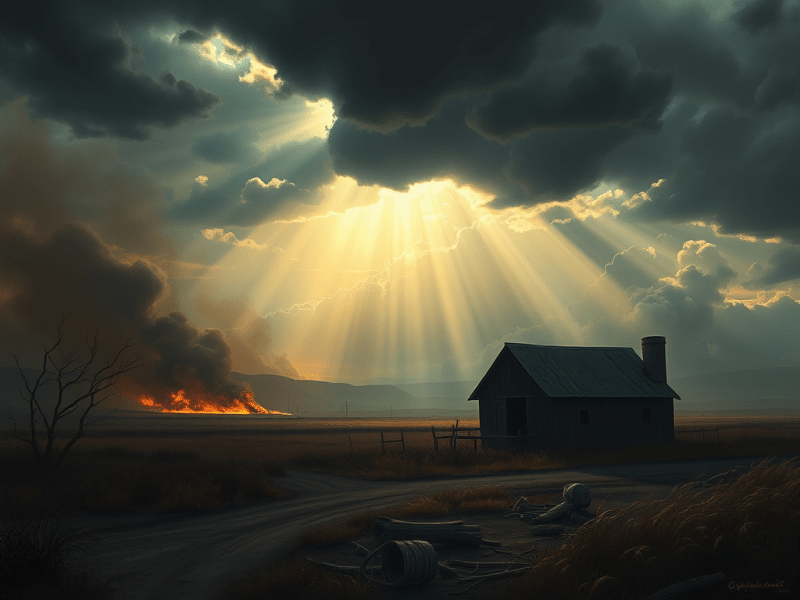
(Painting by Sandy Lowder, Austin, Texas)
The satellite data says our forests are healthy. But in my new novel, Love in Eternal Gardens, Dr. Sarah Chen knows the numbers are lying. The green on the screen is just a curated façade; the real collapse has already begun.
When ancient organisms wake beneath the Antarctic ice, they trigger a planetary reset. Humanity faces a choice: extinction or a radical transformation into a collective planetary consciousness.
Sarah resists. She becomes a Memory Keeper. She fights to preserve the jagged edges of human individuality. Her partner, Tom, chooses a different path. He disperses his consciousness into the physics of the new Earth to remain with her.
This is a story about ecological reckoning, the architecture of grief, and a love that survives the rewriting of reality.
More>> Love in Eternal Gardens
Love in Eternal Gardens is available to download at the link above or buy on Amazon.
Introducing “Biosphere Collapse: Causes and Solutions”

Our planet’s life-support system is in trouble. For centuries, we have treated the biosphere as an infinite resource. We have used its soils, forests, and waters. We have filled its air and oceans with waste. Now, the bill is coming due.
The signs are all around us. We have pushed the Earth beyond its safe operating limits (Richardson et al. 2023). The systems that kept our climate stable for millennia are beginning to break down. This is not a distant problem for future generations. It is a present reality. The window for simple fixes has closed.
My new book, Biosphere Collapse: Causes and Solutions, confronts this reality directly. It argues that we must shift our focus from preserving and restoring the past to preserving a future. The book moves beyond describing the problem. It offers a clear, structured framework for the necessary transformation of our civilization.
The framework organizes the required changes into four levels of increasing difficulty. It starts with straightforward technical solutions, like managing fisheries. It moves to restructuring entire economic sectors, like energy and agriculture. It then addresses systemic drivers like urbanization. Finally, it tackles the deepest challenge: shifting our core beliefs about progress and growth.
The book makes a pragmatic case for preparation. Profound change is difficult in times of comfort. It often takes a crisis to create the political will for action. As climate-related disasters become more common, they will create windows of opportunity. Biosphere Collapse advocates developing detailed blueprints that communities, towns, and nations can have ready to implement when those windows open.
This is a book about facing hard truths. But it is also a book about agency and hope. It outlines a path forward, one that combines technical knowledge, political strategy, and a deeper ethical relationship with the living world.
To learn more about this essential framework, please read the full executive summary on our new website page.
Bibliography
Richardson, K., et al. 2023. Earth beyond six of nine planetary boundaries. Science Advances 9: eadh2458.
Recent Blog Posts:
Manifesto of the Initiation
Here is a short explanation of the title. It breaks down the metaphor used in the text to clarify that “Initiation” refers to a rite of passage rather than a beginning. The title reframes the collapse of industrial civilization not as a meaningless end, but as a necessary rite of passage for humanity. It argues…
Announcing My New Novel: The Long Fire Season
I am pleased to announce the release of my new novel, The Long Fire Season. For years, I have written about the technical realities of biosphere collapse and the necessity of adaptation. Now, I am exploring those themes through the most powerful lens available to us: the human heart. Love in the Time of Nature’s…
The Great Simplification is the Mechanism. The Initiation is the Meaning.
We stand at the terminal edge of the Holocene. By now, those of us paying attention to the data know that the era of “green growth” and technological salvation is a delusion. We are beginning to understand what systems theorist Nate Hagens calls “The Great Simplification”—the inevitable thermodynamic correction that occurs as our civilization’s energy…
Transportation Adaptation to Climate Change
Without radical climate-change adaptations, movement of people and goods will soon become severely limited. Recent studies estimate that climate-related damage to transportation infrastructure could exceed $1 trillion by 2050. #ClimateAdaptation #TransportResilience
Transforming Transportation for a Changing World
The accelerating deterioration of Earth’s biosphere demands fundamental changes in how we approach transportation. From coastal infrastructure threatened by rising seas to rail lines buckling under extreme heat, our existing transportation systems face mounting challenges that require innovative solutions and comprehensive adaptation strategies.
Climate Impacts on Infrastructure
The scale of climate impacts on transportation infrastructure is staggering. Research by the American Society of Civil Engineers projects that climate-related damages will surpass $1 trillion by 2050 (ASCE 2021). Coastal transportation networks are particularly vulnerable, with studies indicating that up to 60% of coastal infrastructure will face risks from sea-level rise and storm surges by 2100 (Dawson et al. 2016).
Heat impacts present another critical challenge. Extreme temperatures cause rail buckling and road surface degradation, leading to billions in annual repair costs. Chinowsky et al. (2019) estimate that heat-related damage to transportation infrastructure will become a major economic burden by mid-century.
Innovative Materials and Design Solutions
To address these challenges, engineers are developing climate-resilient materials and adaptive design approaches. The Arizona Department of Transportation’s pioneering use of rubber-modified asphalt demonstrates the potential of advanced materials to enhance infrastructure stability (Rodezno et al. 2020).
The Netherlands offers another inspiring example with their innovative floating roads concept, enabling transportation infrastructure to adjust to changing water levels (Rijkswaterstaat 2018). Such flexible design approaches will become increasingly crucial as environmental conditions become more volatile.
Alternative Transportation Methods
Diversifying transportation options strengthens system resilience. Electric and hydrogen-powered vehicles represent a crucial step toward reducing fossil fuel dependence while integrating with renewable energy systems. Norway’s rapid transition to electric vehicles demonstrates the feasibility of large-scale transportation electrification (Norwegian EV Association 2021).
Active transportation infrastructure, particularly walking and cycling networks, provides low-carbon mobility options that remain functional during energy disruptions. Copenhagen’s extensive bicycle infrastructure network exemplifies climate-resilient urban transportation (City of Copenhagen 2019).
Supply Chain Adaptations
The resilience of supply chains becomes increasingly critical as environmental conditions deteriorate. Distributed storage facilities and flexible routing systems enhance supply chain stability. Amazon’s network of fulfillment centers illustrates the potential of distributed logistics (Hoberg and Alicke 2019).
Local production and shorter supply chains reduce vulnerability to transportation disruptions. The concept of “smart specialization” in regional economies can enhance stability while maintaining efficiency (Foray 2018).
Urban and Rural Considerations
Urban transportation systems require focused adaptation due to high population density and infrastructure concentration. Transit-oriented development reduces transportation vulnerability while improving accessibility. Singapore’s integration of land use and transportation planning serves as a model for resilient urban mobility (Meng et al. 2018).
Rural areas face unique challenges, including dispersed populations and limited resources. Queensland, Australia’s flood-resistant road design guidelines offer valuable insights for rural adaptation (Queensland Government 2019). Alternative access methods, such as small aircraft and autonomous vehicles, become vital for remote areas.
Emergency Transportation Planning
As environmental disruptions increase, emergency transportation planning becomes critical. Florida’s evacuation planning system provides valuable lessons for large-scale population movements (Florida Division of Emergency Management 2021). The United Nations Humanitarian Response Depot network highlights the importance of pre-positioned transportation resources (UNHRD 2020).
Conclusion
Reviewing the literature on transportation adaptation gives one the same old “too little too late” feeling. The 200-year minimum planning period is not being applied. If it were, the worst-case prospects would generate much stronger preparations. (I included more discussion of this issue in Silent Earth (Rogers 2025). The Kindle version is free on Amazon today and tomorrow.)
References
ASCE. 2021. Infrastructure report card: Transportation. American Society of Civil Engineers, Reston.
City of Copenhagen. 2019. Copenhagen bicycle account 2018. Technical and Environmental Administration, Copenhagen.
Chinowsky P, et al. 2019. Infrastructure adaptation to climate change: Dynamic adaptation pathways for road infrastructure. Climate Risk Management 23: 76-93.
Dawson D, et al. 2016. On the potential for climate change impacts on marine infrastructure. Proceedings of the Institution of Civil Engineers 169(4): 167-178.
Florida Division of Emergency Management. 2021. State of Florida comprehensive emergency management plan. Florida Division of Emergency Management, Tallahassee.
Foray D. 2018. Smart specialization strategies and industrial modernization in European regions—theory and practice. Cambridge Journal of Economics 42(6): 1505-1520.
Hoberg K, Alicke K. 2019. Five lessons for supply chains from the COVID-19 crisis. McKinsey & Company, New York.
Meng M, et al. 2018. Transit-oriented development in an urban rail transportation corridor. Transportation Research Part B 118: 231-247.
Norwegian EV Association. 2021. Norwegian EV policy. Norwegian EV Association, Oslo.
Queensland Government. 2019. Flood Resistant Road Design Guidelines. Department of Transport and Main Roads.
Rijkswaterstaat. 2018. Floating Roads: Innovation in Dutch Water Management. Ministry of Infrastructure and Water Management.
Rodezno MC, et al. 2020. Development of a nanomaterial for use in pavements to reduce the urban heat island effect. Transportation Research Record 2674(10): 617-627.
Rogers, G. 2025. Silent Earth: Adaptations for life in a devasted biosphere. Coldwater Press, Humboldt, AZ. 452 p.
UNHRD. 2020. Annual Report 2020. United Nations Humanitarian Response Depot, Geneva.

Intersection Of Human Environmental Solutions and Impacts
The fundamental question of whether humanity’s environmental solutions will overtake and halt its environmental destruction in time to preserve human civilization is the subject of intense scientific debate. An analysis of peer-reviewed research on climate change and its effects on human civilization suggests that while positive developments in technology and policy may prevent the absolute worst-case warming scenarios, they are unlikely to be deployed fast enough to avoid irreversible damage to key global ecosystems. The “intersection” will occur, but after some critical tipping points have been crossed.
I approached this issue in: “Adapting to Worst-Case Climate Change” and “Silent Earth, Adaptations for Life in a Devastated biosphere.” This blog post is a more balanced review of optimism due to positive developments and pessimism due to negative impacts. Last week I added Kindle versions of my books. Enrolled in Amazon’s Free Book promotion, they are free starting today with “Adapting. . . .”
The Acceleration of Solutions: A Techno-Economic Revolution
The case for optimism rests on the exponential growth of clean technologies, driven by powerful economic feedback loops.
- Economic Tipping Points: The most significant positive trend is that renewable energy sources are now, in many parts of the world, the cheapest form of new electricity generation available. This has created a powerful economic momentum for decarbonization that is less dependent on political will. A study by Way et al. (2022) in the journal Joule found that a rapid transition to clean energy is likely to result in trillions of dollars in net savings globally compared to a fossil-fuel-based system.
- Exponential Growth & S-Curves: The deployment of key technologies like solar, wind, and batteries is not linear but follows an exponential adoption “S-curve”. BloombergNEF (2023) data shows that solar and wind now account for most new power-generating capacity added globally each year. Similarly, global EV sales have doubled every two years, a trend that, if sustained, could lead to a near-total transition away from internal combustion engines for new car sales by the early 2030s.
- Policy as an Accelerator: While political will is fickle, major policy actions can create long-term industrial momentum. The U.S. Inflation Reduction Act (IRA) and the E.U.’s Green Deal are not just climate policies, but massive industrial strategies designed to onshore clean energy manufacturing and secure a competitive advantage. These initiatives will accelerate decarbonization pathways in the world’s largest economies, though this will be retarded by the U. S. counter moves in 2025.

The Acceleration of Impacts: The Unyielding Physics of the Earth System
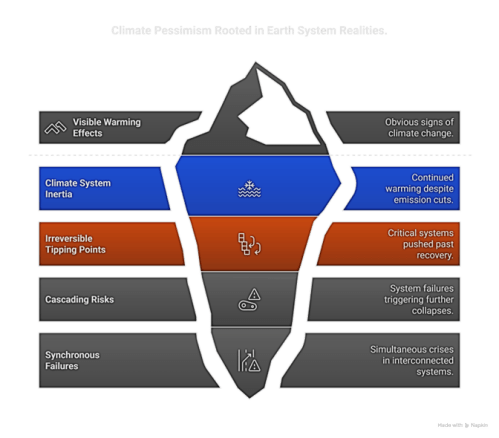
The case for pessimism is grounded in the physical realities of the Earth system, which possesses immense inertia and potential for non-linear dynamics.
- Climate System Inertia and “Locked-In” Warming: The central challenge is the inertia of the climate system. Even if global emissions were to cease today, the planet would continue to warm because of past emissions and the thermal inertia of the oceans. This has been referred to as “warming in the pipeline” (Hansen et al. 2023). A significant amount of future sea-level rise and ecosystem injury is already “locked in,” regardless of our current actions.
- Irreversible Tipping Points: The greatest risk is that this locked-in warming will push critical Earth systems past irreversible tipping points. A landmark 2022 study in Science by Armstrong McKay et al. found that several key tipping points, including the collapse of the Greenland and West Antarctic ice sheets and the abrupt thaw of permafrost, could be triggered even between 1.5°C and 2°C of warming—thresholds we are on track to cross. The recent die-off of vast areas of coral reefs serves as a stark example of a major ecosystem already crossing this threshold.
- Cascading Risks and Synchronous Failures: These tipping points are not independent. The collapse of one system can increase the risk of another failing, creating a “tipping cascade” (Kemp et al. 2022). For example, losing Arctic sea ice reduces albedo and accelerates regional warming, which hastens the thaw of permafrost. Recent research highlights the growing risk of “synchronous failure,” where climate-related shocks trigger simultaneous crises in multiple interconnected systems, including global food supply chains and financial markets. In their exhaustive study of tipping points, Vasilis Dakos and colleagues concluded that the vast amount of remote sensing and other Earth systems data are bringing us closer to the ability to anticipate tipping points. At present, “Early warnings can tell us that “something” important may be about to happen, but they do not tell us what precisely that “something” may be and when exactly it will happen” (. . . , Dakos et al. 2024).

The Verdict: An Intersection After Irreparable Damage
When comparing these two accelerating trends, the scientific literature points to a deeply unsettling conclusion. The positive socio-economic trends of the clean energy transition are powerful, but they are unlikely to move quickly enough to prevent the biophysical trendlines of climate impact from crossing critical, irreversible thresholds. The most likely outcome is a future where humanity successfully reduces the impacts of its farms and cities and decarbonizes its energy and transportation systems, but only after locking in the collapse of several major ecosystems. We will prevent the 4-5°C “runaway greenhouse” scenario, but we will not prevent the loss of all coral reefs and mountain glaciers, loss of some major ice sheets, and significant, permanent loss of significant portions of the biosphere. The “intersection” will not be a moment of salvation, but a point at which we can adapt to a world that has been irreparably damaged. If humanity’s effort to survive is sufficient, civilization will survive, but in a suppressed state that will persist while the earth cools and cleans itself and Earth’s biosphere heals.

Bibliography
Alber, J., et al. 2021. The Apocalyptic Dimensions of Climate Change between the Disciplines. https://doi.org/10.1515/9783110730203-001.
Armstrong McKay, D. I., et al. (2022). “Exceeding 1.5°C global warming could trigger multiple climate tipping points.” Science, 377(6611), eabn7950.
BloombergNEF. (2023). New Energy Outlook 2023. Bloomberg Finance L.P.
Claes, D. H., & Pineda, L. G. (2023). “The Inflation Reduction Act (IRA) and the new logic of climate and energy policy.” Energy Strategy Reviews, 50, 101258.
Dakos, V. et al. (2024). Tipping point detection and early warnings in climate, ecological, and human systems. Earth System Dynamics 15: 1117-1135.
Hansen, J., et al. (2023). “Global warming in the pipeline.” Oxford Open Climate Change, 3(1), kgad008.
Homer-Dixon, T., et al. (2015). “Synchronous failure: The emerging causal architecture of global crisis.” Ecology and Society, 20(3).
Hughes, T. P., et al. (2018). “Global warming transforms coral reef assemblages.” Nature, 556(7702), 492-496.
IEA. (2023). World Energy Outlook 2023. International Energy Agency.
IPCC. (2021). Climate Change 2021: The Physical Science Basis. Contribution of Working Group I to the Sixth Assessment Report of the Intergovernmental Panel on Climate Change. Cambridge University Press.
Kemp, L., et al. (2022). “Climate Endgame: Exploring catastrophic climate change scenarios.” Proceedings of the National Academy of Sciences, 119(34), e2108146119.
Rogers, G. 2024. Adapting to Worst-Case Climate Change. Coldwater Press, Humboldt, AZ. 99 p.
Rogers, G. 2025. Silent Earth: Adaptations for Life in a Devastated Biosphere. Coldwater Press, Humboldt, AZ. 452 p.
Seba, T. (2020). Rethinking Humanity: Five Foundational Sector Disruptions, the Lifecycle of Civilizations, and the Coming Age of Freedom. RethinkX. https://www.rethinkx.com/publications/rethinkinghumanity2020.en [Accessed 06/09/25]
Steel, D., et al. 2022. Climate change and the threat to civilization. Proceedings of the National Academy of Sciences, 119(42), e2210525119.
Way, R., et al. (2022). “Empirically grounded technology forecasts and the energy transition.” Joule, 6(9), 1967-1971.
Communications Systems Adaptations
As natural disasters intensify, our communication systems require fundamental transformation. There is an urgent need for resilient communication networks that can withstand environmental pressures. #ClimateAdaptation #CommunityResilience
Adapting Communication Systems for an Uncertain Future
The accelerating deterioration of Earth’s biosphere presents unprecedented challenges for maintaining reliable communication networks. These networks are vital not only for coordinating adaptation efforts but for sustaining the social fabric that binds communities together. As extreme weather events intensify and resource constraints grow, our communication infrastructure must evolve while ensuring essential connectivity persists (Rogers 2024).
The Vulnerability of Traditional Infrastructure
Traditional communication infrastructure faces mounting threats from climate-driven disasters. Physical damage to telephone and internet cable networks from flooding, high winds, and temperature extremes is becoming more common (Bartos and Chester 2015). This vulnerability demands innovative approaches to infrastructure design and management.

Innovative Solutions
One promising direction involves the development of mesh networks – decentralized systems that maintain connectivity even when individual nodes fail. The Commotion Wireless project demonstrates how communities can build resilient local networks with limited resources (Rey-Moreno et al. 2017). These distributed architectures prove especially valuable when centralized infrastructure succumbs to environmental stresses.
Underground infrastructure is gaining importance as above-ground systems face increasing challenges. However, even buried infrastructure must contend with soil instability, groundwater fluctuations, and temperature extremes. Recent innovations in materials science, including self-healing cables and resilient components, offer potential solutions (Zhang et al. 2019).

Emergency Communication and Low-Tech Backups
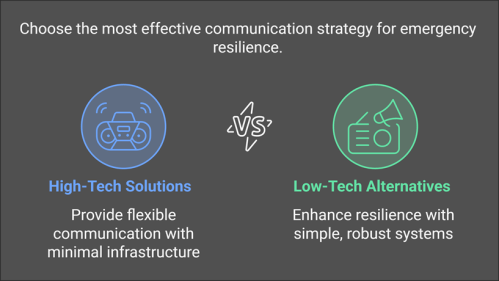
As environmental disruptions become more frequent, robust emergency communication capabilities become critical. Software-defined radio systems provide flexible emergency communications with minimal infrastructure requirements. The Amateur Radio Emergency Service exemplifies the effectiveness of volunteer-based networks during emergencies (ARRL 2022). These systems have repeatedly proven their worth during natural disasters when conventional networks fail.
Most importantly, low-tech backup systems gain value as complex infrastructure faces disruption. Shortwave and packet radio networks offer crucial redundancy when other systems fail. Communities that establish low-tech alternatives demonstrate greater resilience during infrastructure breakdowns (Thompson et al. 2020). This redundancy principle extends to power systems, where distributed renewable energy sources and advanced storage systems support critical communication nodes (Brown et al. 2020).

The Importance of Governance
The challenge extends beyond physical infrastructure to the governance frameworks that guide system development and operation. The International Telecommunication Union has developed comprehensive guidelines for climate-resilient infrastructure (ITU 2023). However, implementing these guidelines faces significant obstacles due to resource constraints and competing priorities.
Real-World Example
The community of Cordova, Alaska, has implemented a microgrid powered by renewable energy sources, coupled with a satellite-based communication system. This has allowed them to maintain communication and power during severe storms that have crippled other coastal communities. This demonstrates the effectiveness of combining innovative technologies with local resources to build resilience.

The Role of Individuals
Beyond government and organizational efforts, individual citizens can play a crucial role. Learning basic first aid, participating in community emergency response teams, and even having a hand-crank radio can contribute to overall community resilience.
Next
Successful adaptation requires a multi-layered approach combining robust physical infrastructure, distributed networks, and strong governance frameworks. We must embrace both technological innovation and proven low-tech solutions while fostering community-based resilience. The stakes couldn’t be higher – our ability to maintain communication systems will determine how effectively we can coordinate responses to mounting environmental challenges.
Conclusion
As we navigate this critical transition, every community must assess its communication vulnerabilities and develop appropriate adaptation strategies. The future may be uncertain, but our response doesn’t have to be. Through thoughtful planning and implementation of resilient communication systems, we can maintain the connections vital for human survival and adaptation in an increasingly unstable world.
References:
ARRL. 2022. Amateur Radio Emergency Service manual. American Radio Relay League, Newington.
Bartos M, Chester M. 2015. Impacts of climate change on electric power supply in the Western United States. Nature Climate Change 5: 748-752.
Brown T, et al. 2020. Response to ‘Burden of proof: A comprehensive review of the feasibility of 100% renewable-electricity systems’. Renewable and Sustainable Energy Reviews 128: 109917.
ITU. 2023. Guidelines on climate-resilient network infrastructure. International Telecommunication Union, Geneva.
Rey-Moreno C, et al. 2017. A telemedicine WiFi network optimized for long distances in the Amazonian jungle of Peru. International Conference on Wireless Technologies for Humanitarian Relief.
Rogers G. 2024. Silent Earth: Adaptations for Life in a Devastated Biosphere. Coldwater Press, Prescott. 333 p.
Thompson A, et al. 2020. Emergency communications during natural disasters: The role of amateur radio in disaster response. Journal of Emergency Management 18: 523-532.
Zhang S, et al. 2019. Nanomaterial-enabled self-healing cables for extreme environments. Advanced Materials 31: 1903875.