Watching the natural world change can be deeply saddening. Many of us feel a sense of grief or anxiety about the loss of species, the changing seasons, and the degradation of familiar landscapes. But paying attention—bearing witness—is a powerful act. It connects us to reality, helps us process grief, and can motivate meaningful action. Our project is to create “A Field Guide to the Anthropocene” (or similar title). This guide will blend ecological knowledge with simple observation techniques. It will help everyday people notice the environmental changes happening in their own communities, understand what they mean, and navigate the complex emotions that arise. It concerns learning to see clearly, grieve honestly, and find purpose in bearing witness to our changing planet.
The Bramble Cay melomys was wiped out by sea level rise, according to a new study
By John R. Platt on June 15, 2016.–“Climate change has claimed its first confirmed mammal extinction. The tiny Bramble Cay melomys (also known as the Bramble Cay mosaic-tailed rat, Melomysrubicola) has been declared extinct by the government of Queensland, Australia after an exhaustive search failed to turn up any evidence of its continued existence.
“The Bramble Cay melomys lived in just a single habitat, a small reef island at the northern tip of the Great Barrier Reef. The sandy cay—which only measures 340 meters by 150 meters—has been repeatedly buffeted by storm surges from extreme weather events over the past decade, wiping out about 97 percent of its vegetation. High tides now cover the majority of the entire island. With nothing to eat and few places left to escape the ocean, the melomys appears to have now disappeared.” Continue reading: Climate Change Has Claimed Its First Mammal Extinction – Scientific American Blog Network
GR: As the human population grows and expands, encounters with wildlife increase. We kill any animals that injure a human–usually no questions asked. We also kill wildlife as we build homes and roads and destroy necessary wildlife habitat. Research indicates that already half of all animals are gone. Eventually, there will only be humans, their domestic animals, and a small number of other species.
Do we care enough about other creatures to protect their habitat and reduce our population? None of the zoning regulations I’ve seen preserve habitat just because wild animals need it. Certainly there is no effective effort to control our population. So, is it truly inevitable that humans doom most wild animals to extinction?
PHOENIX — “Arizona Game and Fish Department officers last night trapped and euthanized a black bear that had scratched and injured a camper earlier in the day in a dispersed camping area (not a developed campground) near Cherry Creek in Young, Ariz.
“The subadult (1-1/2 to 2-1/2 year-old) [young] male bear was caught in a culvert trap set by a highly trained team of wildlife officers. They confirmed this was the bear involved in the incident based on descriptions from other campers and because it had a unique hind paw pad that matched tracks found at the scene. The bear was euthanized [killed] per department policy because it attacked a human and was deemed a threat to public safety.
“Officers noted there were unsecured food sources and garbage in the area, and a field necropsy revealed garbage in the bear’s stomach contents. Arizona Game and Fish reminds everyone that leaving food and trash around may be luring an animal to its death.” Read more: AZGFD.gov Game and Fish officers euthanize bear that clawed camper.
Unaware of the consequences of its behavior, the growing human population is erasing sixty-five million of years of biodiversity recovery since the massive extinction that eliminated dinosaurs and most other species. This is without doubt the greatest issue of our time, perhaps of all time. In the article below, Quentin Wheeler points out that biodiversity is not even being mentioned by our current presidential candidates.
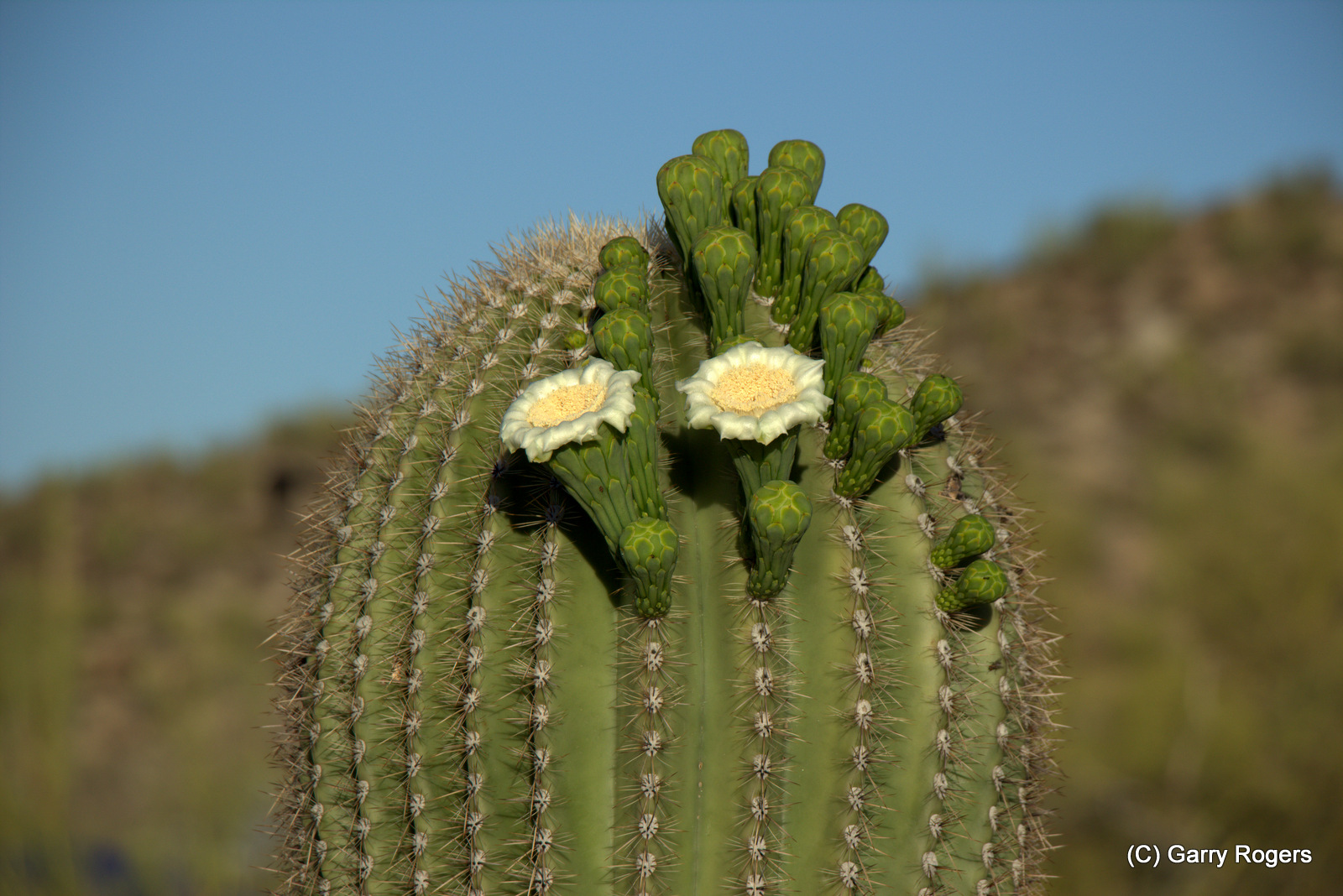
Saguaro, the iconic species of the Sonoran Desert, blooming in April, two months earlier than usual (Rogers, 2016).
Global warming, deforestation, desertification, environmental pollution, and ocean acidification are familiar labels for human-caused destruction of biodiversity and stability of Earth ecosystems. They are all connected to the attempt by our billions of people to satisfy their desires for food, reproduction, safety, and convenience. Allowed uncontrolled expansion, any one of them can achieve planet-wide destruction of biodiversity. Consider that even if this year’s great climate-change treaty achieves a sudden shift to safe energy and stops global warming, it will not save life on Earth. No single-issue approach can.
“It’s unlikely that presidential candidates will ever utter the word “biodiversity” while campaigning this year.
“Yet among emerging environmental challenges, none has fewer facts or more enduring threats than the large-scale loss of biodiversity. That’s why we need a visionary investment in fundamental exploration to create knowledge and options.
“And our elected representatives should lead vigorous discussions about what we can and should do about it. From Jefferson to Kennedy, from the Northwest Territory to the depths of space, presidents of vision have opened new frontiers to exploration.
“Serious environmental problems are a bipartisan challenge that deserves to be in every presidential platform. While scientific questions should be firewalled from politics, what we do with scientific knowledge should not. The best solutions should emerge from the rough and tumble of public debate.
“Biodiversity belongs in our public discussion because we have so much to learn from the Earth’s species – both what it means to be human and the knowledge encapsulated in nature – as we plot our future in a time of great change.”
“This is not the first time that earth has weathered such a mass extinction event. There have been five previously, the most recent occurring 65 million years ago, marked by the disappearance of the great dinosaurs.
“In each case, evolutionary processes have restored high levels of species diversity, but this should give us little comfort. Biodiversity recovery takes place over tens of millions of years. And in the meanwhile, there can be enormously chaotic consequences for ecosystems.
“It’s estimated that 10 million more species could be described or redescribed in greater detail.andreaskay/flickr, CC BY-NC-SA”
“Our knowledge of the species with which we share planet Earth is dangerously limited, meaning that we make decisions and policies in near complete ignorance of basic facts. Our best guess is that there are 10 million living species, more or less, excluding the single-celled bacteria and Archaea.
“Of these, fewer than two million are known to science. And of documented species, most are known by little more than a few diagnostic features and a name. While the rate of species extinction has greatly increased, the pace at which we are exploring species has not.
“In one of the original “big science” ideas, the Swedish naturalist Linnaeus set out in the mid-18th century to complete a global inventory of all the kinds of animals and plants. That inventory continues today, but at an unacceptably slow pace. We discover about 18,000 species each year, a rate unchanged since the 1940s in spite of technological advances.
“This need not be so. Given appropriate technical support and coordinated teamwork, it has been estimated that 10 million species could be described or redescribed in greater detail in no more than 50 years.
“As global environments are stressed, we need reliable knowledge of species diversity upon which to detect and measure changes. Ironically, we have mapped the rocky surface of Mars in greater detail than the living biosphere of our own planet.
“Unless we know what species exist and where, how are we to recognize invasive species, measure rates of extinction or even know whether our conservation strategies are working or not? How are we to understand or restore complex ecosystems when we are ignorant of the majority of their functioning parts? And how much are we willing to risk losing by not undertaking a comprehensive biodiversity moon shot?”
Half the Earth?
“Three major benefits would accrue from a NASA-scale mission to explore the biosphere.
“First would be baseline documentation of the species that exist early in the 21st century, including how they assemble into complex networks in ecosystems. Such baseline data would be transformative for ecology, conservation biology, and resource management, and establish a detailed point of comparison for whatever changes come in the future.
“Second is unleashing the full potential of biomimicry. For 3.8 billion years natural selection has maintained favorable adaptations and weeded out unworkable ones. Among the millions of such adaptations, engineers and innovators can find inspiration for entirely new designs, materials, products and processes.
“The extent to which we succeed creating a truly sustainable future – from renewable energy to degradable materials to cities that function like efficient ecosystems – may well depend on how much knowledge we gather from other species, including those about to go extinct.
“Last, but not least, is knowledge of our origins. Anthropologists continue to fill gaps in our knowledge of the emergence of modern humans, but that is only the most recent chapter in our story. Every attribute that we think of as uniquely human was modified from characteristics of earlier mammals. And features supposedly unique to mammals were similarly modified from even earlier ancestors and so forth, all the way back to the first single-celled species from which the diversity of life around us evolved.
“We can no more understand what it is to be human without exploring this whole history than we could account for why Earth is as it is in the absence of knowledge of the universe.
“We stand a much better chance of slowing the rate of extinction and reducing the percentage of species ultimately lost if we complete a planetary species inventory. And by preserving evidence and knowledge of those species that are lost, we can continue to learn from them.
“New tools, such as those from information science and molecular genetics, can help speed species exploration, but are most powerful when used in combination with detailed descriptive studies of species that reveal their evolutionary novelties.
“E.O. Wilson’s new book, “Half Earth,” proposes that half our planet be reserved for all the other species. His suggestion has unassailable common sense and is perhaps the most workable solution holding promise for millions of other species.
“If we accelerate species exploration, we can add value to “their” half of the world by better understanding and appreciating its residents while finding nature-inspired solutions to sustainably meet our needs in the confines of our half.
“The sooner we act, the greater our chances to avoid a sixth extinction event and preserve nature’s vast library of clues to better ways to meet human needs in an era of rapid global environmental change.”
Gill nets are still being used in protected areas, according to conservation advocates.
Better monitoring and enforcement of gill net ban needed in Gulf of California
Staff Report
So far, Mexico’s efforts to save the Gulf of California’s endangered vaquita haven’t been enough, according to conservation activists tracking the last-ditch attempt to save one of the world’s most endangered marine mammals. By some estimates, as few as 50 vaquita remain.
In an open letter to Mexican President Enrique Peña Nieto, nonprofit organizations asked Mexico to step up patrols and enforcement of a gill-netting ban aimed at preventing extinction of the species. In recent months, three vaquitas have died in illegally set nets.
We are living in the Anthropocene age, in which human influence on the planet is so profound – and terrifying – it will leave its legacy for millennia. Politicians and scientists have had their say, but how are writers and artists responding to this crisis?
“There are species going extinct today that have never been described,” Plotnick said. “Others are going extinct that are known only because someone wrote it down.” All such species would thus be unknown in the far future, he said, if the written historical record is lost — as it might well be.
The fossil record, Plotnick points out, is much more durable than any human record.
“As humanity has evolved, our methods of recording information have become ever more ephemeral,” he said. “Clay tablets last longer than books. And who today can read an 8-inch floppy?” he shrugged. “If we put everything on electronic media, will those records exist in a million years? The fossils will.”
Other authors on the study, published earlier this month in Ecology Letters, are Felisa A. Smith of the University of New Mexico and S. Kathleen Lyons of the National Museum of Natural History in Washington, D.C.
Media Contact:
Bill Burton
312-996-2269
burton@uic.edu
From: news.uic.edu
GR: We are the cause of the current mass extinction, and most of us simply don’t care. The research reported here shows that there will be no permanent record of most of the species that existed during our time on Earth. But, of course, we don’t care.
“These six examples illustrate that there is no one-size-fits all approach for researchers to address today’s grand environmental challenges, but two common themes emerge. The first is that it is no longer enough to simply do the science and publish an academic paper; that is a necessary first step, but moves only halfway towards the goal of guiding the planet towards a future that is sustainable for both human civilization and the biosphere. To implement knowledge that arises from basic research, it is necessary to establish dialogues and collaborations that transcend narrow academic specialties, and bridge between academia, industry, the policy community and society in general. The second theme is that now is the time to rise to these scientific and communication challenges. The trajectories of population overgrowth, climate change, ecosystem loss, extinctions, disease, and environmental contamination have been rapidly accelerating over the past half-century. If not arrested within the next decade, their momentum may prevent us from stopping them short of disaster.” From: elementascience.org
Excellent post. The attrition of open space, wildlife, and natural ecosystems occurs slowly and quietly. Without vigilance and unrelenting effort, the attrition is unstoppable. Always, the urge to obtain immediate convenience or profit obscures the potential long-term consequences of our actions. Learning to take the long-term view is essential for managers of natural systems.
The grizzly bears that inhabit the Greater Yellowstone Ecosystem have played an important role in one of the nation’s greatest endangered species success stories. Since 1975, the bears have been beneficiaries of the Endangered Species Act that enabled the grizzly population to beat all odds after teetering on the brink of extinction. It grew from 136 bears in 1975 to around 700 in 2016, although estimates range from 674 to 839.
On March 3, 2016, the United States Fish and Wildlife Service announced its proposal to delist the Yellowstone area grizzlies, which includes Grizzly 399, from the federal threatened species list. It is expected to make a final decision by the end of 2016.
The Numbers
50,000
The number of grizzly bears that roamed between the Pacific Ocean and the Great Plains during Lewis and Clark Expedition, 200 years ago.
674-839 The approximate number of grizzly bears in…





 GarryRogers Nature Conservation