
Human Hothouse Spurs Longest Coral Die-Off on Record

It’s like a bad dream from which one cannot wake.

robertscribbler's avatarrobertscribbler

The big coral die-off began in the Western Pacific as a massive ocean temperature spike built up during 2014. Back then, ocean heat accumulation had hit a very high ramp. A vicious, century-and-a-half long increase in atmospheric greenhouse gasses re-radiated greater and greater portions of the sun’s energy hitting the Earth — transferring the bulk (about 90 percent) to the world ocean system.
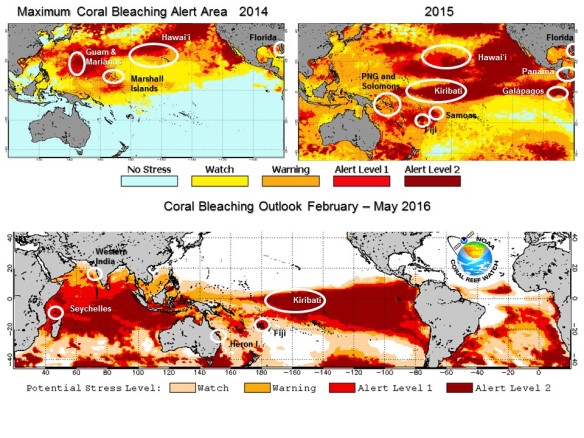
Major Coral Bleaching Event

(A report out today from AGU finds that the world is now experiencing its longest coral die-off event on record. Image source: AGU.)

By 2015, as one of the strongest El Ninos on record began to extend its influence across the globe, a broad region stretching from the Western Pacific, through the Central Pacific and on into the Eastern Pacific and Caribbean were all experiencing mass coral die-offs. Into early 2016, die-off events again expanded taking in Australian waters and sections of the Indian Ocean off…

View original post 784 more words

The oceans can’t take any more: Fundamental change in oceans predicted

GR:  Running out of time. Species extinctions, intensifying storms, dying forests and the seas. Scientists study the causes, activists fight small battles and talk about solutions, and our corporate-controlled governments and politicians say it isn’t practical just now to change course.  The article below and others describe the approaching disaster.

A warm-water coral reef and boat. Credit: A. Venn

Science News:  “Our oceans need immediate and substantial reduction of anthropogenic greenhouse gas emissions. If that doesn’t happen, we could see far-reaching and largely irreversible impacts on marine ecosystems, which would especially be felt in developing countries. That’s the conclusion of a new review study published today in the journal Science. In the study, the research team from the Ocean 2015 initiative assesses the latest findings on the risks that climate change poses for our oceans, and demonstrates how fundamentally marine ecosystems are likely to change if human beings continue to produce just as much greenhouse gases as before.” www.sciencedaily.com

New ocean energy plan could worsen global warming

GR:  Unintended consequences lurk behind many of our ideas and our practices.  Reducing our population and learning the equality of other species are the ultimate solutions.  Anything less is only temporary.

By Tim Radford

“An apparently promising way of producing energy from the world’s oceans in fact risks causing catastrophic harm by warming the Earth far more than it can bear, US scientists say.

“One of renewable energy’s more outspoken enthusiasts has delivered bad news for the prospects of developing ocean thermal energy. His prediction is that although the technology could work for a while, after about 50 years it could actually exacerbate long-term global warning.  Source: www.climatenewsnetwork.net

Dead Zones: Massive Loss of Ocean Biodiversity From Warming May Take Millennia to Recover

DeadZonesImage from the Washington Post.

“. . . the effects of the current rise in temperatures of our oceans is worse than you or I could have imagined. It’s so bad that it may take thousands of years for ocean life to recover. That’s a recovery time measured in millennia, for those who prefer polysyllabic Latinate words:

“A study has found that it might take thousands of years for the ocean to recover from climate change. Researchers studied more than 5,400 fossils from a 30-foot-long core sample taken from the Pacific Ocean floor near Santa Barbara, California, and found that it can take millennia for ocean ecosystems to recover after periods of deoxygenation and warming waters. […] “In this study, we used the past to forecast the future,” Peter Roopnarine, curator of invertebrate zoology and geology at the California Academy of Sciences and co-author of the study, said in a statement. “We don’t want to hear that ecosystems need thousands of years to recover from disruption, but it’s critical that we understand the global need to combat modern climate impacts.”

“Here is what the article posted at Science News regarding this research study has to say about its importance to our understanding of the impacts of global warming on Ocean ecosystems and biodiversity (Source: www.dailykos.com).”

GR:  I agree with the author “News like this should be cause for all of us to be running around screaming with our heads on fire.”

When one of the Coldwater Farm ponds developed a heavy algae bloom that began killing fish, I felt the same urgency that comes when you watch a newborn on its first search for a teat.  I aerated and filtered desperately, but in the end all the fish died.

Are we as helpless to save our ocean ecosystems?  Probably, but let’s watch for opportunities to urge our leaders to apply the Earth Ethic to our marine ecosystems.

What’s going on in the North Atlantic?

The North Atlantic between Newfoundland and Ireland is practically the only region of the world that has defied global warming and even cooled. Last winter there even was the coldest on record – while globally it was the hottest on record. Our recent study (Rahmstorf et al. 2015) attributes this to a weakening of the Gulf Stream System, which is apparently unique in the last thousand years. The whole world is warming. The whole world? …

Source: www.realclimate.org

This is a good discussion of the science.  The comments are enlightening.  Highly recommended.

World Ocean Heartbeat Fading? ‘Nasty’ Signs North Atlantic Thermohaline Circulation is Weakening

“Scientists call it Atlantic Meridional Overturning Circulation (AMOC). But we may as well think of it as the heartbeat of the world ocean system. And when that heartbeat begins to slow down, we’d best sit up and start paying attention.”

Source: robertscribbler.wordpress.com

“New video produced by climate hawk Peter Sinclair and featuring top scientists Stefan Rahmstorf, Michael Mann, and Jason Box, issues warnings about an observed disruption to ocean circulation due to water freshening in the North Atlantic. This is the kind of work I mentioned last week in my KPFA interview. The kind that should be showing on major network news every single night. Since that probably won’t happen, I urgently ask you to spread this video, together with its critical information, as far and as wide as possible.

“Now, a new 2015 report headed by Dr. Stefan Rahmstorf finds that the world ocean system is cooling in exactly the wrong place — the North Atlantic just south and east of Greenland. This cooling is an indicator that a high volume outflow of cold, fresh water is entering this region of ocean. A cold, fresh outflow that comes directly from the melting glaciers of Greenland itself. A cooling and freshening that creates a physical block to salt water down welling in the North Atlantic. The kind of block that can directly disrupt the Gulf Stream and the rest of ocean circulation on down the line.”

Starving Sea Lion Pups and Liquified Starfish — How We’ve Turned the Eastern Pacific into A Death Trap for Marine Species

As of late January, the news reports were coming in hot and heavy. Baby sea lions were dying in droves. More than 15,000 of the pups were already lost due to starvation. And with each passing week, more than 100 of the emaciated, beleaguered, hopeless animals were washing up on California shores.

The pups staggered across beaches, wandered into vacant lots, or tottered, disoriented, along roadways. Refugees all to some unspeakable disaster. Orphans lost or abandoned by parents unable to provide them with even the most basic of sustenance. Source: robertscribbler.wordpress.com

GR:  Warming ocean with falling oxygen level may explain this growing disaster.  Maps in evidence are included.  The author points to a more deadly situation that could arise if atmospheric CO2 levels continue to climb to and beyond 800ppm. Then it’s silo (bunker) time folks.

Something really, really terrible is about to happen to our coral

The last time this happened, we lost almost a fifth of world reefs.

“Coral reefs cover just 0.1 percent of the ocean floor, but provide habitat to 25 percent of sea-dwelling fish species. That’s why coral scientist C. Mark Eakin, who coordinates the National Oceanic and Atmospheric Administration’s Coral Reef Watch program, is surprised that the warning he has been sounding since last year (PDF)—that the globe’s reefs appear to be on the verge of a mass-scale bleaching event—hasn’t drawn more media attention.

“Bleaching happens when coral loses contact with zooxanthellae, an algae that essentially feeds them nutrients in symbiotic exchange for a stable habitat. The coral/zooxanthellae relationship thrives within a pretty tight range of ocean temperatures, and when water warms above normal levels, coral tends to expel its algal lifeline. In doing so, coral not only loses the brilliant colors zooxanthellae deliver—hence, “bleaching”—but also its main source of food. A bleached coral reef rapidly begins to decline. Coral can reunite with healthy zooxanthellae and recover, Eakin says, but even then they often become diseased and may die. That’s rotten news, because bleaching outbreaks are increasingly common.”  Source: www.motherjones.com

Feds launch ocean biodiversity monitoring network

GR: We should be monitoring the species that define biodiversity in all habitats. It seems foolish for our government to ignore the drastic declines being reported for most animal groups. You can help identify and understand the nature and causes of the declines. Join one of the Citizen Naturalist projects (https://garryrogers.com/2014/10/08/citizen-naturalists/). Learn more about the issues by following the Nature Conservation News (http://natconnews.com).

Bob Berwyn's avatarSummit County Citizens Voice

A pelican perch along the coast in Englewood, Florida. A pelican perches along the coast in Englewood, Florida.

Florida, California and Alaska sites will host pilot phase of research effort

Staff Report

FRISCO — Federal agencies are launching an ambitious $17 million pilot project to monitor ocean biodiversity, recognizing that fragile coastal and marine ecosystems face increasing threats, including climate change.

“To mitigate and adapt to such threats, we need a fuller, more integrated, picture of how the biodiversity within these ecosystems may be changing, especially since marine biodiversity is a key indicator of ocean health and critical to sustaining natural resources such as fisheries,” the National Oceanic and Atmospheric Administration said in a press release.

View original post 568 more words