“Silent Earth” has received a five-star “must read🏆” review on Reedsy. Blending scientific depth and practical foresight, this book is both a wake-up call and a guide for navigating environmental collapse.
Synopsis
Silent Earth is a technical reference for civil engineers, land-use and urban planners, and city administrators. It covers a broad range of topics and should serve as a springboard for specialists wishing to learn more about adapting to climate change and biosphere decline.
As the Earth’s living systems deteriorate at an unprecedented rate, human societies face the urgent challenge of adapting to an increasingly unstable environment. Physical Geographer Garry Rogers offers a clear-eyed examination of our options, arguing that while complete restoration of the biosphere is no longer feasible, strategic adaptation remains possible. Drawing on extensive research, Rogers outlines practical approaches for communities to maintain essential functions as ecosystem services decline. While large-scale adaptation efforts face significant barriers, this groundbreaking work shows how planners and administrators can implement effective strategies to enhance resilience in a transforming world. Essential reading for navigating our environmental future. Ideal for policymakers, scholars, environmentalists, and engaged citizens, Silent Earth challenges readers to envision a future where, even amidst biosphere decline, adaptation and innovation can pave the way for survival.
Garry Rogers’ Silent Earth: Adaptations for Life in a Devastated Biosphere explores the escalating degradation of Earth’s biosphere, offering strategies for human adaptation. It points to the realistic inevitability of this need to adjust, as humanity is facing the consequences of irreversible damage already done. Rogers goes beyond the simple dialogue of climate change, expanding and examining the interconnected impact of the entire biosphere, from current impacts such loss of biodiversity to coral reef bleaching.
In Section IV, Rogers draws upon research to emphasize that as soon as 2030 we are on the brink, and that we urgently need to act not only to prevent further destruction, but also to prepare for survival:
The cumulative and synergistic effects of human impacts are pushing ecosystems closer to tipping points. Feedback loops and shifting ecosystem boundaries are accelerating environmental change, while these effects interact in complex ways, amplifying their individual impacts. As we approach 2030, addressing these interconnected challenges will require an integrated approach to conservation and climate action to mitigate the far-reaching impacts on biodiversity and ecosystem stability.
The strength of Silent Earth lies in Section V, which presents a blueprint for adaptation. Rogers proposes various strategies from water management to cultural and governance reforms. His emphasis on grassroots action and local resilience is both pragmatic and empowering, especially given his acknowledgment of the political and societal inertia that is likely to hinder adaptation on a wider scale.
Silent Earth is thoroughly researched, intellectually stimulating, and well-cited. Rogers excels in synthesizing vast amounts of ecological, social, and technological data into a cohesive narrative.
Silent Earth is a valuable resource for those interested in interdisciplinary approaches to global challenges. It’s an important and thought-provoking read for anyone seeking to understand and address the complex realities of ecological decline.
Posted by: Joshua Hanthorn, Elizabeth Ruther and Karla Dutton. Oceans, covering two-thirds of Earth, are so vast and so deep that it’s easy to take their importance for granted. They provide us with oxygen, and they regulate our climate by removing carbon dioxide from the atmosphere — important functions for both humans and wildlife.
Unfortunately, the world’s oceans — home to whales, sea otters, ice-dependent seals, dolphins, manatees, seabirds, sea turtles, sharks and other marine life — are in a sea of trouble. The oceans are overworked; they cannot remove carbon dioxide from the atmosphere quickly enough to keep up with how much we create, which is causing ocean acidification. The Arctic Sea is warming at twice the rate than past years, which is reducing sea ice — a growing threat to our marine mammals. Just recently, scientists shared that over a third of the Great Barrier Reef is dead, a permanent fate for the species and a damaging one for species that depend on the reef for shelter and food.
The health of the Earth’s oceans are indicators of our planet’s overall health – when they’re in trouble, so are we. So, it’s important to keep our oceans healthy not just for marine life, but also for the future health of the entire planet. Read more: Every Day is World Oceans Day for Us
While oceans are in many respects the heart of our ecosystem, their sustainable existence is threatened by our actions.
The first World Oceans Day was celebrated in 1992 after the Canadian government proposed the idea at the Earth Summit in Rio de Janeiro. In 2008, the United Nations recognised the initiative officially.
“We have to ensure that oceans continue to meet our needs without compromising those of future generations. They regulate the planet’s climate and are a significant source of nutrition. Their surface provides essential passage for global trade, while their depths hold current and future solutions to humanity’s energy needs.” More:Population matters for the world’s oceans – Population Matters
GR: Watch this short video to get a clear idea of what’s happening to coral.
Richard Vevers from the Ocean Agency had never experienced anything like the devastation he witnessed in May diving around the dead and dying coral reefs off Lizard Island on the Great Barrier Reef. When his team emerged from the water, he says, ‘We realised we just stank – we stank of the smell of rotting animals.’ The reefs around the island have been ravaged by coral bleaching caused by climate change. Special report by Josh Wall and Michael Slezak, theguardian.com. Source: Great Barrier Reef: diving in the stench of millions of rotting animals – video | Environment | The Guardian
Almost 10% of the ocean surfaces are above 85 degrees Fahrenheit. The chart below and this record indicate that the oceans are warming up. Read Scribbler’s analysis to learn just how terrible this really is.
Robert Scribbler: “Not only is a human-forced warming of the globe expected to increase average surface ocean and land temperatures, it is also expected to generate higher peak readings over larger and larger regions. Such was the case during May of 2016 as a massive expanse of the world ocean saw temperatures rocket to above 30 degrees Celsius (or 86 degrees Fahrenheit).
(A record hot global ocean has brewed up yet one more new extreme in the form of a 32.7 million square kilometer expanse of steaming hot waters above 86 degrees Fahrenheit or 30 degrees Celsius. Image source: Brian Brettschneider.)
“According to climatologist Brian Brettschneider, 32.7 million square kilometers of the world ocean saw temperatures in excess of 30 degrees Celsius during May of 2016. A new record for the largest sea surface area above a high temperature threshold that typically sets off a range of harmful ocean conditions — including coral bleaching, lower levels of seawater oxygen, and increased rates of algae growth — even as it dumps copious volumes of high latent heat water vapor into the Earth’s atmosphere.” More: Extent of Ocean Surface Above 86 Degrees (F) Hits New Record During May of 2016 | robertscribbler
When New England fishers complained of working harder and harder to catch fewer and fewer fish, Spencer Baird assembled a scientific team to investigate. Though a fishery failure would once have seemed inconceivable, Baird wrote in his report, “an alarming decrease of the shore-fisheries has been thoroughly established by my own investigations, as well as by evidence of those whose testimony was taken.”The report was Baird’s first as head of the U.S. Commission of Fish and Fisheries. The year was 1872.Baird recognized the ocean’s limits. A decade later, however, his British counterpart, Thomas Huxley, took a decidedly different view. Calling the sea fisheries “inexhaustible,” Huxley deemed regulations useless, since “nothing we do seriously affects the number of fish.”
In a rare move to shun tourism profits for environmental protection, 10 popular dive sites have been shut down in a bid to slow a coral bleaching crisis.
Thailand has shut down 10 popular diving sites in a bid to slow a coral bleaching crisis, an official said Thursday, in a rare move to shun tourism profits to protect the environment.
The tropical country’s southern coastline and string of islands are home to some of the world’s most prized white sand beaches and scuba sites, and the booming tourism industry props up Thailand’s lagging economy.
But warming waters and ever-growing swarms of visitors have damaged coral reefs and local ecosystems.
A reduction in the amount of oxygen dissolved in the oceans due to climate change is already discernible in some parts of the world and should be evident across large regions of the oceans between 2030 and 2040. — The National Center for Atmospheric Research in a press release on April 27th.
*****
Loss of oxygen in the world’s oceans. It’s one of those really, really bad effects of a human-forced warming of our world. One of the those climate monsters in the closet that Steve Pacala talks about. The kind of thing we really don’t want to set loose on our world.
Deoxygenated Oceans as Major Killing Mechanism During Hothouse Extinctions
The damage caused by ocean oxygen loss is multi-variant and wide-ranging. The most obvious harm comes in the form of generating environments in which oxygen-dependent life in the oceans can no longer breathe. Any living creature that…
Unaware of the consequences of its behavior, the growing human population is erasing sixty-five million of years of biodiversity recovery since the massive extinction that eliminated dinosaurs and most other species. This is without doubt the greatest issue of our time, perhaps of all time. In the article below, Quentin Wheeler points out that biodiversity is not even being mentioned by our current presidential candidates.
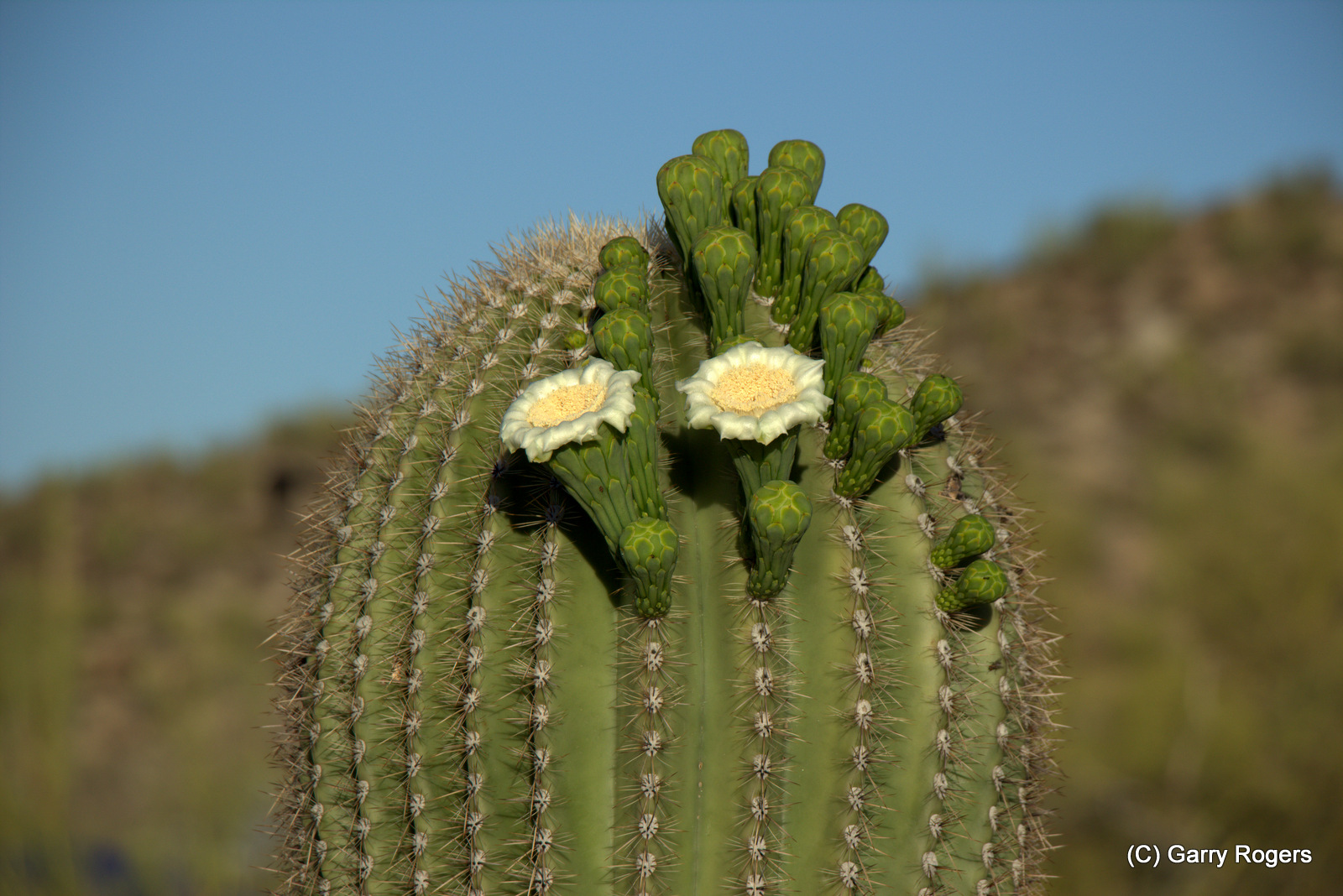
Saguaro, the iconic species of the Sonoran Desert, blooming in April, two months earlier than usual (Rogers, 2016).
Global warming, deforestation, desertification, environmental pollution, and ocean acidification are familiar labels for human-caused destruction of biodiversity and stability of Earth ecosystems. They are all connected to the attempt by our billions of people to satisfy their desires for food, reproduction, safety, and convenience. Allowed uncontrolled expansion, any one of them can achieve planet-wide destruction of biodiversity. Consider that even if this year’s great climate-change treaty achieves a sudden shift to safe energy and stops global warming, it will not save life on Earth. No single-issue approach can.
“It’s unlikely that presidential candidates will ever utter the word “biodiversity” while campaigning this year.
“Yet among emerging environmental challenges, none has fewer facts or more enduring threats than the large-scale loss of biodiversity. That’s why we need a visionary investment in fundamental exploration to create knowledge and options.
“And our elected representatives should lead vigorous discussions about what we can and should do about it. From Jefferson to Kennedy, from the Northwest Territory to the depths of space, presidents of vision have opened new frontiers to exploration.
“Serious environmental problems are a bipartisan challenge that deserves to be in every presidential platform. While scientific questions should be firewalled from politics, what we do with scientific knowledge should not. The best solutions should emerge from the rough and tumble of public debate.
“Biodiversity belongs in our public discussion because we have so much to learn from the Earth’s species – both what it means to be human and the knowledge encapsulated in nature – as we plot our future in a time of great change.”
“This is not the first time that earth has weathered such a mass extinction event. There have been five previously, the most recent occurring 65 million years ago, marked by the disappearance of the great dinosaurs.
“In each case, evolutionary processes have restored high levels of species diversity, but this should give us little comfort. Biodiversity recovery takes place over tens of millions of years. And in the meanwhile, there can be enormously chaotic consequences for ecosystems.
“It’s estimated that 10 million more species could be described or redescribed in greater detail.andreaskay/flickr, CC BY-NC-SA”
“Our knowledge of the species with which we share planet Earth is dangerously limited, meaning that we make decisions and policies in near complete ignorance of basic facts. Our best guess is that there are 10 million living species, more or less, excluding the single-celled bacteria and Archaea.
“Of these, fewer than two million are known to science. And of documented species, most are known by little more than a few diagnostic features and a name. While the rate of species extinction has greatly increased, the pace at which we are exploring species has not.
“In one of the original “big science” ideas, the Swedish naturalist Linnaeus set out in the mid-18th century to complete a global inventory of all the kinds of animals and plants. That inventory continues today, but at an unacceptably slow pace. We discover about 18,000 species each year, a rate unchanged since the 1940s in spite of technological advances.
“This need not be so. Given appropriate technical support and coordinated teamwork, it has been estimated that 10 million species could be described or redescribed in greater detail in no more than 50 years.
“As global environments are stressed, we need reliable knowledge of species diversity upon which to detect and measure changes. Ironically, we have mapped the rocky surface of Mars in greater detail than the living biosphere of our own planet.
“Unless we know what species exist and where, how are we to recognize invasive species, measure rates of extinction or even know whether our conservation strategies are working or not? How are we to understand or restore complex ecosystems when we are ignorant of the majority of their functioning parts? And how much are we willing to risk losing by not undertaking a comprehensive biodiversity moon shot?”
Half the Earth?
“Three major benefits would accrue from a NASA-scale mission to explore the biosphere.
“First would be baseline documentation of the species that exist early in the 21st century, including how they assemble into complex networks in ecosystems. Such baseline data would be transformative for ecology, conservation biology, and resource management, and establish a detailed point of comparison for whatever changes come in the future.
“Second is unleashing the full potential of biomimicry. For 3.8 billion years natural selection has maintained favorable adaptations and weeded out unworkable ones. Among the millions of such adaptations, engineers and innovators can find inspiration for entirely new designs, materials, products and processes.
“The extent to which we succeed creating a truly sustainable future – from renewable energy to degradable materials to cities that function like efficient ecosystems – may well depend on how much knowledge we gather from other species, including those about to go extinct.
“Last, but not least, is knowledge of our origins. Anthropologists continue to fill gaps in our knowledge of the emergence of modern humans, but that is only the most recent chapter in our story. Every attribute that we think of as uniquely human was modified from characteristics of earlier mammals. And features supposedly unique to mammals were similarly modified from even earlier ancestors and so forth, all the way back to the first single-celled species from which the diversity of life around us evolved.
“We can no more understand what it is to be human without exploring this whole history than we could account for why Earth is as it is in the absence of knowledge of the universe.
“We stand a much better chance of slowing the rate of extinction and reducing the percentage of species ultimately lost if we complete a planetary species inventory. And by preserving evidence and knowledge of those species that are lost, we can continue to learn from them.
“New tools, such as those from information science and molecular genetics, can help speed species exploration, but are most powerful when used in combination with detailed descriptive studies of species that reveal their evolutionary novelties.
“E.O. Wilson’s new book, “Half Earth,” proposes that half our planet be reserved for all the other species. His suggestion has unassailable common sense and is perhaps the most workable solution holding promise for millions of other species.
“If we accelerate species exploration, we can add value to “their” half of the world by better understanding and appreciating its residents while finding nature-inspired solutions to sustainably meet our needs in the confines of our half.
“The sooner we act, the greater our chances to avoid a sixth extinction event and preserve nature’s vast library of clues to better ways to meet human needs in an era of rapid global environmental change.”





 GarryRogers Nature Conservation