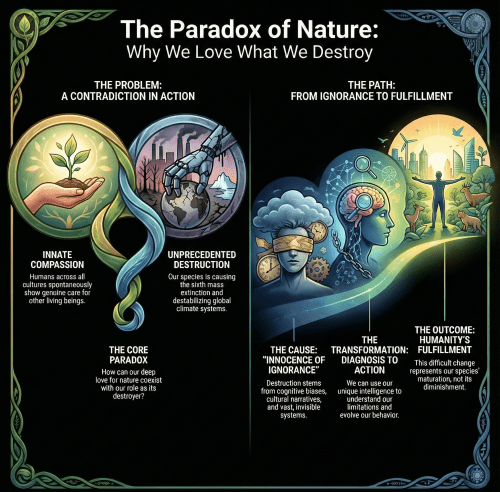
Five Stars for Biosphere Collapse: Causes and Solutions: A Critical Call for Change

The core truth of our time is stark: “Our planet’s life-support system, the biosphere, is in a state of severe and irreversible decline”. This thesis, presented in the new book Biosphere Collapse: Causes and Solutions , has just received a major validation, earning a coveted five-star review from Dr. Paul Knobloch at Reader Views.

The review confirms that the book is an essential, timely, and credible contribution to the global conversation on humanity’s future.

The Core Message: A Shift in Worldview

Knobloch immediately recognized the uncompromising nature of the book’s premise. However, the reviewer highlights that this is not a message of “doom and gloom”. Instead, it is a plan for transformation, offering a clear “path forward”.

The book’s blueprint for survival involves a “hierarchy of transformation difficulty” consisting of four critical levels of change:

  • Level 1: Limiting Direct Extraction. These are the most technically straightforward changes, aimed at curbing activities like hunting and fishing.
  • Level 2: Transforming Production. This requires restructuring entire global sectors like agriculture and energy.
  • Level 3: Changing Systemic Drivers. This involves coordinating action across multiple institutions and scales to tackle root problems such as urbanization and deforestation.
  • Level 4: Shifting Core Beliefs. The final and most difficult step requires fundamentally rethinking our beliefs about economic growth, consumption, and humanity’s place in nature.

Beyond Human-Centric Solutions

The review emphasizes that a truly effective solution must move past theories focused strictly on human activity. This is the essence of the book’s call for Ecocentrism. Knobloch quotes the book’s direct definition: “Earth’s biosphere is a complex, interconnected system in which all species play a role, making their existence valuable beyond their utility to humans”.

Ultimately, survival requires accepting that we are merely “one ingredient in a bigger ecological and even cosmic network”.

Rigor and Accessibility

The comprehensive 5-star rating confirms that the book successfully navigates the complex space between rigorous science and accessible prose. The overall program evaluation for the book awarded the highest rating of 5 for:

  • Clarity and Organization: The central idea is clearly introduced, and the structure is organized logically.
  • Credibility: The information is backed by “credible sources, research, or the author’s firsthand experience”.
  • Readability and Style: The prose is “clean, jargon-free (or defines technical terms), and easy to digest”.

The book offers both an exhaustive review of existing literature and a decisive plan for action. As the reviewer concludes, this is a much-needed addition to the critical issues surrounding climate disaster and planetary health.


Read more about the ideas presented in the book and the ongoing work to address global environmental challenges on the Biosphere Collapse book page.

Silent Earth Review

“Silent Earth” has received a five-star “must read🏆” review on Reedsy. Blending scientific depth and practical foresight, this book is both a wake-up call and a guide for navigating environmental collapse.

Synopsis

Silent Earth is a technical reference for civil engineers, land-use and urban planners, and city administrators. It covers a broad range of topics and should serve as a springboard for specialists wishing to learn more about adapting to climate change and biosphere decline.

As the Earth’s living systems deteriorate at an unprecedented rate, human societies face the urgent challenge of adapting to an increasingly unstable environment. Physical Geographer Garry Rogers offers a clear-eyed examination of our options, arguing that while complete restoration of the biosphere is no longer feasible, strategic adaptation remains possible. Drawing on extensive research, Rogers outlines practical approaches for communities to maintain essential functions as ecosystem services decline. While large-scale adaptation efforts face significant barriers, this groundbreaking work shows how planners and administrators can implement effective strategies to enhance resilience in a transforming world. Essential reading for navigating our environmental future. Ideal for policymakers, scholars, environmentalists, and engaged citizens, Silent Earth challenges readers to envision a future where, even amidst biosphere decline, adaptation and innovation can pave the way for survival.

Garry Rogers’ Silent Earth: Adaptations for Life in a Devastated Biosphere explores the escalating degradation of Earth’s biosphere, offering strategies for human adaptation. It points to the realistic inevitability of this need to adjust, as humanity is facing the consequences of irreversible damage already done. Rogers goes beyond the simple dialogue of climate change, expanding and examining the interconnected impact of the entire biosphere, from current impacts such loss of biodiversity to coral reef bleaching.

In Section IV, Rogers draws upon research to emphasize that as soon as 2030 we are on the brink, and that we urgently need to act not only to prevent further destruction, but also to prepare for survival:

The cumulative and synergistic effects of human impacts are pushing ecosystems closer to tipping points. Feedback loops and shifting ecosystem boundaries are accelerating environmental change, while these effects interact in complex ways, amplifying their individual impacts. As we approach 2030, addressing these interconnected challenges will require an integrated approach to conservation and climate action to mitigate the far-reaching impacts on biodiversity and ecosystem stability.

The strength of Silent Earth lies in Section V, which presents a blueprint for adaptation. Rogers proposes various strategies from water management to cultural and governance reforms. His emphasis on grassroots action and local resilience is both pragmatic and empowering, especially given his acknowledgment of the political and societal inertia that is likely to hinder adaptation on a wider scale.

Silent Earth is thoroughly researched, intellectually stimulating, and well-cited. Rogers excels in synthesizing vast amounts of ecological, social, and technological data into a cohesive narrative.

Silent Earth is a valuable resource for those interested in interdisciplinary approaches to global challenges. It’s an important and thought-provoking read for anyone seeking to understand and address the complex realities of ecological decline.

Reviewed by: Brittney Banning

Latest Posts

Americans’ increasing distrust of science — and not just on climate change

By Aaron Blake.  “It’s also not just Republicans.

“Eight in 10 Americans believe science has made life better for most people, but they still don’t trust scientists — and/or aren’t aware of their consensus — on many of the most important science-related issues of the day.

“And that goes for far more than just climate change. And it includes plenty of Democrats too.

“A new Pew study comparing the attitudes of scientists and the public shows wide gaps between the two when it comes to climate, food that uses genetically modified organisms and pesticides, research using animals, and also the threat posed by the fast-growing world population.”  Source: www.washingtonpost.com

GR:  School-aged children and adults often hear conflicting views on important issues.  Young people I know often ask my opinion on interesting ideas or arguments they’ve heard.  Often, I find the arguments are obvious fallacies.  There are many ways to argue for unsound conclusions, even that science itself is faulty or dangerous.

A fallacious argument in logic or rhetoric is one that is invalid.  Wikipedia defines more than 100 fallacies that people often use to make unsound arguments.  Some of the fallacies are difficult to spot without prior knowledge.  Learning to recognize the long lists of fallacies takes time and that’s why I suggest schoolwork.

Schools should include middle-grade units and high-school courses on fallacy and debate. Otherwise, choosing what to believe is like choosing foods without taste buds.

The Patterns of Bird Population Irruptions


“An irruption is the sudden change in the population density of an organism. In North American birds, irruptions often refer to the movement of northern-wintering species to the south in years of low food availability. You can recognize irruptive movement patterns at your feeders: some winters you may see a species at your feeders in great numbers, but in other winters they don’t show up at all.”

Explore FeederWatch data and tell us what you can find

Source: www.birds.cornell.edu

GR:  Here’s a volunteer citizen naturalist opportunity for everyone, but especially for those who love birds.

New research could help the welfare of working animals

Domestic Animal Welfare

With over 42 million horses and 95 per cent of the world’s donkeys found in developing countries, new research could change the health and welfare of millions of working animals in some of the poorest parts of the world.

 The three research studies led by Dr Becky Whay, Reader in Animal Welfare and Behaviour in the School of Veterinary Sciences at the University of Bristol, aim to build greater understanding and encourage collaboration in addressing the welfare problems of the world’s working equids. The papers, funded by the Brooke, are part of a new collection of free research articles published online by the Equine Veterinary Journal (EVJ) and sponsored by World Horse Welfare.

“We hope our research will make a difference to the lives of these animals and our work will advise owners and vets on how to better look after their animals.”

Source: phys.org

GR:  The scientific method in all its variations is a tool that humans can use to care for their fellow creatures.  Research using the method produces reliable reports that add to our knowledge.

Can We Feed 3 Billion More People and Save the Environment?

Feeding 3 Billion More People

worldpopThe U. S. Census Bureau uses world data to estimate that in 2150, Earth’s human population will reach 9 billion and stay around that number for the next few centuries.  But must we stop?  Can’t we go on to 12 billion?  In an article published in America’s leading academic journal, Science, a group of scientists led by Paul C. West say yes.  Here is the full abstract of their article:

“Achieving sustainable global food security is one of humanity’s contemporary challenges. Here we present an analysis identifying key “global leverage points” that offer the best opportunities to improve both global food security and environmental sustainability. We find that a relatively small set of places and actions could provide enough new calories to meet the basic needs for more than 3 billion people, address many environmental impacts with global consequences, and focus food waste reduction on the commodities with the greatest impact on food security. These leverage points in the global food system can help guide how nongovernmental organizations, foundations, governments, citizens’ groups, and businesses prioritize actions” (Paul C. West, et al, Science 345: 325-328).

The editors of Science had this to say:  “Keeping societies stable and managing Earth’s resources sustainably depend on doing a good, steady job producing and distributing food. West et al. asked what combinations of crops and regions offer the best chance of progress. Their analysis focused on reducing greenhouse gas emissions, nutrient pollution, water use, and food waste. They identify regions that are likely to yield the best balance between applying fertilizer to increase crop yields versus the resulting environmental impact” (editor, Science 345: 325).

Of course, there will be problems finding the leadership needed to pull the levers the authors identify.  If we can find them, however, perhaps we can then begin looking for more solutions that will let us sustain our growth far into the future.  Some pessimists have pointed out that we can’t keep growing because we would eventually reach the point where we would shoulder-to-shoulder cover the planet.  Well, we have learned it is possible to live and reproduce in tight spaces.  Besides, what about adapting to living standing on someone’s shoulders (or being stood upon)?  We could double the bleaker’s so-called space limitation.

New Housing With Uncertain Water Supplies

New Housing With Uncertain Water Supplies

Despite the uncertainties, the effort of Paul C. West his coauthors should encourage renewed efforts by developers who might have felt a tingle of concern that growth and profits could slow.  Their new slogan might become:  “Don’t say slow, science says grow.” ;-).