Silent Earth Review

“Silent Earth” has received a five-star “must read🏆” review on Reedsy. Blending scientific depth and practical foresight, this book is both a wake-up call and a guide for navigating environmental collapse.

Synopsis

Silent Earth is a technical reference for civil engineers, land-use and urban planners, and city administrators. It covers a broad range of topics and should serve as a springboard for specialists wishing to learn more about adapting to climate change and biosphere decline.

As the Earth’s living systems deteriorate at an unprecedented rate, human societies face the urgent challenge of adapting to an increasingly unstable environment. Physical Geographer Garry Rogers offers a clear-eyed examination of our options, arguing that while complete restoration of the biosphere is no longer feasible, strategic adaptation remains possible. Drawing on extensive research, Rogers outlines practical approaches for communities to maintain essential functions as ecosystem services decline. While large-scale adaptation efforts face significant barriers, this groundbreaking work shows how planners and administrators can implement effective strategies to enhance resilience in a transforming world. Essential reading for navigating our environmental future. Ideal for policymakers, scholars, environmentalists, and engaged citizens, Silent Earth challenges readers to envision a future where, even amidst biosphere decline, adaptation and innovation can pave the way for survival.

Garry Rogers’ Silent Earth: Adaptations for Life in a Devastated Biosphere explores the escalating degradation of Earth’s biosphere, offering strategies for human adaptation. It points to the realistic inevitability of this need to adjust, as humanity is facing the consequences of irreversible damage already done. Rogers goes beyond the simple dialogue of climate change, expanding and examining the interconnected impact of the entire biosphere, from current impacts such loss of biodiversity to coral reef bleaching.

In Section IV, Rogers draws upon research to emphasize that as soon as 2030 we are on the brink, and that we urgently need to act not only to prevent further destruction, but also to prepare for survival:

The cumulative and synergistic effects of human impacts are pushing ecosystems closer to tipping points. Feedback loops and shifting ecosystem boundaries are accelerating environmental change, while these effects interact in complex ways, amplifying their individual impacts. As we approach 2030, addressing these interconnected challenges will require an integrated approach to conservation and climate action to mitigate the far-reaching impacts on biodiversity and ecosystem stability.

The strength of Silent Earth lies in Section V, which presents a blueprint for adaptation. Rogers proposes various strategies from water management to cultural and governance reforms. His emphasis on grassroots action and local resilience is both pragmatic and empowering, especially given his acknowledgment of the political and societal inertia that is likely to hinder adaptation on a wider scale.

Silent Earth is thoroughly researched, intellectually stimulating, and well-cited. Rogers excels in synthesizing vast amounts of ecological, social, and technological data into a cohesive narrative.

Silent Earth is a valuable resource for those interested in interdisciplinary approaches to global challenges. It’s an important and thought-provoking read for anyone seeking to understand and address the complex realities of ecological decline.

Reviewed by: Brittney Banning

Latest Posts

Monster African Thunderstorm Hurls Enormous Haboob at Europe, 100 + Degree (F) Heat to Follow | robertscribbler

GR:  Humans cause desertification directly as livestock grazing, farming, and logging remove plants and expose soil to erosion.  They also cause desertification indirectly by burning fossil fuel, increasing global temperature, and increasing droughts and storms.  Of course, there are also the disturbing impacts of our toxic wastes and our footprints on the land.  And there’s more.  Folks, I think we’ve covered all the bases.

(Monster thunderstorm explodes over Northwestern Africa last night, hurling a huge dust storm or Haboob northward toward Europe. Image source: The Met Office.)

Robertscribbler.–“An expansion of the Sahara Desert northward into Europe. A scenario that has long been a concern raised by scientists modeling potential extreme weather and climate scenarios related to human-caused climate change. And this week, it appears that Southern and Eastern Europe are going to get a taste of Sahara Desert-type weather conditions. It’s just unfolding a bit more dramatically than scientists at first anticipated.

“Last night, a massive thunderstorm large enough to cover the England, Scotland and Ireland combined blew up over western Africa. The storm, larger than most hurricanes, drew in strong, hot winds from North Africa and the Sahara Desert. These winds bore upon them a great load of dust. Dust which the strong outflow of the storm then turned northward along a frontal boundary draped across the Mediterranean toward Europe.”  Continue reading:  Monster African Thunderstorm Hurls Enormous Haboob at Europe, 100 + Degree (F) Heat to Follow | robertscribbler

Save

Save

Australian researchers call for more coastal monitoring in the face of expected climate change impacts

Bob Berwyn–June storms highlight impacts of rising seas, shifting storm patterns.

Just after the Australian government announced massive cuts to the country’s science agency, researchers are warning that there’s more of a need than ever to track climate change impacts.

A series of recent storms that lashed Australia’s east coast are reminder that rising sea level presents a growing threat to coastal communities, according scientists with the University of New South Wales.

“The damage we’ve seen is a harbinger of what’s to come,” said Ian Turner, director of the Water Research Laboratory at the University of New South Wales. “Climate change is not only raising the oceans and threatening foreshores, but making our coastlines much more vulnerable to storm damage. What are king high tides today will be the norm within decades.”  Continue.– Australian researchers call for more coastal monitoring in the face of expected climate change impacts | Summit County Citizens Voice

Save

New Extreme Climate to Hurl More Rain Bombs at Texas, Light off Another Record West Coast Heatwave | robertscribbler

More Severe Storms

They call them rain bombs. A new breed of severe storm fueled by a record hot atmosphere. One capable of dumping 2-4 inches of rainfall an hour and generating voracious flash floods that can devour homes and cars in just minutes. And in southeast Texas, the rain bombs have been going off like gangbusters.

In this week’s most recent iteration of flaring, climate change induced, storms, a region north of Houston and South of Dallas saw flood after flood after flood. Now, hundreds of people have been forced to abandon inundated homes, thousands of cars have been submerged, and seven people are dead. Rainfall totals for the region over the past seven days have averaged between 7 and 10 inches. But local amounts in the most intense bombification zones have come in at 16, 19, and even as high as 30 inches in Washington County. All time record rainfall totals that might be associated with a powerful hurricane. Floods that would typically happen only once every 500 years. But in the new moisture-laden atmosphere of a record warm world, a garden variety thunderstorm now has enough atmospheric oomph to frequently set off what were once multi-century floods.

Source: New Extreme Climate to Hurl More Rain Bombs at Texas, Light off Another Record West Coast Heatwave | robertscribbler

Save

Record Rain Events a Global Pattern | Climate Denial Crock of the Week

GR:  As predicted by scientists more than 30 years ago, the storms are growing stronger.  As the Earth’s atmosphere and oceans warm, the storms will continue to grow.

Climate denial:  “This weekend’s record flooding in Germany was a reminder of one of the most basic, first-order-physics predictions of climate science – warmer air holds more moisture. The pattern of increase in record breaking precipitation events is well documented and global, as my friend Stephan Rahmstorf reminded me this morning with a graph from a recent study of similar events.”

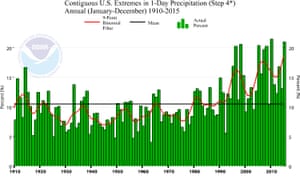
Potsdam University: Heavy rainfall events setting ever new records have been increasing strikingly in the past thirty years. While before 1980, multi-decadal fluctuations in extreme rainfall events are explained by natural variability, a team of scientists of the Potsdam Institute for Climate Impact Research detected a clear upward trend in the past few decades towards more unprecedented daily rainfall events. They find the worldwide increase to be consistent with rising global temperatures which are caused by greenhouse-gas emissions from burning fossil fuels. Short-term torrential rains can lead to high-impact floodings.

More at: Record Rain Events a Global Pattern | Climate Denial Crock of the Week

Fire in the Sky — More Than 330,000 Lightning Strikes Hit Europe in Just Eight Hours | robertscribbler

“Whatever happened to normal weather? Earth has always experienced epic storms, debilitating drought, and biblical floods. But lately it seems the treadmill of disruptive weather has been set to fast-forward.” — Paul Douglas.

A cold, unstable air mass aloft. A record atmospheric moisture load due to human-caused climate change. Add in 80 degree or warmer surface temperatures and these three ingredients can spark some seriously epic thunderstorms. Such was the case across Europe today as towering thunderheads exploded into the skies, raining more than 330,000 bolts of lightning down upon the continent.

Source: Fire in the Sky — More Than 330,000 Lightning Strikes Hit Europe in Just Eight Hours | robertscribbler

Meteorologists are seeing global warming’s effect on the weather | Paul Douglas | Environment | The Guardian

GR:  Read my last post to see how forecasters failed to predict the extreme rainfall and flooding that hit Texas today.

“Whatever happened to normal weather? Earth has always experienced epic storms, debilitating drought, and biblical floods. But lately it seems the treadmill of disruptive weather has been set to fast-forward. God’s grandiose Symphony of the Seasons, the natural ebb and flow of the atmosphere, is playing out of tune, sounding more like a talent-free second grade orchestra, with shrill horns, violins screeching off-key, cymbal crashes coming in at the wrong time. Something has changed.”  Source: Meteorologists are seeing global warming’s effect on the weather | Paul Douglas | Environment | The Guardian

Multi-Day ‘Siege of Storms’ Follows Exxon Shareholder Meeting | robertscribbler

A multi-day siege of severe thunderstorms morphed into a major flash flood event in parts of Texas, Kansas, and other states late Thursday into Friday, and more severe weather is expected into Friday night.

NOAA weather forecasts earlier this week had identified some risk of severe rainfall over this region. But the forecasts had only predicted around 3 inches of rainfall in the most heavily affected areas. The forecast therefore undershot Thursday rainfall intensity by 14-16 inches. And this makes it look like the current weather models are having some serious difficultly keeping up with the human-forced atmospheric changes that are now fully in swing. Combine this with current weather media’s near complete blindness (there are noted exceptions — Weather Underground included) to factors related to human-caused climate change and we have what could best be described as a hazardous degree of under-reporting on climate related risk factors. And the result is a great underutilization of a vast array of weather sensors and scientific talent that would be capable of providing helpful and life-saving information if only they were enabled to. But media-wide, we’re still living and acting as if climate change doesn’t affect the weather.  Source: Multi-Day ‘Siege of Storms’ Follows Exxon Shareholder Meeting | robertscribbler

Atlantic Tropical Storm Bonnie May Become Second 2016 Cyclone to Form Before Hurricane Season Start | robertscribbler

Ocean temperatures off the East Coast of the US are extraordinarily warm for this time of year. A region of water in the Gulf Stream 100 miles off Virginia Beach now features sea surface temperatur…

Source: Atlantic Tropical Storm Bonnie May Become Second 2016 Cyclone to Form Before Hurricane Season Start | robertscribbler

Posted in Uncategorized | Tagged