The Fate of Trees: How Climate Change May Alter Forests Worldwide

By the end of the century, the woodlands of the Southwest will likely be reduced to weeds and shrubs. And scientists worry that the rest of the planet may see similar effects

Source: www.rollingstone.com

GR:  Continued harvest (logging and livestock grazing)  will work with wildfires to remove long-lived species.  This is already visible in arid regions.

Drought, fire management and land use changes have led to denser forests in California

20130817-FS-UNK-0002“A team of researchers with members from several institutions in the U.S. has found that compared to the beginning of the last century, California’s forests are more dense, with fewer large trees, more small growth and are a much bigger risk for fires. In their paper published in Proceedings of the National Academy of Sciences, the researchers describe how they compared forest surveys over the past century and the changes they noted and what it might mean for the future of forest management in the state.
“In the past, before people arrived, fires, generally due to lightening strikes would start, and burn thousands of acres before dying natural deaths. That would allow for new growth, which would eventually lead to tall tree growth. Now, whenever a fire starts, it is put out as quickly as possible to protect homes and businesses in the area. The result is highly with dry small —the perfect conditions for fires to start and spread very quickly. The researchers also found that oak trees have grown more numerous while pine populations have declined—another result of the drier climate.”
Read more at: http://phys.org/news/2015-01-drought-denser-forests-california.html#jCp

GR:  The researchers need to test their assumption that fire prevention and suppression have been effective.  Even though fire-fighting budgets are growing, fire size is increasing.

It is interesting that large trees are fewer now.  Could that be because of logging?  And the spread of oak trees, is that influenced by logging or cattle grazing?  The research conclusions seem to suggest that things are going to get back to what the researchers consider normal now that fires are becoming larger and more frequent. All that small growth that is preventing large trees will get burned up.

Why the White House posted a video linking the California wildfires to climate change

Firefighter Keith McMillen at a controlled burn in Washington state. (David Ryder/Reuters)

Firefighter Keith McMillen at a controlled burn in Washington state. (David Ryder/Reuters)

Wildfires are tangible. Carbon dioxide is not.

“Here’s the tricky thing about President Obama’s proposal to cut carbon dioxide emissions 30 percent by 2030: In order for people to support the move, they need to understand the link between carbon dioxide emissions and climate change. They need to accept that the proposal — a mandate being developed by the Environmental Protection Agency — will help curtail global warming. And they need to prioritize those cuts over concerns — more loudly articulated by opponents — that the cuts will hurt the economy.

“So the White House is starting that fight on YouTube.

“The administration released a video  Tuesday aimed at clarifying the link between climate change and one of the most tangible products of climate change: wildfires. Wildfires have been an an increasing topic of conversation on Capitol Hill, thanks both to the record wildfire years we’ve had this decade and to a strain on funding to fight them.”

Source: www.washingtonpost.com

GR:  Fire fighters know that climate controls fire occurrence.  Day to day variations and annual averages of temperature, humidity, wind, and fuel are principal ingredients in fire severity and spread.  As the normal gradient from arctic to tropics breaks down and the jet stream wanders and stalls, occasional high-fire-danger conditions can persist long enough for destructive fires to spread far beyond historical experience.

However, the destructive nature of human-caused climate change is so severe that a 30% emissions cut in 15 years is pointless.  We need stronger medicine.

Late June 2014: Arctic in Hot Water as Sea Ice Thins and Tundra Fires Erupt

Huge tundra fire smoke plumes just to the right of the center.

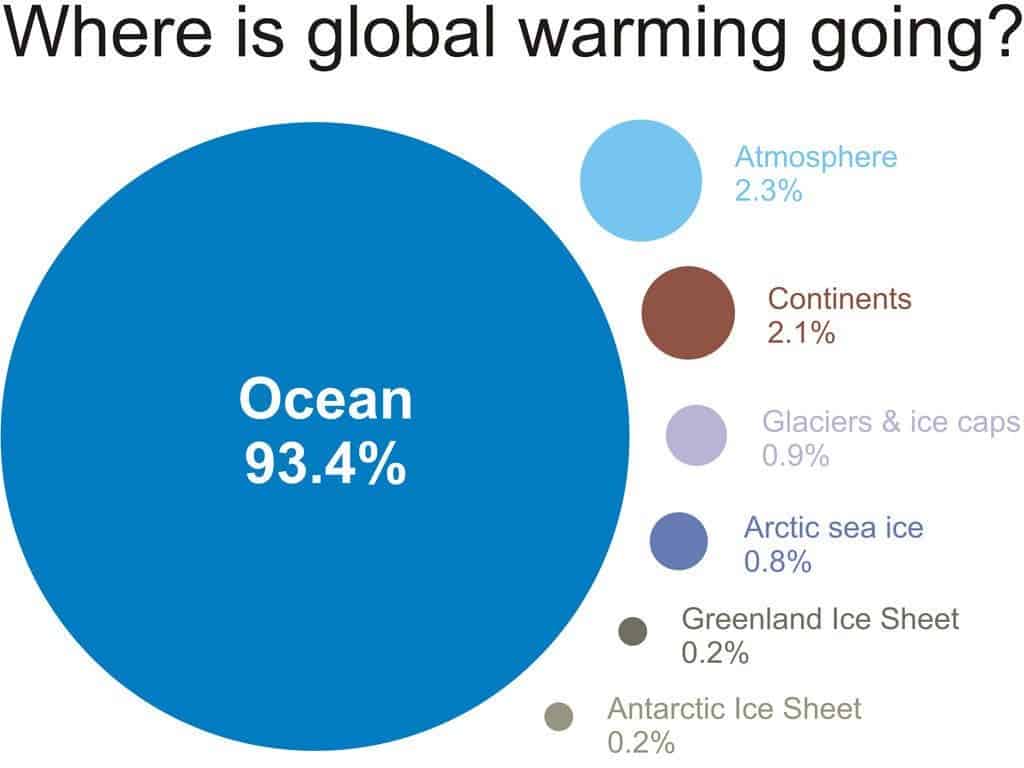
“Atmospheric warming due to human-caused climate change. It’s the general measure we’ve used to track a devastating and ongoing heat amplification due to a terrible greenhouse gas emission. But if we were to look for where the greatest amount of that heat has accumulated, it would be in the world’s oceans. For from its air-contacting surface to its depths thousands of meters below, the World Ocean has captured 93.4% of the total heat forcing humans have already unleashed. The remainder is almost evenly divided between the atmosphere, the continents, and the ice.”

Source: robertscribbler.wordpress.com

GR:  Don’t miss these informative discussions of global-warming events around the world.