New Lawsuit To Protect Richardson Grove Redwoods

News release from EPIC, WildCalifornia:  Following two previously successful federal and state court legal actions, conservation groups and local residents filed a lawsuit in federal court today challenging Caltrans’ renewed approval of a controversial highway-widening project that would endanger ancient and irreplaceable redwood trees in Richardson Grove State Park in Humboldt County. Due to Caltrans’ flawed environmental-review process, the project to cut into and pave over the roots of old-growth redwoods along Highway 101 was halted by a federal court ruling in 2012 and a state court decision earlier this year.

“The shortsightedness of this project is dumbfounding,” said Peter Galvin with the Center for Biological Diversity. “Does Caltrans really expect the public to accept a multimillion dollar project that would needlessly damage this iconic grove of giant redwoods?”

Source: naturalhistorywanderings.com


GR:  Cutting trees to cut time? No problem! The need for speed places public road agencies near the top of the environmental offenders list. For highway planners and engineers, travel time is far more important than trees, animals, or soil. Thus, we must scrutinize all highway plans for the inevitable impacts on nature. We must force Caltrans and other transportation agencies to adhere to the environmental standards that are usually already present in the laws of the land.


Gila National Forest Plan Allows 3,000 Miles for Off-road Vehicles

Press Release, Center for Biological Diversity, August 1, 2013. 

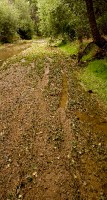
Tracks on the Agua Fria River Banks

Off-road vehicle tracks beside a stream.

The Center for Biological Diversity filed an appeal this week of the Gila National Forest’s travel management plan because it fails to protect the wild San Francisco River, imperiled frogs, fish and birds, and potential wilderness areas from rampant off-road vehicles.

The plan will continue to allow ORVs on 3,000 miles of roads, including in sensitive riparian areas. While the new plan closes much of the San Francisco River to motorized access, it leaves open one of the most heavily trafficked areas near the river. The plan also designates motorized roads and trails near many other rivers and creeks, including those eligible for “wild and scenic river” designation.

“If we’re going to keep these river areas wild and livable for wildlife, we just can’t have off-road vehicles coming in and causing damage. They need to be completely closed to motorized recreation,” said Katie Davis, public lands campaigner at the Center. “By continuing to allow ORV access near the San Francisco River, the Gila plan dismissed the importance of that unique habitat.”

The Forest Service’s recent travel management decision takes several important steps toward reducing the harm from motorized trails on the Gila’s waters and wildlife but falls short of meeting all its legal obligations to the public and the millions of backpackers, hikers, birders and others seeking quiet recreation. The Lower San Francisco River is eligible for federal designation as a “wild and scenic river” and is important for bald eagles, imperiled Chiricahua leopard frogs, loach minnows, spikedace, southwestern willow flycatchers and bighorn sheep.

Read more.

GR:  Off-road vehicles disturb wildlife and damage habitats. According to RoadFree.org, keeping wild areas free of roads is a remarkably cost-efficient way of preventing deforestation and protecting biodiversity.

Chinas Hunger For Timber Is Wrecking Mozambique

China’s hunger for timber is wrecking Mozambique

“China, with its rapidly urbanizing population, is the world’s biggest importer of wood products. And in its dealings with Mozambique, it is increasingly buying timber that is illegally harvested, according to a new report (pdf). The nonprofit Environmental Investigation Agency compared Mozambique’s official harvest numbers to global import numbers and calculated that 93% of Mozambique’s timber was illegally harvested in 2013, up from 76% in 2007—and most of that goes to China.

“That’s perhaps no surprise; Mozambique is poor and timber is a good source of income. But the level of illegal logging and timber smuggling for the Chinese market is way beyond sustainable levels, despite claims to the contrary by Mozambican officials, according to the EIA. If the excessive focus on just a handful of commercial timber species continues, the country’s commercial stocks will be largely depleted in the next 15 years.

“The figures are complicated by some rather murky Mozambican government accounting. In 2013, China reported imports of some 516,000 cubic meters of timber from Mozambique, while the Mozambican government reported only 281,000 cubic meters of exports. In theory, then, just under half of the timber China imported was illegally exported. But in that year the Mozambican government also registered only 66,000 cubic meters of legal timber harvest—far less than it said it licensed for export. Hence, the Environmental Investigation Agency (EIA) reckons, the vast majority of the wood going to China is illegally harvested.

mozambique export timber

The illegal exports mean that Mozambique suffered losses of $146 million in potential export and exploration taxes from 2007-2013, the EIA says. That could have covered the 2014 state budget for poverty-alleviation programs more than twice over. It could, alternatively, have covered 30 years of law enforcement for Mozambique’s National Forest Program, according to the report from the EIA.

“What’s worse, if illegal logging continues in order to meet China’s demand, the number of “first” and “precious class” woods—the species of woods China imports—will be completely depleted by 2029. “China wants the timber as raw in form as possible,” said Jago Wadley, Senior Forest Campaigner at the EIA. “They don’t want to invest in manufacturing or invest in the country they’re operating in.”

mozambique timber depletion

Environmental Investigation Agency (EIA)

The King’s Decree of 7-28-14, “Regarding the United States Navy and the destruction of Hawai’i’s marine environment”

This letter (decree/edict) was written by Ali’i Nui Mō`ī Edmund K. Silva, Jr. Selected highlights are below (bolding is the King’s).

“…the U.S. government has no spiritual or ancestral ties to these islands, as myself and my people do, they have raped and pillaged these lands and our oceans with absolutely no regard for the effect such heinous actions will have on our future generations. This abhorrent behavior will no longer be tolerated, as the Kingdom cares deeply for the land, the oceans, and all walks of life, both human and animal, which inhabit this archipelago.

“The governments of the world continue to operate within 2nd and 3rd dimensional thinking, and continue to destroy our world with stupid conflicts created by man… It is difficult to find words to adequately characterize the the behavior of the United States foreign military forces now using Hawaiian waters for their war games, with little to no regard for the destruction such behavior is causing to our delicate ecosystem and marine life. A dead whale washing up on the beach, turtles with their legs blown off, and coral reefs reduced to rubble, – the horror continues.

“We have known about the effects of high energy sonar on Whales and other marine life for years. It was fifteen years ago that whale watch boat captains and shore observers documented that the Whales had fled from the U.S. Navy low frequency sonar testing area off the Island of Hawai’i. The Navy has been killing or injuring Whales and other marine life for decades while issuing one denial after another.

“These are not respectful people. They have no respect for the creatures living in the ocean. They have no respect for the future of the oceans. They have no respect for life. They only worship their imperial goals and the death that accompanies pursuit of those goals.

As Sovereign of this Nation, I therefore issue the following edict: ‘RIMPAC 2014 is the last time foreign armies will be allowed to abuse the Hawaiian environment.

“Of particular concern is the use of high-powered sonar at low, middle, and high frequencies. The history of such sonars killing or harming marine life, especially Whales, is sufficient to conclude they cannot be used safely…. Such sonars are now banned from all Hawaiian waters.

Therefore, in conclusion, I am not directing but ordering you to cease and desist in your war games, for it is my kuleana and sacred duty to protect this Sovereign Nation and all its resources. The ocean is our source of life and your activities are not welcomed. The Kingdom of Hawai’i is a non-aligned nation and has no use for your Military campaigns and war games. You are to cease and desist in your activities immediately.

“I am sending this letter to Governor Abercrombie and the Trustees of OHA because they have failed miserably in their duties to protect the Hawaiian ‘aina from the destructive actions of the occupying nation.”

Source: kingdomofhawaiiinfo.wordpress.com
How Monsanto and biotech companies violate the Nuremberg Code

“The basic human rights protections established by the Nuremberg Code, which was adopted immediately after the end of World War II, continue to serve as a global template for how human beings are to be treated by the scientific community. But the modern equivalent of the Holocaust is now taking form under the guise of feeding the world and saving the planet, with Monsanto and others in the biotech industry routinely testing their chemicals and faux foods on the public without informed consent, just like amoral scientists did in the death camps.

“As far as medical experiments go, every individual has the right under the Code to consent, or not, to being used in scientific trials or tests that involve toying around with new or unusual substances. This constitutes the essence of the Code, which expressly prohibits human experimentation unless the person being experimented on first gives his or her permission, with full disclosure of any potential adverse events.”

Full article: theresistanceunited.com

GR:  The Nuremberg Code does not protect nonhuman species, but since other species influence human health, it should.

The NOAA Ocean Acidification Program

Too much acid in the ocean is bad news for sea life. Acid eats away at calcium carbonate, the primary ingredient of shells and skeletons that many ocean animals depend on for survival. The shell pictured here is a victim of this process.

“Since the sToo much acid in the ocean is bad news for sea life. The shell pictured here is a victim of this processtart of the industrial revolution, the ocean has silently absorbed roughly 30% of the carbon dioxide that people generate through industry and agriculture.  Now ocean chemistry of the seawater is rapidly changing in a process known as ocean acidification. These changes in seawater chemistry affect animal growth, survival and behavior, and they are depleting the ocean of calcium carbonate, a nutrient vital for shellfish to build shells. Marine organisms with calcium carbonate shells or skeletons – such as corals, oysters, clams, and mussels – can be affected by small changes in acidity. That’s important, because shelled organisms are essential throughout the marine food chain. They are also vital to our economy, as shellfish hatcheries on the brink of collapse just a few years ago, struggle to adapt.

“The U.S. Integrated Ocean Observing System, or IOOS, is helping mitigate economic impacts with real-time data that signal the approach of acidified seawater one to two days before it arrives.  An early warning helps hatchery managers take action – such as shutting off intake valves or treating the water – to save crops.

“Ocean acidification has the potential to fundamentally change the ocean, its habitats, food webs and marine life. The implications of this sea change to our environment and our economy are endless, and the current rate of change of ocean acidification is faster than any time on record.  We need to better understand what is happening so we can develop tools to help slow the rate of change.  Efforts like IOOS and NOAA’s Ocean Acidification Program will help our nation begin to understand how to address this problem on a global scale and help reverse it.”

Source: www.scoop.it

Say NO to Arctic Drilling

The U.S. government is starting to prepare a five-year program—spanning the years 2017 to 2022—that could open the Arctic Ocean to oil and gas drilling. Stand with us against new oil and gas leasing and protect the animals and people who depend on a clean, healthy Arctic Ocean.

Tell the Bureau of Ocean Energy Management (BOEM) to say no to risky Arctic drilling.

Recipients

  • Sally Jewell

Source: secure.oceanconservancy.org

GR:  Fossil fuels pollute our air and water.  Overfishing, ocean acidification, and other human activities are already harming marine life.  Let’s stop looking for oil and focus on cleaning up the mess we’ve made.  Please sign the petition.

Offroad race planned for Gran Desierto de Altar | Wild Sonora

See on Scoop.itGarry Rogers Nature Conservation News (#EcoSciFi)

Garry Rogers insight:

The dates are April 2-5, 2014.  The devastation of a UNESCO World Heritage site is not of concern to motor recreation planners and participants.

See on www.wildsonora.com

Outdoor Recreation Aids Invasive Plants

By Garry Rogers

Outdoor Recreation Aids Plant Invasions

Tracks on the Agua Fria River BanksOutdoor recreation does far more than simply transport invasive plants.  It disturbs soils and vegetation and takes the lives of animals.  Leopold commented on the most violent type of recreation:

“The disquieting thing is the trophy hunter who never grows up. … To enjoy he must invade, possess, appropriate.  Hence the wilderness that he cannot personally see has no value to him.  Hence the universal assumption that an unused hinterland is rendering no service to society” (Leopold 1949:  176). Continue reading