
How Austrailia’s Great Barrier Reef got polluted – from farms and fossil fuels to filthy propaganda | Graham Readfearn | Environment | The Guardian

GR:  This is the best discussion of the cause of coral death in Australia’s Great Barrier Reef I’ve seen–it’s people.
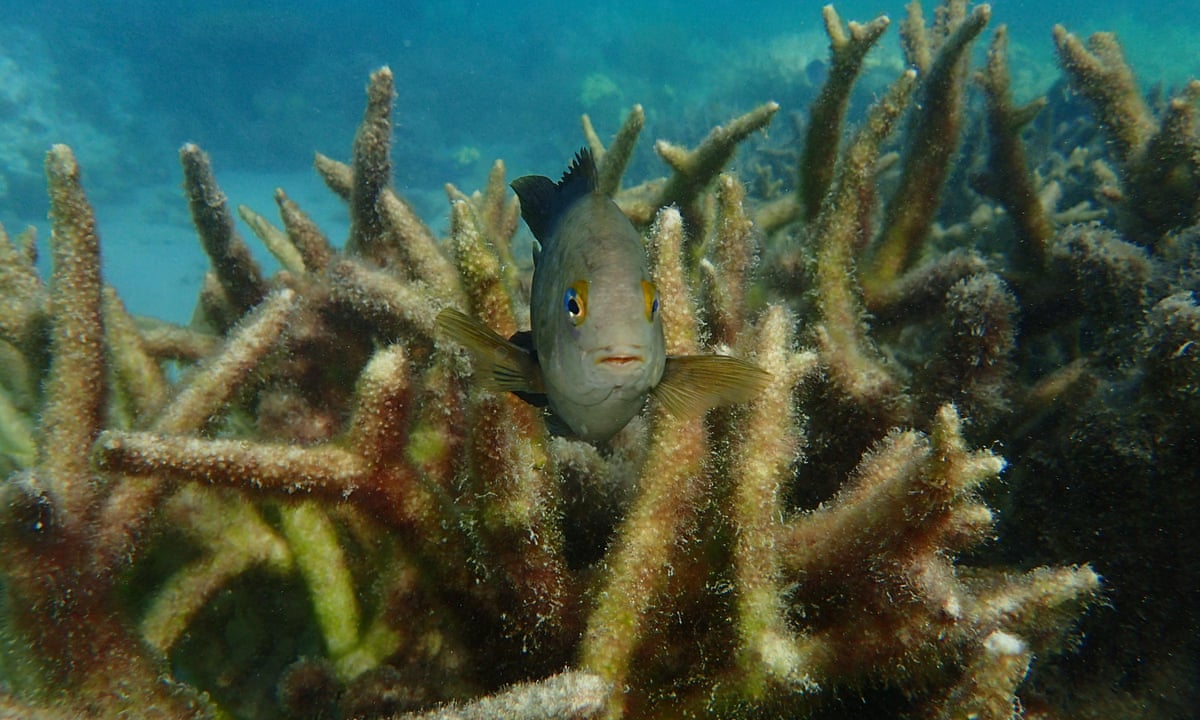
Coral bleaching at Loomis Reef, off Lizard Island, Great Barrier Reef, Australia. Photograph: Essential Median

Graham Readfearn:  In late November 2015, as corals across the northern section of the Great Barrier Reef started to bleach white, the game was finally up.

For years, Australians had been told the country’s jewel in the ocean’s crown was on the mend. Only months earlier the Coalition government had won a two-year fight to keep the reef off a United Nations list of world heritage sites in danger.

The stakes were high. International reputations and tourist dollars were at stake. The foreign minister, Julie Bishop, and the trade minister, Andrew Robb, had even attacked Barack Obama, who feared for the reef’s future.

The reef was not in danger, Bishop insisted. The president was misinformed, claimed Robb.

Conservative commentators hanging around News Corp media have said the dangers to the reef were overblown.

The mining industry cast the views of environmentalists as green propaganda, ignoring how for the most part, conservationists were echoing the findings of the government’s own scientists.

Now, about half the corals bleached in the once pristine northern section are dead or dying.  More– How the Great Barrier Reef got polluted – from farms and fossil fuels to filthy propaganda | Graham Readfearn | Environment | The Guardian

Save

How Will Egypt Rein In Its Explosive Population Growth?

By Joe Bish, Population Media Center

“No matter how many economic projects we launch, the population growth will consume that development.”

Egypt’s Central Agency for Public Mobilization and Statistics (CAPMAS) recently announced that, according to their calculations, the population growth rate in that northern African country is currently 2.4% per year. If accurate, this measure dwarfs the growth rate associated with the U.N.’s high variant assumption for the years 2015 to 2020 — which is “just” 2.06%. As you know, a 2.4% growth rate means the population doubling time works out to 29 years.

Shockingly, according to CAPMAS, the 2.4% rate has to be considered progress — marking a decrease from 2.55% in 2014.Precision of the numbers aside, what has happened in Egypt is that the national family planning program was driven into a ditch in the wake of 2011’s political instability. As the article below points out, this dereliction has created a systemic, long-lasting challenge: Egypt’s population pyramid now has an enormous bulge at its base. Hania Sholkamy, an associate professor at the American University in Cairo’s Social Research Center, is wise to suggest that the country must heavily invest in this young cohort with good-quality education, health services, and sexual and reproductive health curriculum. In this way, they will be predisposed to “contribute positively to family planning strategies” when they reach reproductive age. The question is, will anybody listen to Ms. Sholkamy’s advice?

Egypt’s Population Pyramid, 2016 How will Egypt rein in its explosive population growth?Egypt’s population is growing at a rate five times higher than that of developed countries, and twice as high as developing countries, according to the state-run Central Agency for Public Mobilization and Statistics (CAPMAS).

Cairo, Egypt

Read More: How Will Egypt Rein In Its Explosive Population Growth?Save

Every Day is World Oceans Day for Us

   Oceans, covering two-thirds of Earth, are so vast and so deep that it’s easy to take their importance for granted. They provide us with oxygen, and they regulate our climate by removing carbon dioxide from the atmosphere — important functions for both humans and wildlife.

Unfortunately, the world’s oceans — home to whales, sea otters, ice-dependent seals, dolphins, manatees, seabirds, sea turtles, sharks and other marine life — are in a sea of trouble. The oceans are overworked; they cannot remove carbon dioxide from the atmosphere quickly enough to keep up with how much we create, which is causing ocean acidification. The Arctic Sea is warming at twice the rate than past years, which is reducing sea ice — a growing threat to our marine mammals. Just recently, scientists shared that over a third of the Great Barrier Reef is dead, a permanent fate for the species and a damaging one for species that depend on the reef for shelter and food.

The health of the Earth’s oceans are indicators of our planet’s overall health – when they’re in trouble, so are we. So, it’s important to keep our oceans healthy not just for marine life, but also for the future health of the entire planet.  Read more:  Every Day is World Oceans Day for Us

Save

Bay Area Voters Approve Tax to Fix Marshes As Seas Rise | Climate Central

GR:  Individuals, not the corporations responsible for the problem are paying this tax.  Hey, Republicans, why not reverse fossil-fuel subsidies and let the fossil-fuel industry’s past profits help pay to clean up polluted air, water, and land?

John Upton:  Voters in the San Francisco Bay Area approved an unprecedented tax Tuesday to help fund an ambitious vision for restoring lost marshlands, handing electoral victory to shorebirds, crabs and advocates of a muddy strategy for adapting to rising seas.

Measure AA is projected to raise an estimated $25 million a year for 20 years. As of Wednesday morning, 69 percent of voters in the nine Bay Area counties supported it, with only a small number of votes left to be counted. The $12 annual tax proposed for each parcel of property owned in the Bay Area needed two thirds of votes to pass.  Read more:  Bay Area Voters Approve Tax to Fix Marshes As Seas Rise | Climate Central

Save

Population matters for the world’s oceans – Population Matters

While oceans are in many respects the heart of our ecosystem, their sustainable existence is threatened by our actions.

The first World Oceans Day was celebrated in 1992 after the Canadian government proposed the idea at the Earth Summit in Rio de Janeiro. In 2008, the United Nations recognised the initiative officially.

“We have to ensure that oceans continue to meet our needs without compromising those of future generations. They regulate the planet’s climate and are a significant source of nutrition. Their surface provides essential passage for global trade, while their depths hold current and future solutions to humanity’s energy needs.”  More:  Population matters for the world’s oceans – Population Matters

Save

The Guardian view on the Great Barrier Reef: the crisis they prefer to downplay | Opinion | The Guardian

Many of the politicians fighting Australia’s election campaign talk about the economy and immigration but the world is listening for what they say about the impact of climate change.

If the rest of the world could vote in next month’s Australian election, there would almost certainly be one issue that would be raised to the top of the country’s political agenda: saving the Great Barrier Reef. Scientists say this year 93% of its reefs experienced some bleaching, and 22% of all of the reef’s coral was killed by unusually warm waters. Unheard of just three decades ago, large-scale bleaching has become a regular occurrence. Within 20 years the conditions that drove this year’s bleaching in Australia will occur every second year. A Guardian report illustrates in vivid detail the scale of the devastation unfolding beneath the surface. Over the past 34 years the average proportion of the Great Barrier Reef exposed to temperatures where bleaching or even death is likely has increased from about 11% a year to about 27% a year.

It is a constant struggle to motivate most people most of the time about climate change. The evidence accumulates slowly; despite being an emergency, it often . . . more:  The Guardian view on the Great Barrier Reef: the crisis they prefer to downplay | Opinion | The Guardian

Save

Arctic Sea Ice Breaks May Record . . . By A Lot | Climate Central

By Bobby Magill:  Arctic sea ice shrank to its fourth-lowest level in 50 years last month, setting a record low for the month of May and setting up conditions for what could become the smallest Arctic ice extent in history, according to National Snow and Ice Data Center data released Tuesday.

“We didn’t just break the old May record, we’re way below the previous one,” NSIDC Director Mark Serreze said.  More:  Source: Arctic Sea Ice Breaks May Record . . . By A Lot | Climate Central

Save

To save the Great Barrier Reef ‘we need to start now, right now’ – video | Environment | The Guardian

GR:  The video leaves us with a grim outlook.  Human wastes running into the oceans coupled with global warming will soon destroy all the reefs.  Do enough people care to force our governments to act?  Probably not.  Do you see any answers?

and , theguardian.com:  Jon Brodie from James Cook University says to give the Great Barrier Reef even a fighting chance to survive, Australia needs to spend $1bn a year for the next 10 years to improve water quality. If we don’t do that now, he says, we might need to just give up on the reef. ‘Climate change is happening much more quickly and much more severely than most scientists predicted’•

The Great Barrier Reef: a catastrophe laid bare – special report.    Source: To save the Great Barrier Reef ‘we need to start now, right now’ – video | Environment | The Guardian

Save

Predator Control in Alaska Wildlife Refuges

Pat Lavin:  The state of Alaska is pursuing aggressive predator control measures on our national wildlife refuges, targeting bears, wolves and other wildlife on land that was meant for their conservation.

Alaska is a state unlike any other, home to diverse landscapes from the tundra of the high arctic to temperate rainforests in the south. Polar bears, wolves, and brown bears live here. In many parts of the state, these carnivores live in pristine habitat as they have for thousands of years, hunting their natural prey, including moose, caribou, deer, salmon and more.  More:  Predator Control in Alaska Wildlife Refuges

Save

Save