
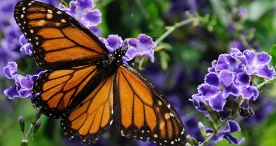
Agreement turns I-35 into pollinator haven | Finance & Commerce

GR:  It is definitely time to get serious about pollinator protection.  Unfortunately, this agreement is not binding and it does not mention mowing or herbicides, the principal roadside vegetation management tools of departments of transportation.  If I-35 roadsides start to become wild and rough, it will be a sign that the effort to aid pollinators is sincere.  Fingers crossed!

DES MOINES, Iowa — Soon, passengers zipping along Interstate 35 will see a lusher refuge and more food for bees and butterflies in the hopes of helping the insects boost their declining populations, six states and the Federal Highway Administration announced Thursday.

That 1,500-mile stretch of road from northern Minnesota to southern Texas is a flyway for monarch butterflies that migrate between Mexico and Canada, and is surrounded by acres of public land that can serve as friendly territory for the bees and butterflies that pollinate the plants that produce much of the nation’s food, such as fruits and vegetables.

But the monarch butterfly has lost population in recent years, which researchers say is due in part to shrinking stands of milkweed, on which butterflies feed and lay eggs. And last year, beekeepers reported losing about 40 percent of honey bee colonies in part due to pesticide use, habitat loss and parasites.

The agreement signed Thursday by officials from Minnesota, Iowa, Missouri, Kansas, Oklahoma and Texas and the federal government is meant to improve the habitat and develop a branding campaign to informally name the interstate the Monarch Highway.  Source: Agreement turns I-35 into pollinator haven | Finance & Commerce

Butterfly species decline ‘dramatically’ in Germany | Global Ideas | DW.COM | 30.03.2016

GR:  Similar reports are coming in from around the world.  Toxic pesticides are an important contributor to the decline in many other areas.

“Climate change and nitrogen pollution may be behind the “dramatic drop” in the number of butterfly species in Germany over the past 200 years, according to new research.

“Of the 117 butterfly species recorded in 1840 in the survey site, a protected habitat in the south-German state of Bavaria, just 71 are still found today, said the authors of the study recently published in journal “Conservation Biology.”

“Species requiring a specific type of habitat or food source, such as the “elegant white and ochre-spotted” hermit butterfly, are threatened with extinction in Germany. The hermit, for instance, lives in dry grasslands and will be hit even harder by changes in land use and global warming in the future, say the authors.”  From: www.dw.com

Summit County Citizens Voice

Commercially managed honeybee colonies may be speeding the spread of disease to wild bee populations, according to a new study by a University of California, Riverside entomologist.

“Even in cases when the managed bees do not have a disease, they still stress local wild bees, making them more susceptible to disease,” said Peter Graystock, a postdoctoral researcher in the Department of Entomology and the lead author of a paper published online last week in the International Journal for Parasitology: Parasites and Wildlife. Continue reading → summitcountyvoice.com

GR:  The human destruction of nature comes in many forms. With so many humans on the planet, everything we do is multiplied to the level of catastrophe.

Nature News Digests

GarryRogersNature News Digests:

Banned pesticides pose a greater risk to bees than thought, EU experts warn

“Three pesticides banned in Europe for their potential to damage bee populations could pose an even greater threat than was thought, according to a new assessment by the European Food Safety Authority (Efsa).

“Already proscribed for seed treatments and soil applications, the Efsa analysis says that clothianidin, imidacloprid and thiamethoxam also pose a ‘high risk’ to bees when sprayed on leaves.

“The UK is currently facing a legal challenge to an emergency exemption it granted, allowing use of two of the substances, after protests by the National Farmers Union.

“But far from supporting the British case, the advisory expert assessment will add to pressure for an extension of the ban to apply to fruit orchards after blooming, and crops gown in greenhouses, Greenpeace says.

“The commission should expand the EU-wide ban to cover all uses of neonicotinoids on all crops, and end the self-service approach to derogations. Viable non-chemical alternatives exist and the EU should encourage farmers to use them,” said the group’s agriculture policy director, Marco Contiero.”  Sourced through Scoop.it from: www.theguardian.com

GR:  The rest of the world needs to pay attention here and see the need to escape from the chemistry industry’s death grip.

Global Warming Is Wiping Out the Bees

Bumblebees, a linchpin of the global food supply, are vanishing across huge swaths of North America and Europe as a result of climate change, a new study says.  Sourced through Scoop.it from: www.usnews.com

GR:  Earth’s lands, like its oceans, can’t take anymore. Though many species are better adapted to warming than bumblebees, none will escape human impacts unchanged.

Bees Still Dying

Imrs phpIt appears that we are powerless against Monsanto and the USDA. Have we no one in government that can defend nature? I guess that’s a foolish question. We can’t even convince Walmart to take its employees off the public welfare system.

Eli Spiritweaver's avatarEarth Report

Honeybees Still Dying

Just last year, it seemed there was something to celebrate despite planet Earth’s ongoing honeybee apocalypse: Bee colony losses were down. Not by enough, but they were down.

“It’s better news than it could have been,” said Dennis vanEngelsdorp, a University of Maryland entomology professor who led a survey of bee populations that reported a loss of 23 percent of bee colonies — less than 30 percent, the average from 2005 to 2013. “It’s not good news.”

Though scientists cited progress in battles against an Asian mite that has killed many an American bee, they had words of caution.

“One year does not make a trend,” Jeff Pettis, a co-author of the survey who heads the federal government’s bee research laboratory in Beltsville, Md., told the New York Times.

Turns out Pettis was right. VanEngelsdorp and other researchers at the Bee Informed Partnership, affiliated with the Department…

View original post 204 more words

Making Sacramento a haven for honeybees

Carpenter Bee on LarkspurSacramento is the latest city to become an official honeybee haven. More residents are interested in keeping their own hives. But how do you catch this buzz?  Source: www.sacbee.com

GR:  Here’s the link to put your honeybee haven on the map.  For other posts on bees, pollinators, and pesticides, enter “bees” in the search window.

Six solutions for transforming your balcony into a biodiversity sanctuary

Your balcony – a little corner of paradise…

Source: livingcircular.veolia.com

GR:  If you live in North America, here’s a good source for beekeeping information:  http://www.beeculture.com/directory/find-local-beekeeper/.  Beekeeping associations in other parts of the world are listed here: http://honeyo.com/org-International.shtml.  You can find more information through the one of the beekeeping forums.  Interested?  It takes about 30 minutes per hive per week, and 2 hours per hive twice a year to extract honey.