Peace park proposed for Karen State, Myanmar- DVB Multimedia Group

Proposed Nature Sanctuary/Park in Myanmar

KESAN hopes the introduction of the Salween Peace Park will also stop logging concessions in the area, which cause irreparable damage to wildlife and the environment.  Source: Peace park proposed for Karen State- DVB Multimedia Group

Salawin River

Salawin River

Click for Photo Source


US Oil Sands announces slow down and lack of funding! USOS STOCKS plummet!

June 27, 2016:  Utah Tar Sands Resistance is hopeful about the real impact of the recent announcement by US Oil Sands of the scale down of their plans for tar sands strip mining at PR Springs Utah. All beings will continue to gain from the existence of this remote ecosystem and the preservation of this historic source of spring water.  From: www.tarsandsresist.org

Consider joining a tar-sands protest vigil in June.

One More Time – Here Is A Video That Tells It Like It Is When It Comes To The Serious Threat This Thing Government Reps Call “Biodiversity Offsetting” Poses To Niagara’s Natural Wetlands

GR:  Experience has taught me that most governments represent business interests dominated by desire for short-term profits and growth-at-all-costs.  When individuals take public office, their new power over the wealth of the people elevates them to the society of investors and developers. Rather than becoming advisers that help the wealthy control their avarice, they become students and tools of the wealthy.  Whatever original thoughts they had about stability and sustainability fade away. There are exceptions, but they are rare and fleeting.

The only solution is heavy public participation and opposition to development proposals.  Without overwhelming threats from large numbers of people, individuals in governments will be most strongly influenced by their new society—the rich and ambitious.  Activism is the answer.

The following is by Doug Draper.

“The Niagara Peninsula Conservation Authority – a government body created by the Province of Ontario decades ago and stacked with board members appointed by municipal governments in the region – is floating the idea of destroying at least some of that’s left of Niagara’s natural wetlands to make way for more development.
Only about 10 to 15 per cent of Niagara’s wetlands – vital to the survival of many birds, fish and other wildlife – remain in Niagara and a regional ‘Conservation Authority” is now looking at “offsetting” to make way for development. Photo by Doug Draper

“Only about 10 to 15 per cent of Niagara’s wetlands – vital to the survival of many birds, fish and other wildlife – remain in Niagara and a regional ‘Conservation Authority” is now looking at “offsetting” to make way for development. Photo by Doug Draper

“The NPCA says it is thinking of taking this idea to the provincial government for approval under the guise of something called “biodiversity offsetting” which involves (as best as one can determine from an explanation offered by Conservation Authority’s chief administrative officer Carmen D’Angelo at a public meeting this January) replacing some wetland for development and replacing it somewhere else with something the same or similar that someone would construct.
More than 200 citizens attended the January meeting, many of them to express their concern or outright opposition to the idea. And when one citizen asked NPCA representatives flat out for a definition of “biodiversity offsetting,” one Conservation Authority member stood to say they do not yet have a full definition of the term.” niagaraatlarge.com
Inside the US agency charged with killing a ‘mindboggling’ number of animals

“Wildlife Services funds the lethal control methods, but they don’t fund the nonlethal,” says Fox. “That in and of itself disincentivizes nonlethal methods, and incentivizes the reliance on the federal government for predator control. The reliance on an agency for that kind of subsidy is really, really hard to counter.” www.theguardian.com

GR:  The policies of the U. S. Department of Agriculture’s Wildlife Service demonstrate the way American land-use agencies place the interests of ranchers first and the interests of wildlife and the land second. It is clear now that as long as land managers must fear politicians controlled by special interests such as the National Cattlemen’s Beef Association (http://bit.ly/1Nkudid), and the National Livestock Producers Association (http://www.nlpa.org/), there can be no safety for wildlife and its habitats.  Of course, the destruction of nature by its appointed stewards is not limited to America; human governments worldwide conduct it. Will we ever see a government created for the good of the Earth and all its creatures? In the midst of the great human-caused mass extinction, it appears that we will not.

I write EcoSciFi, science fiction with an ecological theme. Here’s an idea for a story about the future of nature conservation:    As the destruction of wildlife becomes apparent to all people, privately funded wildlife-protection militias embedded with the animals will spread. Local governments will oppose these defenders of nature, arms manufacturers will sell to both sides, and violence will escalate. Humanity will have created another force behind its descending spiral to oblivion.

Activist calls for removal of leg-hold traps on public lands

Trapping, hunting, livestock grazing, logging, mining, and more are the ways that public land is used. Not for the sake of the land or its creatures, but for the benefit of one species. And not even in the best interests of that species, land use of the public land has never been sustainable; it has always been destructive. Our schools do not tell our children about nature, and our leaders whose “beliefs” are determined by the finances of special interests deny it. A century and a half ago, Humboldt, Thoreau, Marsh, and others recognized and alerted us to the demise of nature in the name of progress and profit. Blocked by our leaders, the message has been repeated by Leopold, Abbey, Wilson and others whose wisdom is no match for human avarice and impatience.

Exposing the Big Game's avatarExposing the Big Game

Activist calls for removal of leg-hold traps on public lands

http://www.santafenewmexican.com/life/features/activist-calls-for-removal-of-leg-hold-traps-on-public/article_244c1088-fc31-5ad1-bf6b-b06f9cbbc585.html#.Vm2qoPjl6N4.facebook

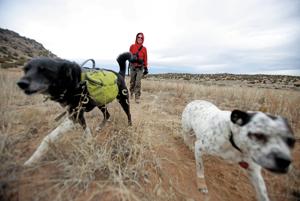
Z Jacobson of Santa Fe walks Friday with her dogsNoodles on Dead Dog Trail off Old Buckman Road, where Noodles got caught in a trap. The experience has turned Jacobson into an activist, with a goal of banning leg-hold traps on public lands. Luis Sánchez Saturno/The New Mexican

Posted: Saturday, December 12, 2015 

Z Jacobson was hiking with her dogs, Noodles and Lulu, and a friend along a new trail off Old Buckman Road in the Santa Fe National Forest on Thanksgiving Day.

It’s ominously called Dead Dog Trail, and it leads to the top of the Caja del Rio Plateau. Jacobson’s friend had helped build it, and she was interested in touring a couple of canyons along the way said to contain rock art.

During the hike, they walked over to a cliff and were admiring the view when…

View original post 907 more words

Demonstrate for an End to Global Warming

Climate-change demonstrations show our leaders that we want them to take steps to stop global warming. We must also ask our leaders to change the human activities that are causing climate change.

  1. We want them to block corporate control over our government and the decisions it makes.
  2. We want them to end international sales of weapons and begin to encourage peace and a focus on life style and resource use.
  3. We want them to discourage unsustainable resource harvests.
  4. We want them to encourage human rights and equality.
  5. We want them to speak out for wild animals and natural ecosystems.
  6. We want them to call for restoring the damaged lands and seas.
  7. And finally, we want them to oppose gender inequality and overpopulation.

Even if we stopped burning fossil fuels today, activities causing climate change would continue. Farming, deforestation, industrial fishing, desertification, construction, and growth of the human population would continue to waste the Earth and release CO2 and other greenhouse gases.

822e6515-ef8b-4ba3-840b-8d4921eca1b6.jpg

e867c623-988a-4361-ae66-a2bc07c7ba96.jpg

Native tribe fights to save Boreal forest in Quebec

Mandy Gull holds back tears as she steps off the helicopter in northern Quebec. “I’ve never seen anything so sad,” says the young woman whose aboriginal tribe is seeing its ancestral lands eroded by logging.

“If my grandfather knew,” says the deputy leader of the Cree tribe, one of 11 indigenous ethnic groups present in Quebec.

The flyover of the Boreal forest, pockmarked by clear-cuts, both saddens her and toughens her resolve to end deforestation in the region.

“We don’t own this land… as Cree, we know that we’re stewards of the land, (and) we’re here to protect the land,” she said.  Sourced through Scoop.it from: phys.org

GR:  Faced by rapacious loggers and their government representatives, defenders of the forests have many roadblocks to success, not the smallest being personal danger of injury and incarceration.

Eco-Sabotage is Planetary Self-Defense | Deep Green Resistance Blog

Max Wilbert and other members of Deep Green Resistance Seattle participated in a May “ShellNO” protest against Shell’s arctic drilling rig. Their display of signs reading “Sabotage the Machine” and “Eco-Sabotage is Planetary Self-Defense” attracted a lot of attention. Elliot Stoller conducted a short video interview in which Wilbert explains his concern about ineffective tactics and strategies in the face of dramatic threats to biodiversity, climate, and social justice.

Wilbert discusses DGR’s radical evaluation of systems of power and what might actually work to alter their destructive course: targeting critical communication, electrical, and oil infrastructures, and addresses some common questions about what that means for the safety of activists who undertake such work, and what sort of life humans can live without the comforts and elegancies of industrial civilization.  Sourced through Scoop.it from: deepgreenresistance.blogspot.com

GR:  In this video (http://bit.ly/1MA5av2) Wilbert describes eco-sabotage as necessary self-defense for nature.  This radical perspective is gaining momentum as it becomes apparent that Earth ecosystems are deteriorating due to excessive corporate resource extraction and government mismanagement of natural resources.  Worth watching.

Civic Disobedience and Climate Change

On July 30, the whole world watched as 13 Greenpeace activists dangled from ropes tied to the St. John’s bridge in Portland, Ore., red and yellow streamers catching the wind. They were blocking the exit of the Fennica, Shell’s ice breaker headed to the Arctic to facilitate drilling. These young activists hung there for 40 hours in makeshift platforms and slings during some of the hottest days on record, before the police and Coast Guard brought them down. One hundred feet below them, filling the river with their colorful small boats, were Portland’s “kayactivists” from the local Climate Action Coalition — some were experienced paddlers, others kayaking for the very first time. On shore stood over 500 people, cheering and chanting “Stop that boat!” Some were moved to tears by this unprecedented spectacle and by the courage of the protesters.  Sourced through Scoop.it from: www.huffingtonpost.com

GR:  Civil disobedience must often be disagreeable and even unlawful.  The term implies an argument with existing practices and laws.  Whistleblowing, marching, and gathering are essential to maintain a healthy democracy.

Human rights and welfare are the common focus of civil disobedience, but some, like the Greenpeace activists in the photo, believe that animal and ecosystem rights are equally important reasons for civil disobedience.  This is usually justified by arguing that humans cannot survive without healthy ecosystems occupied by healthy animal and plant populations.  There is another, rarer, form of this justification:  Nature, consisting of air, rocks, water, soil, animals, and plants has inherent importance unrelated to humans, not because of how humans benefit from nature, but because nature has equal rights to exist.