
The Guardian view on the Great Barrier Reef: the crisis they prefer to downplay | Opinion | The Guardian

Many of the politicians fighting Australia’s election campaign talk about the economy and immigration but the world is listening for what they say about the impact of climate change.

If the rest of the world could vote in next month’s Australian election, there would almost certainly be one issue that would be raised to the top of the country’s political agenda: saving the Great Barrier Reef. Scientists say this year 93% of its reefs experienced some bleaching, and 22% of all of the reef’s coral was killed by unusually warm waters. Unheard of just three decades ago, large-scale bleaching has become a regular occurrence. Within 20 years the conditions that drove this year’s bleaching in Australia will occur every second year. A Guardian report illustrates in vivid detail the scale of the devastation unfolding beneath the surface. Over the past 34 years the average proportion of the Great Barrier Reef exposed to temperatures where bleaching or even death is likely has increased from about 11% a year to about 27% a year.

It is a constant struggle to motivate most people most of the time about climate change. The evidence accumulates slowly; despite being an emergency, it often . . . more:  The Guardian view on the Great Barrier Reef: the crisis they prefer to downplay | Opinion | The Guardian
Save

Fishermen battling for Brexit | Environment | The Guardian

GR:  As the human population grows and fish populations shrink, it is critical that we drastically cut our fishing activities.  These people are only concerned with immediate self-interest.  They ignorantly continue the human devastation of the Earth and scream for more.  Do they realize that their continued over-harvest will end their industry?

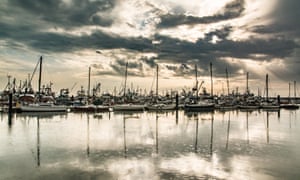
The EU referendum has united an often fractious industry, with skippers in ports from northern Scotland to Cornwall desperate to dump imposed quotasby Severin Carrell in Fraserburgh, Steven Morris in Newlyn and Henry McDonald in Lough Neagh. Main picture: Murdo MacLeodWilliam Whyte has a new flag flying from the rigging of his vast blue-hulled trawler, its fabric snapping in the brisk breeze coming in off the North Sea. It features the cartoon of a militant-looking fish wearing armour, a union jack shield at its waist and the legend “Fishing for Leave”.

Source: Salt in their veins and fire in their bellies: fishermen battling for Brexit | Environment | The Guardian

The number one thing we can do to protect Earth’s oceans | Ensia

Protecting Earth’s Oceans

By Liza Gross

When New England fishers complained of working harder and harder to catch fewer and fewer fish, Spencer Baird assembled a scientific team to investigate. Though a fishery failure would once have seemed inconceivable, Baird wrote in his report, “an alarming decrease of the shore-fisheries has been thoroughly established by my own investigations, as well as by evidence of those whose testimony was taken.”The report was Baird’s first as head of the U.S. Commission of Fish and Fisheries. The year was 1872.Baird recognized the ocean’s limits. A decade later, however, his British counterpart, Thomas Huxley, took a decidedly different view. Calling the sea fisheries “inexhaustible,” Huxley deemed regulations useless, since “nothing we do seriously affects the number of fish.”

Source: The number one thing we can do to protect Earth’s oceans | Ensia

Help save Britain’s seas from governments who make a mockery of marine conservation | George Monbiot

“Governments take the advice they want to hear. As they seek to avoid trouble and find the path of least resistance, they often look for advice that meshes with the demands of industrial lobbyists.

“This problem has afflicted the life of the sea for many years. Governments consult the scientists who tell them that high catches of fish are sustainable, and ignore more cautious assessments. This allows them to get the fishing lobby off their backs, while claiming to have based their decisions on science. Bad advice from scientists and selective hearing by government were among the factors that led to the collapse of the Grand Banks cod fishery off Newfoundland.

“One of the most destructive industries humankind has developed is scallop dredging. Scallop dredges are rakes with long steel teeth that are towed over the seafloor, ripping out not only scallops, but also much of the life and structure of the seabed. They have wrecked habitats all around our coasts.”  www.theguardian.com

GR:  Monbiot begins by pointing out that governments act on behalf of commercial interests.  It’s the same everywhere.  Elected to public office, humans gain power and enter the society of the powerful.  They become friends with industry and development.  Do people with the moral strength to refuse this transformation avoid politics, or are there just too few that have the strength to fill the available government posts?

NOVA documentary examines declining Krill populations in the Southern Ocean (VIDEO)

GR: I think that now we are going to start hearing more stories about failing ocean productivity. They appear so vast, but Earth’s oceans are no match for Homo sapiens.

Antarctic Krill_(Euphausia_superba)

Antarctic Krill (Euphausia superba)

Robert A. Vella's avatarThe Secular Jurist

By Robert A. Vella

Krill are small invertebrate shrimp-like crustaceans no bigger than your little finger.  They feed primarily on phytoplankton (i.e. bacterial algae, or cyanobacteria) which bloom in huge numbers particularly in the Southern Ocean waters surrounding Antarctica during summertime.  Together, these organisms form the productive base of a food-chain ecosystem of great diversity and importance.  Many species of whales, seals, penguins and other birds, as well as other marine life in the Antarctic and beyond, are dependent upon the krill for their survival.

But, this ecosystem is beginning to falter and krill populations – along with their predators – are in decline.  The cause appears to be climate change which is shortening the duration of the winter sea ice season that is crucial for the krill’s survival when its phytoplankton food supply isn’t blooming.

Watch the 1 hour video here, from PBS/NOVAMystery Beneath the Ice

View original post 139 more words

Demonstrate for an End to Global Warming

Climate-change demonstrations show our leaders that we want them to take steps to stop global warming. We must also ask our leaders to change the human activities that are causing climate change.

  1. We want them to block corporate control over our government and the decisions it makes.
  2. We want them to end international sales of weapons and begin to encourage peace and a focus on life style and resource use.
  3. We want them to discourage unsustainable resource harvests.
  4. We want them to encourage human rights and equality.
  5. We want them to speak out for wild animals and natural ecosystems.
  6. We want them to call for restoring the damaged lands and seas.
  7. And finally, we want them to oppose gender inequality and overpopulation.

Even if we stopped burning fossil fuels today, activities causing climate change would continue. Farming, deforestation, industrial fishing, desertification, construction, and growth of the human population would continue to waste the Earth and release CO2 and other greenhouse gases.

822e6515-ef8b-4ba3-840b-8d4921eca1b6.jpg

e867c623-988a-4361-ae66-a2bc07c7ba96.jpg

Education the path to more support for shark conservation

“The data also revealed that many recreational anglers are supportive of marine protected areas for threatened shark species, however that climate change is a larger perceived threat to sharks than recreational fishing.

“The findings are encouraging in that many anglers care about shark conservation, but they don’t always know what they can do, including simply changing some fishing techniques to improve shark survival.”  From: summitcountyvoice.com

GR:  It is certainly true that individual sport fisherman have almost no impact on marine ecosystems.  It’s the commercial fishing industry that is driving species toward extinction.

Posted in Uncategorized | Tagged

A Solution to Criminal Overfishing Comes Closer

The odds that American consumers will be able to go into a store and buy fish that’s safe and legally caught have begun to improve, perhaps dramatically, over the past week. At the same time, a new report from the World Wildlife Fund illustrates just how bad the situation has become: It estimates that 86 percent of global fisheries are now at high or moderate risk of pirate fishing.

The official term is IUU, for Illegal, Unreported, and Unregulated fisheries, and it means that those glistening imported fillets in your local market are highly likely to have been harvested in the wrong place or with the wrong methods. They may not even be the species advertised on the label. Or they could be contaminated with antibiotics, other drugs, or toxic chemicals used in some countries in farming or processing fish.

From: strangebehaviors.wordpress.com

GR:  Though stopping illegal fishing will guarantee safe seafood for some people for a while, the long-term outlook for most of the fish we eat is not good.  We only protect a small portion of the world’s oceans, and massive fish harvests with huge bycatch are continuing nonstop.  Already half our fish are gone, and projections are for increasing demand from our growing population.