In a candid December 2025 appearance on the program Climate Chat, climatologist James Hansen spoke plainly regarding the state of global climate communication. He described the scientific community’s current posture not merely as cautious, but as “scientific reticence on steroids”. Hansen argued that the persistent political narrative, that global warming can still be limited to 1.5°C via net-zero emissions by 2050, is “hogwash,” explicitly stating that such a figure “exposes too much” about the widening gap between official goals and physical reality. He noted greenhouse gas forcing is still increasing, making the 1.5°C target physically implausible without massive, immediate interventions that go far beyond current commitments.
This urgent warning serves as the catalyst for the deep-dive essay, Epistemic Reticence and the Structural Underestimation of Catastrophic Climate Risk. While Hansen sounds the alarm on the immediate data, the essay investigates the deep-seated structural and sociological reasons such warnings are routinely muffled. It explores the “Erring on the Side of Least Drama” (ESLD) hypothesis, which suggests scientists are culturally predisposed to downplay extreme risks to avoid accusations of alarmism. It examines how the IPCC’s requirement for consensus acts as a structural filter, often excising the “fat tails” of probability distributions, the very worst-case scenarios that Hansen warns we are ignoring.
If Hansen is right, and reticence has indeed gone too far, understanding the machinery of this silence is no longer just an academic exercise, it is a survival imperative. The essay attempts to dismantle that machinery to show exactly how and why we underestimate the risk of ruin.
Here is a short explanation of the title. It breaks down the metaphor used in the text to clarify that “Initiation” refers to a rite of passage rather than a beginning.
The title reframes the collapse of industrial civilization not as a meaningless end, but as a necessary rite of passage for humanity. It argues that humans are behaving as adolescents: obsessed with immediate gratification, a false sense of invincibility, and growth, the accumulation of material wealth.
Therefore, the “Initiation” refers to the painful evolutionary bottleneck we have entered. Just as a tribal initiation forces a child to endure an ordeal to become an adult, the climate and biosphere crises are the “initiatory ordeals” required to strip humanity of its illusions.
The goal of our initiation is a shift in consciousness: moving us from the role of planetary conqueror to that of a mature, responsible member of the biosphere. We are not dying; we are being forced to grow up.
In short: The biosphere collapse is the harsh lesson (the Initiation) required to transform humanity from reckless adolescence into mature sapience.
The fundamental question of whether humanity’s environmental solutions will overtake and halt its environmental destruction in time to preserve human civilization is the subject of intense scientific debate. An analysis of peer-reviewed research on climate change and its effects on human civilization suggests that while positive developments in technology and policy may prevent the absolute worst-case warming scenarios, they are unlikely to be deployed fast enough to avoid irreversible damage to key global ecosystems. The “intersection” will occur, but after some critical tipping points have been crossed.
I approached this issue in: “Adapting to Worst-Case Climate Change” and “Silent Earth, Adaptations for Life in a Devastated biosphere.” This blog post is a more balanced review of optimism due to positive developments and pessimism due to negative impacts. Last week I added Kindle versions of my books. Enrolled in Amazon’s Free Book promotion, they are free starting today with “Adapting. . . .”
The Acceleration of Solutions: A Techno-Economic Revolution
The case for optimism rests on the exponential growth of clean technologies, driven by powerful economic feedback loops.
Economic Tipping Points: The most significant positive trend is that renewable energy sources are now, in many parts of the world, the cheapest form of new electricity generation available. This has created a powerful economic momentum for decarbonization that is less dependent on political will. A study by Way et al. (2022) in the journal Joule found that a rapid transition to clean energy is likely to result in trillions of dollars in net savings globally compared to a fossil-fuel-based system.
Exponential Growth & S-Curves: The deployment of key technologies like solar, wind, and batteries is not linear but follows an exponential adoption “S-curve”. BloombergNEF (2023) data shows that solar and wind now account for most new power-generating capacity added globally each year. Similarly, global EV sales have doubled every two years, a trend that, if sustained, could lead to a near-total transition away from internal combustion engines for new car sales by the early 2030s.
Policy as an Accelerator: While political will is fickle, major policy actions can create long-term industrial momentum. The U.S. Inflation Reduction Act (IRA) and the E.U.’s Green Deal are not just climate policies, but massive industrial strategies designed to onshore clean energy manufacturing and secure a competitive advantage. These initiatives will accelerate decarbonization pathways in the world’s largest economies, though this will be retarded by the U. S. counter moves in 2025.
The Acceleration of Impacts: The Unyielding Physics of the Earth System
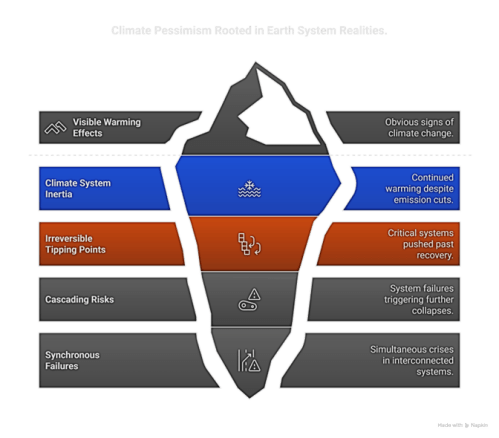
The case for pessimism is grounded in the physical realities of the Earth system, which possesses immense inertia and potential for non-linear dynamics.
Climate System Inertia and “Locked-In” Warming: The central challenge is the inertia of the climate system. Even if global emissions were to cease today, the planet would continue to warm because of past emissions and the thermal inertia of the oceans. This has been referred to as “warming in the pipeline” (Hansen et al. 2023). A significant amount of future sea-level rise and ecosystem injury is already “locked in,” regardless of our current actions.
Irreversible Tipping Points: The greatest risk is that this locked-in warming will push critical Earth systems past irreversible tipping points. A landmark 2022 study in Science by Armstrong McKay et al. found that several key tipping points, including the collapse of the Greenland and West Antarctic ice sheets and the abrupt thaw of permafrost, could be triggered even between 1.5°C and 2°C of warming—thresholds we are on track to cross. The recent die-off of vast areas of coral reefs serves as a stark example of a major ecosystem already crossing this threshold.
Cascading Risks and Synchronous Failures: These tipping points are not independent. The collapse of one system can increase the risk of another failing, creating a “tipping cascade” (Kemp et al. 2022). For example, losing Arctic sea ice reduces albedo and accelerates regional warming, which hastens the thaw of permafrost. Recent research highlights the growing risk of “synchronous failure,” where climate-related shocks trigger simultaneous crises in multiple interconnected systems, including global food supply chains and financial markets. In their exhaustive study of tipping points, Vasilis Dakos and colleagues concluded that the vast amount of remote sensing and other Earth systems data are bringing us closer to the ability to anticipate tipping points. At present, “Early warnings can tell us that “something” important may be about to happen, but they do not tell us what precisely that “something” may be and when exactly it will happen” (. . . , Dakos et al. 2024).
The Verdict: An Intersection After Irreparable Damage
When comparing these two accelerating trends, the scientific literature points to a deeply unsettling conclusion. The positive socio-economic trends of the clean energy transition are powerful, but they are unlikely to move quickly enough to prevent the biophysical trendlines of climate impact from crossing critical, irreversible thresholds. The most likely outcome is a future where humanity successfully reduces the impacts of its farms and cities and decarbonizes its energy and transportation systems, but only after locking in the collapse of several major ecosystems. We will prevent the 4-5°C “runaway greenhouse” scenario, but we will not prevent the loss of all coral reefs and mountain glaciers, loss of some major ice sheets, and significant, permanent loss of significant portions of the biosphere. The “intersection” will not be a moment of salvation, but a point at which we can adapt to a world that has been irreparably damaged. If humanity’s effort to survive is sufficient, civilization will survive, but in a suppressed state that will persist while the earth cools and cleans itself and Earth’s biosphere heals.
Armstrong McKay, D. I., et al. (2022). “Exceeding 1.5°C global warming could trigger multiple climate tipping points.” Science, 377(6611), eabn7950.
BloombergNEF. (2023). New Energy Outlook 2023. Bloomberg Finance L.P.
Claes, D. H., & Pineda, L. G. (2023). “The Inflation Reduction Act (IRA) and the new logic of climate and energy policy.” Energy Strategy Reviews, 50, 101258.
Dakos, V. et al. (2024). Tipping point detection and early warnings in climate, ecological, and human systems. Earth System Dynamics 15: 1117-1135.
Hansen, J., et al. (2023). “Global warming in the pipeline.” Oxford Open Climate Change, 3(1), kgad008.
Homer-Dixon, T., et al. (2015). “Synchronous failure: The emerging causal architecture of global crisis.” Ecology and Society, 20(3).
Hughes, T. P., et al. (2018). “Global warming transforms coral reef assemblages.” Nature, 556(7702), 492-496.
IEA. (2023). World Energy Outlook 2023. International Energy Agency.
IPCC. (2021). Climate Change 2021: The Physical Science Basis. Contribution of Working Group I to the Sixth Assessment Report of the Intergovernmental Panel on Climate Change. Cambridge University Press.
“Silent Earth” has received a five-star “must read🏆” review on Reedsy. Blending scientific depth and practical foresight, this book is both a wake-up call and a guide for navigating environmental collapse.
Synopsis
Silent Earth is a technical reference for civil engineers, land-use and urban planners, and city administrators. It covers a broad range of topics and should serve as a springboard for specialists wishing to learn more about adapting to climate change and biosphere decline.
As the Earth’s living systems deteriorate at an unprecedented rate, human societies face the urgent challenge of adapting to an increasingly unstable environment. Physical Geographer Garry Rogers offers a clear-eyed examination of our options, arguing that while complete restoration of the biosphere is no longer feasible, strategic adaptation remains possible. Drawing on extensive research, Rogers outlines practical approaches for communities to maintain essential functions as ecosystem services decline. While large-scale adaptation efforts face significant barriers, this groundbreaking work shows how planners and administrators can implement effective strategies to enhance resilience in a transforming world. Essential reading for navigating our environmental future. Ideal for policymakers, scholars, environmentalists, and engaged citizens, Silent Earth challenges readers to envision a future where, even amidst biosphere decline, adaptation and innovation can pave the way for survival.
Garry Rogers’ Silent Earth: Adaptations for Life in a Devastated Biosphere explores the escalating degradation of Earth’s biosphere, offering strategies for human adaptation. It points to the realistic inevitability of this need to adjust, as humanity is facing the consequences of irreversible damage already done. Rogers goes beyond the simple dialogue of climate change, expanding and examining the interconnected impact of the entire biosphere, from current impacts such loss of biodiversity to coral reef bleaching.
In Section IV, Rogers draws upon research to emphasize that as soon as 2030 we are on the brink, and that we urgently need to act not only to prevent further destruction, but also to prepare for survival:
The cumulative and synergistic effects of human impacts are pushing ecosystems closer to tipping points. Feedback loops and shifting ecosystem boundaries are accelerating environmental change, while these effects interact in complex ways, amplifying their individual impacts. As we approach 2030, addressing these interconnected challenges will require an integrated approach to conservation and climate action to mitigate the far-reaching impacts on biodiversity and ecosystem stability.
The strength of Silent Earth lies in Section V, which presents a blueprint for adaptation. Rogers proposes various strategies from water management to cultural and governance reforms. His emphasis on grassroots action and local resilience is both pragmatic and empowering, especially given his acknowledgment of the political and societal inertia that is likely to hinder adaptation on a wider scale.
Silent Earth is thoroughly researched, intellectually stimulating, and well-cited. Rogers excels in synthesizing vast amounts of ecological, social, and technological data into a cohesive narrative.
Silent Earth is a valuable resource for those interested in interdisciplinary approaches to global challenges. It’s an important and thought-provoking read for anyone seeking to understand and address the complex realities of ecological decline.
GR.–Climate change will destroy many beautiful places. It’s not just a threat anymore. The continue burning of fossil fuels to the present and into at least the near future will change the world.
Bob Berwin.–“LOWER AUSTRIA — Austria’s high alpine pastures, called Alms, are an important part of the country’s cultural tradition. For centuries, herders have driven cattle and sheep up and down the sides of the mountains following seasonal cycles of plant growth and snow melt.
“The livestock grazing is managed mindfully to promote vegetation growth and biodiversity. It may be a difficult concept to grasp at first, but the rhythm of alpine grazing actually fosters biodiversity. Orchids, medicinal herbs and wildflowers thrive in the clearings and create lush green open patches in the landscape that are aesthetically pleasing.
. . . .
“But climate change is taking a toll on Austria. The country’s average temperature has increased by 2 degrees Celsius in the past 50 years, more than twice the global average of .85 degrees Celsius, according to a 2014 climate assessment. That warming spells big changes for mountain environments, including the bucolic pastures around the Alm. For now, the cowbells still chime, but the future is uncertain.” Continue reading: Can the Hochbärneckalm survive global warming? | Summit County Citizens Voice
GR.–Our response to environmental disasters often comes in the form of rescues and recovery aid after the event. The climate emergency is different. The way we’ve ignored forecasts of global warming is comparable to remaining in the house after receiving the forecasts for an approaching tornado and a tsunami. For climate change, however, we will not have a quiet time to rebuild, because the catastrophe will roll on gathering strength for centuries. The disaster recurrence interval will become too short for us to rebuild.
From RobertScribbler:
“What is happening right now is we are catapulting ourselves out of the Holocene, which is the geological epoch that human civilisation has been able to develop in, because of the relatively stable climate. It allowed us to invent agriculture, rather than living as nomads. It allowed a big population growth, it allowed the foundation of cities, all of which required a stable climate.” — Stefan Rahmstorf
RobertScribbler.–“A strong El Nino in 2015 helped to contribute to record hot global temperatures over the past three years. But with so much heat unexpectedly showing up in the global climate system, there’s clearly something else going on. And indicators are that the natural climate variability that human beings have grown accustomed to over the last 10,000 years may now be a thing of the past — as it is steadily overwhelmed by a stronger overall greenhouse gas based warming signature. One that is concentrating more and more warming near the poles.
“2014 was the hottest year on record. But that lasted only until the end of 2015 — which shattered the 2014 global heat record by a big margin. Then 2016 rolled around and produced what could best be described as an insane heat spike during the January through May period. Now, it’s about 95 percent certain that the 2015 record will also fall, leaving 2016 as the new hottest year on record in yet one more climate vertigo inducing temperature jump.”
(“The rate of warming for 2014 through 2015 is just off the charts. This scares scientists, and it should. This makes many climate experts wonder about causes, and it should. Pime suspect for the increased rate of change — amplifying feedbacks in the Arctic. Image source: NOAA Global Analysis and Weather Underground.”)
GR.–These public employees have chosen to aid the oil companies in their efforts to deceive the public. This action demonstrates the power of money over truth. Dump ’em!
Texas Attorney General Kenneth Paxton, center, speaks to the media in Washington in April. (Photo by Alex Wong/Getty Images)
James Osborne.–“A campaign by Texas Attorney General Ken Paxton to end the investigation into ExxonMobil and other fossil fuel companies over false statements on climate change is gaining support among other state law enforcement officials.
“Attorneys general from 13 states signed an open letter Wednesday, arguing that climate change is a public policy debate, not a criminal matter, and urging law enforcement officials in other states to “stop policing viewpoints.”
“We all understand the need for a healthy environment, but we represent a wide range of viewpoints regarding the extent to which man contributes to climate change and the costs and benefits of any proposed fix,” the letter reads. “Nevertheless, we agree on at least one thing—this is not a question for the courts.”
By Brian Kahn.–“We’re officially living in a new world.
“Carbon dioxide has been steadily rising since the start of the Industrial Revolution, setting a new high year after year. There’s a notable new entry to the record books. The last station on Earth without a 400 parts per million (ppm) reading has reached it.
“A little 400 ppm history. Three years ago, the world’s gold standard carbon dioxide observatory passed the symbolic threshold of 400 ppm. Other observing stations have steadily reached that threshold as carbon dioxide spreads across the planet’s atmosphere at various points since then. Collectively, the world passed the threshold for a month last year.
“In the remote reaches of Antarctica, the South Pole Observatory carbon dioxide observing station cleared 400 ppm on May 23, according to an announcement from the National Oceanic and Atmospheric Administration on Wednesday. That’s the first time it’s passed that level in 4 million years (no, that’s not a typo). Continue reading:Antarctic CO2 Hit 400 PPM For First Time in 4 Million Years | Climate Central
The animation showing how carbon dioxide moves around the planet is worth watching: NASA/YouTube
Bob Berwyn.–“New study shows soil moisture is a big factor in global warming equation.
“Methane won’t be the only problem as Arctic permafrost thaws in the coming decades. A new study shows that, as frozen permafrost areas warm and dry out, they will also release more CO2. The study was led by Northern Arizona University assistant research professor Christina Schädel and published in the journal Nature Climate Change.
“The findings show that a 10 degree Celsius increase in soil temperature released twice as much carbon into the atmosphere, and drier, aerobic soil conditions released more than three times more carbon than wetter, anaerobic soil conditions.
“Our results show that increasing temperatures have a large effect on carbon release from permafrost but that changes in soil moisture conditions have an even greater effect,” said Schädel. “We conclude that the permafrost carbon feedback will be stronger when a larger percentage of the permafrost zone undergoes thaw in a dry and oxygen-rich environment.”
“The study was part of an ongoing effort to quantify greenhouse gas releases from thawing permafrost, a critical part of the global warming equation because so much carbon is currently locked up in frozen organic soils in the Arctic. Much of the data came from the international Permafrost Carbon Network that Schädel co-leads with Northern Arizona University professor of ecosystem ecology, Ted Schuur.” Continue reading: How much CO2 will melting permafrost release? | Summit County Citizens Voice




 GarryRogers Nature Conservation
