Invasive Species and the Bighorn Sheep Die-off in Montana Mountains, Nevada

Invasive Species

GarryRogersGR: Human-introduced animals, plants, and disease organisms have destroyed many species and ecosystems. This aspect of the human impact on nature became a global disaster in the 1500’s as we began crossing the oceans. In the lands we reached, we rampaged about with no thought of the seeds stuck to our boots or the diseases carried by our livestock. Then we developed nature. We cut the soil and filled it with pipes and wires and then we entombed its microorganism ecosystem with pavement. We damned streams, dried up springs, cut the forests, stripped the land with cattle and sheep, and we poisoned the water and air. Now comes our grand slam: We’ve added sufficient greenhouse gasses to the atmosphere to give our climate warmer temperatures, droughts, fires, and stronger storms.

How do we react to all that we’ve done? In the current time of competition between oil producers, for example, the temptation to burn more of the cheaper gasoline doesn’t horrify us, no, we call the lower prices a consumer blessing. Fuels Supplied

And so, in all that we do, our species appears to be striving for maximum destruction of earth ecosystems. Here are a few essays I wrote about how this works with invasive plants.

The following article is by Ken Cole on the Wildlife News website (February 19, 2016).
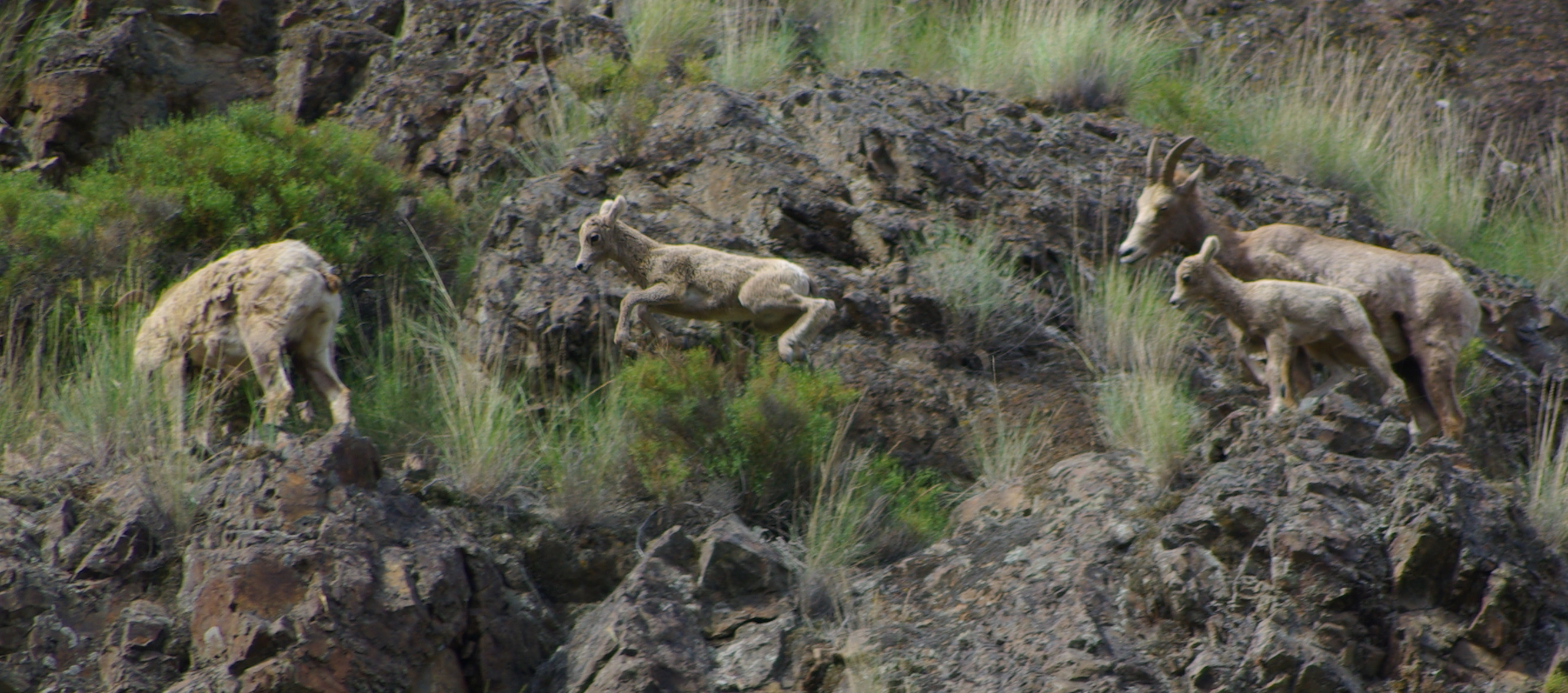
Bighorn sheep by Ken Cole

Bighorn sheep photo copyright by Ken Cole

“On Sunday and Monday, February 14-15, 2016, USDA Wildlife Services took to the skies and shot the remaining 24 bighorn sheep in the Montana Mountains of northwest Nevada at the request of Nevada Department of Wildlife.

“While the exact source of the disease outbreak is not known, it is not surprising that the bighorn sheep in this area are suffering this fate because there are two domestic sheep grazing allotments – the Bilk Creek allotment and the Wilder-Quinn allotment – in the middle of this area and BLM ignored the disease threat that they pose to bighorn sheep.

“In 2012 the BLM began the permit renewal process for one of the allotments – the Bilk Creek allotment – and Western Watersheds Project submitted comments notifying them of our concern about the risk that domestic sheep posed to bighorn sheep in this area. It is well know that domestic sheep are carriers of pathogens that result in deadly pneumonia to bighorn sheep and that even just one nose-to-nose contact between these related species can result in a disease outbreak that commonly kills up to 90% of a herd and kills the offspring of the remaining animals for up to a decade.

“In 2013 the BLM issued the Final Environmental Assessment that dismissed those concerns . . . . ”  Read more at:  http://www.thewildlifenews.com/2016/02/19/bighorn-sheep-die-off-in-montana-mountains-nevada-is-it-any-wonder.

Students create tool to stop pests in their tracks

Every day, invasive species threaten the health of vital agricultural and natural lands, from plants like the fast-growing kudzu vine to animals like the pernicious red scale insect that chomps through citrus crops. The US Department of Agriculture estimates invasives to be a $120 billion problem annually.

Now there is a new tool to help in the fight against these non-native pests, developed by three college students during their summer research program at the National Institute for Mathematical and Biological Synthesis (NIMBioS).

“Prevention is the most cost-effective method for controlling the spread of invasives, but it can be difficult without the proper knowledge. With ComFlo, we aim to provide the information to identify significant pathways of invasion so that managers know which sites to focus their resources on,” said co-developer Ryan Yan, a student majoring in mathematical biology at the College of William and Mary.

Biosecurity Protects Islands

“Without island biosecurity pests will rapidly recolonize islands from which they have been eradicated, or worse still colonise islands for the first time. Only with a rigorous audited biosecurity programme can pest-free status be maintained. The gold standard in New Zealand is Nature Reserve islands like Antipodes Island, where quarantine occurs before, during and after arrival, surveillance occurs pre and post border, and incursion response strategies are in place. The New Zealand Department of Conservation operates a robust island biosecurity programme to protect their conservation investments, but it was reported in the news today that last year numbers spiked, including mice, rats, cats and stoats all making it out to islands. Stranger critters such as ferrets and even otters have reached New Zealand’s offshore islands in the past. Unlike the original pest eradications which cleared these islands, and were years in the planning, a response to an incursion must, as DOC manager Andy Cox points out, be as rapid as if a forest fire had broken out. Pest incursions are the biological equivalent of chemical spills, only the agent can keep reproducing.”  Sourced through Scoop.it from: voices.nationalgeographic.com

GR:  Biosecurity is another term for nature conservation.  It is a relevant concern planet wide.  This article focuses on invasive species, but there are more things people do that are affecting  biosecurity on land and sea.

My lineup for the worst human impacts on nature are:  Greenhouse gases (global warming, ocean acidification), habitat destruction (construction and farming), invasive species (includes disease), resource use (fishing, gathering, grazing, hunting, recreation, and water diversion), and toxic wastes (other than greenhouse gases).  Behind them all looms the great instigator, human population growth.

Watch “The Sagebrush Sea” Tomorrow

The sagebrush vegetation of the Great Basin is the most abused and devastated ecosystem in America. Livestock grazing, introduced invasive plants, and wildfire have replaced it with invasive alien plants.

Sandy Steinman's avatarNatural History Wanderings

This Wednesday, May 20 the PBS show Nature is showing “The Sagebrush Sea”, a documentary shot, edited, and produced by the Cornell Lab of Ornithology’s multimedia team. The film focuses on wildlife and conservation in the threatened sagebrush region that covers 250,000 square miles of North America. Watch the trailer at Sagebrush Sea Trailer. Check your local PBS station for broadcast time. Learn more at The Sagebrush Sea.

View original post

International travel is changing biodiversity

Erin Brodwin says along with international travellers often travel dozens of tiny hitchhikers – foreign plants, insects, and sometimes other animals too.  Source: agenda.weforum.org

GR:  Before plants and animals can invade a habitat and become problems, they must reach the habitat.  Potentially invasive species are no threat if they stay home.  For centuries, we have been spreading plants and animals around the globe, and some of them have invaded the new habitats. Human sailing ships that began crossing the oceans 500 years ago gave a tremendous boost to natural plant and animal dispersal.  Though some plant seeds can blow or float across the oceans, most cannot.  Many, however, can stow away in cargo and on ship hulls.  Regular human travel across deserts and through the jungles began even earlier.  A friend once counted the plant seeds in car-wash drains and found more than 400 species.  Human assisted dispersal is continuing and after global warming and habitat destruction, is the most critical impact that humans have on natural ecosystems.  If Elon Musk and Pope Francis can convince our leaders to solve the global warming crisis, we can turn our attention to other critical issues including population and pollution.  Learn more about invasive plants (https://garryrogers.com/invasive-plant-articles-by-garry-rogers).

Converting A ‘Weedy’ Grass To Quality Forage For Livestock

Messing with Nature and Calling it Range Management

066e4483-c4eb-4d61-ac20-3e2f478c7292.jpg

Purple threeawn

“While native plants are adapted to thrive in our region, they don’t always provide the best forage for livestock or wildlife. But what if you could change that? What if you could convert bad forage to good? That’s the question Agricultural Research Service (ARS) scientist Lance Vermeire asked when studying purple threeawn, a decidedly less than…”

Source: www.roundupweb.com

welfare ranchingGR:  The ignorance displayed by this range manager is shocking.  It should remind us all that focusing too closely on a single goal can cause us to overlook critical alternatives.  This article describes an instance where managing nature to benefit domestic livestock creates a willingness to take chances.  Range managers have gambled on new techniques and new species for many years.  They ignore negative possibilities and focus on their goal—more food for cows or sheep. They do not consider ecosystem responses to their new techniques.  They do not consider the effects on on soil microorganisms, and they do not worry about future invasion potential. The result of similar “range management” has been the loss of more than 100-million acres of productive native grasslands and shrublands in the western U. S.  Go here to read more about the results of foolhardy management of rangelands.

The Fate of Trees: How Climate Change May Alter Forests Worldwide

By the end of the century, the woodlands of the Southwest will likely be reduced to weeds and shrubs. And scientists worry that the rest of the planet may see similar effects

Source: www.rollingstone.com

GR:  Continued harvest (logging and livestock grazing)  will work with wildfires to remove long-lived species.  This is already visible in arid regions.

Imported invasive beavers and minks threaten biodiversity in southern Chile

The proliferation of beavers and minks at Chile’s southern tip – a legacy of a failed attempt to establish a fur industry – threatens biodiversity in one of the world’s most pristine corners.  Source: www.bluechannel24.com

GR:  Human introductions (accidental and intentional) account for 99.99% of invasive species problems.  It all began more than 500 years ago as sailing ships began crossing the great ocean barriers.  Surprising that after all these years, we can still find problem species to transport.

Invasive Tropical Fish Are Changing Ocean Ecosystems

Tropical fish are moving north as the global climate warms, in some cases with devastating impacts to ocean ecosystems.  Source: summitcountyvoice.com

GR:  Invasive species of the land, water, and air are causing greater immediate impacts on Earth ecosystems than global warming.  At present, human activities are spreading far more invasive species than global warming. This will change in the future, but for now, we can stoop many invasives with the well-known methods for inventorying, monitoring, and prevention.  Of course, the cost might be as astronomical as that of a warplane.