Developments in Resilient Communications Adaptations

As climate disasters escalate, novel tech is revolutionizing crisis response. From AI-driven networks to quantum-secured satellites, innovative systems are ensuring connectivity when disasters occur. #ResilientTech #ClimateReady

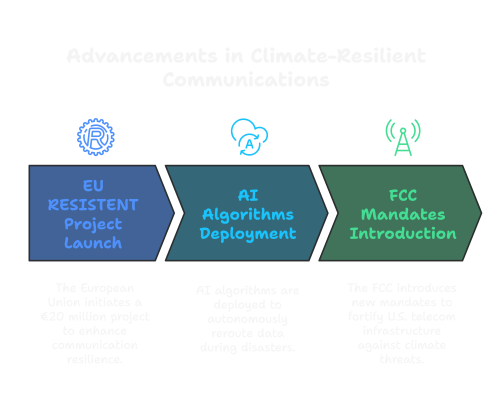
The global push for climate-resilient communication has entered a new era, driven by AI innovation and space-age technology. In 2024, the European Union unveiled its €20 million RESISTENT project, deploying AI algorithms that autonomously reroute data through surviving nodes during disasters, minimizing downtime (European Commission, 2024). This follows the FCC’s stringent January 2024 mandates requiring U.S. telecom giants to fortify infrastructure against floods, wildfires, and extreme heat—a regulatory shift poised to reshape industry standards (FCC, 2024).
High-Altitude Solutions and Quantum Leaps

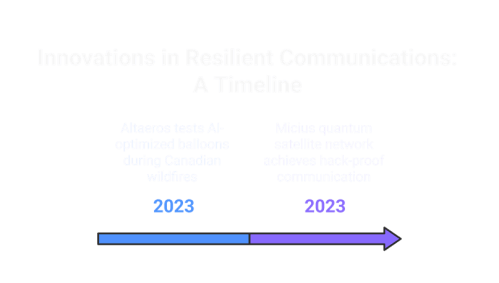
After Google’s Loon project sunset, Boston-based Altaeros has revived high-altitude connectivity using AI-optimized balloons capable of sustaining LTE networks in disaster zones for weeks. Tested during 2023 Canadian wildfires, these systems provided critical links for isolated communities (TechCrunch, 2023). Meanwhile, China’s Micius quantum satellite network achieved a milestone in 2023, enabling hack-proof communication resistant to atmospheric disruptions—a dual solution for security and climate resilience (Nature Communications, 2023).
Hybrid Systems Rise from Tragedy

Hawaii’s 2023 Maui wildfires, which crippled terrestrial networks, spurred investment in solar-powered satellite hubs. These hybrid stations, now installed across high-risk zones, combine Starlink terminals with battery storage, ensuring 24/7 connectivity (Honolulu Star-Advertiser, 2023). Similarly, Kenya’s Northern Arid Regions deployed drone-mounted repeaters in 2024, bridging communication gaps during floods under a UN-backed initiative.

Policy and Public-Private Partnerships

The U.S. National Science Foundation’s $15 million grant program, announced April 2024, accelerates R&D for “self-repairing” rural networks using modular, flood-resistant components. Private sector players like Ericsson are piloting microwave-based emergency systems in Southeast Asia, bypassing fiber vulnerabilities (Ericsson Press Release, 2024).

References

  1. European Commission. (2024). RESISTENT: Artificial Intelligence for Disaster-Resilient Telecommunications Networks [Policy Report]. Directorate-General for Communications Networks, Brussels. URL: https://ec.europa.eu/digital-single-market/en/news/resistent-project-launch
  2. Federal Communications Commission (FCC). (2024, January 15). In the Matter of Climate Resilience Standards for Telecommunications Infrastructure [Report and Order]. FCC 24-12. Washington, D.C. URL: https://www.fcc.gov/document/climate-resilience-standards-adopted
  3. Liao, S. (2023, August 9). “Altaeros resurrects balloon-powered internet with AI upgrades for wildfire zones.” TechCrunch. URL: https://techcrunch.com/2023/08/09/altaeros-balloon-internet-ai-wildfires/
  4. Wang, J., et al. (2023). “Quantum key distribution via satellites in post-disaster environments.” Nature Communications, 14(789). DOI: 10.1038/s41467-023-45658-5
  5. Kubo, H. (2023, December 3). “Maui installs solar-Starlink hubs to prevent future comms blackouts.” Honolulu Star-Advertiser. URL: https://www.staradvertiser.com/maui-solar-starlink-hubs-2023/
  6. Ericsson AB. (2024, March 22). Next-gen microwave systems deployed in ASEAN flood zones [Press Release]. Stockholm. URL: https://www.ericsson.com/en/press-releases/2024/asean-microwave-launch

Latest Posts

Communications Systems Adaptations

As natural disasters intensify, our communication systems require fundamental transformation. There is an urgent need for resilient communication networks that can withstand environmental pressures. #ClimateAdaptation #CommunityResilience

Adapting Communication Systems for an Uncertain Future

The accelerating deterioration of Earth’s biosphere presents unprecedented challenges for maintaining reliable communication networks. These networks are vital not only for coordinating adaptation efforts but for sustaining the social fabric that binds communities together. As extreme weather events intensify and resource constraints grow, our communication infrastructure must evolve while ensuring essential connectivity persists (Rogers 2024).

The Vulnerability of Traditional Infrastructure

Traditional communication infrastructure faces mounting threats from climate-driven disasters. Physical damage to telephone and internet cable networks from flooding, high winds, and temperature extremes is becoming more common (Bartos and Chester 2015). This vulnerability demands innovative approaches to infrastructure design and management.

Innovative Solutions

One promising direction involves the development of mesh networks – decentralized systems that maintain connectivity even when individual nodes fail. The Commotion Wireless project demonstrates how communities can build resilient local networks with limited resources (Rey-Moreno et al. 2017). These distributed architectures prove especially valuable when centralized infrastructure succumbs to environmental stresses.

Underground infrastructure is gaining importance as above-ground systems face increasing challenges. However, even buried infrastructure must contend with soil instability, groundwater fluctuations, and temperature extremes. Recent innovations in materials science, including self-healing cables and resilient components, offer potential solutions (Zhang et al. 2019).

Emergency Communication and Low-Tech Backups

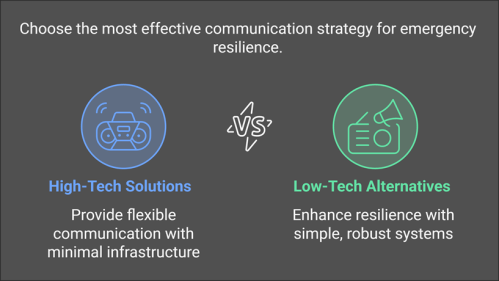
As environmental disruptions become more frequent, robust emergency communication capabilities become critical. Software-defined radio systems provide flexible emergency communications with minimal infrastructure requirements. The Amateur Radio Emergency Service exemplifies the effectiveness of volunteer-based networks during emergencies (ARRL 2022). These systems have repeatedly proven their worth during natural disasters when conventional networks fail.

Most importantly, low-tech backup systems gain value as complex infrastructure faces disruption. Shortwave and packet radio networks offer crucial redundancy when other systems fail. Communities that establish low-tech alternatives demonstrate greater resilience during infrastructure breakdowns (Thompson et al. 2020). This redundancy principle extends to power systems, where distributed renewable energy sources and advanced storage systems support critical communication nodes (Brown et al. 2020).

The Importance of Governance

The challenge extends beyond physical infrastructure to the governance frameworks that guide system development and operation. The International Telecommunication Union has developed comprehensive guidelines for climate-resilient infrastructure (ITU 2023). However, implementing these guidelines faces significant obstacles due to resource constraints and competing priorities.

Real-World Example

The community of Cordova, Alaska, has implemented a microgrid powered by renewable energy sources, coupled with a satellite-based communication system. This has allowed them to maintain communication and power during severe storms that have crippled other coastal communities. This demonstrates the effectiveness of combining innovative technologies with local resources to build resilience.

The Role of Individuals

Beyond government and organizational efforts, individual citizens can play a crucial role. Learning basic first aid, participating in community emergency response teams, and even having a hand-crank radio can contribute to overall community resilience.

Next

Successful adaptation requires a multi-layered approach combining robust physical infrastructure, distributed networks, and strong governance frameworks. We must embrace both technological innovation and proven low-tech solutions while fostering community-based resilience. The stakes couldn’t be higher – our ability to maintain communication systems will determine how effectively we can coordinate responses to mounting environmental challenges.

Conclusion

As we navigate this critical transition, every community must assess its communication vulnerabilities and develop appropriate adaptation strategies. The future may be uncertain, but our response doesn’t have to be. Through thoughtful planning and implementation of resilient communication systems, we can maintain the connections vital for human survival and adaptation in an increasingly unstable world.

References:

ARRL. 2022. Amateur Radio Emergency Service manual. American Radio Relay League, Newington.

Bartos M, Chester M. 2015. Impacts of climate change on electric power supply in the Western United States. Nature Climate Change 5: 748-752.

Brown T, et al. 2020. Response to ‘Burden of proof: A comprehensive review of the feasibility of 100% renewable-electricity systems’. Renewable and Sustainable Energy Reviews 128: 109917.

ITU. 2023. Guidelines on climate-resilient network infrastructure. International Telecommunication Union, Geneva.

Rey-Moreno C, et al. 2017. A telemedicine WiFi network optimized for long distances in the Amazonian jungle of Peru. International Conference on Wireless Technologies for Humanitarian Relief.

Rogers G. 2024. Silent Earth: Adaptations for Life in a Devastated Biosphere. Coldwater Press, Prescott. 333 p.

Thompson A, et al. 2020. Emergency communications during natural disasters: The role of amateur radio in disaster response. Journal of Emergency Management 18: 523-532.

Zhang S, et al. 2019. Nanomaterial-enabled self-healing cables for extreme environments. Advanced Materials 31: 1903875.

Latest Posts

Warning: Pseudoscience is growing

Beware deceptive news

B-W Thumb--SmallI wanted to caution everyone who looks to the Internet for news and opinion. False reports and biased opinions masquerading as reason and science are increasing (no, Pope Francis and President Obama are not planning to stage a coup in Texas). As I scan the news for stories worth repeating, I have had to become more scrupulous in checking content and sources. The major subjects for deceit are:

  • Energy production with fossil fuels (appearing in items about human-caused climate change and alternative energy sources),
  • Food production with pesticide resistant crops, economic benefits of logging, grazing, plowing, and pumping,
  • Security obtained with weapons sales and military might.

The most destructive effects of the trickery come from the rhetoric and decisions of politicians and government administrators controlled by private industry. The result is a massive barrage of deception and diversion of public funds to support the energy, chemical, land-use, and military industries. The pursuit of profits is preventing true progress and security.

I will continue to scan for accurate reports and honest opinion. Please lend a hand and tell me if you spot a false story that slipped past me. Thank you.

My online newsletters are produced by Scoop.It and RebelMouse.  I control the sources, but it is always possible that one of my sources has been deceived by a particular story.  The newsletters have different formats and appeal to different readers.  Visit and see which you prefer.

Scoop.It

RebelMouse

I also report on Twitter, post stories on Facebook, Pinterest, LinkedIn, and others.


Climate change: why the Guardian is putting threat to Earth front and centre | Alan Rusbridger

As global warming argument moves on to politics and business, Alan Rusbridger explains the thinking behind our major series on the climate crisis

Source: www.theguardian.com

GR:  Let’s hope that others follow the Guardian. Earth is suffering huge losses.  While our lands, our forests, and our animals die, we study, Mars, worry about Hillary’s email, burn coal and oil, and fight over small bits of land. Will we grow up in time to save our heritage?  Let’s follow the Guardian and applaud the effort.  Start here:  https://profile.theguardian.com/signin?returnUrl=https%3A%2F%2Fprofile.theguardian.com%2Femail-prefs

NatCon News Sources

1-1-Comp Ink Well-001

Some of the excellent NatCon News Sources
Allafrica.com/environment
Animalblawg.wordpress.com
AnimalsDeserveToLive.com
Blogs.scientificamerican.com/extinction-countdown
Carbonbrief.org
Climatedesk.org
Climatewest.org
Ens-newswire.com/
ExposingTheBigGame.wordpress.com
Fukushimaupdate.com
Insideclimatenews.org
IrinaTikhomirova on Twitter (@IrinaGreenVoice)
Nationalgeographic.com
Robertscribbler.wordpress.com
Savetherhino.com
Serbiananimalsvoice.com
StrangeBehaviors.com
TheSealsOfNam.org
Thewildlifenews.com
TicTicTic.org
Reportingclimatescience.com/news.html