The Other Wolverine Who Rivaled X-Men for Fame – Defenders of Wildlife Blog

Wolverine. By Robert Carleton.

GR:  The pointless killing of this special individual from a rare species indicates just how total is our threat to nature.

M56 never made it to the silver screen, but he fascinated millions, trekking hundreds of miles and bringing much-needed attention to the plight of wolverines.

Source: The Other Wolverine Who Rivaled X-Men for Fame – Defenders of Wildlife Blog

“His movements were first recorded in Wyoming in 2008. He took off in 2009, heading south for hundreds of miles. He traveled across inhospitable lands looking for a place he might fit in and finally settled in Colorado. He wandered around Colorado for years, then headed north once again, possibly up to Montana. He trekked east across flat lands and found himself in North Dakota.

“This is no tale of a wandering, fugitive human, following some wanderlust or trying to find a job. This is M56. He’s a wolverine, the largest (and arguably the toughest) member of the weasel family. These fearless scavengers are incredible — they can drive grizzly bears and wolves away from carcasses, and have been documented climbing 5,000 vertical feet in the middle of winter in less than two hours. M56 was an ambassador for his species, captivating the entire state of Colorado with hope of a reestablished wolverine population, and inspiring all who learned of his immense travels and ability to traverse unlikely habitat. Sadly, wolverine M56’s remarkable life and unbelievable journey ended a few weeks ago near Alexander, North Dakota, where he was killed by a ranch hand who didn’t recognize what M56 was and thought he could threaten livestock.”

Human Population Answers

Earth’s Human Population Problem

Book--Over Pop 2

Click the book to read online.

I learned about human population as mathematical relationships between migration, birth rates, and death rates. As I started my academic career, I continued to use the numbers, the formulas and projections to discuss population. My students learned about population growth, but the numbers didn’t create much excitement.  [Click here for current numbers.]

In the years since I began lecturing about population, injuries to Earth’s ecosystems have spread around the planet. We no longer need math to see what will come; it’s visible everywhere. This book, “Over,” illustrates the human impact on nature with a set of magnificent photographs. In sequence, the photographs first show how we are damaging the planet and then they show the beauty that can be ours if we want to fight for it.

The beautifully written essays that accompany the photos discuss the consequences of feeding the 10 billion or more people the United Nations projects will be alive by this century’s end.  The authors explain that producing enough food will require conversion of the Earth into a factory farm for humans.

The writers point out that reducing our birth rate will not require any form of coercion.  Evidence from developed countries clearly shows that with education and access to birth control, women freely choose to have fewer children.

The chart below shows that the most recent world population projections by the United Nations sets the probable number of people alive in 2100 (the solid red median line) at 11.3 billion.  The needs of that many people will crush the life out of the Earth.

UN 2015 World Pop Projections for 2100

The writers do not attempt to describe the future that someone born this year (2015) will face when the year 2100 arrives.  Will that elderly person be living on a food-factory planet still dominated by the growth objectives of corporations and countries, or will they be living in a beautiful world they helped save?  Will they be unsure of the future?  If the Earth has become a human food factory by 2100, will population and artificial food sources continue to rise, or will businesses find new ways to grow and profit from a static supply of workers and consumers?

Answers:  Responding to the Population Problem

Click this link to follow the population and immigration news.

For the past 50 years, our leaders have done almost nothing to slow population growth.  There have been a few national programs (see the review in Wikipedia), but certainly no real successes.  Looking at the photos in the book, the inaction seems irresponsible, an incredible failure.  It will take the utmost pressure from all of us to make our governments form strategies to reduce population.  I don’t know what we can do about the universal growth imperative of our businesses, but that is a key problem that we must solve.  For a first step, I hope you will go to the Global Population Speak Out website and choose one of the ways to help communicate the seriousness of the population problem.  You might also wish to check on the population control programs by the Center for Biological Diversity.

Description:

  • Title:  Overdevelopment, Overpopulation, Overshoot
  • Authors: Tom ButlerMusimbi Kanyoro, William N. Ryerson, Eileen Crist
  • Hardcover: 330 pages
  • Publisher: Goff Books (February 17, 2015)
  • Language: English
  • ISBN: 978-1939621238

Grieving over Growth. Gary Gripp: To a Future Generation

BY GARY GRIPP, to a future generation:

“Everything central to our way of life is in the growth mode: the banks, the corporations, all our extractive and service industries, and, not least of all, our population. More people means: more willing buyers of homes, cars, electronic gadgets, and all the trappings of modern life. More jobs, more prosperity, more everything.

“More, more, more. It is in the interest of banks and corporations, as well as businesses large and small, that the market for products continues to grow. More, more, more. Grow, grow, grow.

“On a finite planet with degraded natural systems and diminishing natural resources, this growth imperative, built-in to our systems and into our lives, is an irresistible force coming up against an immovable object. It is us hitting a wall, and doing so at speed. More and more people in my time now see this crash coming.” blog.edsuom.com

GR:  Hey grandkids, we just couldn’t help ourselves.  (We really couldn’t.  To see what it would take for humans to survive on Earth, read Corr Syl the Warrior.)

Nature News Digests

GarryRogersNature News Digests:

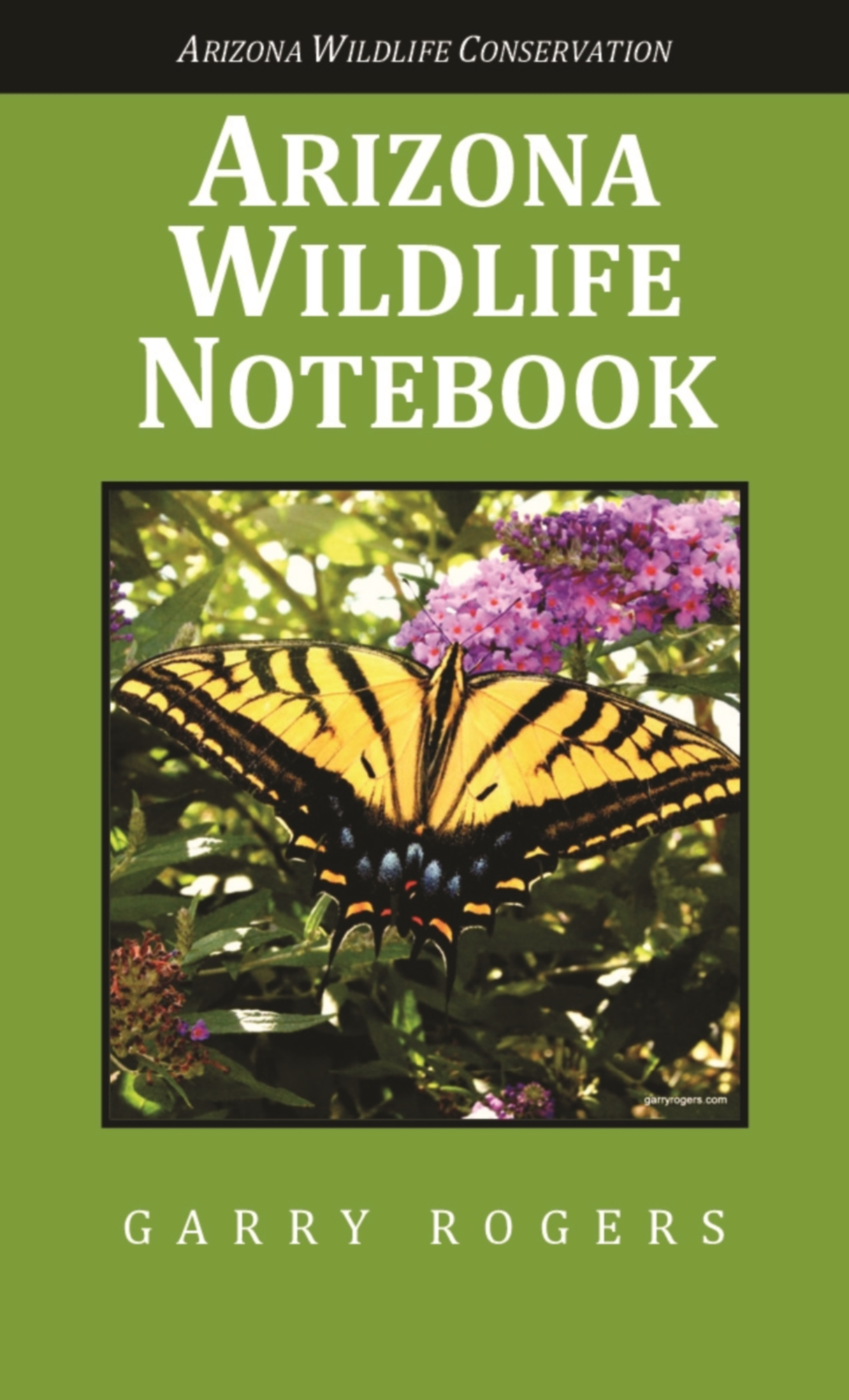
Arizona Wildlife Notebook Revised – #Wildlife, #Arizona, #Conservation

Arizona Wildlife Notebook

A new edition of the “Arizona Wildlife Notebook” is available.

In the year, 2015, lethal heat waves and storms made it clear that humanity was changing the Earth.  Anyone who paid attention to the news knew that Earth’s animals and plants were disappearing.

Animal Declines

This figure from the review by the World Wildlife Fund (2014) shows that, from 1970 to 2010, Earth’s animals declined by 52%.

I have come to believe that nature conservation is the great challenge of our time. Human beings are imposing a mass extinction that will eliminate almost all animals on Earth. We may not be able to stop this, but I believe that the Notebook will be useful for anyone who hasn’t given up and wishes to work to protect Earth’s creatures.

Arizona Species Conservation Status

For this edition of the Notebook, I added more information on conservation.  The table below shows group status for species that AZGFD specialists consider critically imperiled (S1), imperiled (S2), and vulnerable (S3).  It also shows group status according to the Endangered Species Act (ESA) for Threatened (LT) and Endangered (LE) species.  I didn’t include butterflies, moths, damselflies, and dragonflies in this table because the status of most species in those groups is unknown.

Many species that the AZGFD says are critically imperiled are not given national recognition and protection by the U. S. Endangered Species Act (ESA).  It seems that only after species are mostly gone that protection becomes available.  Thus, the ESA achieves very little overall protection from biodiversity loss.

ARIZONA WILDLIFE CONSERVATION STATUS

Species Group

Total  minus

Exotic & Extinct

AZGFD

S1+S2+S3

ESA

LT+LE

Amphibians

31

18 (58%)

2

Birds

451

260 (58%)

9

Fish

40

40 (100%)

13

Lizards

67

27 (40%)

0

Mammals

189

64 (34%)

15

Snakes

76

35 (46%)

1

Turtles

10

6 (67%)

2

TOTAL

864

450 (52%)

42

The third column shows how many species AZGFD considers at risk.  For instance, all native Arizona fish species are at risk, and about one-third of native Arizona mammals are at risk.  Being “at risk” usually means that numbers are dropping.  The principal causes are construction of buildings and roads, and invasive plants and animals.

Click–Arizona Wildlife Notebook–for a free copy of the 168-page book formatted as a PDF “fillable form.” If you like the book, tell others. Write a review for Amazon: http://mybook.to/AZWildlifeNotebook , or Goodreads: http://bit.ly/1Mkgmei.  If you would like to review a printed copy of the book, send a note using the form below.  Thank you.

Now that you’ve downloaded the book, you have a conversation-starter for tonight’s warm-up party for World Animal Day!

Go back

Your message has been sent

Warning
Warning
Warning
Warning

Warning.

Record-Breaking Wildfires, Greenland Melting and Earth’s Hottest Month Ever

Humans have some advantages over other animal species, but like the animals, we can’t control our urge to reproduce and our desire for the security of material wealth. Sentient but not sapient, sensitive but not wise, our advantages have let us to eliminate competition, disease, and danger. Thus, nothing can stop our booming population and our world-destroying “environmental footprint.”  (ACD = anthropogenic climate disruption)

Exposing the Big Game's avatarExposing the Big Game

The following article from Truthout.org covers all that I was going to go over in Part 2 of Global Warming: the Future is Now, so here’s this instead:

Featured Image -- 10312

Dahr Jamail | The World on Fire:

The US is now officially in the worst wildfire season in its history, as almost 7.5 million acres across the country have burned up since spring.

Articles about ACD’s impacts are now being published in more mainstream outlets, carrying titles that include verbiage like “the point of no return,” and it is high time for that, given what we are witnessing.

A recently published study by the UK-US Taskforce on Extreme Weather and Global Food System Reliance revealed that “major shocks” to worldwide food production will become at least three times more likely within the next 25 years due to increasingly extreme weather events generated by ACD. One of the coauthors of the report…

View original post 1,998 more words

Deforestation in Mexico butterfly reserve more than triples

In this Jan. 4, 2015 file photo, a kaleidoscope of Monarch butterflies hang from a tree branch, in the Piedra Herrada sanctuary, near Valle de Bravo, Mexico. Illegal logging has almost tripled in the monarch butterfly’s wintering grounds in …more.

“Illegal logging more than tripled in the monarch butterfly’s wintering grounds In central Mexico, reversing several years of steady improvements, investigators announced Tuesday.

“Almost all of the loss occurred in just one rural hamlet in the state of Michoacan. Loggers cut down 47 acres (19 hectares) of trees in San Felipe de los Alzati since last year’s gathering of butterflies. A total of 52 acres (21 hectares) of forest in the reserve were lost overall, including losses due to drought or pests.”

That’s the highest figure since 2009, well above the 20 acres (8 hectares) lost in 2014, according to the announcement by the World Wildlife fund and the Institute of Biology of Mexico’s National Autonomous University. The 2014 loss was about 12 acres (5 hectares) due to logging and 8 acres (3 hectares) to drought.

Sourced through Scoop.it from: phys.org

How Much Will Antarctica and Greenland Ice Raise Seas?

Scientists have figured out the worst that could happen if the mammoth chuck of continental ice at the bottom of the world—the West Antarctic Ice Sheet—continues melting. By 2100, ice sheet melt would raise sea levels by 7.9 inches, enough to pose a risk to low-lying nations, according to a study published today in The Cryosphere.
By 2200, ice sheet melt would raise sea levels by 1.6 feet.

The melted water from Antarctica and Greenland, glaciers, and the thermal expansion of the ocean due to higher temperatures are expected to raise sea levels by 3.3 feet in 2100, according to the Intergovernmental Panel on Climate Change. That would be sufficient to submerge 17 percent of Bangladesh.  Sourced through Scoop.it from: www.scientificamerican.com

GR:  Adding all that freshwater to the oceans will have enormous impacts that are quite horrible in comparison to simple coastal flooding.  Read about the possible outcomes HERE.

Extinction Resources: Information, Opinion, Ideas, & Questions

Extinction Information Resources

PassengerPigeon

Passenger Pigeon

Stopping human-caused extinction of Earth’s plant and animal species is the greatest challenge of our time. This post provides access to the latest articles on extinction. The first item (Ceballos et al. 2015) is the latest detailed report on what we know and how we acquired the information.

 Ceballos, Gerardo, Paul R. Ehrlich, Anthony D. Barnosky, Andrés García, Robert M. Pringle, and Todd M. Palmer. 19 June 2015. Accelerated modern human–induced species losses: Entering the sixth mass extinction. Science Advances Vol. 1, no. 5 (e1400253, DOI: 10.1126/sciadv.1400253). Corresponding author. E-mail: gceballo@ecologia.unam.mx.

More than a thousand recent articles are linked to my blog (https://garryrogers.com/blog):

Causes of Extinction

My blog covers the things that people do to cause extinctions and reduce biodiversity. These deeds of ours are woven into individual and our collective habits and beliefs. Stopping them will alter our society and our culture. It will be difficult. Our population must be reduced, our food choices must change, and our resource harvest must decline. Nothing less will succeed. Search the blog using the following terms for recent reports:  Burning, Coal, Construction, Deforestation, Desertification, Energy, Farming, Fishing, Fracking, Grazing, Hunting, Invasive Species, Logging, Mining, Oil, Pesticides, Pet Trade, Pollution, Population, Roads, and Soil.

Climate change will become the major cause of extinction.  Here’s its search link on my blog:  Climate Change.

For more reading, my Internet newsletters include a wider variety of articles than my blog.