Activist calls for removal of leg-hold traps on public lands

Trapping, hunting, livestock grazing, logging, mining, and more are the ways that public land is used. Not for the sake of the land or its creatures, but for the benefit of one species. And not even in the best interests of that species, land use of the public land has never been sustainable; it has always been destructive. Our schools do not tell our children about nature, and our leaders whose “beliefs” are determined by the finances of special interests deny it. A century and a half ago, Humboldt, Thoreau, Marsh, and others recognized and alerted us to the demise of nature in the name of progress and profit. Blocked by our leaders, the message has been repeated by Leopold, Abbey, Wilson and others whose wisdom is no match for human avarice and impatience.

Exposing the Big Game's avatarExposing the Big Game

Activist calls for removal of leg-hold traps on public lands

http://www.santafenewmexican.com/life/features/activist-calls-for-removal-of-leg-hold-traps-on-public/article_244c1088-fc31-5ad1-bf6b-b06f9cbbc585.html#.Vm2qoPjl6N4.facebook

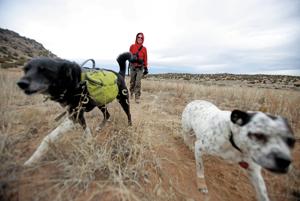
Z Jacobson of Santa Fe walks Friday with her dogsNoodles on Dead Dog Trail off Old Buckman Road, where Noodles got caught in a trap. The experience has turned Jacobson into an activist, with a goal of banning leg-hold traps on public lands. Luis Sánchez Saturno/The New Mexican

Posted: Saturday, December 12, 2015 

Z Jacobson was hiking with her dogs, Noodles and Lulu, and a friend along a new trail off Old Buckman Road in the Santa Fe National Forest on Thanksgiving Day.

It’s ominously called Dead Dog Trail, and it leads to the top of the Caja del Rio Plateau. Jacobson’s friend had helped build it, and she was interested in touring a couple of canyons along the way said to contain rock art.

During the hike, they walked over to a cliff and were admiring the view when…

View original post 907 more words

Demonstrate for an End to Global Warming

Climate-change demonstrations show our leaders that we want them to take steps to stop global warming. We must also ask our leaders to change the human activities that are causing climate change.

  1. We want them to block corporate control over our government and the decisions it makes.
  2. We want them to end international sales of weapons and begin to encourage peace and a focus on life style and resource use.
  3. We want them to discourage unsustainable resource harvests.
  4. We want them to encourage human rights and equality.
  5. We want them to speak out for wild animals and natural ecosystems.
  6. We want them to call for restoring the damaged lands and seas.
  7. And finally, we want them to oppose gender inequality and overpopulation.

Even if we stopped burning fossil fuels today, activities causing climate change would continue. Farming, deforestation, industrial fishing, desertification, construction, and growth of the human population would continue to waste the Earth and release CO2 and other greenhouse gases.

822e6515-ef8b-4ba3-840b-8d4921eca1b6.jpg

e867c623-988a-4361-ae66-a2bc07c7ba96.jpg

Consume more, conserve more: sorry, but we just can’t do both | George Monbiot

“Governments urge us both to consume more and to conserve more. We must extract more fossil fuel from the ground, but burn less of it. We should reduce, reuse and recycle the stuff that enters our homes, and at the same time increase, discard and replace it. How else can the consumer economy grow? We should eat less meat to protect the living planet, and eat more meat to boost the farming industry. These policies are irreconcilable. The new analyses suggest that economic growth is the problem, regardless of whether the word sustainable is bolted to the front of it.

“It’s not just that we don’t address this contradiction; scarcely anyone dares even name it. It’s as if the issue is too big, too frightening to contemplate. We seem unable to face the fact that our utopia is also our dystopia; that production appears to be indistinguishable from destruction.”  From: www.theguardian.com

GR:  In Arizona, the government asks us to conserve water while, at the same time, the government invites more people and businesses to move here.  Perhaps we should begin awarding huge cash prizes for promoting zero growth.

Forest Service Revs Up Push to Open Over 170 Million Tons of Coal to Mining From Colorado Roadless Forest

Proposed Loophole Could Cause Millions of Tons of Carbon Pollution, undermine Obama Administration Climate Goals, and Degrade Wildlife Habitat

DENVER— National and local conservation groups today condemned a decision by the U.S. Forest Service to continue pressing to open national forest roadless areas in Colorado to coal mining.
Bulldozer
Photo of bulldozer near Sunset Roadless Area courtesy U.S. Forest Service. Photos are available for media use.

In a notice filed today, the Forest Service announced it would move forward by issuing a draft environmental impact statement on the proposal to pave the way for mining. The proposal would reopen a loophole in the “roadless rule” for national forests in Colorado to enable Arch Coal — the nation’s second largest coal company — to scrape roads and well pads on nearly 20,000 acres of otherwise-protected, publicly owned national forest and wildlife habitat in Colorado’s North Fork Valley.

The loophole was thrown out by the U.S. District Court of Colorado last year because the Forest Service had failed to consider the climate change impacts of mining as much as 350 million tons of coal in the national forest. (Today’s notice reduces the estimated coal available to 173 million tons.) The Forest Service admits that reopening the loophole could result in hundreds of millions of tons of additional carbon pollution from mining and burning the coal. That carbon pollution could cost the global economy and environment billions of dollars, according to today’s notice.  From: www.biologicaldiversity.org

GR:  Apparently, the U. S. Forest Service isn’t satisfied with just clear-cutting the forests; it wants to widen its attack with more roads and more global warming CO2 emissions.  Way-to-go Forest Service!

Finland’s nuclear waste burial plan

As in all things we do, we humans have a very shortsighted view of the future. We have 5-year plans, we discuss what might happen by the end of the century, and all the while, we are destroying species and ecosystems that took thousands of years to develop. Nuclear wastes will be with us for tens or hundreds of thousands of years. Don’t we expect to be around still? Do we expect that within a few hundred years we will have found the means to destroy our wastes? Scientists are warning that our civilization may not survive human-caused global warming and our planet-wide ecocide. Our descendants, living in collapsing buildings and searching the ruins for anything edible, do not need radiation sickness to contend with as well.

Christina Macpherson's avatarnuclear-news

flag-Finlandwastes-1Finland’s Nuclear Waste Solution. IEEE Spectrum,  By Sandra Upson 30 Nov 2009 Here on Olkiluoto Island, the forest is king. Elk and deer graze near sun-dappled rivers and shimmering streams, and humans search out blueberries and chanterelle mushrooms. Weathered red farmhouses sit along sleepy dirt roads in fields abutting the woods. Far beneath the vivid green forest, deep in the bedrock, workers are digging the labyrinthine passages and chambers that they hope to someday pack with all of Finland’s spent nuclear fuel.

Posiva, the Finnish company building an underground repository here, says it knows how to imprison nuclear waste for 100 000 years. These multimillennial thinkers are confident that copper canisters of Scandinavian design, tucked into that bedrock, will isolate the waste in an underground cavern impervious to whatever the future brings: sinking permafrost, rising water, earthquakes, copper-eating microbes, or oblivious land developers in the year 25 000. If the Finnish…

View original post 1,447 more words

Choking air, melting glaciers: how global warming is changing India

Globally, India is the third largest carbon-emitting country—though its per capita emissions are only one third of the international average—according to the World Resources Institute.

In its action plan for the Paris COP21 meet, India pledges to reduce its carbon intensity—a measure of a country’s emissions relative to its economic output—by 35% by 2030.  From: phys.org

GR:  Taking a long view of developments in India, one can see that from a bright beginning in 1950, the country has descended through failure after failure. Population control has failed, living standards (health and wealth) are extremely imbalanced, and wildlife and its habitats are disappearing. As climate change adds to the other human impacts, farming will fall farther and farther behind the needs of the swelling population. By 2040 or so when emigration becomes necessary, Europe, Russia, and China will have become fortresses. Where will the people go?  And we have to ask, was it all worth it?  Did the urge to reproduce have to be satisfied at the cost of all else?

Some wild animals more tolerant of human interaction than others

02-20090220-20090220-P1020064

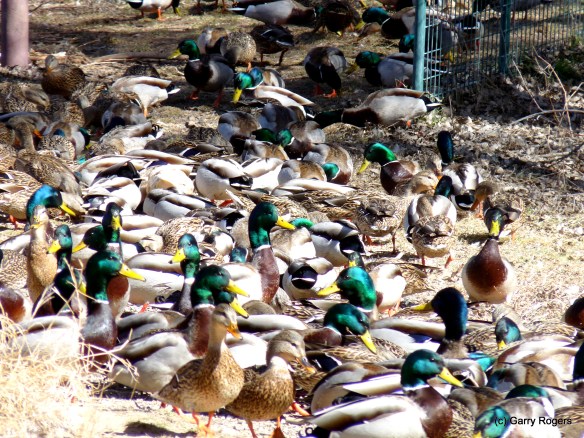
Wild Mallards

Bird Photos

Flower Photos

“The researchers’ findings could ultimately help shape wildlife conservation practices. The paper notes, for example, that protecting smaller birds might be more dependent on creating environments that reduce human disturbance. The paper also suggested that ecotourism—which has been said to be dangerous to animal species in general—might be less harmful to larger birds than previously thought because larger animals are more likely to be able to tolerate human disturbance.”  From: phys.org

GR:  Outdoor recreation, including ecotourism, and eco-education, is one of largest human impacts on nature.  Researchers have repeatedly shown that human presence is harmful to birds.  The study reported in this article found that ecotourism is less harmful to larger birds. It didn’t find that ecotourism was not harmful at all.

Kids in Mexico block a development that would pave over a mangrove forest

mangrove-plant“When it comes to fighting environmental battles, low expectations are kind of the name of the game. So when a group of warm-hearted kids tries to stop a massive development project in the name of environmental protection, they ought to be met with immediate and soul-crushing failure, right?

“But, as we’ve seen recently in Washington, the tide may be turning! As Quartz reports, a group of 113 youngsters in Mexico garnered a big win for their local community — and, you know, the air and water around them. They petitioned a judge to halt the pending destruction of 170 acres of mangrove forest in Cancún to build a mixed-use resort development, arguing that they have a constitutional right to a healthy environment. The judge apparently agreed that fancy new homes, shops, and a boardwalk didn’t quite fit that definition.

“Mexico’s tourism development agency put this project in the works more than two decades ago, and if it doesn’t go forward, investors stand to lose something like $900 million, Quartz reports. But, as one four-year-old explained to Quartz, “If we cut everything down then we’re going to die. … Trees help us breathe.” That’s a compelling point — and makes it pretty hard to give a shit about those investors, $900 million or no.

“Here’s Quartz with more on the unfolding drama:

Sourced through Scoop.it from: grist.org


Walking in a Welsh rainforest

You don’t have to go to Brazil to trek through a rainforest – Snowdonia has its very own wet woodland just waiting to be explored
Does the phrase “save the rainforest” conjure up visions of: a) Brazil, b) Borneo, or c) north Wales?  www.theguardian.com

GR:  How to preserve the forest?  Block the trails and stay out of it.  Look on from the edge.  Hikers carry invasive organisms and they disturb wildlife with their scents and sounds.  Nature is dying and we have to become more responsible in our care for the remnants.