Colorado Parks and Wildlife targets illegally stocked pike in Green Mountain Reservoir with a bounty for anglers | Summit County Citizens Voice

Non-native predators could threaten endangered species in Colorado River.

Colorado wildlife managers will try to curb expansion of non-native northern pike in Summit County’s Green Mountain Reservoir by paying anglers a $20 bounty for each fish they deliver to the Heeney Marina.

The illegally introduced fish are taking a toll on trout in the reservoir north of Silverthorne and could escape to the Blue River and make their way to the Colorado River. That could add to the challenges of trying to recover four endangered native Colorado River fish species, according to Colorado Parks and Wildlife.

Source: Colorado Parks and Wildlife targets illegally stocked pike in Green Mountain Reservoir with a bounty for anglers | Summit County Citizens Voice

Feds outline plan to curb invasive species

“Early detection and response, partnerships across jurisdictions seen as critical measures

“The spread of invasive species has been identified as the second-leading cause of extinctions among all plants and animals worldwide — and the problem is getting worse in the era of global trade. Just a few months ago, scientists warned that North American amphibians are at risk from an invasive fungus. White-nose syndrome, which has wiped out millions of bats, may have also spread to the U.S. from Europe.

“Federal officials now say they have a plan to try and curb the proliferation of invasive species by focusing on early detection and swift response. The measures are outlined in a report released by the Interior Department: Safeguarding America’s Lands and Waters from Invasive Species: A National Framework for Early Detection and Rapid Response.

“Invasive species pose one of the most significant ecological threats to America’s lands and waters,” said U.S. Department of the Interior Principal Deputy Assistant Secretary Kristen J. Sarri. “Early detection and rapid response actions can reduce the long-term costs, economic burden, and ecological harm that they have on communities. Strong partnerships and a shared commitment to preventing the spread of invasive species can lay the foundation for more effective and cost-efficient strategies to stop their spread.”  From: summitcountyvoice.com

GR:  Though the invasive-species threat is real and much damage has already been done, the U. S. land management agencies do very little to control the problem.  Every few years, the agencies repeat the ideas covered in this post and then don’t act.  In fact, the USDI already has policy guidance on the books that include Early Detection and Rapid Response (EDRR), and it has plans drawn up for weed control in specific areas.  However, it never implements the plans.  The problem is that true invasive-species management would require changes in the way the land is used.

Land-use changes required for effective invasive species control would be expensive, but more importantly, they would lower the profits of the mining, logging, and grazing industries using the land.  Because the U. S. government is more concerned with corporate profits than with sustaining the land, executive, legislative, or judicial action blocks attempts by agencies to perform effective invasive species control.  The same shameful behavior occurs in every government on Earth.  Thus, we are not surprised to learn that the spread of invasive species and many other destructive human practices are eliminating forests, wild animals, and the crucial top layer of soil.

These are not new problems, people have commented on them for thousands of years.  As the human impact has grown, the comments have grown more detailed.  Alexander Humboldt, for instance, after touring South America in the first years of the 18th Century, wrote extensively about the abuse of the land for the sake of profit.
Casualties of the Vanishing West

GR:  Wild horses compete with deer, antelope, and other wildlife. They also compete with cattle, the principal occupant of the western ranges. It is sometimes difficult to manage the invasive species that we’ve introduced over the past 600 years. It is especially difficult when we eliminate potential predators. As things stand, it is impossible to say whether wild horses might merge with native animals/ecosystems if we removed the cattle and allowed wolves and lions to return. I for one would really like to try it.

Exposing the Big Game's avatarExposing the Big Game

Sunday, 27 December 2015
Written by
Sonia Luokkala

By Sonia Luokkala, Earth Island Journal

Chief, a Kiger mustang born in the remote wilderness of Utah, lives with 400 other rescued wild horses and burros in a 1,500 acre sanctuary, hundreds of miles from his original home. Years ago the stallion was captured in a round up led by the Bureau of Land Management. After a long helicopter chase, he ended up in a government-run holding facility for years before being adopted by Return to Freedom Wild Horse Sanctuary in Lompoc, CA. Not all horses rounded up by the BLM are as lucky.

Over the past four decades the BLM has eradicated or moved to holding facilities more than 70 percent of the country’s wild horse population.Over the past four decades the BLM has eradicated or moved to holding facilities more than 70 percent of the country’s wild horse population. (Photo: Bureau of Land Management – Utah)

The majority of captured equines remain stuck for years, if not for the rest of their lives, in cramped holding facilities…

View original post 140 more words

Introduced species and biodiversity

https://www.youtube.com/v/wRgJ-IexHKk?fs=1&hl=fr_FR

Great animation from the California Academy of Sciences about Introduced or exotic species, how and when they become also invasive, and the problems … Sourced through Scoop.it from: www.youtube.com

GR:  This is one of three excellent presentations.  I highly recommend them to anyone who wishes to learn more or teach more about these critical subjects. I once believed that invasive species would wreck Earth’s ecosystems before global warming became a serious force.  The effects of global warming are coming faster than expected, however, and I now believe that stopping our CO2 emissions is our number one priority, a little ahead of reducing our population, preventing invasive species introductions, and so forth.

Wild Horses a Problem for Ranchers? Wolves Could Fix That

I agree with Mr. Conniff’s response that predators could control the horse problem. First, the cattle have to go. The cattle use range resources that should support pronghorn and other wildlife species.
Cattle are probably as adapted to predators as other species, but as a preferred species, cattle numbers are artificially high. The result is that cattle, and more recently horses, have overused the range and eliminated other species.
Analysts report that cattle numbers on the ranges have been declining, and currently represent a tiny fraction of the national economy. No significant number of jobs or other economic or political issues would be impacted if we shutdown cattle ranching. Perhaps it’s time that we hired ranchers to become conservationists and work to maintain the range for wildlife. The ranchers I’ve met claim to know and care for the land. So why not suspend cattle grazing on the public lands and hire the ranchers as stewards of the land. This would give ranchers stable income, and it would benefit the national economy.

Richard Conniff's avatarstrange behaviors

wild_horses_0Today’s New York Times has a report on the wild horse population boom in the American West, and for once, I agree with the ranchers:  Bizarre federal policies over the last 40 years have caused wild horses to run out of control, causing rampant overgrazing while also running up out-of-control costs (currently $50 million a year) to house horses that have been taken off the land, but can’t be euthanized.

The federal policies are the result of misguided sentimental attitudes about a favored species, the same sort of attitudes that cause city people to feed feral cats in parks that would otherwise be havens for wildlife. If animal rights activists want to protect excess horses from being euthanized, or sold for meat, they should be picking up that $50 million cost of housing them, not taxpayers.

And here’s an idea for the ranchers: If you want to keep down the…

View original post 376 more words

Garry Rogers Nature Conservation News

What is the Nature Conservation News?

VultureMy online Scoop.It newspaper, Garry Rogers Nature Conservation News began operating last September.  It presents news stories called scoops.  My scoops are mostly concerned with animals and their interactions with humans.  I sometimes scoop interesting items about writing, and I scoop the rare items of science fiction news that involve stories and books with a nature conservation theme.  This post is a request for your help with scoop suggestions.  (Visit the news). Continue reading

Arizona Fish Update–November 2013

By Garry Rogers

Arizona Fish Habitat

A Beautiful Desert Stream Runs Through the Heart of Dewey-Humboldt, Arizona.

Small stretches of the Agua Fria River in central Arizona are perennial. The water is polluted by farm fertilizer and mine tailings. Invasive species are abundant.

The U. S. State of Arizona occupies a dry region with limited precipitation, high evaporation, and not much surface water.  Widespread winter rain and snow, and heavy summer rain can escape evaporation by penetrating the soil and accumulating in fractured rocks and sediments on slopes and in valley floors.  The moisture soaks down slope through the sediments, and appears in springs, intermittent streams, and a few perennial streams and small lakes.  Many isolated endemic and rare species are present in these small moist habitats across the state.  (The header image is a Beautiful Shiner (Cyprinella formosa) photographed by René Reyes of the U. S. Bureau of Reclamation.)

Continue reading

Arizona Fish Endangered

Arizona Fish Extinctions

Noel M. Burkhead of the U. S. Geological Survey, recently performed an analysis of the extinction rate for North American fish (Burkhead 2012).  Burkhead used the fossil record to determine that throughout geological history, one fish species went extinct about every three million years.  During the past century, 57 fish became extinct, making the modern rate almost 900 times as fast as the historical rate.  Extinctions may have been abrupt in Earth’s past, but probably none were as abrupt as the current event.

The growing probability of extinction of Arizona’s native fish is easy to explain.  The exploding human population has caused widespread degradation and elimination of water habitats.  We have dammed and diverted streams, depleted the groundwater that created springs, and dumped wastes in or near stream channels.  We have introduced exotic species such as carp, bass, and trout that compete with natives, and we have damaged or destroyed the protective vegetation of the watersheds.  We call it progress when we replace natural habitats with houses and roads.   And we ignore the impact on watersheds by introduced fire-prone alien weeds, forest removal, and livestock grazing.

Gila Trout –

About 50 years ago, two Arizona scientists, Robert Miller and Charles Lowe, analyzed the status of Arizona fish.  They reported that elimination of habitats and introduction of exotic species was threatening many species and might soon extinguish the native gila trout (Salmo gilae), humpback chub (Gila cypha), Colorado squawfish (Ptychocheilus lucius), Little Colorado spinedace (Lepidomeda vittata, restricted to Arizona), desert pupfish (Cyprinodon macularius), and Gila topminnow (Poeciliopsis occidentalis) (Miller and Lowe 1964:  133). Continue reading

Invasive Species

Invasive Species:  Our Accidental Attack On Nature

The story of invasive species and their alteration of native habitats is one of the most disappointing tales to be told of human interaction with nature. It is full of surprises, unsolved mysteries, scientific research, and reactive management that too often exemplifies the adage, “too little too late.” This post summarizes the main elements of the plot and its conclusion. It begins about 500 years ago when people started crossing the oceans and taking boatloads of new species to North America and other parts of the world. Some of the new species invaded native habitats, replaced the natives, and became permanent residents. Of all the things people have done to the wildlife and wildlife habitat of the Agua Fria River Basin—road and building construction, ranching, logging, hunting, farming, fertilizing, recreation, burning, and water use—the most destructive has been the accidental introduction of invasive plants and animals.

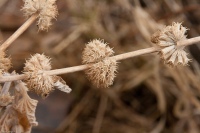
Horehound (Marrubium vulgare) seeds.  This Asian invader is common in the arid uplands of central Arizona.

Horehound (Marrubium vulgare) seeds. This Asian invader is common in the arid uplands of central Arizona.

The photo shows the dry seeds of Horehound (Marubium vulgare).  The seeds have small hooks that catch on clothing and animal fur. Horehound is a small perennial shrub that forms pure stands when native vegetation is removed by livestock. The seeds often create persistent mats in animal fur, and they are irritating when they get in your socks. Cattle will eat a little Horehound when the plants are young, but they don’t eat enough to prevent the plant’s spread.

Continue reading