Feds outline plan to curb invasive species

“Early detection and response, partnerships across jurisdictions seen as critical measures

“The spread of invasive species has been identified as the second-leading cause of extinctions among all plants and animals worldwide — and the problem is getting worse in the era of global trade. Just a few months ago, scientists warned that North American amphibians are at risk from an invasive fungus. White-nose syndrome, which has wiped out millions of bats, may have also spread to the U.S. from Europe.

“Federal officials now say they have a plan to try and curb the proliferation of invasive species by focusing on early detection and swift response. The measures are outlined in a report released by the Interior Department: Safeguarding America’s Lands and Waters from Invasive Species: A National Framework for Early Detection and Rapid Response.

“Invasive species pose one of the most significant ecological threats to America’s lands and waters,” said U.S. Department of the Interior Principal Deputy Assistant Secretary Kristen J. Sarri. “Early detection and rapid response actions can reduce the long-term costs, economic burden, and ecological harm that they have on communities. Strong partnerships and a shared commitment to preventing the spread of invasive species can lay the foundation for more effective and cost-efficient strategies to stop their spread.”  From: summitcountyvoice.com

GR:  Though the invasive-species threat is real and much damage has already been done, the U. S. land management agencies do very little to control the problem.  Every few years, the agencies repeat the ideas covered in this post and then don’t act.  In fact, the USDI already has policy guidance on the books that include Early Detection and Rapid Response (EDRR), and it has plans drawn up for weed control in specific areas.  However, it never implements the plans.  The problem is that true invasive-species management would require changes in the way the land is used.

Land-use changes required for effective invasive species control would be expensive, but more importantly, they would lower the profits of the mining, logging, and grazing industries using the land.  Because the U. S. government is more concerned with corporate profits than with sustaining the land, executive, legislative, or judicial action blocks attempts by agencies to perform effective invasive species control.  The same shameful behavior occurs in every government on Earth.  Thus, we are not surprised to learn that the spread of invasive species and many other destructive human practices are eliminating forests, wild animals, and the crucial top layer of soil.

These are not new problems, people have commented on them for thousands of years.  As the human impact has grown, the comments have grown more detailed.  Alexander Humboldt, for instance, after touring South America in the first years of the 18th Century, wrote extensively about the abuse of the land for the sake of profit.

Human Hothouse Spurs Longest Coral Die-Off on Record

It’s like a bad dream from which one cannot wake.

robertscribbler's avatarrobertscribbler

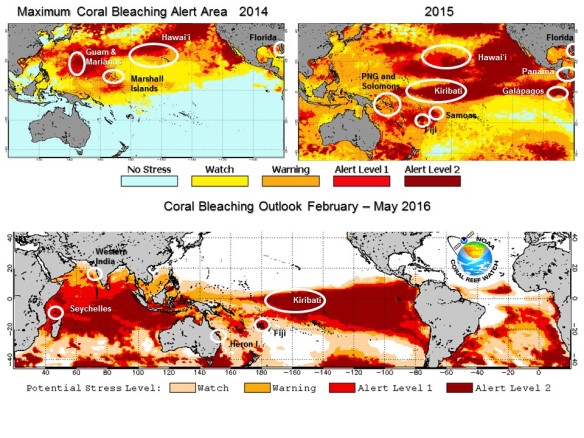
The big coral die-off began in the Western Pacific as a massive ocean temperature spike built up during 2014. Back then, ocean heat accumulation had hit a very high ramp. A vicious, century-and-a-half long increase in atmospheric greenhouse gasses re-radiated greater and greater portions of the sun’s energy hitting the Earth — transferring the bulk (about 90 percent) to the world ocean system.

Major Coral Bleaching Event

(A report out today from AGU finds that the world is now experiencing its longest coral die-off event on record. Image source: AGU.)

By 2015, as one of the strongest El Ninos on record began to extend its influence across the globe, a broad region stretching from the Western Pacific, through the Central Pacific and on into the Eastern Pacific and Caribbean were all experiencing mass coral die-offs. Into early 2016, die-off events again expanded taking in Australian waters and sections of the Indian Ocean off…

View original post 784 more words

Malthus was right. Now what?

“Saturday marked the 250th anniversary of the birth of Thomas Robert Malthus. I would like to wish him many happy returns.

“And he does keep on returning, doesn’t he, despite those who say he is wrong or passé.

“His Essay on the Principle of Population argued that, if left unchecked, human population growth would encounter limits: “The power of population is indefinitely greater than the power in the Earth to produce subsistence for man.” He foresaw famine, disease and much suffering, especially among the poorest. But in addition to these “negative checks,” he also recognized “preventive checks” like limiting birthrates and later marriage. As a cleric, he advocated “the chaste postponement of marriage.”  From: montrealgazette.com

GR:  Missed this, but it’s more a discussion than “breaking News.”

Invasive Species and the Bighorn Sheep Die-off in Montana Mountains, Nevada

Invasive Species

GarryRogersGR: Human-introduced animals, plants, and disease organisms have destroyed many species and ecosystems. This aspect of the human impact on nature became a global disaster in the 1500’s as we began crossing the oceans. In the lands we reached, we rampaged about with no thought of the seeds stuck to our boots or the diseases carried by our livestock. Then we developed nature. We cut the soil and filled it with pipes and wires and then we entombed its microorganism ecosystem with pavement. We damned streams, dried up springs, cut the forests, stripped the land with cattle and sheep, and we poisoned the water and air. Now comes our grand slam: We’ve added sufficient greenhouse gasses to the atmosphere to give our climate warmer temperatures, droughts, fires, and stronger storms.

How do we react to all that we’ve done? In the current time of competition between oil producers, for example, the temptation to burn more of the cheaper gasoline doesn’t horrify us, no, we call the lower prices a consumer blessing. Fuels Supplied

And so, in all that we do, our species appears to be striving for maximum destruction of earth ecosystems. Here are a few essays I wrote about how this works with invasive plants.

The following article is by Ken Cole on the Wildlife News website (February 19, 2016).

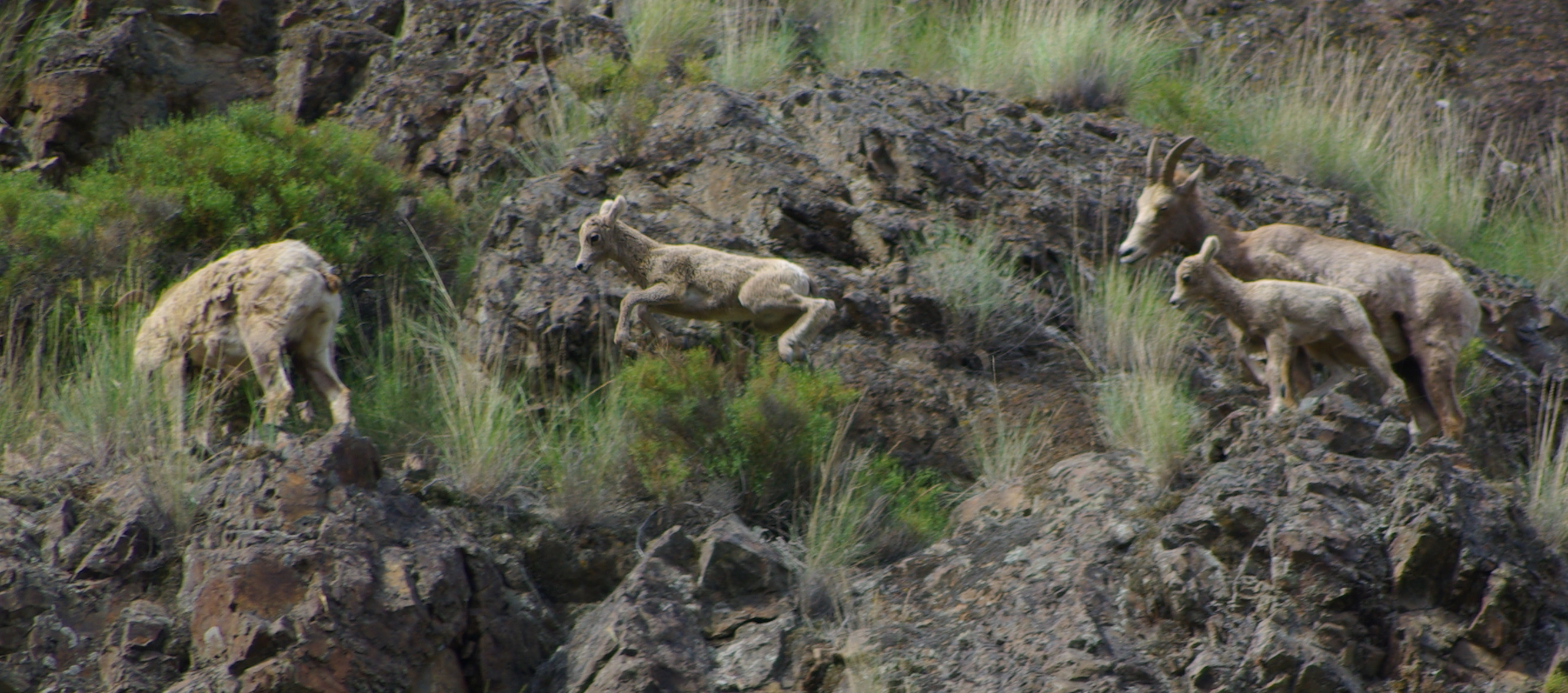
Bighorn sheep by Ken Cole

Bighorn sheep photo copyright by Ken Cole

“On Sunday and Monday, February 14-15, 2016, USDA Wildlife Services took to the skies and shot the remaining 24 bighorn sheep in the Montana Mountains of northwest Nevada at the request of Nevada Department of Wildlife.

“While the exact source of the disease outbreak is not known, it is not surprising that the bighorn sheep in this area are suffering this fate because there are two domestic sheep grazing allotments – the Bilk Creek allotment and the Wilder-Quinn allotment – in the middle of this area and BLM ignored the disease threat that they pose to bighorn sheep.

“In 2012 the BLM began the permit renewal process for one of the allotments – the Bilk Creek allotment – and Western Watersheds Project submitted comments notifying them of our concern about the risk that domestic sheep posed to bighorn sheep in this area. It is well know that domestic sheep are carriers of pathogens that result in deadly pneumonia to bighorn sheep and that even just one nose-to-nose contact between these related species can result in a disease outbreak that commonly kills up to 90% of a herd and kills the offspring of the remaining animals for up to a decade.

“In 2013 the BLM issued the Final Environmental Assessment that dismissed those concerns . . . . ”  Read more at:  http://www.thewildlifenews.com/2016/02/19/bighorn-sheep-die-off-in-montana-mountains-nevada-is-it-any-wonder.

West Coast US Cities Sue Monsanto over Toxic Chemicals

Last week, Seattle, Washington became the latest addition to the list of cities filing lawsuits against multinational corporation Monsanto, joining San Diego, San Jose, Oakland and Berkeley in California, along with Spokane, Washington. These efforts, led by San Diego-based law firm Gomez Trial Attorneys, aim to extract tens of millions of dollars from the agrochemical company for knowingly promoting the severely hazardous line of polychlorinated biphenyls, more commonly known as PCBs.  www.globalresearch.ca

GR:  Hooray!!  It’s about time.  It always strikes me as a disgrace that our government regulators can’t do their jobs and we have to use other resources to resolve problems.  Monsanto and the other major chemical companies have no concern for the damage they do to all animals including humans.  Please share this news, and add updates to the comments.  Thank you.  Garry

Seven million hectares of forests have been lost in Argentina over the past 20 years

Between 1998 and 2006, the deforested surface of Argentina was of almost 3,000 hectares –the equivalent of 250,000 hectares a year or one hectare every two minutes.
A forest law was passed in march of 2007, despite opposition by some lawmakers from the largely deforested northern provinces.
The funds assigned by the Argentinian Congress for forest protection in 2016 are 23 times less than what is established by the national forestry norm. news.mongabay.com

GR:  Drought here, harvest there and the forests disappear.

Posted in Uncategorized | Tagged

March 9: Most Important Climate Lawsuit Ever | Our Children’s Trust’s Fundraiser

“On March 9, the U.S. District Court will hear arguments on the most important climate case ever to be heard in a court of law against the government most responsible for climate change.

“We need your help to insure that all 21 youth plaintiffs, and Dr. James Hansen as official guardian for all future generations, are in court on that day, when the eyes of the court and of the nation will be upon these young people.

“The March 9 arguments will determine if the court will allow the youth’s claims that they have a fundamental constitutional right to be free from the dangers posed by greenhouse gas pollution, and that the government has a public trust obligation to protect the atmosphere and climate system for the benefit of future generations, to proceed to trial.

“It is critical that all 21 of the youth plaintiffs be present before the federal court on March 9 to . . . .”  www.crowdrise.com

GR:  Do governments have a public trust obligation to protect the atmosphere and climate system for the benefit of future generations?  The outcome of this suit will have global consequences. Please make a contribution to show your support.

The beetles: eighty-nine million acres of abrupt climate change

dying forestHigher temperatures in North America have contributed to a pine beetle infestation that has decimated millions of forest acres.  www.truth-out.org

GR:  If you can make it through the muzzy prose, you find that we are losing our forest ecosystems.  Right now.

Wolverine Watchers 2: The Sequel – Defenders of Wildlife Blog

As heavy snows blanketed the ground of Western Montana during the holiday season and into the New Year, the 2016 Wolverine Watchers project kicked off with an enthusiastic “Grrr!” www.defendersblog.org

GR:  Citizen naturalists performing duties for the Earth.