
Air pollution now major contributor to stroke, global study finds | Science | The Guardian

GR:  Air pollution harms all species of plants and animals.  Fortunately, the most toxic concentrations are in human cities and homes where animal numbers are lower.

Science editor.–Scientists say finding is alarming, and shows that harm caused by air pollution to the lungs, heart and brain has been underestimated
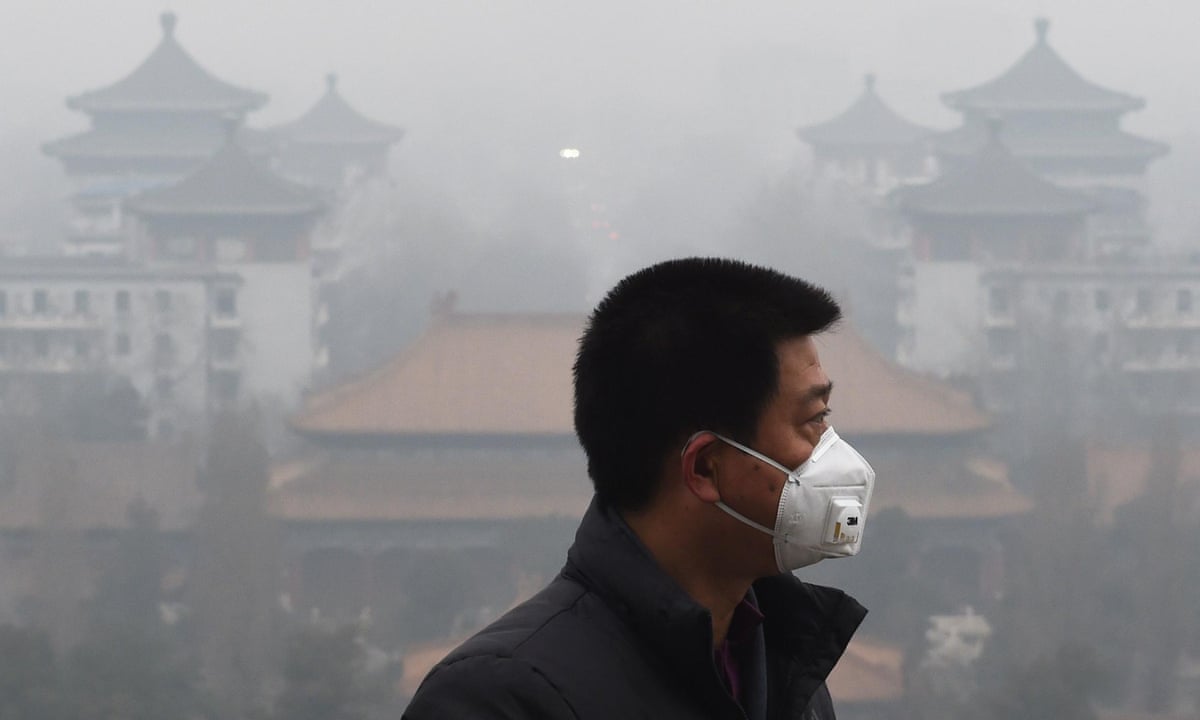
Air pollution has become a major contributor to stroke for the first time, with unclean air now blamed for nearly one third of the years of healthy life lost to the condition worldwide.

In an unprecedented survey of global risk factors for stroke, air pollution in the form of fine particulate matter ranked seventh in terms of its impact on healthy lifespan, while household air pollution from burning solid fuels ranked eighth.

Source: Air pollution now major contributor to stroke, global study finds | Science | The Guardian
Save

The Great Barrier Reef and the subtle power of ‘psychological distance’

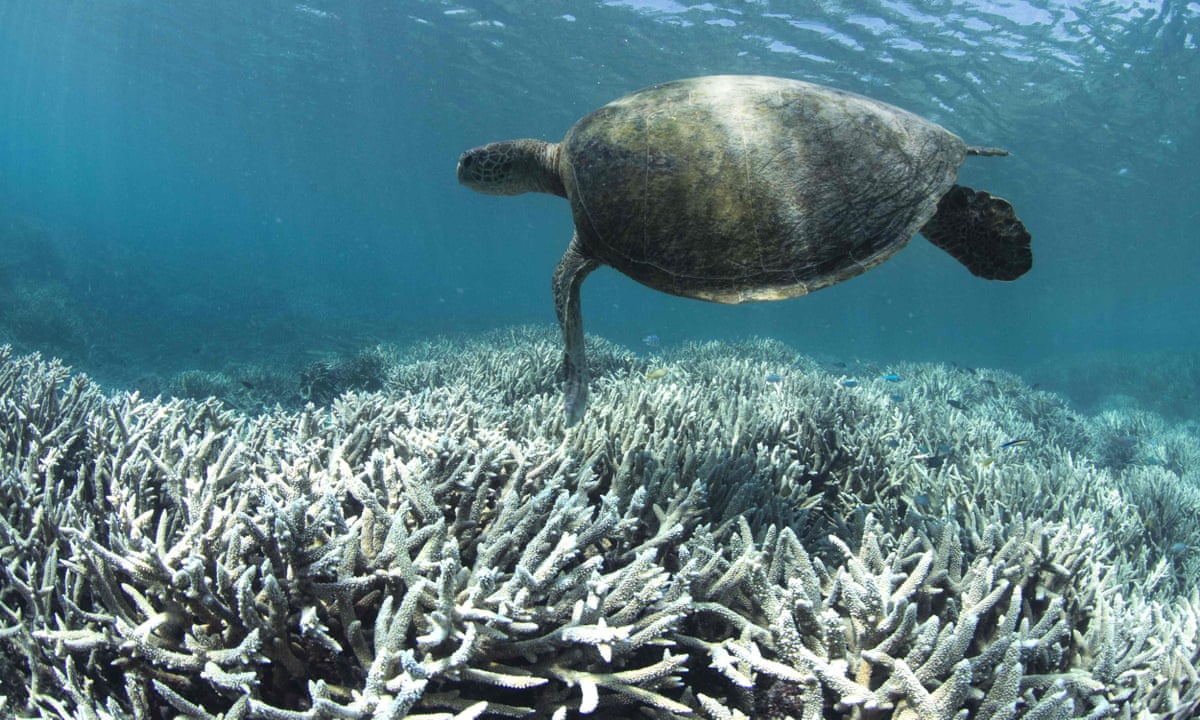
This photo released on 20 April, 2016 by XL Catlin Seaview Survey shows a turtle swimming over bleached coral at Heron Island on the Great Barrier Reef. Photograph: STR/AFP/Getty Images

Don HIne.–If the federal government wants Australians to ignore the Great Barrier Reef as it dies beside us, it has done a masterful job by scrubbing all mentions of the reef from the latest UN climate change report.

The government’s actions have been described as Soviet in style and intent but the political thuggery pales compared to the activation of a subtler and more powerful effect known as psychological distance.

Psychological distance is a construct that measures the “distance” of an event or object in terms of geography, time, cultural similarity and factual certainty. If something is nearby, likely to occur soon, involves people like you, and the facts are certain, that “something” is considered psychologically close. The closer it is, the more likely you are to perceive it as concrete and be willing and able to act on it.  Continue:  The Great Barrier Reef and the subtle power of ‘psychological distance’ | Don Hine | Australia news | The Guardian

Save

Australian researchers call for more coastal monitoring in the face of expected climate change impacts

Bob Berwyn–June storms highlight impacts of rising seas, shifting storm patterns.

Just after the Australian government announced massive cuts to the country’s science agency, researchers are warning that there’s more of a need than ever to track climate change impacts.

A series of recent storms that lashed Australia’s east coast are reminder that rising sea level presents a growing threat to coastal communities, according scientists with the University of New South Wales.

“The damage we’ve seen is a harbinger of what’s to come,” said Ian Turner, director of the Water Research Laboratory at the University of New South Wales. “Climate change is not only raising the oceans and threatening foreshores, but making our coastlines much more vulnerable to storm damage. What are king high tides today will be the norm within decades.”  Continue.– Australian researchers call for more coastal monitoring in the face of expected climate change impacts | Summit County Citizens Voice

Save

Record Drop in Coal Burning Raises Question — Is Peak Fossil Fuel Use Happening Now? RobertScribbler

Peak oil, gas, and coal.

It’s a possibility that many who believe the fossil fuel industry’s false dependency mantra look at with fear and trembling. Because, for years, that industry, through various public relations efforts, has perpetuated a myth that a loss of access to fossil fuels would ruin the modern global economy. That fossil fuels were so high-quality no other energy source could effectively replace them.

It’s a myth that, in many ways, competes with the threat of human-caused climate change for space in the public’s collective imagination. One that is not without a few valid supports. For the shifting of energy use away from one set of sources and on toward another set is a massive, disruptive undertaking even in the case where the new energy sources are superior to the old.

.. (This is what a real existential threat to global civilization looks like. From the 1880s to the six month cold season of 2015-2016, global temperatures warmed by 1.38 degrees Celsius. At the end of the last ice age, it took about 3,000 years for as much warming to occur as human fossil fuel burning has achieved over just the last 136 years. Dealing with what is a problem of geological scale ramping up with lightning speed will require a necessarily rapid reduction to zero fossil fuel burning over the coming decades. Recent swift curtailments of coal use provide some hope that such a reduction may be possible. But rates of fossil fuel use will have to peak soon and be cut even more swiftly to prevent a very rapidly intensifying global emergency. Image source: NASA GISS.)

Source: robertscribbler | Scribbling for environmental, social and economic justice

Save

Scientists Turn Carbon Dioxide Emissions to Stone | Climate Central

GR:  Carbon collects on basalt at the surface in just a few years, so why not underground.  Of course, the drilling and pumping might be as problematic as fracking.  Moreover, we have to be careful that the fossil fuel industry doesn’t see this as an excuse to continue destructive mining and burning.

Chemical engineer Magnus Thor Arnarson, Columbia University hydrologist Martin Stute and CarbFix project manager Edda Sif Aradottir inspect the CarbFix site, where carbon dioxide is injected 2,000 meters underground. Credit: Columbia University

By Bobby Magill–For the first time, carbon dioxide emissions from an electric power plant have been captured, pumped underground and solidified — the first step toward safe carbon capture and storage, according to a paper published Thursday in the journal Science.“This opens another door for getting rid of carbon dioxide or storing carbon dioxide in the subsurface that really wasn’t seen as a serious alternative in the past,” said study co-author Martin Stute, a hydrologist at the Lamont-Doherty Earth Observatory at Columbia University in New York.

Source: Scientists Turn Carbon Dioxide Emissions to Stone | Climate Central

Save

Exciting Update in Youth v. U.S. Climate Case

Our Children’s Trust is pleased to report that U.S. District Court Judge Ann Aiken scheduled oral argument in our youths’ landmark federal climate lawsuit for September 13, at 10 am in Eugene, Oregon. The 21 youth plaintiffs are excited for the opportunity to appear in court again and have their arguments presented to Judge Aiken, who will be reviewing U.S. Magistrate Judge Coffin’s April ruling in their favor.

We will be working hard to prepare for September 13 and we will update you this summer with more hearing details. We encourage you to mark your calendars in the event you are able to join us in Eugene for what will be a truly momentous day!  Source: Exciting Update in Youth v. U.S. Climate Case

Save

T-shirt Time! | Fight for Rhinos

We need to raise $1,152 to support Chloe’s canine ranger class at Hoedspruit Endangered Species Centre. With the purchase of a tee, you can help do that and SHOW your support by being a valuable part of our Rhino Security Team!

T-shirts are 100% cotton, available in 4 colors from S to XL, at a cost of just $19.99 usd.

Not purchasing a tee? Please consider a straight donation through our Paypal button on the top left of the page. Your support means a lot.

Source: T-shirt Time! | Fight for Rhinos

Save

Save

Anti-wildlife, pro-hunting act reaches U.S. Senate; you can help stop it | Examiner.com

Lisa Blanck–These are some of the animals who will be affected – you can help stop this!Courtesy: Mark Kolbe, John Moore, Bill Pugliano/Getty ImagesEarlier this year the Sportsmen’s Heritage and Recreational Enhancement (SHARE) Act (H.R. 2406) passed the US House of Representatives. The sponsor of this bill is Senator Lisa Murkowski, (R-AK), who first introduced it in September, 2015. The SHARE Act is an outright assault on animal welfare and conservation. Having passed the House, it now has reached the floor of the Senate, and, knowing it is extremely controversial, some of members of Congress are trying to bury it within another seemingly harmless Bill. They have attached this extreme anti-wildlife bill as an amendment to the Energy Policy Modernization Act (S.2012). If this bill is passed, the damage to wildlife and conservation will be dramatic and far-reaching.

The Animal Welfare Institute is fighting the passing of this bill, which would be a clear assault on wildlife worldwide. On May 20 they contacted members and humanitarians to ask for their help. Now you can make your voice heard and help stop it by simply clicking on this link and navigating to the “Contact Your Legislators” box to send an email to your State Senator. By simply typing in your address, the name of your senator will pop up. You can even personalize your letters in a box provided by AWI, who will then forward your email for you.

What will the SHARE Act do, should it be passed into legislation? Here’s a quick list:  Anti-wildlife, pro-hunting act reaches U.S. Senate; you can help stop it | Examiner.com

GR:  Thanks to Jim Robertson, ExposingTheBigGame for first reporting on this story.

Save

Truth on the Ground:  Destructive Post-Fire “Salvage” Logging–In Pictures

Source: Environmental Protection Information Center (EPIC) » Westside Truth on the Ground

Save