The core truth of our time is stark: “Our planet’s life-support system, the biosphere, is in a state of severe and irreversible decline”. This thesis, presented in the new book Biosphere Collapse: Causes and Solutions , has just received a major validation, earning a coveted five-star review from Dr. Paul Knobloch at Reader Views.
The review confirms that the book is an essential, timely, and credible contribution to the global conversation on humanity’s future.
The Core Message: A Shift in Worldview
Knobloch immediately recognized the uncompromising nature of the book’s premise. However, the reviewer highlights that this is not a message of “doom and gloom”. Instead, it is a plan for transformation, offering a clear “path forward”.
The book’s blueprint for survival involves a “hierarchy of transformation difficulty” consisting of four critical levels of change:
Level 1: Limiting Direct Extraction. These are the most technically straightforward changes, aimed at curbing activities like hunting and fishing.
Level 2: Transforming Production. This requires restructuring entire global sectors like agriculture and energy.
Level 3: Changing Systemic Drivers. This involves coordinating action across multiple institutions and scales to tackle root problems such as urbanization and deforestation.
Level 4: Shifting Core Beliefs. The final and most difficult step requires fundamentally rethinking our beliefs about economic growth, consumption, and humanity’s place in nature.
Beyond Human-Centric Solutions
The review emphasizes that a truly effective solution must move past theories focused strictly on human activity. This is the essence of the book’s call for Ecocentrism. Knobloch quotes the book’s direct definition: “Earth’s biosphere is a complex, interconnected system in which all species play a role, making their existence valuable beyond their utility to humans”.
Ultimately, survival requires accepting that we are merely “one ingredient in a bigger ecological and even cosmic network”.
Rigor and Accessibility
The comprehensive 5-star rating confirms that the book successfully navigates the complex space between rigorous science and accessible prose. The overall program evaluation for the book awarded the highest rating of 5 for:
Clarity and Organization: The central idea is clearly introduced, and the structure is organized logically.
Credibility: The information is backed by “credible sources, research, or the author’s firsthand experience”.
Readability and Style: The prose is “clean, jargon-free (or defines technical terms), and easy to digest”.
The book offers both an exhaustive review of existing literature and a decisive plan for action. As the reviewer concludes, this is a much-needed addition to the critical issues surrounding climate disaster and planetary health.
Read more about the ideas presented in the book and the ongoing work to address global environmental challenges on the Biosphere Collapse book page.
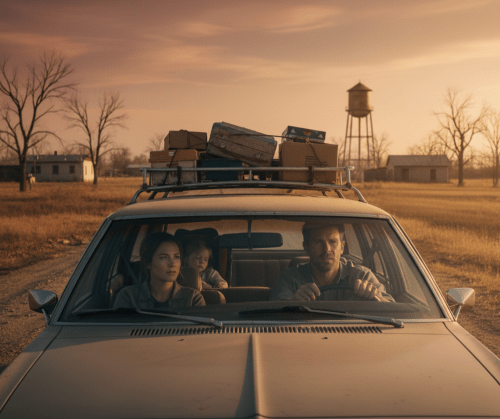
I am pleased to announce the release of The Maplewood Journals. The story chronicles a community’s fight for survival in a world being reshaped by environmental decline.
The story begins as James Holden arrives in the small town of Maplewood with his wife Emily and daughter Sophie. He is the new Town Manager, hired fresh out of college.
James quickly discovers the town has a serious problem, it is running out of water. As the story continues, the water problem is followed by others including catastrophic storms and fires. While James Holden is a central figure, the town of Maplewood itself is the true protagonist. The narrative is a multi-generational saga. It shows residents learning to adapt through community action.
The history of Maplewood and its journey into a new environmental reality is reconstructed from journals, newspaper clippings, and official records. The story’s principal resource is the personal journal of James Holden.
I wanted to understand what happens when the environmental crises we read about in the news become the lived reality of a community.–Garry Rogers
This is not a story of despair. It is a testament to human ingenuity and the power of group action. The narrative explores themes of leadership, loss, and adaptation. It is a tale of the struggle to forge a meaningful future in an uncertain world.
(This article is the last of a six-post reality-check. Concepts and examples are drawn from “Silent Earth: Adaptations for Life in a Devastated Biosphere.”)
Across this series, we have journeyed from the stark physical reality of a wounded planet to the deep, inner landscape of human grief. We have explored the rise of a new geological force in our Technosphere, the radical rethinking of our legal systems through Rights of Nature, the urgent mission to preserve our knowledge, and the profound sorrow of solastalgia.
This journey from the external world to the internal may seem like a shift in focus, but it reveals the fundamental truth of the Anthropocene: the crisis of the biosphere is inseparable from the crisis of our own consciousness. The crucial question is no longer just what technology we can invent, but what kind of beings we choose to become. Can we, armed with knowledge of our own minds, do a better job?
The evidence presented in Silent Earth suggests the path is difficult. Our species is hobbled by cognitive biases that were once adaptive but are now perilous. We discount the future, we are overly optimistic about risk, and we struggle to grasp the slow, cascading nature of complex system collapse (Frederick et al. 2002). These are the mental roadblocks that have led us to this precipice.
Yet, our cognitive toolkit also contains the seeds of a solution. We are, to our knowledge, the only species on this planet capable of understanding its own cognitive flaws. We are the only species that can study its own history, anticipate distant futures, and consciously choose to evolve its culture.
This is the final and most essential adaptation. It is a cognitive adaptation.
It means recognizing that our sprawling Technosphere is the physical result of an extractive mindset. It means understanding that the call for Rights of Nature is a legal manifestation of our yearning for a more just relationship. It means acknowledging that our mission to preserve knowledge is our foresight battling our shortsightedness, and our ecological grief is the pain of a bond that has been broken.
To do a better job is to use this self-knowledge to consciously steer our cultural evolution. It is to build governance systems that account for our cognitive biases, to foster economic models that value long-term stability over short-term gain, and to cultivate an ethic of stewardship rooted not in dominance, but in humility.
As the great conservationist Aldo Leopold urged, we must make the journey from “conqueror of the land-community to plain member and citizen of it” (Leopold 1949). In a deteriorating biosphere, this is no longer just a poetic ideal. It is the most pragmatic and necessary survival strategy we have left. The ultimate test of human intelligence will be whether we can learn to live wisely on the only home we have ever known.
References
Albrecht, G., et al. 2007. Solastalgia: the distress caused by environmental change. Australasian Psychiatry 15(sup1): S95-S98.
Brand, S. 2018. The manual for civilization. Long Now Foundation Press, San Francisco, 324 p.
Cunsolo, A., and Ellis, N. R. 2018. Ecological grief as a mental health response to climate change-related loss. Nature Climate Change 8(4): 275-281.
Dartnell, L. 2016. The knowledge: How to rebuild civilization in the aftermath of a cataclysm. Penguin Press, New York, 352 p.
Frederick, S., Loewenstein, G., and O’Donoghue, T. 2002. Time discounting and time preference: A critical review. Journal of Economic Literature 40(2): 351-401.
Haff, P. 2014. Technology as a geological phenomenon: implications for human well-being.
Geological Society, London, Special Publications 395(1): 301-309.
Hutchison, A. 2019. The Whanganui River as a legal person. Alternative Law Journal 44(1): 16-20.
Kauffman, C. M., and Martin, P. L. 2017. Can rights of nature make development more sustainable? Why some Ecuadorian lawsuits succeed and others fail. World Development 92: 130-142.
Leopold, A. 1949. A Sand County Almanac. Oxford University Press, New York, 226 p.
Zalasiewicz, J., et al. 2017. The technosphere: its composition, structure, and dynamics. The Anthropocene Review 4(1): 9-28.
(This article is part of a six-post reality-check. Concepts and examples are drawn from “Silent Earth: Adaptations for Life in a Devastated Biosphere.”)
Earth’s environmental changes are not just an external, physical phenomenon. They have powerful effects on our inner, psychological landscape. As the world we know changes, many of us are experiencing distress that, until recently, had no name.
Philosopher Glenn Albrecht coined the term solastalgia to describe the feeling of homesickness caused by the negative transformation of the environment (Albrecht et al. 2007). It’s the pain of seeing a beloved forest logged, a familiar river run dry, or a vibrant reef turn white. This is accompanied by ecological grief, a deep sadness in response to experienced or anticipated environmental losses (Cunsolo and Ellis 2018).
These are not abstract concepts. They are the lived reality for people around the world. Researchers have documented the grief of Inuit communities as they witness the decline of caribou herds (Cunsolo et al. 2020). Conservation professionals report experiencing significant emotional distress as they conduct their work.
This emotional toll can lead to a dangerous feedback loop. As people lose direct, positive interactions with nature, their emotional connection weakens, reducing their motivation to protect it. This can lead to further loss (Soga and Gaston 2016).
By acknowledging these genuine emotions, we can address the mental health dimensions of biosphere decline. It’s time to explore our inner landscape response to our changing planet,
References
Albrecht, G., et al. 2007. Solastalgia: the distress caused by environmental change. Australasian Psychiatry 15(sup1): S95-S98.
Cunsolo, A., and Ellis, N. R. 2018. Ecological grief as a mental health response to climate change-related loss. Nature Climate Change 8(4): 275-281.
Cunsolo, A., et al. 2020. You can never replace the caribou: Inuit experiences of ecological grief from caribou declines. Cultural Geographies 27(4): 599-616.
Soga, M., and Gaston, K. J. 2016. Extinction of experience: the loss of human–nature interactions. Frontiers in Ecology and the Environment 14(2): 94-101.
(This article is part of a six-post reality-check. Concepts and examples are drawn from “Silent Earth: Adaptations for Life in a Devastated Biosphere.”)
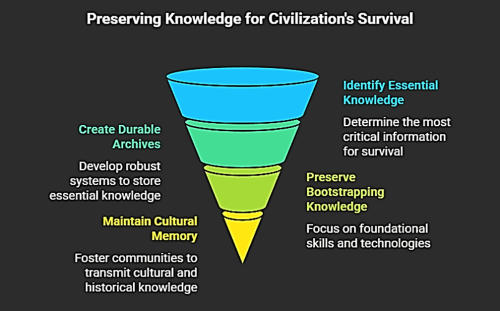
In times of crisis, we focus on saving lives and priceless artifacts. But what about the most vital asset for the long-term survival of our civilization: our accumulated knowledge? As the biosphere degrades and the risk of social disruption grows, the mission to preserve the blueprint of our knowledge becomes a critical imperative.
Our current knowledge systems are fragile. Digital archives are vulnerable to energy loss, hardware degradation, and format obsolescence. At the same time, physical libraries are threatened by environmental disasters (Morrow 2020). This has spurred innovative projects like The Long Now Foundation’s Manual for Civilization, which seeks to create a durable, multi-format library of essential information (Brand 2018).
But it’s not enough to save data. We must preserve what author Lewis Dartnell calls “bootstrapping knowledge.” This is the foundational instructions needed to rebuild basic technologies and access more complex information (Dartnell 2016). Without the ability to make a simple motor or generate electricity, a digital library of all human knowledge would be a useless artifact.
Also important is the preservation of cultural and historical memory, which provides the social cohesion necessary to navigate collapse and recovery. This requires a focus on living knowledge communities and practical skills transmitted through apprenticeship (Marchand 2016). This will be difficult, but safeguarding this blueprint is an essential investment in the potential for a future rebirth.
References
Brand, S. 2018. The manual for civilization. Long Now Foundation Press, San Francisco, 324 p.
Dartnell, L. 2016. The knowledge: How to rebuild civilization in the aftermath of a cataclysm. Penguin Press, New York, 352 p.
Marchand, T. H. J. 2016. Craftwork as problem solving: Ethnographic studies of design and making. Routledge, London, 286 p.
Morrow, J. 2020. Knowledge persistence in unstable times. Library Quarterly 90(2): 154-173.
(This article is part of a six-post reality-check. Concepts and examples are drawn from “Silent Earth: Adaptations for Life in a Devastated Biosphere.”)
When a forest is cleared or a river is polluted, who speaks for them? For centuries, our legal systems have treated nature as property—a resource to be owned, used, and exploited. But what if nature had rights of its own?
This is not a mere metaphor. In a groundbreaking move, Ecuador’s 2008 constitution enshrined the Rights of Nature, recognizing that nature has the “right to exist, persist, maintain and regenerate its vital cycles” (Kauffman and Martin 2017). Following this, New Zealand granted legal personhood to the Whanganui River in 2017, and appointed guardians to act on its behalf and protect its interests as a living, integrated whole (Hutchison 2019).
This shift from nature as “property” to nature as a “rights-bearing entity” raises complex questions. Who has the standing to represent an ecosystem in court? How do we balance the rights of a river against the rights of a community that depends on it? Implementing these legal conditions is still evolving, but they represent a fundamental rethinking of environmental protection.
By recognizing the intrinsic value and legal standing of the natural world, we open up entirely new avenues for its defense. This approach invites us to move beyond our role as masters of the Earth and toward a more just relationship as members of a wider ecological community. Related Resources
References
Hutchison, A. 2019. The Whanganui River as a legal person. Alternative Law Journal 44(1): 16-20.
Kauffman, C. M., and Martin, P. L. 2017. Can rights of nature make development more sustainable? Why some Ecuadorian lawsuits succeed and others fail. World Development 92: 130-142.
(This article is part of a six-post reality-check. Concepts and examples are drawn from “Silent Earth: Adaptations for Life in a Devastated Biosphere.”)
For billions of years, the Earth’s surface was governed by the slow, elegant cycles of the biosphere. But now, a new planetary system has emerged, one of human origin: the technosphere. Coined by geologist Peter Haff, this concept describes the interconnected global network of all our technology—our cities, roads, power grids, and digital networks (Haff 2014). Its physical mass, a staggering 30 trillion tons of concrete, plastic, and metal, now rivals or even exceeds the total mass of all living things on the planet (Zalasiewicz et al. 2017).
This new kingdom has a complex, almost parasitic relationship with its parent. The technosphere depends utterly on the biosphere for energy, raw materials, and waste cycling, yet its very operation disrupts those sustaining systems. Agriculture is a primary example of this hybrid reality, where biological processes are co-opted and amplified by technological intervention, transforming the landscape (Foley et al. 2005).
Now, some propose to use the technosphere to manage the biosphere through geoengineering. These proposals to manipulate Earth’s climate systems carry immense promise and equally immense, uncertain risks (Lawrence et al. 2018).
The emergence of the technosphere as a dominant geological force requires a profound shift in perspective. We are no longer simply a species living within nature; we are the architects and unwitting subjects of a new planetary layer, and we have only just understood its unruly dynamics.
References
Foley, J. A., et al. 2005. Global consequences of land use. Science 309(5734): 570-574.
Haff, P. 2014. Technology as a geological phenomenon: implications for human well-being. Geological Society, London, Special Publications 395(1): 301-309.
Lawrence, M. G., et al. 2018. Evaluating climate geoengineering proposals in the context of the Paris Agreement temperature goals. Nature Communications 9(1): 3734.
Zalasiewicz, J., et al. 2017. The technosphere: its composition, structure, and dynamics. The Anthropocene Review 4(1): 9-28.
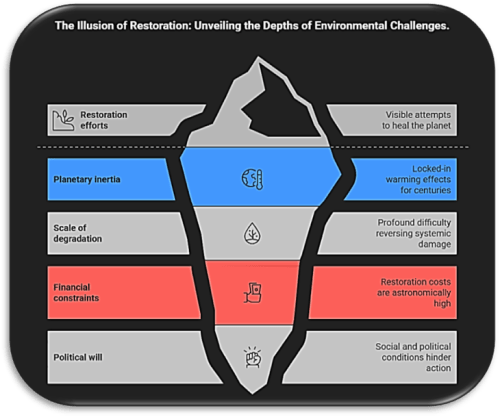
In the grand narrative of our species, we have arrived at a pivotal, sobering moment. The Earth’s biosphere, a delicate and complex tapestry woven over eons, now bears the deep imprint of our civilization. A noble and understandable impulse urges us to restore the planet to its former glory, yet a clear-eyed look at the evidence suggests this may be beyond our grasp. The inertia of our planetary systems is immense; even if all greenhouse gas emissions ceased today, significant warming is already locked in and would persist for centuries as a new equilibrium is slowly reached (King et al. 2024).
The sheer scale of the challenge is written upon our landscapes and in our waters. Consider the Chesapeake Bay, once North America’s largest and most productive estuary. Despite decades of concerted effort and billions of dollars in investment, its ecological health remains precarious, a testament to the profound difficulty of reversing systemic degradation (Rust and Blum 2018). Look to the Amazon, the lungs of our planet, where the cost to restore even a fraction of what has been lost is estimated in the hundreds of billions of dollars (Lennox et al. 2018). The financial and political will for such an undertaking on a global scale is simply not present.
The very social and political conditions that hinder restoration are the same ones that will impede large-scale adaptation. It is time, therefore, to pivot our focus toward achievable survival strategies. This is not a message of despair, but a necessary recalibration based on the evidence before us. We must learn to navigate a new world, one where our role is not to restore the past, but to thoughtfully and ethically adapt to the future we have created.
References
King, A. D., et al. 2024. Exploring climate stabilisation at different global warming levels in ACCESS-ESM-1.5. Earth System Dynamics 15: 1353-1383.
Lennox, G. D., et al. 2018. Second rate or a second chance? Assessing biomass and biodiversity recovery in regenerating Amazonian forests. Global Change Biology 24(12): 5680-5694.
The fundamental question of whether humanity’s environmental solutions will overtake and halt its environmental destruction in time to preserve human civilization is the subject of intense scientific debate. An analysis of peer-reviewed research on climate change and its effects on human civilization suggests that while positive developments in technology and policy may prevent the absolute worst-case warming scenarios, they are unlikely to be deployed fast enough to avoid irreversible damage to key global ecosystems. The “intersection” will occur, but after some critical tipping points have been crossed.
I approached this issue in: “Adapting to Worst-Case Climate Change” and “Silent Earth, Adaptations for Life in a Devastated biosphere.” This blog post is a more balanced review of optimism due to positive developments and pessimism due to negative impacts. Last week I added Kindle versions of my books. Enrolled in Amazon’s Free Book promotion, they are free starting today with “Adapting. . . .”
The Acceleration of Solutions: A Techno-Economic Revolution
The case for optimism rests on the exponential growth of clean technologies, driven by powerful economic feedback loops.
Economic Tipping Points: The most significant positive trend is that renewable energy sources are now, in many parts of the world, the cheapest form of new electricity generation available. This has created a powerful economic momentum for decarbonization that is less dependent on political will. A study by Way et al. (2022) in the journal Joule found that a rapid transition to clean energy is likely to result in trillions of dollars in net savings globally compared to a fossil-fuel-based system.
Exponential Growth & S-Curves: The deployment of key technologies like solar, wind, and batteries is not linear but follows an exponential adoption “S-curve”. BloombergNEF (2023) data shows that solar and wind now account for most new power-generating capacity added globally each year. Similarly, global EV sales have doubled every two years, a trend that, if sustained, could lead to a near-total transition away from internal combustion engines for new car sales by the early 2030s.
Policy as an Accelerator: While political will is fickle, major policy actions can create long-term industrial momentum. The U.S. Inflation Reduction Act (IRA) and the E.U.’s Green Deal are not just climate policies, but massive industrial strategies designed to onshore clean energy manufacturing and secure a competitive advantage. These initiatives will accelerate decarbonization pathways in the world’s largest economies, though this will be retarded by the U. S. counter moves in 2025.
The Acceleration of Impacts: The Unyielding Physics of the Earth System
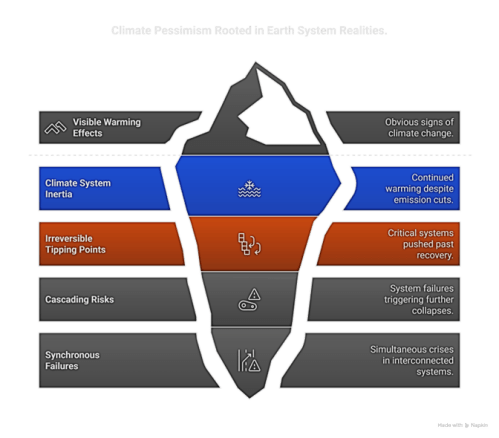
The case for pessimism is grounded in the physical realities of the Earth system, which possesses immense inertia and potential for non-linear dynamics.
Climate System Inertia and “Locked-In” Warming: The central challenge is the inertia of the climate system. Even if global emissions were to cease today, the planet would continue to warm because of past emissions and the thermal inertia of the oceans. This has been referred to as “warming in the pipeline” (Hansen et al. 2023). A significant amount of future sea-level rise and ecosystem injury is already “locked in,” regardless of our current actions.
Irreversible Tipping Points: The greatest risk is that this locked-in warming will push critical Earth systems past irreversible tipping points. A landmark 2022 study in Science by Armstrong McKay et al. found that several key tipping points, including the collapse of the Greenland and West Antarctic ice sheets and the abrupt thaw of permafrost, could be triggered even between 1.5°C and 2°C of warming—thresholds we are on track to cross. The recent die-off of vast areas of coral reefs serves as a stark example of a major ecosystem already crossing this threshold.
Cascading Risks and Synchronous Failures: These tipping points are not independent. The collapse of one system can increase the risk of another failing, creating a “tipping cascade” (Kemp et al. 2022). For example, losing Arctic sea ice reduces albedo and accelerates regional warming, which hastens the thaw of permafrost. Recent research highlights the growing risk of “synchronous failure,” where climate-related shocks trigger simultaneous crises in multiple interconnected systems, including global food supply chains and financial markets. In their exhaustive study of tipping points, Vasilis Dakos and colleagues concluded that the vast amount of remote sensing and other Earth systems data are bringing us closer to the ability to anticipate tipping points. At present, “Early warnings can tell us that “something” important may be about to happen, but they do not tell us what precisely that “something” may be and when exactly it will happen” (. . . , Dakos et al. 2024).
The Verdict: An Intersection After Irreparable Damage
When comparing these two accelerating trends, the scientific literature points to a deeply unsettling conclusion. The positive socio-economic trends of the clean energy transition are powerful, but they are unlikely to move quickly enough to prevent the biophysical trendlines of climate impact from crossing critical, irreversible thresholds. The most likely outcome is a future where humanity successfully reduces the impacts of its farms and cities and decarbonizes its energy and transportation systems, but only after locking in the collapse of several major ecosystems. We will prevent the 4-5°C “runaway greenhouse” scenario, but we will not prevent the loss of all coral reefs and mountain glaciers, loss of some major ice sheets, and significant, permanent loss of significant portions of the biosphere. The “intersection” will not be a moment of salvation, but a point at which we can adapt to a world that has been irreparably damaged. If humanity’s effort to survive is sufficient, civilization will survive, but in a suppressed state that will persist while the earth cools and cleans itself and Earth’s biosphere heals.
Armstrong McKay, D. I., et al. (2022). “Exceeding 1.5°C global warming could trigger multiple climate tipping points.” Science, 377(6611), eabn7950.
BloombergNEF. (2023). New Energy Outlook 2023. Bloomberg Finance L.P.
Claes, D. H., & Pineda, L. G. (2023). “The Inflation Reduction Act (IRA) and the new logic of climate and energy policy.” Energy Strategy Reviews, 50, 101258.
Dakos, V. et al. (2024). Tipping point detection and early warnings in climate, ecological, and human systems. Earth System Dynamics 15: 1117-1135.
Hansen, J., et al. (2023). “Global warming in the pipeline.” Oxford Open Climate Change, 3(1), kgad008.
Homer-Dixon, T., et al. (2015). “Synchronous failure: The emerging causal architecture of global crisis.” Ecology and Society, 20(3).
Hughes, T. P., et al. (2018). “Global warming transforms coral reef assemblages.” Nature, 556(7702), 492-496.
IEA. (2023). World Energy Outlook 2023. International Energy Agency.
IPCC. (2021). Climate Change 2021: The Physical Science Basis. Contribution of Working Group I to the Sixth Assessment Report of the Intergovernmental Panel on Climate Change. Cambridge University Press.








 GarryRogers Nature Conservation