Feds finalize plan to save country’s most endangered toad

“After more than a quarter century on the Endangered Species List, Wyoming toads may have a chance at recovery under a new plan that sets specific targets and requires long-term monitoring.

“The once-common toads died off in massive numbers starting in the 1970s, succumbing to a deadly fungal disease that has afflicted amphibians around the world.

“Listed as endangered in 1984, the Wyoming toad is considered one of the four most endangered amphibian species in North America and is currently classified as “extinct in the wild” by the International Union for Conservation of Nature. Approximately 500 individuals are currently held in captivity for breeding and reintroduction efforts.”  More at:  Summit County Voice

GR:  The goal is to establish stable populations at five sites.  It will be tough.  Amphibians face the harshest human impacts of any species group.  They face declining habitats, increasing pollution, increasing short-wave solar radiation, increasing invasive predators and competitors, and disease.  It will be tough.

Collaborative conservation plan eyed for Wyoming toad

Please send a note in support of this project.

Bob Berwyn's avatarSummit County Citizens Voice

A Wyoming toad. Photo via USFWS. A Wyoming toad. Photo via USFWS.

Voluntary conservation easements would protect habitat and traditional land use

Staff Report

FRISCO — Federal biologists are seeking input on a draft plan to protect habitat for the endangered Wyoming toad. The species was common in the Laramie plains area through the 1970s, when populations crashed, leading to an endangered species listing in 1984.

The proposed conservation would enable the USFWS to buy conservation easements and limited fee-title lands from willing sellers in the Southern Laramie River area whose lands provide important habitat for the endangered Wyoming toad and a variety of other fish and wildlife resources.

View original post 237 more words

Wildlife decline: Why does biodiversity matter anyway? – Christian Science Monitor

Half of the planet’s wildlife populations suffered severe decline between 1970 and 2010, according to a new report from the WWF. So what does dwindling biodiversity mean for us?

Source: www.csmonitor.com

GR:  As biodiversity declines, the Earth’s carrying capacity, its ability to produce renewable resources, declines. Scientists are already telling us that the growing human population has exceeded the Earth’s carrying capacity.  What motivates our leaders to continue with development and “progress” when they surely know what is happening? What should we do?

Arizona Wildlife Notebook Second Edition

Arizona Wildlife Notebook Introduction

Base Layer for Notebook Cover

Base Layer for Notebook Cover

The second edition of my “Arizona Wildlife Notebook” will be off to the printer (CreateSpace) as soon as I finish the cover.  This edition has introductions and checklists for 12 groups of Arizona animal species:  Amphibians, ants, bats, birds, butterflies and moths, dragonflies and damselflies, fish, grasshoppers, lizards, mammals, snakes, and turtles.  Groups in bold type are new to the Notebook.  The introduction to each group covers the group’s conservation issues and provides references for printed and online field guides.  The checklist for each group includes scientific and common names and conservation status.  I alphabetized each checklist by scientific name, and I included an index for all the common names. Continue reading

Robert C. Stebbins Dies

Robert C. Stebbins Dies at 98

Robert StebbinsBest known for A Field Guide to Western Reptiles and Amphibians, a book I find indispensable, Robert Stebbins was a renown specialist who believed that direct observation of nature out-of-doors was as important as laboratory research. He was also concerned for the welfare of his subjects.  He recognized that amphibian and reptile decline was a symptom of rampant human population growth.

Interest in wildlife preservation cannot be separated from concern with efforts to limit human population growth (Robert C. Stebbins, 1966:  21).

Read more about Stebbins here.

Stebbins, Robert C.  1966.  A Field Guide to Western Reptiles and Amphibians.  Houghton Mifflin Company, Boston, 279 p.

Wildlife Rescue in Arizona

Wildlife Rescue in Arizona

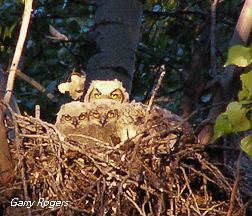
Great Horned Owl chicks

Great Horned Owl chicks

“Baby animals you see are probably not orphans; parents are usually nearby.”

Wildlife Rescue in Arizona is licensed by the Arizona Game and Fish Department.  Visit the AZGFD website for a list with contact information and taxa treated.  A second list includes other animal charities in Arizona.  Find more information from local veterinarians and animal control departments of local governments.

These organizations provide additional information:

Jack is Back! #amphibians

Jack, a One-Eyed Rocky Mountain Toad

A few months ago, I blogged about the human devastation of the world’s amphibians.  In that post, I mentioned a one-eyed Rocky Mountain toad that for several years had appeared at my back door at the start of the summer monsoon.  I am pleased to report that Jack, the name I gave the toad, is back.  Toads are generally long lived, from a few years to near 40 years.  I haven’t found longevity stats for Jack’s subspecies, but he is at least four years old.

Before Roly Polie Feast

One-Eyed Rocky Mountain Toad Before Roly Polies

After Roly Polie Feast

One-Eyed Rocky Mountain Toad After Roly Polie Feast

When I first spotted Jack yesterday, the poor creature was shriveled and its back was contorted.  But after an hour-long roly polie feast, he plumped up and looked perfectly normal (except for the missing eye).  Click the photos for larger views.

Or Is It Jill?

Jack wasn’t around this afternoon.  He probably went down to the pond to try to socialize a bit.  As I type this, however, and look at Jack’s pale throat, I wonder if the name should be Jill.  Have to check that throat after the pond tour.  During mating season, throats of the males are darker than the females.

I am glad Jack and the other toads are here.  They help control the annual monsoon earwig and mosquito explosion.  Our local toads, wrens, and thrushes provide ground support for our aerial defenders, the dragonflies, hummingbirds, swallows, whippoorwills, and bats.  Though we have big swampy ponds near (200 feet) the house, the few mosquitoes that survive the fish, dragonfly larvae, other aquatic predators, rarely penetrate our aerial defenses, and if they do reach the house, they meet the toads.  If they pass the toads, they encounter the spiders.  Every doorway, window, and room has carefully monitored spider webs.

July 1, 2014.  Jill hasn’t appeared yet.

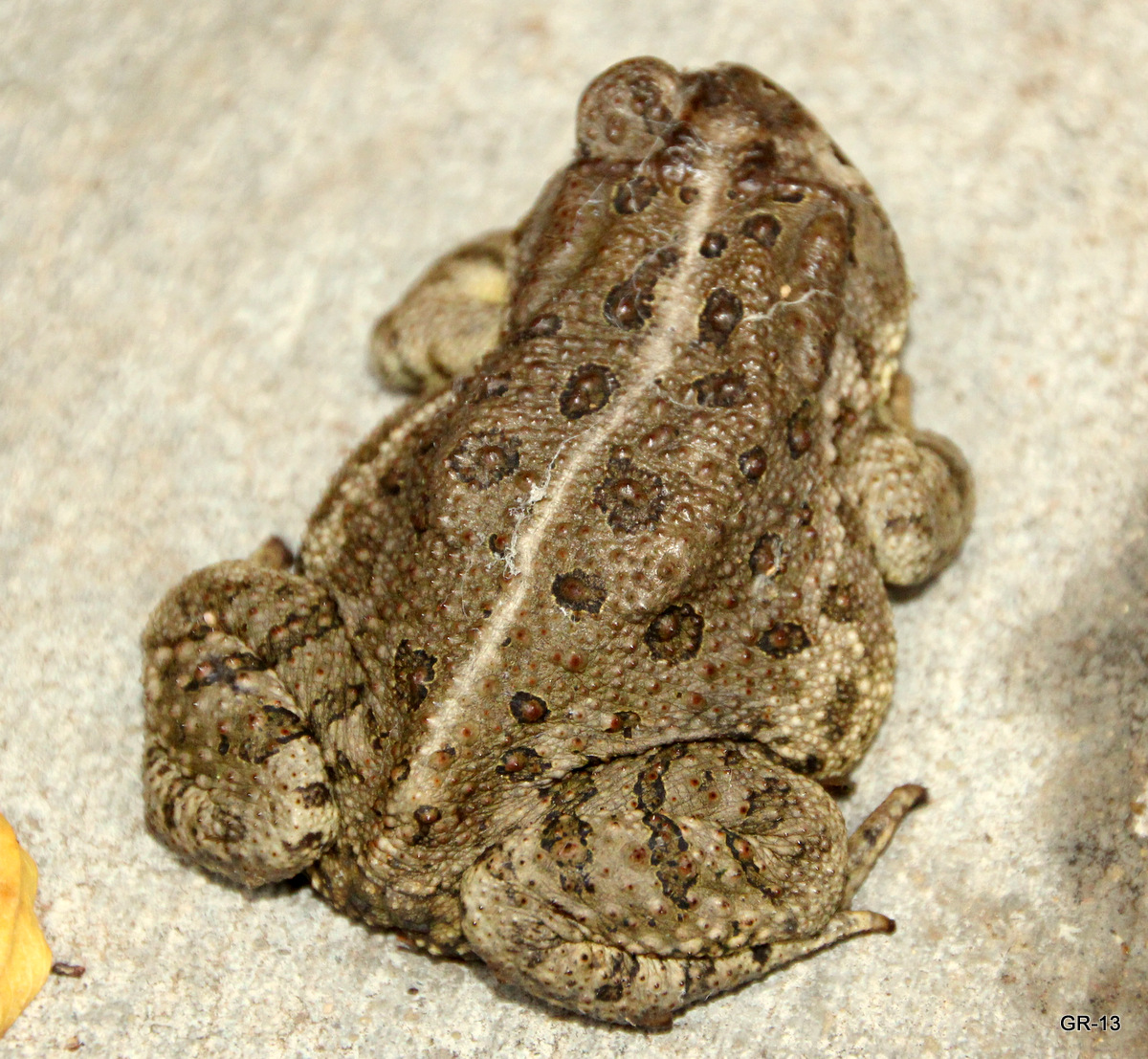
Colorado River Toad.

Back to the Arizona amphibian update.

Colorado River Toad aka Sonoran Desert Toad

Colorado River Toad (CRT) aka Sonoran Desert Toad
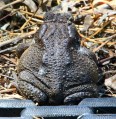
Colorado River Toad at Coldwater Farm

Colorado River Toad at Coldwater Farm

This giant toad appeared by my back step yesterday, May 13, 2013, and remained all day, moving only once in the afternoon to stay in the shade.  This is the first of these toads I have seen here, though it is obvious that this individual has been here gobbling insects and growing for at least two years.

July 1, 2014:  Haven’t yet seen the CRT.

 The California River Toad (CRT) (Bufo alvarius a.k.a. Ollotis alvariaare and Incillius alvarius) or Sonoran Desert Toad lives in southern Arizona and desert areas of New Mexico.  It formerly lived in southeastern California.  Above the desert, CRT is found near streams and lakes. My place in central Arizona is near the species’ northern limit.

At seven and one half inches long, CRTs are the largest native toads of the U. S.  This one is about five inches (and almost as wide ;-).

These toads are primarily nocturnal.  They are not as visible or noisy as the Rocky Mountain Toads that live in my yard.  Though I did not know they were here, the CRTs are probably an important reason that I have no insect problems despite the lawns around the house and the large stock ponds only a few hundred feet away.

This chubby amphibian has powerful defense toxins.  Glands on its sides, back, and legs produce the toxins.  Predators absorb the toxins through their nose, eyes, and mouth.  Dogs that mouth one of these toads can become paralyzed.  The toxin is hallucinogenic, and several states have classified it as a controlled substance.  Perhaps “toad lickers” are partially responsible for the toad’s decline.

 The CRT eats anything it can catch and fit in its mouth, even small mice.  It can enter homes through pet doors.  A welcome visitor, the toad will roam about eliminating household pests while providing amphibian decor unique to the Southwest.  I haven’t had this good fortune yet, but I am optimistic.

 The CRT has disappeared from its former range in California, and is declining in Arizona and New Mexico.  It is a candidate for protection under the Endangered Species Act.  A google search will provide more information.

One-eyed Rocky Mountain Toad.

Back to the Arizona Amphibian Update.
Arizona Amphibians Disappearing

Arizona Amphibian Conservation

Fresh water, the essential habitat of Arizona’s amphibians, is declining in both quality and quantity.  Frogs, toads, and salamanders are dependent on open water habitats.  Like many other places in the world, Arizona’s human population has exceeded the state’s carrying capacity.  Water resources in most areas of the state can no longer support the state’s human population.  In their unconscious drive to become the only species left, Arizona’s humans have depleted and polluted their water resources.  As the human population continues to grow, water and amphibians will continue to disappear.

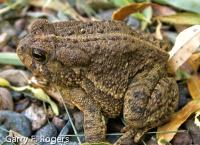
Rocky Mountain Toad

Rocky Mountain Toad

The photograph shows a palm-sized Rocky Mountain Toad.  In spring, it cries its nasal “waaah” mating call from the banks of Arizona’s streams, lakes, and temporary rain pools.  On warm moist nights, one or more of these small predators will often sit beneath outdoor lights and windows where insects congregate. Continue reading