“Silent Earth” has received a five-star “must read🏆” review on Reedsy. Blending scientific depth and practical foresight, this book is both a wake-up call and a guide for navigating environmental collapse.
Synopsis
Silent Earth is a technical reference for civil engineers, land-use and urban planners, and city administrators. It covers a broad range of topics and should serve as a springboard for specialists wishing to learn more about adapting to climate change and biosphere decline.
As the Earth’s living systems deteriorate at an unprecedented rate, human societies face the urgent challenge of adapting to an increasingly unstable environment. Physical Geographer Garry Rogers offers a clear-eyed examination of our options, arguing that while complete restoration of the biosphere is no longer feasible, strategic adaptation remains possible. Drawing on extensive research, Rogers outlines practical approaches for communities to maintain essential functions as ecosystem services decline. While large-scale adaptation efforts face significant barriers, this groundbreaking work shows how planners and administrators can implement effective strategies to enhance resilience in a transforming world. Essential reading for navigating our environmental future. Ideal for policymakers, scholars, environmentalists, and engaged citizens, Silent Earth challenges readers to envision a future where, even amidst biosphere decline, adaptation and innovation can pave the way for survival.
Garry Rogers’ Silent Earth: Adaptations for Life in a Devastated Biosphere explores the escalating degradation of Earth’s biosphere, offering strategies for human adaptation. It points to the realistic inevitability of this need to adjust, as humanity is facing the consequences of irreversible damage already done. Rogers goes beyond the simple dialogue of climate change, expanding and examining the interconnected impact of the entire biosphere, from current impacts such loss of biodiversity to coral reef bleaching.
In Section IV, Rogers draws upon research to emphasize that as soon as 2030 we are on the brink, and that we urgently need to act not only to prevent further destruction, but also to prepare for survival:
The cumulative and synergistic effects of human impacts are pushing ecosystems closer to tipping points. Feedback loops and shifting ecosystem boundaries are accelerating environmental change, while these effects interact in complex ways, amplifying their individual impacts. As we approach 2030, addressing these interconnected challenges will require an integrated approach to conservation and climate action to mitigate the far-reaching impacts on biodiversity and ecosystem stability.
The strength of Silent Earth lies in Section V, which presents a blueprint for adaptation. Rogers proposes various strategies from water management to cultural and governance reforms. His emphasis on grassroots action and local resilience is both pragmatic and empowering, especially given his acknowledgment of the political and societal inertia that is likely to hinder adaptation on a wider scale.
Silent Earth is thoroughly researched, intellectually stimulating, and well-cited. Rogers excels in synthesizing vast amounts of ecological, social, and technological data into a cohesive narrative.
Silent Earth is a valuable resource for those interested in interdisciplinary approaches to global challenges. It’s an important and thought-provoking read for anyone seeking to understand and address the complex realities of ecological decline.
GR: The article below contains an argument for more people on the planet. It uses one of the standard homocentric arguments to justify population growth: A genus among the new people will solve all our problems. Some of the article’s contents are so biased they are painful to read. “The shelves are wrapped in certified zero-deforestation leather from Brazil . . . .” and “. . . I’m in love with Timothy Han’s new scent, which features fairly traded Brazilian cedarwood.” Google “controlling population growth” for more arguments. One thing you will learn is that controlling growth is extremely difficult. And with the current economic benefits of more consumers and workers for wealthy investors, it is impossible.
Lucy Siegle, Sunday 12 June 2016.–“The regularity with which I’m contacted by population worriers – people who think it’s pointless discussing green energy, climate change and ethical pensions when the elephant in the room is actually the new human in the room – is impressive. They say that the planet needs fewer people. End of.
“The numbers are indeed eye catching. Today there are 7 billion humans alive (twice the number who were alive in 1965) – and each hour we add 10,000 more. By 2050, UN demographers predict, there will be at least 9 billion of us putting a strain on life-sustaining resources.
“Some experts suggest we’re at “peak farmland”, – meaning the predictions of cleric Thomas Malthus, who published his population theory in 1798, are coming to fruition. Malthus suggested that our global population would outpace food supplies until war, disease and famine arrived to halt the party.I prefer to be Pollyanna-ish about it: rather than fearing more people, let’s believe that the new ones will make a difference, fix the energy gap, work out how to develop sustainable protein sources and so on [emphasis by me].” Continue reading:The eco guide to population growth | Environment | The Guardian
Indian villagers walk towards the Mahan forest during a protest against a coal mining project in Singrauli district, Madhya Pradesh. Of the 14,000 sq km of forests cleared over the past three decades in India, the largest area was given to mining (4,947 sq km), followed by defence projects (1,549 sq km) and hydroelectric projects (1,351 sq km).
Over the last 30 years, forests nearly two-thirds the size of Haryana have been lost to encroachments (15,000 sq km) and 23,716 industrial projects (14,000 sq km), according to government data, and artificial forests cannot be replacements, as the government recently acknowledged.
GR: Deforestation is rampant across the face of the Earth. Progress, development, and profit–all trump forest. And if forests aren’t totally cleared to make way for various enterprises, they are cut by timber companies that care nothing for biodiversity, only for sales of logs and lumber.
GR: The human efforts to destroy the Earth are like the moves of a chess grand master–always catching us by surprise.
Marlowe Hood: “Palm oil produced on tropical plantations that drive deforestation has become a major biofuel for vehicles in the European Union, industry figures released Tuesday by an environmental group revealed.
“In 2014, nearly half of the palm oil used in Europe wound up in the gas tanks of cars and trucks, according to data compiled by the EU vegetable oil industry association Fediol, and obtained by Brussels-based NGO Transport & Environment.
“Second only to rapeseed as a biofuel, overall palm oil use in EU countries jumped six-fold from 2010 to 2015, accounting for a 34 percent increase in biodiesel consumption during that period, the figures showed.
“Palm oil is also found in food, animal feed and cosmetics, but use in these sectors has dropped in Europe, in part due to pressure from environmental groups on major corporations.
“Up to now, how palm oil was distributed across products in the EU was not known.
“We now know why the industry is withholding these numbers,” said Jos Dings, executive director of Transport & Environment.”They show the ugly truth of Europe’s biofuel policy, which drives tropical deforestation, increases transport emissions, and does nothing to help European farmers,” he said in a statement.
Unaware of the consequences of its behavior, the growing human population is erasing sixty-five million of years of biodiversity recovery since the massive extinction that eliminated dinosaurs and most other species. This is without doubt the greatest issue of our time, perhaps of all time. In the article below, Quentin Wheeler points out that biodiversity is not even being mentioned by our current presidential candidates.
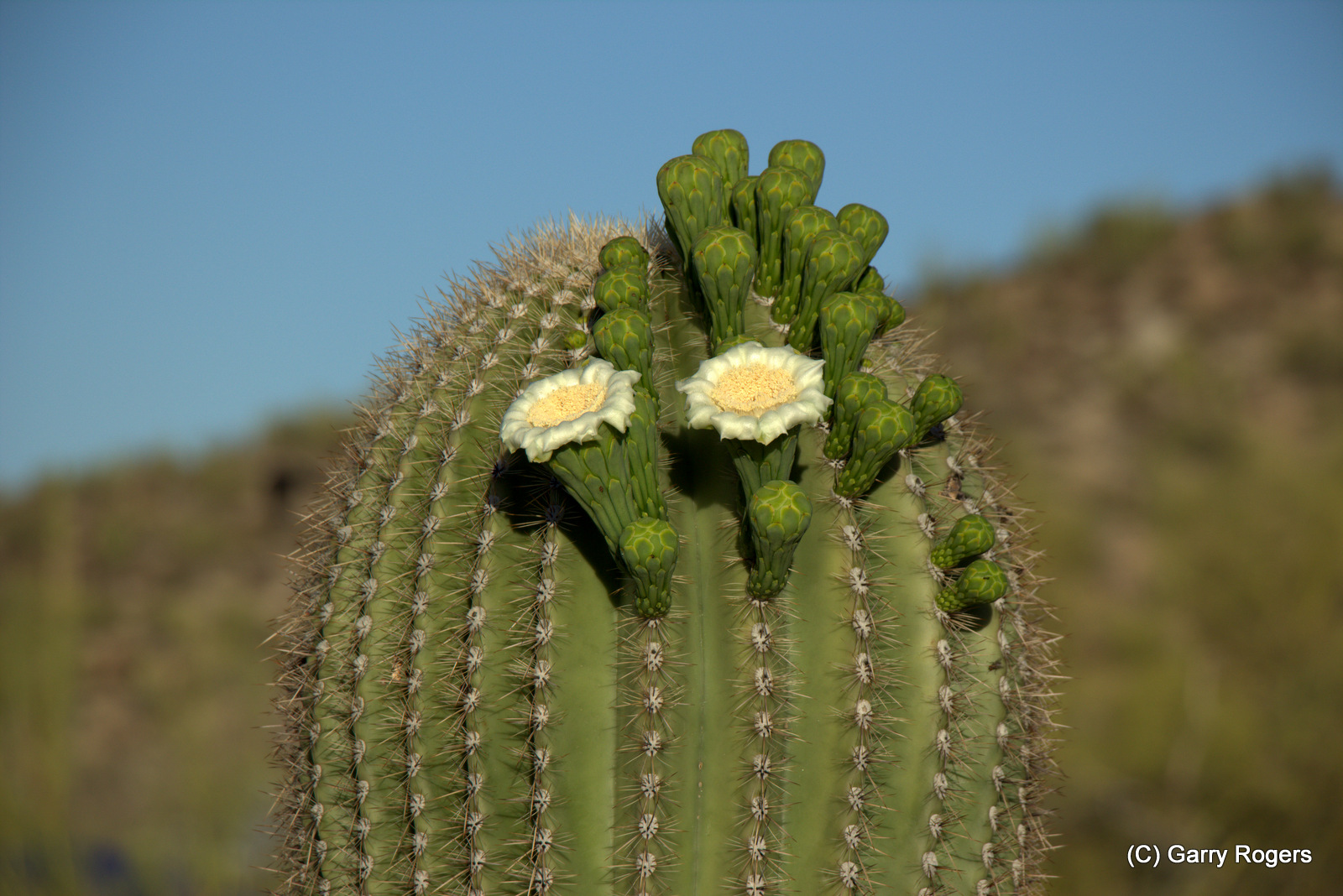
Saguaro, the iconic species of the Sonoran Desert, blooming in April, two months earlier than usual (Rogers, 2016).
Global warming, deforestation, desertification, environmental pollution, and ocean acidification are familiar labels for human-caused destruction of biodiversity and stability of Earth ecosystems. They are all connected to the attempt by our billions of people to satisfy their desires for food, reproduction, safety, and convenience. Allowed uncontrolled expansion, any one of them can achieve planet-wide destruction of biodiversity. Consider that even if this year’s great climate-change treaty achieves a sudden shift to safe energy and stops global warming, it will not save life on Earth. No single-issue approach can.
“It’s unlikely that presidential candidates will ever utter the word “biodiversity” while campaigning this year.
“Yet among emerging environmental challenges, none has fewer facts or more enduring threats than the large-scale loss of biodiversity. That’s why we need a visionary investment in fundamental exploration to create knowledge and options.
“And our elected representatives should lead vigorous discussions about what we can and should do about it. From Jefferson to Kennedy, from the Northwest Territory to the depths of space, presidents of vision have opened new frontiers to exploration.
“Serious environmental problems are a bipartisan challenge that deserves to be in every presidential platform. While scientific questions should be firewalled from politics, what we do with scientific knowledge should not. The best solutions should emerge from the rough and tumble of public debate.
“Biodiversity belongs in our public discussion because we have so much to learn from the Earth’s species – both what it means to be human and the knowledge encapsulated in nature – as we plot our future in a time of great change.”
“This is not the first time that earth has weathered such a mass extinction event. There have been five previously, the most recent occurring 65 million years ago, marked by the disappearance of the great dinosaurs.
“In each case, evolutionary processes have restored high levels of species diversity, but this should give us little comfort. Biodiversity recovery takes place over tens of millions of years. And in the meanwhile, there can be enormously chaotic consequences for ecosystems.
“It’s estimated that 10 million more species could be described or redescribed in greater detail.andreaskay/flickr, CC BY-NC-SA”
“Our knowledge of the species with which we share planet Earth is dangerously limited, meaning that we make decisions and policies in near complete ignorance of basic facts. Our best guess is that there are 10 million living species, more or less, excluding the single-celled bacteria and Archaea.
“Of these, fewer than two million are known to science. And of documented species, most are known by little more than a few diagnostic features and a name. While the rate of species extinction has greatly increased, the pace at which we are exploring species has not.
“In one of the original “big science” ideas, the Swedish naturalist Linnaeus set out in the mid-18th century to complete a global inventory of all the kinds of animals and plants. That inventory continues today, but at an unacceptably slow pace. We discover about 18,000 species each year, a rate unchanged since the 1940s in spite of technological advances.
“This need not be so. Given appropriate technical support and coordinated teamwork, it has been estimated that 10 million species could be described or redescribed in greater detail in no more than 50 years.
“As global environments are stressed, we need reliable knowledge of species diversity upon which to detect and measure changes. Ironically, we have mapped the rocky surface of Mars in greater detail than the living biosphere of our own planet.
“Unless we know what species exist and where, how are we to recognize invasive species, measure rates of extinction or even know whether our conservation strategies are working or not? How are we to understand or restore complex ecosystems when we are ignorant of the majority of their functioning parts? And how much are we willing to risk losing by not undertaking a comprehensive biodiversity moon shot?”
Half the Earth?
“Three major benefits would accrue from a NASA-scale mission to explore the biosphere.
“First would be baseline documentation of the species that exist early in the 21st century, including how they assemble into complex networks in ecosystems. Such baseline data would be transformative for ecology, conservation biology, and resource management, and establish a detailed point of comparison for whatever changes come in the future.
“Second is unleashing the full potential of biomimicry. For 3.8 billion years natural selection has maintained favorable adaptations and weeded out unworkable ones. Among the millions of such adaptations, engineers and innovators can find inspiration for entirely new designs, materials, products and processes.
“The extent to which we succeed creating a truly sustainable future – from renewable energy to degradable materials to cities that function like efficient ecosystems – may well depend on how much knowledge we gather from other species, including those about to go extinct.
“Last, but not least, is knowledge of our origins. Anthropologists continue to fill gaps in our knowledge of the emergence of modern humans, but that is only the most recent chapter in our story. Every attribute that we think of as uniquely human was modified from characteristics of earlier mammals. And features supposedly unique to mammals were similarly modified from even earlier ancestors and so forth, all the way back to the first single-celled species from which the diversity of life around us evolved.
“We can no more understand what it is to be human without exploring this whole history than we could account for why Earth is as it is in the absence of knowledge of the universe.
“We stand a much better chance of slowing the rate of extinction and reducing the percentage of species ultimately lost if we complete a planetary species inventory. And by preserving evidence and knowledge of those species that are lost, we can continue to learn from them.
“New tools, such as those from information science and molecular genetics, can help speed species exploration, but are most powerful when used in combination with detailed descriptive studies of species that reveal their evolutionary novelties.
“E.O. Wilson’s new book, “Half Earth,” proposes that half our planet be reserved for all the other species. His suggestion has unassailable common sense and is perhaps the most workable solution holding promise for millions of other species.
“If we accelerate species exploration, we can add value to “their” half of the world by better understanding and appreciating its residents while finding nature-inspired solutions to sustainably meet our needs in the confines of our half.
“The sooner we act, the greater our chances to avoid a sixth extinction event and preserve nature’s vast library of clues to better ways to meet human needs in an era of rapid global environmental change.”
“These six examples illustrate that there is no one-size-fits all approach for researchers to address today’s grand environmental challenges, but two common themes emerge. The first is that it is no longer enough to simply do the science and publish an academic paper; that is a necessary first step, but moves only halfway towards the goal of guiding the planet towards a future that is sustainable for both human civilization and the biosphere. To implement knowledge that arises from basic research, it is necessary to establish dialogues and collaborations that transcend narrow academic specialties, and bridge between academia, industry, the policy community and society in general. The second theme is that now is the time to rise to these scientific and communication challenges. The trajectories of population overgrowth, climate change, ecosystem loss, extinctions, disease, and environmental contamination have been rapidly accelerating over the past half-century. If not arrested within the next decade, their momentum may prevent us from stopping them short of disaster.” From: elementascience.org
Dams, mining, land-cover changes, and climate change are degrading the streams, rivers, lakes, and forests of the world’s largest river basin at unprecedented rates, according to scientists. From: phys.org
GR: The problems were recognized by Alexander von Humboldt over 200 years ago. What does that say about professional land management and planning agencies?
These interactive maps show carbon emissions associated with clearing of above ground live woody biomass across the tropics. You can use the map layers to create custom maps of forest change, cover, and use. This is a great resource! Recommended.
“GFW Climate provides interactive and high resolution (30 meter) maps of both the carbon stored in forests and the carbon dioxide emitted to the atmosphere when forests are cleared. It also offers a customized user experience through the creation of on-the-fly maps and analysis, interactive country dashboards, customized reports and data downloads. The result is decision-relevant information that is transparent, easy to understand, and available to all who want to mitigate climate change through the implementation of better forest policies and programs. The entire GFW platform is free to use and follows an open data approach.
“At this time, GFW Climate focuses only on estimating emissions from tropical deforestation, and does not include emissions or removals from other land use activities such as forest degradation or carbon stock enhancements from forest gains. Methods and data for these activities are generally less developed than those for deforestation. Given the recent momentum behind global and regional restoration initiatives, future versions of GFW Climate may expand to include other activities as new data become available.
“GFW Climate is supported by a diverse partnership of organizations that contribute data, technology, funding, and expertise. The GFW partnership is convened by the World Resources Institute. See a full list of partners below.” —Global Forest Watch.







 These interactive maps show carbon emissions associated with clearing of above ground live woody biomass across the tropics. You can use the map layers to create custom maps of forest change, cover, and use. This is a great resource! Recommended.
 “GFW Climate provides
  GarryRogers Nature Conservation