Human Impact: Artificial Light Disrupts Sex Hormones of Birds

GR:  Artificial light contributes to wildlife decline. Harmful human impacts also come from habitat loss, invasive species, toxic waste, pesticides, hunting, livestock grazing, water diversion, logging, mining, hiking, sound, and more. The growing impact of our seven billion mouths to feed and seats to sit overwhelms every little improvement we make. For a well-documented survey, I recommend Goudie’s “The Human Impact.”

The following by  Jane Kay, Environmental Health News 

2014 1004 night fw“San Francisco at night. (Photo: Niyantha Shekar)

“San Francisco – High on bluffs overlooking the Pacific, Dominik Mosur was strolling along at 2 a.m. searching for owls. Darkness enveloped the Presidio, a historic military encampment turned national park, as Mosur made his way through cypress-scented fog.

“Alert in the mist as he cut through a forest, Mosur listened for the hoot of the great horned owl. Instead, he heard the singing of a bird that should have been asleep in its nest until dawn. The Nuttall’s white crowned sparrow was throbbing away with its distinctive zu-zee trill.

“To this day, Mosur wonders whether the bright street lamps, 50 feet from the songbird’s territory, caused its odd nocturnal behavior, which usually is limited to moonlit nights along this part of the coast.

“Mosur puzzled over the toll that the nighttime singing was taking on the songbird: Would it have the energy in the morning to defend its territory, attract a mate and raise its young?

“Around the world, scientists seeking to answer that question have gathered mounting evidence that city lights are altering the basic physiology of urban birds, suppressing their estrogen and testosterone and changing their singing, mating and feeding behaviors. One lab experiment showed that male blackbirds did not develop reproductive organs during the second year of exposure to continuous light at night.

“Streetlights, shopping centers, stadiums and houses turn night into day, a phenomenon that scientists call “loss of night.”

“Birds are particularly sensitive to light and different chemical interventions. If you see these deleterious effects in the birds, you’re likely to see them in humans in short-order. The smart thing to do is to pay attention to avian life,” said Vincent Cassone, whose University of Kentucky lab examines neuroendocrine systems of birds and mammals.

“People can suffer an array of health problems when they work night shifts that alter their circadian, or daily, cycles governed by a biological clock. In the wild, light pollution causes hatchling sea turtles to lose their way from beach to the ocean, and disorients Monarch butterflies searching for migration routes. In field experiments, Atlantic salmon swim at odd times, and frogs stop mating under skies glowing from stadium lights at football games. Millions of birds die from collisions with brightly lit communication towers, and migratory flocks are confused by signals gone awry.

“More recently, researchers have documented an earlier dawn chorus, which influences mate selection, feeding and interplay among species. At a deeper, molecular level, the changes in birds’ hormones raise questions about their reproductive fitness and the potential for ecological and evolutionary consequences.

2014 1004 night 4“Western scrub-jays were used in an experiment that showed sex hormones were altered by artificial light at night. (Photo: Francesco Veronesi)

“Under light at night, something gets broken and you see a dampening of their hormonal system,” said University of Memphis biology professor Stephan Schoech, who found hormone changes in western scrub-jays.”

More at Truthout.

Study: Cheetah Population Dwindling


GR:  Monospecific landscapes are boring.  Wouldn’t we all prefer to have a few more cheetahs and a few less humans?

In 1900, cheetahs numbered around 100,000. Today, there are just 10,000 in the wild. A new study says being fast is not enough to survive.

Listen to De Capua report on cheetahs.

Source: www.voanews.com


How Monarch Butterflies Found (and Lost) Their Migration

This is what happens when corporations rule the government. Our government is approving herbicide resistant plants and it is allowing continued use of pesticides, both of which eliminate monarch butterflies and many other species. Let’s sign every petition, send every email, divest in toxic polluters, and vote for any conservation conscious politicians that run.

Richard Conniff's avatarstrange behaviors

monarch cluster by Jaap de Roodee Monarchs at their overwintering site cluster against the cold (Photo: Jaap de Roodee)

As the monarch butterfly migration faces a worsening risk of extinction, a research team has discovered the basis of that legendary migration in a single gene. Genetic analysis also suggests that monarch butterflies originated here in North America, not in the tropics, as previously thought.

Here’s the press release:

The monarch butterfly is one of the most iconic insects in the world, best known for its distinct orange and black wings and a spectacular annual mass migration across North America. However, little has been known about the genes that underlie these famous traits, even as the insect’s storied migration appears to be in peril.

Sequencing the genomes of monarch butterflies from around the world, a team of scientists has now made surprising new insights into the monarch’s genetics. They identified a single gene that appears central…

View original post 781 more words

Predator Killing Contest Environmental Assessment Available for 15-day Comment Period

“The BLM is asking for comments on an Environmental Assessment that examines the impacts of issuing a Special Recreation Permit (SRP) to conduct a predator killing contest on BLM lands. The comment period begins today and remains open for 15 days, until Friday, October 16, 2014.

“If the SRP is issued, the killing contest is scheduled to take place from January 2-4, 2015 and would include prizes for killing a variety of species from wolves, coyotes, weasels, skunks, jackrabbits, raccoons, and starlings. Last year the contestants killed 21 coyotes and at least one badger. The permit would allow the contest to take place on BLM lands in a large portion of eastern Idaho.”

Source: www.thewildlifenews.com

GR:  Please send a comment to the BLM.  Instead of killing predators, we should be tending to the habitats that their prey need.  With more than half of Earth’s vertebrates wiped out by humans since 1970 (report by World Wildlife Fund), it is past time to begin conserving wildlife species, not killing them for fun.

Wild Horses a Problem for Ranchers? Wolves Could Fix That

I agree with Mr. Conniff’s response that predators could control the horse problem. First, the cattle have to go. The cattle use range resources that should support pronghorn and other wildlife species.
Cattle are probably as adapted to predators as other species, but as a preferred species, cattle numbers are artificially high. The result is that cattle, and more recently horses, have overused the range and eliminated other species.
Analysts report that cattle numbers on the ranges have been declining, and currently represent a tiny fraction of the national economy. No significant number of jobs or other economic or political issues would be impacted if we shutdown cattle ranching. Perhaps it’s time that we hired ranchers to become conservationists and work to maintain the range for wildlife. The ranchers I’ve met claim to know and care for the land. So why not suspend cattle grazing on the public lands and hire the ranchers as stewards of the land. This would give ranchers stable income, and it would benefit the national economy.

Richard Conniff's avatarstrange behaviors

wild_horses_0Today’s New York Times has a report on the wild horse population boom in the American West, and for once, I agree with the ranchers:  Bizarre federal policies over the last 40 years have caused wild horses to run out of control, causing rampant overgrazing while also running up out-of-control costs (currently $50 million a year) to house horses that have been taken off the land, but can’t be euthanized.

The federal policies are the result of misguided sentimental attitudes about a favored species, the same sort of attitudes that cause city people to feed feral cats in parks that would otherwise be havens for wildlife. If animal rights activists want to protect excess horses from being euthanized, or sold for meat, they should be picking up that $50 million cost of housing them, not taxpayers.

And here’s an idea for the ranchers: If you want to keep down the…

View original post 376 more words

The Slow-Motion Train Wreck of Industrial Civilization

“Human limitations and ignorance are causing Earth’s environment to deteriorate, species to go extinct, and climate to become inhospitable.” Sounds like radical talk until you see that the most respected scientists and news media are saying the same things. You might once have considered the discussion in this post quite radical, but now I think you will find that it simply gives an articulate insight to our new reality.

xraymike79's avatarCollapse of Industrial Civilization

weapons-of-mass-destruction-02-621x439

The linear thinking that has dominated Western civilization since the Enlightenment has become a death trap for mankind in the 21st century. The dynamic system of the Earth’s biosphere with its many interconnected parts interacting in complex and unpredictable ways is clashing with modern man’s linear, sequential, and reductionist frame of thought for solving problems. Technical fixes only act as bandaids to the inherent flaws of global techno-capitalism. Time lags and feedbacks set in motion by industrial civilization’s rampant consumption of natural resources will extend over centuries and into deep geologic time. Ignoring the various environmental and social warnings at our own peril, we neither fully understand nor comprehend the consequences of our unsustainable way of life. The laws of physics and chemistry are indifferent to such human tragedy.

Institutional changes required to deal with complicated problems such as climate change move at a sloth’s pace, and the transition to new…

View original post 856 more words

World population to hit 11bn in 2100 – with 70% chance of continuous rise

The 1970’s efforts to deal with population were abandoned. Now, population growth, like global warming, cannot be stopped in time to save Earth’s species and ecosystems.

Exposing the Big Game's avatarExposing the Big Game

New study overturns 20 years of consensus on peak projection of 9bn and gradual decline

by Damian Carrington

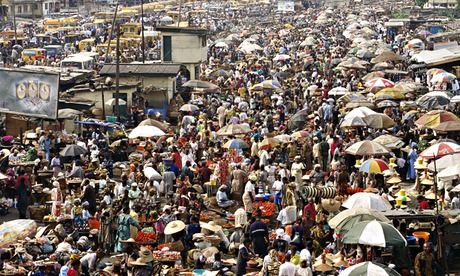
World population increase most in Africa: Crowded Oshodi Market in Lagos, Nigeria.
A crowded Oshodi market in Lagos, Nigeria – the country’s population is expected to soar from 200m today to 900m by 2100. Photograph: James Marshall/Corbis

The world’s population is now odds-on to swell ever-higher for the rest of the century, posing grave challenges for food supplies, healthcare and social cohesion. A ground-breaking analysis released on Thursday shows there is a 70% chance that the number of people on the planet will rise continuously from 7bn today to 11bn in 2100.

The work overturns 20 years of consensus that global population, and the stresses it brings, will peak by 2050 at about 9bn people. “The previous projections said this problem was going to go away so it took the focus…

View original post 757 more words

From Pine Beetles to Disappearing Glaciers, NASA Scientists Tell of “Dramatic” Planetary Changes

In addition to droughts and floods, anthropogenic climate disturbances scientists and astronauts can see from space include fires, insect outbreaks and more direct human impacts.

Source: truth-out.org

GR:  Recent studies show that global warming didn’t stop during the past 10 years, it accelerated. “Dramatic” planetary changes are happening now.

Animals are dying off 1,000 times FASTER now that humans are present

fa84089b-b3de-4474-8b8b-3f86686a6e15

“Brown University scientists in Providence found that the pre-human extinction rate was 10 times lower than scientists had believed, which means that the current level is 10 times worse.

Results:

  • Nature is thought to kill off one in every ten million animals each year
  • Past estimates put it at 10 yearly extinctions for 10 million species
  • Since mankind arrived on Earth, more than 1,000 out of every 10 million species have been dying out each year, a recent study discovered
  • Study looked at fossils and genetic variation in a species’ family tree
  • It claims future extinction rates are likely to be 10,000 times higher

By Ellie Zolfagharifard for MailOnline

Source: www.dailymail.co.uk

GR:  The Earth could get along just fine without us.  If anyone can think of an ecosystem function that requires our presence, I would like to hear about it.  Circumstantial and fossil evidence indicates that even when human numbers were small, the fires, animal drives, and plant preferences had harmful effects.  Ecosystem resilience absorbed early human impacts, but now with more than seven billion of us, the impacts are simply overwhelming earth ecosystems. Livestock?  Earth could tolerate a few domestic beasts, but not the billions we have now.