How Austrailia’s Great Barrier Reef got polluted – from farms and fossil fuels to filthy propaganda | Graham Readfearn | Environment | The Guardian

GR:  This is the best discussion of the cause of coral death in Australia’s Great Barrier Reef I’ve seen–it’s people.
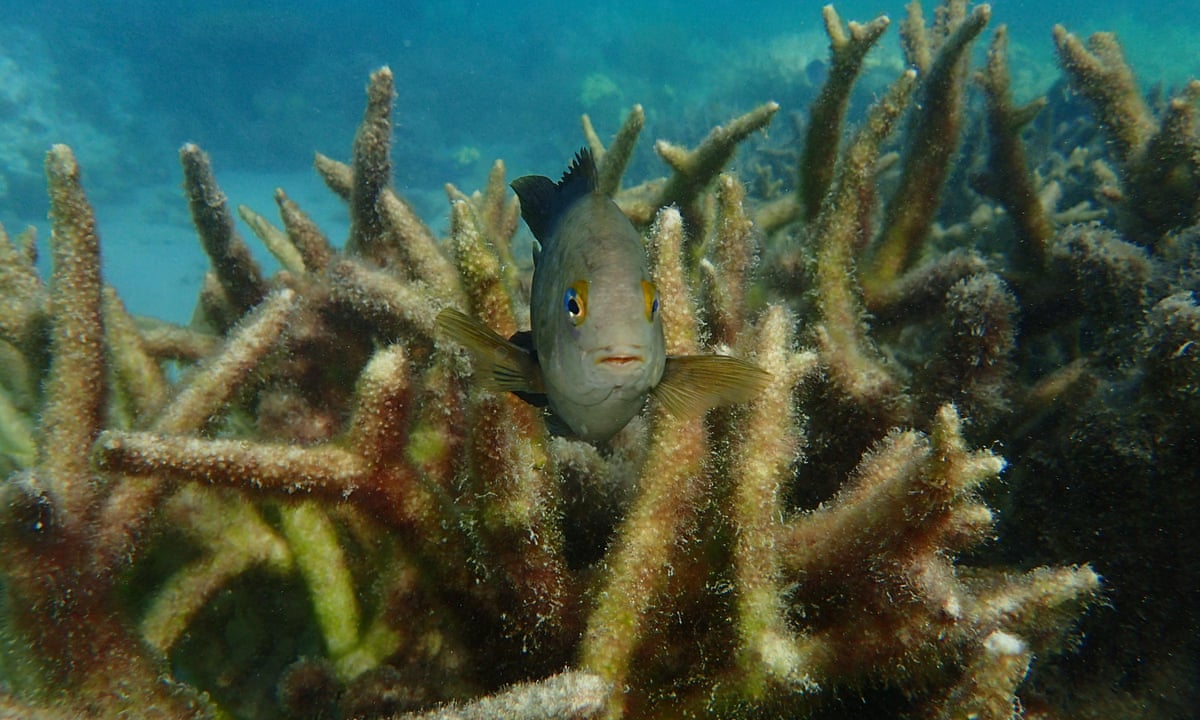
Coral bleaching at Loomis Reef, off Lizard Island, Great Barrier Reef, Australia. Photograph: Essential Median

Graham Readfearn:  In late November 2015, as corals across the northern section of the Great Barrier Reef started to bleach white, the game was finally up.

For years, Australians had been told the country’s jewel in the ocean’s crown was on the mend. Only months earlier the Coalition government had won a two-year fight to keep the reef off a United Nations list of world heritage sites in danger.

The stakes were high. International reputations and tourist dollars were at stake. The foreign minister, Julie Bishop, and the trade minister, Andrew Robb, had even attacked Barack Obama, who feared for the reef’s future.

The reef was not in danger, Bishop insisted. The president was misinformed, claimed Robb.

Conservative commentators hanging around News Corp media have said the dangers to the reef were overblown.

The mining industry cast the views of environmentalists as green propaganda, ignoring how for the most part, conservationists were echoing the findings of the government’s own scientists.

Now, about half the corals bleached in the once pristine northern section are dead or dying.  More– How the Great Barrier Reef got polluted – from farms and fossil fuels to filthy propaganda | Graham Readfearn | Environment | The Guardian

Save

Green Conservatives call for earlier UK coal power phase-out | Environment | The Guardian

Damian Carrington:  The UK should close all its coal-fired power stations two years earlier than the government’s pledge of 2025, according to green Conservatives including former energy minister Lord Greg Barker.

The move would not cause the lights to go out, would cut both carbon emissions and air pollution and would boost cleaner energy projects, according to a report from Bright Blue, a thinktank of Tory modernisers.

The report also concludes that if the troubled Hinkley C nuclear plant is cancelled it could be replaced by renewable energy.  Source: Green Conservatives call for earlier UK coal power phase-out | Environment | The Guardian

Save

Yes to Clean Energy and Clean Air. No to Coal and Climate Change. | Climate Reality

Please click the link below and sign the petition.

Climate Reality Project:  “In the coming months, Millennium Bulk Terminals plans to build the largest coal export terminal in the US near Longview, Washington, exporting up to 44 million metric tons of dirty coal annually from the Pacific Northwest to Asia.

Photo:  NBCNews.com

Photo: NBCNews.com

“Our choice is simple. We can support clean energy and protect the health of Northwest communities and the stunning beauty of our mountains and rivers. Or we can let coal trains spread dangerous coal dust across towns and cities, pollute our air and water, and accelerate the climate crisis devastating our planet.

“It’s time to put our environment and planet before coal company profits – and today, you can help. Add your name by June 13 and help ensure Millennium’s coal export proposal doesn’t move forward.

“Add your name below and say no to coal and yes to a clean energy future for the Pacific Northwest.”  Source: Yes to Clean Energy and Clean Air. No to Coal and Climate Change. | Climate Reality

Climate activists threaten to shut down world’s major coal sites

“Climate activists will use direct action to try to shut down major fossil fuel sites across the world in May, including the UK’s largest opencast coal mine in south Wales.

“The dozen international sites facing civil disobedience from the Break Free 2016 campaign span the globe from the US to Australia and South Africa to Indonesia.

“The Ffos-y-fran opencast mine, near Merthyr Tydfil in Wales, is about halfway through extracting 11m tonnes of coal. Ellie Groves, from the Reclaim the Power network, said: “The only way we can stop catastrophic climate change is taking action to keep fossil fuels in the ground.”

“The local community have battled Ffos-­y-­fran for nearly a decade and now face the threat of a new mine next door at Nant Llesg,” said Groves. “Enough is enough. We need a ban on opencast coal mining across Wales, and the rest of the UK.”  From: www.theguardian.com

GR:  Direct action by citizens is necessary when business control over government becomes so strong it blocks rational rules and enforcement.  Help stop fossil-fuel mining and use, help block military actions and the international arms trade, divest in energy, financial, and chemical stocks.  Help your government do the right thing.  Take part in protests whenever you can!

Alberta must move away from oil-based economy, minister says

EDMONTON — Climate isn’t all that’s changing in Alberta. The province’s NDP government has arguably made bigger moves on global warming in six months than the previous Conservatives made in a generation.  From: thechronicleherald.ca

Thank you Shannon Phillips.  Trudeau makes it all possible.

Yale Climate Opinion Maps

Public Opinion About Global Warming

Public opinion about global warming is an important influence on decision making about policies to reduce global warming or prepare for the impacts, but American opinions vary widely depending on where people live. So why would we rely on just one national number to understand public responses to climate change at the state and local levels?  Click this link to go to the interactive map: environment.yale.edu

GR:  Here is an interactive map that will let you check the results of opinion polls about coal-fired power plants, CO2, and global warming.  You will see that in 46 states, most people want to set strict limits on coal-fired power plants.

Thanks to Dan.

See on Scoop.itGarryRogers NatCon News

What Can We Do About Climate Change?

This interview, the fourth in a series on political topics, discusses philosophical issues that underlie recent debates about climate change. My interviewee is Dale Jamieson, a professor of environmental studies and philosophy at New York University. He is the author of “Reason in a Dark Time: Why the Struggle to Stop Climate Change Failed — and What It Means for Our Future.” — Gary Gutting

Gary Gutting.: It’s clear that global warming is an established fact, and that a good amount of it is due to human activities. But to what extent can we reliably predict how warming will affect our lives if we do little or nothing about it, or predict the effects of various policies designed to lessen its effects? In other words, does climate science have sufficient predictive reliability to be a good guide to forming public policy?

Dale Jamieson: The difference in scale between what climate models deliver and what managers and planners need has long been a major problem. Our current models make predictions primarily expressed in terms of very abstract constructs such as “mean surface temperature” that are not very useful to decision makers. Work is advancing on regional climate models that would be more useful, but there are multiple ways of trying to build these models and they remain controversial.  Source: opinionator.blogs.nytimes.com

From the article:  “The “war on coal” is nothing more than a set of policies that require producers and consumers of coal to bear some of the costs that they now evade.”

1980 View of CO2 and Global Warming–Must-See Video

Global Warming in 1980

This video gives insight to the progress of science on this issue.  Must see.

Go here for the latest on global warming and climate change.

Big Coal Dumps on Wildlife in a Biological Motherlode

GR:  Just like my dogs’ manic pursuit of squirrels.

The following by Richard Conniff.

“When most people think about a biological hotspot, a motherlode of species, the Amazon may come to mind, along with certain regions in West Africa and Southeast Asia. Hardly anybody thinks about the Appalachians. But more species of salamanders and freshwater mussels live in the streams and forests of this region, stretching from upstate New York to northern Alabama, than anywhere else in the world. Those temperate, deciduous forests are more diverse than anywhere else in the world, too, apart from those in central China.

“Unfortunately, seams of coal also run through the Appalachian Mountains, often buried deep within the range. To extract it, coal companies have been literally blowing the tops off of these mountains in a practice called mountaintop removal coal mining. Not only does this method change the landscape and leave swaths of barren rock in place of forested mountainsides, but the mining companies also take the millions of tons of dynamited rock and dump them in the valleys next to the decapitated mountains. These valleys usually have streams in them, and those streams are where the salamanders, mussels, and other freshwater species of the region live. As you might imagine, these animals don’t love having chunks of mountain dumped on their habitat.

“A new study…”

Source: strangebehaviors.wordpress.com