Butterflies Decline at Coldwater Farm

Butterfly Decline in Arizona

Coldwater Farm butterflies have declined over the past few years.  This year (2015) was the worst with many of my butterfly/bee flowers going untended. For instance, Mourning Cloaks (Nymphalis antiopa) were present only in late spring and early summer. In earlier years, the Mourning Cloaks were so abundant that I had nominated they to represent the Agua Fria River ecosystem. Perhaps butterfly numbers will rebound in 2016, but knowing nothing of the specific causes of the decline, I have no assurance they will. Click here for a checklist of the butterfly and moth species known to live in Arizona. Here are pictures of a few of the common butterflies and moths (Please excuse the fx experiments).

California drought may exacerbate wildlife-human encounters – Sacramento Bee

The scarcity of food in the wild has been blamed for unusual animal activity during California’s drought including a recent bear attack, mountain lion sightings and an uptick in orphaned animals.  Sourced through Scoop.it from: www.sacbee.com

GR:  We are seeing more deer and javelina at Coldwater Farm.  A general drought and a local groundwater decline are probably responsible.  Our ponds are shrinking every year now, and have new stains this year.  If the upstream town and farm keep pumping the water and adding wastes, the refuge we offer will eventually be lost.

April 2015 ranks as 4th-warmest on record for Earth

Take note of the cold spot in the North Atlantic. From the movie The Day After Tomorrow: Terry Rapson: “We found something extraordinary… extraordinary and disturbing, that is. You recall what you said in New Delhi about how polar melting might disrupt the North Atlantic Current?”
Jack Hall: “Yes.”
Terry Rapson: “Well… I think it’s happening.”

Bob Berwyn's avatarSummit County Citizens Voice

Year to-date is record warm

sdfg Only a few small areas of the globe were cooler than average in April 2015.

Staff Report

FRISCO — April’s globally averaged temperature was the fourth-warmest on record, at 1.33 degrees Fahrenheit above the 20th century average, according to federal climate trackers releasing the monthly Global State of the Climate update.

View original post 203 more words

Other Flowers at Coldwater Farm

Garry Rogers Coldwater Farm Flowers

Click here for other photo sets.

One in ten European wild bee species face extinction

One in ten European wild bee species face extinction

Source: www.wildlifearticles.co.uk

GR:  This is a global problem.  This morning I stood inhaling the sweet scent beneath the magnificent plumb tree that shades my bird garden bench, looked up into the countless fragrant blossoms, and listened in vain for the hum of working bees.  There was silence except for the distant hum of a truck on the road a mile away.  No movement amidst the thousands of blooms except for a single fly.

This is the worst spring for pollinators in the eighteen I’ve lived and worked at Coldwater Farm.  There were a few bees last month when the apricot bloomed, fewer when the willows bloomed, and now nothing in the plumbs.  We have a farm nearby, and I wonder if they are killing the bees with Monsanto GMO crops and pesticides.  If they aren’t, could the lawn and garden pesticides my neighbors are using cause the bees to disappear?

Wildlife News from Coldwater Farm

Coldwater Farm Wildlife

Located on the Agua Fria River in central Arizona, Coldwater Farm is a tiny, 20 acre, refuge for wildlife. Despite being in the center of the Town of Dewey-Humboldt, the Farm is an ideal wildlife habitat. It has abundant surface water supplies and patches of dense vegetation.  The Agua Fria River flows above ground through the farm, and there are three large ponds. Willow thickets and a nice grove of tall cottonwood trees fill the river’s flood plain.

Mule Deer Visits

1-IMG_2203Last July, I wrote about two fawns that visited my back yard three days after they were born (see the post here).  Mule Deer became regular visitors last winter.  They are particularly pleased with the black sunflower seeds the birds miss.

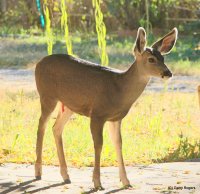
The fawns just came again, and this time another pair of twins joined them. The photo shows one of them. I think the kid looks good for four months.

Barn Owl Box

Yesterday I finished setting up a nest box for the Barn Owls that live here. I’ve know the owls were here for about 10 years now. Last winter, wind blew down the best roosting tree, and the owls have lived in less protective trees. That’s when I decided to put up a nest box.

Barn Owls are unique in many ways. They tolerate humans, and in return for permission to sleep in barns and other buildings, they control the local mouse population. Wise farmers use Barn Owls, not mousetraps. Read the two earlier posts about the Coldwater Farm Barn Owls here, and the windstorm disaster here.

1-IMG_2241The nest box is about 12 feet above the ground.  My telescoping pipe plan would have put it at 16 feet, but the wind happened to be gusting to 30 MPH, and was creating too strong a sway.  Don’t want the owls to get seasick (or the pole to bend).  I bought the box from the Barn Owl Box company.  The box is white, intended to be installed in full sun, but I chose a shady spot and decided to paint the shell flat green.

The box is visible from my back door.  If I pay attention in the evenings, I hope to see owls coming and going now and then.

Other Coldwater Farm Wildlife News

1-DSCN0729Quail are trying to make a permanent home here.  They began stopping by three years ago, but the flock didn’t began sticking around until last winter.

The annual return of wild ducks to the ponds is going well.  Mallards, Ring Necks, and American Wigeon so far.  I started throwing out a little corn when I take this old dog down for his daily swim.

1-IMG_2237-001A hawk has stayed around the house for two months now.  This week he/she dropped onto the lawn and began eating grasshoppers.  We have a good late supply this year.  I guess they are easier to catch than the songbirds and gophers that the other hawks choose.  The hawk is about 22 inches.  If you recognize the species, please let me know.

Deer at Coldwater Farm

Deer Birth Announcement

We have two new fawns! They were probably born Sunday night, July 27, 2014. Both appear normal and healthy.

Last year we regularly saw a doe in our fallowed cow pasture, and in July, she bore a fawn. Last winter several deer began visiting. The group included two yearlings, a pair of two-year olds, and several doe. One of the does looked pregnant. I didn’t see her on Monday, she came alone on Tuesday, and this morning she brought two tiny fawns.

1-IMG_1955The fawns are tiny dynamos. The one on the left didn’t have time for milk, only time for running, jumping, and running some more. Awkward, but quite fast. The other fawn made a few short sprints and jumps, but was too hungry to do more just now.

Mule Deer are showing up in yards and gardens across the western U. S. Our continuing drought is limiting forage production, and combined with our incessant pumping, the drought is drying up some springs. We are happy to have deer visit. They are eating our weeds, pruning all of our shrubs and trees, and eating unfenced garden vegetables. They love to help the birds and squirrels clean up the sunflower and millet seeds I scatter each morning.

Western U. S. deer populations are shrinking. Well-known causes include livestock grazing, farming, construction, and hunting.  We know that the causes of deer decline including hunting will not stop.  These two small creatures could be shot and killed within the next two or three years.  Nevertheless, we will continue to provide our bit of support to the deer and we are encouraging our neighbors to do so as well.


Deer Decline in Western U. S. as Drought Continues

Deer in Arizona

Mule Deer Mother and Daughter at Coldwater Farm (Garry Rogers April, 2014)

Mule Deer Mother and Daughter at Coldwater Farm (Garry Rogers April, 2014)

The Arizona deer “harvest” is declining as the drought deepens.  Though the Arizona Game and Fish Department now places no limits on the number of deer hunting licenses sold, the number of deer that hunters kill is shrinking as the deer population shrinks.

Last year, wildlife managers warned that deer would start showing up in towns where there are irrigated lawns and gardens.  That certainly was true for Coldwater Farm where the first repeated deer visit occurred and a fawn was born.  More deer are coming to the Farm this year, and we are expecting more births.

The deer are coming for water and to eat our flowers, vegetables, and weeds.  We are delighted, and would rather see deer than tomatoes.  If necessary, we can fence our garden. There are two problems:  1) we do not want to spoil the deer ability to live in the forest when the drought fades (if it does).   2) Some of our neighbors prefer tomatoes over deer and may call Animal Control (Wildlife Services?) to remove the deer.

Problem 1) is insignificant.  Because of local geology, the river has carried surface water through the site of Coldwater Farm for tens of thousands of years.  Deer have probably come for the water and riparian vegetation many times in the past and returned to the chaparral and forest when rains returned.

Problem 2) is more significant.  Already two neighbors report “shooing” deer from their garden.  Climate forecasts predict that our drought will continue for many years.  Deer could join the smaller mammals to become a permanent part of our small town biosphere.  How long before Humans demand that the deer are removed?  What will I have to do to protect their right to water and food?

Deer in Colorado

“The number of deer in Colorado and other parts of the West is rapidly declining, including a 36 percent drop among mule deer in the Centennial State from 2005 through last year, and a reported drop of at least 10 percent throughout the region.

“Brutal winters followed by extremely dry summers, loss of habitat due to commercial and residential development and predators like coyotes and mountain lions are factors in the decline, Matt Robbins, spokesman for Colorado Parks and Wildlife, told FoxNews.com.

“It’s a culmination of things,” Robbins said. “Weather has absolutely been a factor; we’ve had very harsh winters and then very dry summers, and we’re always very conscious of chronic wasting disease, loss of habitat, highway mortalities, predators and oil and gas development.”