Three principles define the shift from adolescence to maturity, from destroyer to steward.
Ecocentricity means rejecting the view that nature exists for human utility. It means recognizing intrinsic value throughout the biosphere. Rivers have worth independent of irrigation potential. Forests matter beyond timber value. Species deserve protection not for ecosystem services but because they exist. New Zealand’s Whanganui River, granted legal personhood in 2017, embodies this principle in law.
Interdependence means acknowledging that no organism exists alone. The illusion of independence proves strong in urban societies, where food appears in supermarkets and water flows from taps. Ecology shows this illusion is fiction. Every organism depends on countless others. Human wellbeing requires biosphere wellbeing.
Reciprocity means moving from extraction to exchange. Industrial civilization takes resources, produces goods, and discards waste while the biosphere receives nothing in return except degradation. Reciprocity asks not only what we can extract but what we can contribute to ecosystem health. This is partnership, not parasitism.
Together, these principles transform the human-biosphere relationship from exploitation to citizenship.
Humans possess something no other species has: the capacity to think about our own thinking.
We can identify our biases and design systems to counteract them. We can study collapsed civilizations and extract lessons applicable today. We can model futures and change course before critical impacts. We can consciously direct cultural evolution rather than stumbling through it blindly.
This metacognitive capacity is the ultimate human adaptation. Chimpanzees solve problems but cannot design institutions to overcome their cognitive limitations. Dolphins communicate but cannot write histories documenting their mistakes. Only humans can anticipate distant futures and deliberately choose to evolve.
Cognitive adaptation means recognizing that optimism bias, temporal discounting, and shifting baselines are not character flaws but universal features of human information processing. It means building governance systems that account for these biases rather than assuming rational actors. It means cultivating ecological consciousness through direct nature experience, systems education, and intergenerational knowledge transfer.
The transformation from conqueror to citizen is no longer just an ideal. It is a survival strategy. The ultimate test of human intelligence will be our ability to live wisely on Earth.
We refused to mature through foresight. Now we must mature through catastrophe.
This is not punishment. It is pedagogy. The floods, fires, famines, and extinctions are initiatory ordeals—the only teachers capable of piercing frameworks that voluntary learning could not penetrate.
Developmental psychology reveals the pattern. Adolescents often require painful experiences to accept realities they have intellectually ignored. Warnings prove insufficient. The crash teaches what caution could not. The loss instructs where abundance taught nothing.
Philosopher Glen Albrecht named the grief following the ecological losses paralleling our carelessness “solastalgia.” This is the distress caused by transformation of familiar places. Climate scientists report psychological anguish from witnessing planetary degradation. Farmers mourn disappearing seasons. Children express anxiety about futures they feel have been stolen.
This grief serves essential function. It breaks through cognitive barriers—optimism bias, shifting baselines, strategic ignorance—that insulate consciousness from environmental truth. Direct experience of loss penetrates defenses that data cannot.
The tragic irony is clear. The cognitive biases preventing voluntary transformation ensure that transformation will come through suffering. The teachers arrive uninvited, bearing lessons no one wants.
The core truth of our time is stark: “Our planet’s life-support system, the biosphere, is in a state of severe and irreversible decline”. This thesis, presented in the new book Biosphere Collapse: Causes and Solutions , has just received a major validation, earning a coveted five-star review from Dr. Paul Knobloch at Reader Views.
The review confirms that the book is an essential, timely, and credible contribution to the global conversation on humanity’s future.
The Core Message: A Shift in Worldview
Knobloch immediately recognized the uncompromising nature of the book’s premise. However, the reviewer highlights that this is not a message of “doom and gloom”. Instead, it is a plan for transformation, offering a clear “path forward”.
The book’s blueprint for survival involves a “hierarchy of transformation difficulty” consisting of four critical levels of change:
Level 1: Limiting Direct Extraction. These are the most technically straightforward changes, aimed at curbing activities like hunting and fishing.
Level 2: Transforming Production. This requires restructuring entire global sectors like agriculture and energy.
Level 3: Changing Systemic Drivers. This involves coordinating action across multiple institutions and scales to tackle root problems such as urbanization and deforestation.
Level 4: Shifting Core Beliefs. The final and most difficult step requires fundamentally rethinking our beliefs about economic growth, consumption, and humanity’s place in nature.
Beyond Human-Centric Solutions
The review emphasizes that a truly effective solution must move past theories focused strictly on human activity. This is the essence of the book’s call for Ecocentrism. Knobloch quotes the book’s direct definition: “Earth’s biosphere is a complex, interconnected system in which all species play a role, making their existence valuable beyond their utility to humans”.
Ultimately, survival requires accepting that we are merely “one ingredient in a bigger ecological and even cosmic network”.
Rigor and Accessibility
The comprehensive 5-star rating confirms that the book successfully navigates the complex space between rigorous science and accessible prose. The overall program evaluation for the book awarded the highest rating of 5 for:
Clarity and Organization: The central idea is clearly introduced, and the structure is organized logically.
Credibility: The information is backed by “credible sources, research, or the author’s firsthand experience”.
Readability and Style: The prose is “clean, jargon-free (or defines technical terms), and easy to digest”.
The book offers both an exhaustive review of existing literature and a decisive plan for action. As the reviewer concludes, this is a much-needed addition to the critical issues surrounding climate disaster and planetary health.
Read more about the ideas presented in the book and the ongoing work to address global environmental challenges on the Biosphere Collapse book page.
The satellite data says our forests are healthy. But in my new novel, Love in Eternal Gardens, Dr. Sarah Chen knows the numbers are lying. The green on the screen is just a curated façade; the real collapse has already begun.
When ancient organisms wake beneath the Antarctic ice, they trigger a planetary reset. Humanity faces a choice: extinction or a radical transformation into a collective planetary consciousness.
Sarah resists. She becomes a Memory Keeper. She fights to preserve the jagged edges of human individuality. Her partner, Tom, chooses a different path. He disperses his consciousness into the physics of the new Earth to remain with her.
This is a story about ecological reckoning, the architecture of grief, and a love that survives the rewriting of reality.
Watching the natural world change can be deeply saddening. Many of us feel a sense of grief or anxiety about the loss of species, the changing seasons, and the degradation of familiar landscapes. But paying attention—bearing witness—is a powerful act. It connects us to reality, helps us process grief, and can motivate meaningful action. Our project is to create “A Field Guide to the Anthropocene” (or similar title). This guide will blend ecological knowledge with simple observation techniques. It will help everyday people notice the environmental changes happening in their own communities, understand what they mean, and navigate the complex emotions that arise. It concerns learning to see clearly, grieve honestly, and find purpose in bearing witness to our changing planet.
The fundamental question of whether humanity’s environmental solutions will overtake and halt its environmental destruction in time to preserve human civilization is the subject of intense scientific debate. An analysis of peer-reviewed research on climate change and its effects on human civilization suggests that while positive developments in technology and policy may prevent the absolute worst-case warming scenarios, they are unlikely to be deployed fast enough to avoid irreversible damage to key global ecosystems. The “intersection” will occur, but after some critical tipping points have been crossed.
I approached this issue in: “Adapting to Worst-Case Climate Change” and “Silent Earth, Adaptations for Life in a Devastated biosphere.” This blog post is a more balanced review of optimism due to positive developments and pessimism due to negative impacts. Last week I added Kindle versions of my books. Enrolled in Amazon’s Free Book promotion, they are free starting today with “Adapting. . . .”
The Acceleration of Solutions: A Techno-Economic Revolution
The case for optimism rests on the exponential growth of clean technologies, driven by powerful economic feedback loops.
Economic Tipping Points: The most significant positive trend is that renewable energy sources are now, in many parts of the world, the cheapest form of new electricity generation available. This has created a powerful economic momentum for decarbonization that is less dependent on political will. A study by Way et al. (2022) in the journal Joule found that a rapid transition to clean energy is likely to result in trillions of dollars in net savings globally compared to a fossil-fuel-based system.
Exponential Growth & S-Curves: The deployment of key technologies like solar, wind, and batteries is not linear but follows an exponential adoption “S-curve”. BloombergNEF (2023) data shows that solar and wind now account for most new power-generating capacity added globally each year. Similarly, global EV sales have doubled every two years, a trend that, if sustained, could lead to a near-total transition away from internal combustion engines for new car sales by the early 2030s.
Policy as an Accelerator: While political will is fickle, major policy actions can create long-term industrial momentum. The U.S. Inflation Reduction Act (IRA) and the E.U.’s Green Deal are not just climate policies, but massive industrial strategies designed to onshore clean energy manufacturing and secure a competitive advantage. These initiatives will accelerate decarbonization pathways in the world’s largest economies, though this will be retarded by the U. S. counter moves in 2025.
The Acceleration of Impacts: The Unyielding Physics of the Earth System
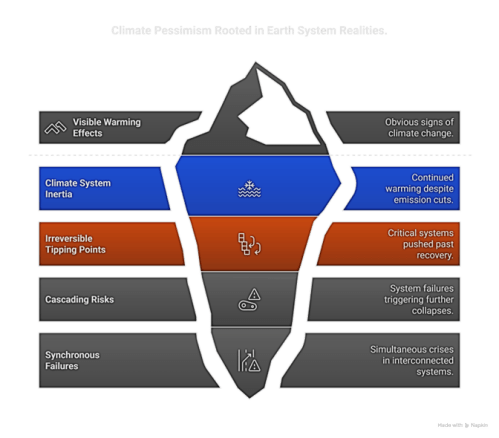
The case for pessimism is grounded in the physical realities of the Earth system, which possesses immense inertia and potential for non-linear dynamics.
Climate System Inertia and “Locked-In” Warming: The central challenge is the inertia of the climate system. Even if global emissions were to cease today, the planet would continue to warm because of past emissions and the thermal inertia of the oceans. This has been referred to as “warming in the pipeline” (Hansen et al. 2023). A significant amount of future sea-level rise and ecosystem injury is already “locked in,” regardless of our current actions.
Irreversible Tipping Points: The greatest risk is that this locked-in warming will push critical Earth systems past irreversible tipping points. A landmark 2022 study in Science by Armstrong McKay et al. found that several key tipping points, including the collapse of the Greenland and West Antarctic ice sheets and the abrupt thaw of permafrost, could be triggered even between 1.5°C and 2°C of warming—thresholds we are on track to cross. The recent die-off of vast areas of coral reefs serves as a stark example of a major ecosystem already crossing this threshold.
Cascading Risks and Synchronous Failures: These tipping points are not independent. The collapse of one system can increase the risk of another failing, creating a “tipping cascade” (Kemp et al. 2022). For example, losing Arctic sea ice reduces albedo and accelerates regional warming, which hastens the thaw of permafrost. Recent research highlights the growing risk of “synchronous failure,” where climate-related shocks trigger simultaneous crises in multiple interconnected systems, including global food supply chains and financial markets. In their exhaustive study of tipping points, Vasilis Dakos and colleagues concluded that the vast amount of remote sensing and other Earth systems data are bringing us closer to the ability to anticipate tipping points. At present, “Early warnings can tell us that “something” important may be about to happen, but they do not tell us what precisely that “something” may be and when exactly it will happen” (. . . , Dakos et al. 2024).
The Verdict: An Intersection After Irreparable Damage
When comparing these two accelerating trends, the scientific literature points to a deeply unsettling conclusion. The positive socio-economic trends of the clean energy transition are powerful, but they are unlikely to move quickly enough to prevent the biophysical trendlines of climate impact from crossing critical, irreversible thresholds. The most likely outcome is a future where humanity successfully reduces the impacts of its farms and cities and decarbonizes its energy and transportation systems, but only after locking in the collapse of several major ecosystems. We will prevent the 4-5°C “runaway greenhouse” scenario, but we will not prevent the loss of all coral reefs and mountain glaciers, loss of some major ice sheets, and significant, permanent loss of significant portions of the biosphere. The “intersection” will not be a moment of salvation, but a point at which we can adapt to a world that has been irreparably damaged. If humanity’s effort to survive is sufficient, civilization will survive, but in a suppressed state that will persist while the earth cools and cleans itself and Earth’s biosphere heals.
Armstrong McKay, D. I., et al. (2022). “Exceeding 1.5°C global warming could trigger multiple climate tipping points.” Science, 377(6611), eabn7950.
BloombergNEF. (2023). New Energy Outlook 2023. Bloomberg Finance L.P.
Claes, D. H., & Pineda, L. G. (2023). “The Inflation Reduction Act (IRA) and the new logic of climate and energy policy.” Energy Strategy Reviews, 50, 101258.
Dakos, V. et al. (2024). Tipping point detection and early warnings in climate, ecological, and human systems. Earth System Dynamics 15: 1117-1135.
Hansen, J., et al. (2023). “Global warming in the pipeline.” Oxford Open Climate Change, 3(1), kgad008.
Homer-Dixon, T., et al. (2015). “Synchronous failure: The emerging causal architecture of global crisis.” Ecology and Society, 20(3).
Hughes, T. P., et al. (2018). “Global warming transforms coral reef assemblages.” Nature, 556(7702), 492-496.
IEA. (2023). World Energy Outlook 2023. International Energy Agency.
IPCC. (2021). Climate Change 2021: The Physical Science Basis. Contribution of Working Group I to the Sixth Assessment Report of the Intergovernmental Panel on Climate Change. Cambridge University Press.
Max Wilbert and other members of Deep Green Resistance Seattle participated in a May “ShellNO” protest against Shell’s arctic drilling rig. Their display of signs reading “Sabotage the Machine” and “Eco-Sabotage is Planetary Self-Defense” attracted a lot of attention. Elliot Stoller conducted a short video interview in which Wilbert explains his concern about ineffective tactics and strategies in the face of dramatic threats to biodiversity, climate, and social justice.
Wilbert discusses DGR’s radical evaluation of systems of power and what might actually work to alter their destructive course: targeting critical communication, electrical, and oil infrastructures, and addresses some common questions about what that means for the safety of activists who undertake such work, and what sort of life humans can live without the comforts and elegancies of industrial civilization. Sourced through Scoop.it from: deepgreenresistance.blogspot.com
GR: In this video (http://bit.ly/1MA5av2) Wilbert describes eco-sabotage as necessary self-defense for nature. This radical perspective is gaining momentum as it becomes apparent that Earth ecosystems are deteriorating due to excessive corporate resource extraction and government mismanagement of natural resources. Worth watching.
“To find out [how meat consumption impacted biodiversity], Brian Machovina and his colleagues looked at studies that identified the world’s biodiversity hotspots—those areas that contain the highest percentage of endemic plant and animal species. Most are located in tropical nations. Then, the researchers picked out countries that are most likely to expand their industrial livestock operations, and determined where and how much land will be lost to grazing and growing crops to feed livestock. Using data from the Food and Agriculture Organization and other studies about the production of cattle, pigs, and chickens in these countries from 1985 to 2013 and the amount of land the livestock required, they extrapolated the likely future expansion of agricultural lands. Finally, they created maps of overlap.
“Many of the places expected to see the greatest shift in land use from forest to livestock are in 15 “megadiverse” countries, which harbor the largest number of species, Machovina says. “By 2050, given current trends, these countries will likely increase the lands used for livestock production by 30% to 50%”—some 3,000,000 square kilometers—the researchers estimate.
“The habitat loss is so great that it will cause more extinctions than any other factor, the study notes, particularly when coupled with other deleterious effects of livestock production, including climate change and pollution. “These changes will have major, negative impacts on biodiversity,” Machovina says. “Many, many species will be lost.” Sourced through Scoop.it from: news.sciencemag.org
GR: Eventually all human “eaters” speed extinction. Soybeans, wheat, and cabbages all require land to grow. As the number of hungry humans grows, the amount of farmed land will grow. If the coming massive storms do not reverse our growth, the loss of nature will.




 GarryRogers Nature Conservation