
Intersection Of Human Environmental Solutions and Impacts

The fundamental question of whether humanity’s environmental solutions will overtake and halt its environmental destruction in time to preserve human civilization is the subject of intense scientific debate. An analysis of peer-reviewed research on climate change and its effects on human civilization suggests that while positive developments in technology and policy may prevent the absolute worst-case warming scenarios, they are unlikely to be deployed fast enough to avoid irreversible damage to key global ecosystems. The “intersection” will occur, but after some critical tipping points have been crossed.

I approached this issue in: “Adapting to Worst-Case Climate Change” and “Silent Earth, Adaptations for Life in a Devastated biosphere.” This blog post is a more balanced review of optimism due to positive developments and pessimism due to negative impacts. Last week I added Kindle versions of my books. Enrolled in Amazon’s Free Book promotion, they are free starting today with “Adapting. . . .”

The Acceleration of Solutions: A Techno-Economic Revolution

The case for optimism rests on the exponential growth of clean technologies, driven by powerful economic feedback loops.

  • Economic Tipping Points: The most significant positive trend is that renewable energy sources are now, in many parts of the world, the cheapest form of new electricity generation available. This has created a powerful economic momentum for decarbonization that is less dependent on political will. A study by Way et al. (2022) in the journal Joule found that a rapid transition to clean energy is likely to result in trillions of dollars in net savings globally compared to a fossil-fuel-based system.
  • Exponential Growth & S-Curves: The deployment of key technologies like solar, wind, and batteries is not linear but follows an exponential adoption “S-curve”. BloombergNEF (2023) data shows that solar and wind now account for most new power-generating capacity added globally each year. Similarly, global EV sales have doubled every two years, a trend that, if sustained, could lead to a near-total transition away from internal combustion engines for new car sales by the early 2030s.
  • Policy as an Accelerator: While political will is fickle, major policy actions can create long-term industrial momentum. The U.S. Inflation Reduction Act (IRA) and the E.U.’s Green Deal are not just climate policies, but massive industrial strategies designed to onshore clean energy manufacturing and secure a competitive advantage. These initiatives will accelerate decarbonization pathways in the world’s largest economies, though this will be retarded by the U. S. counter moves in 2025.

The Acceleration of Impacts: The Unyielding Physics of the Earth System

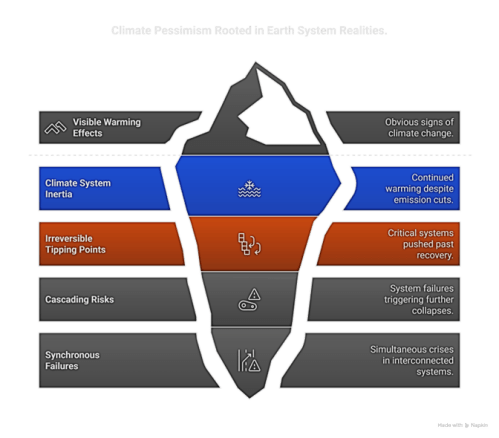
The case for pessimism is grounded in the physical realities of the Earth system, which possesses immense inertia and potential for non-linear dynamics.

  • Climate System Inertia and “Locked-In” Warming: The central challenge is the inertia of the climate system. Even if global emissions were to cease today, the planet would continue to warm because of past emissions and the thermal inertia of the oceans. This has been referred to as “warming in the pipeline” (Hansen et al. 2023). A significant amount of future sea-level rise and ecosystem injury is already “locked in,” regardless of our current actions.
  • Irreversible Tipping Points: The greatest risk is that this locked-in warming will push critical Earth systems past irreversible tipping points. A landmark 2022 study in Science by Armstrong McKay et al. found that several key tipping points, including the collapse of the Greenland and West Antarctic ice sheets and the abrupt thaw of permafrost, could be triggered even between 1.5°C and 2°C of warming—thresholds we are on track to cross. The recent die-off of vast areas of coral reefs serves as a stark example of a major ecosystem already crossing this threshold.
  • Cascading Risks and Synchronous Failures: These tipping points are not independent. The collapse of one system can increase the risk of another failing, creating a “tipping cascade” (Kemp et al. 2022). For example, losing Arctic sea ice reduces albedo and accelerates regional warming, which hastens the thaw of permafrost. Recent research highlights the growing risk of “synchronous failure,” where climate-related shocks trigger simultaneous crises in multiple interconnected systems, including global food supply chains and financial markets. In their exhaustive study of tipping points, Vasilis Dakos and colleagues concluded that the vast amount of remote sensing and other Earth systems data are bringing us closer to the ability to anticipate tipping points. At present, “Early warnings can tell us that “something” important may be about to happen, but they do not tell us what precisely that “something” may be and when exactly it will happen” (. . . , Dakos et al. 2024).
The Verdict: An Intersection After Irreparable Damage

When comparing these two accelerating trends, the scientific literature points to a deeply unsettling conclusion. The positive socio-economic trends of the clean energy transition are powerful, but they are unlikely to move quickly enough to prevent the biophysical trendlines of climate impact from crossing critical, irreversible thresholds. The most likely outcome is a future where humanity successfully reduces the impacts of its farms and cities and decarbonizes its energy and transportation systems, but only after locking in the collapse of several major ecosystems. We will prevent the 4-5°C “runaway greenhouse” scenario, but we will not prevent the loss of all coral reefs and mountain glaciers, loss of some major ice sheets, and significant, permanent loss of significant portions of the biosphere. The “intersection” will not be a moment of salvation, but a point at which we can adapt to a world that has been irreparably damaged. If humanity’s effort to survive is sufficient, civilization will survive, but in a suppressed state that will persist while the earth cools and cleans itself and Earth’s biosphere heals.

Bibliography

Alber, J., et al. 2021. The Apocalyptic Dimensions of Climate Change between the Disciplines. https://doi.org/10.1515/9783110730203-001.

Armstrong McKay, D. I., et al. (2022). “Exceeding 1.5°C global warming could trigger multiple climate tipping points.” Science, 377(6611), eabn7950.

BloombergNEF. (2023). New Energy Outlook 2023. Bloomberg Finance L.P.

Claes, D. H., & Pineda, L. G. (2023). “The Inflation Reduction Act (IRA) and the new logic of climate and energy policy.” Energy Strategy Reviews, 50, 101258.

Dakos, V. et al. (2024). Tipping point detection and early warnings in climate, ecological, and human systems. Earth System Dynamics 15: 1117-1135.

Hansen, J., et al. (2023). “Global warming in the pipeline.” Oxford Open Climate Change, 3(1), kgad008.

Homer-Dixon, T., et al. (2015). “Synchronous failure: The emerging causal architecture of global crisis.” Ecology and Society, 20(3).

Hughes, T. P., et al. (2018). “Global warming transforms coral reef assemblages.” Nature, 556(7702), 492-496.

IEA. (2023). World Energy Outlook 2023. International Energy Agency.

IPCC. (2021). Climate Change 2021: The Physical Science Basis. Contribution of Working Group I to the Sixth Assessment Report of the Intergovernmental Panel on Climate Change. Cambridge University Press.

Kemp, L., et al. (2022). “Climate Endgame: Exploring catastrophic climate change scenarios.” Proceedings of the National Academy of Sciences, 119(34), e2108146119.

Rogers, G. 2024. Adapting to Worst-Case Climate Change. Coldwater Press, Humboldt, AZ. 99 p.

Rogers, G. 2025. Silent Earth: Adaptations for Life in a Devastated Biosphere. Coldwater Press, Humboldt, AZ. 452 p.

Seba, T. (2020). Rethinking Humanity: Five Foundational Sector Disruptions, the Lifecycle of Civilizations, and the Coming Age of Freedom. RethinkX. https://www.rethinkx.com/publications/rethinkinghumanity2020.en [Accessed 06/09/25]

Steel, D., et al. 2022. Climate change and the threat to civilization. Proceedings of the National Academy of Sciences, 119(42), e2210525119.

Way, R., et al. (2022). “Empirically grounded technology forecasts and the energy transition.” Joule, 6(9), 1967-1971.

Human Hothouse Spurs Longest Coral Die-Off on Record

It’s like a bad dream from which one cannot wake.

robertscribbler's avatarrobertscribbler

The big coral die-off began in the Western Pacific as a massive ocean temperature spike built up during 2014. Back then, ocean heat accumulation had hit a very high ramp. A vicious, century-and-a-half long increase in atmospheric greenhouse gasses re-radiated greater and greater portions of the sun’s energy hitting the Earth — transferring the bulk (about 90 percent) to the world ocean system.

Major Coral Bleaching Event

(A report out today from AGU finds that the world is now experiencing its longest coral die-off event on record. Image source: AGU.)

By 2015, as one of the strongest El Ninos on record began to extend its influence across the globe, a broad region stretching from the Western Pacific, through the Central Pacific and on into the Eastern Pacific and Caribbean were all experiencing mass coral die-offs. Into early 2016, die-off events again expanded taking in Australian waters and sections of the Indian Ocean off…

View original post 784 more words

Eye on the Ball– #ClimateChange, #Biodiversity, #NatureConservation, & #SarahPalin

Nature Conservation

GarryRogersThe excellent article introduced below is about nature conservation from the human viewpoint.  The argument is that the current mass extinction of wild plants and animals has harmful consequences for the future of the human species.  It most certainly has, but the author’s desire to inform his audience misses its target because it gives a biased view of the problem. The article does not consider the rights of other species. This “homocentric” view of nature assumes that disappearance of other creatures is only important if it endangers humans.

Aldo Leopold and other conservationists realized that this viewpoint is unsustainable. Unless we accept the equality of all Earth’s species, including our own, our conservation efforts will always fail.  With its runaway enthusiasm for untested proposals, our species will take chances with the lives of other species. Experiments aimed only at benefiting our species, experiments that do not respect the rights of other species, experiments that will sometimes have unforeseen consequences, will gradually nibble away at nature until our ecosystems collapse and wash into the sea (carrying us with it).

Unless we begin to respect the rights of all species, we will exert constant damage on the Earth and ourselves.


Our real Sarah Palin nightmare: We debate sideshows and phony problems — while this very real threat looms undiscussed

Former Alaska Gov. Sarah Palin, right, endorses Republican presidential candidate Donald Trump during a rally at the Iowa State University, Tuesday, Jan. 19, 2016, in Ames, Iowa. (AP Photo/Mary Altaffer)

Former Alaska Gov. Sarah Palin, right, endorses Republican presidential candidate Donald Trump during a rally at the Iowa State University, Tuesday, Jan. 19, 2016, in Ames, Iowa. (AP Photo/Mary Altaffer)

“It’s an amazing fact that the contemporary world is marked by a growing number of problems that are genuinely global in scope. Some of these problems even have existential implications for the survival of human civilization — yet instead we spend too much time discussing smaller threats, including North Korea, ISIS, Oregon militias and even Sarah Palin. One such problem is anthropogenic climate change — a catastrophe whose effects are anticipated to be “severe,” “pervasive” and “irreversible.”

“But climate change isn’t the only problem of this sort. In fact, for many who spend their lives studying environmental issues, it can be frustrating to see climate change — a highly contentious issue among non-experts, despite a scientific consensus about its reality and causes — dominate the public discussion. The fact is that biodiversity loss constitutes an equally worrisome (albeit related) threat to the future of humanity.

“Consider some cold hard facts. According to the 3rd Global Biodiversity Report (GBO-3), the total population of vertebrates — a broad category that includes mammals, birds, reptiles, sharks, rays and amphibians — living within the tropics declined by a shocking 59% from 1970 to 2006. Take a moment to let this sink in. In only 36 years, more than half of the vertebrate population between the Tropic of Capricorn and the Tropic of Cancer disappeared.”— Read More: , Salon.

Links:

Population

Conservation


Climate Change and Wildfire

Wildfire Ecology

I’ve been interested in natural vegetation response to wildfire for more than 40 years. Most of my work involves the desert shrublands and woodlands of western North America. From the beginning of my studies, I saw that Asian weeds brought by European sheep and cattle herders had heavily infested native vegetation. It soon became clear that added fuel provided by the weeds was allowing fires to increase in size and number. During the past century and a half, the weeds have replaced vast areas of native shrublands and woodlands that could not contend with the increasing wildfires.

Fire-prone invasive plants fueled fires that converted this formerly diverse Sonoran Desert landscape of small trees and tall Saguaro cactus into an impoverished shrubland.

This is one of the study sites that Jeff Steele and I established in 1974.  Two fires (1974 and 1985), converted this formerly diverse Sonoran Desert landscape of small trees and tall Saguaro cactus into an impoverished shrubland.

Humans with their weeds and livestock led the first devastating wave of wildfire across the arid and semi-arid lands of the world. The next wave will come from human-caused global warming.

The following is from Global Warming Forecasts

[Click this link for my review of the Forecasts.  Below, I’ve include 2050 as an example of the forecasts.]

2050 Wildfires

“2050.  Forest wildfire burn area in the U.S. is projected to increase by over 50% and as much as 175% in some areas by 2050.  “The area of forest burnt by wildfires in the United States is set to increase by over 50% by 2050, according to research by climate scientists. The study [Impacts of climate change from 2000 to 2050 on wildfire activity and carbonaceous aerosol concentrations in the western United States], predicts that the worst affected areas will be the forests in the Pacific Northwest and the Rocky Mountains, where the area of forest destroyed by wildfire is predicted to increase by 78% and 175% respectively.

“The research is based on a conservative temperature increase of 1.6 degrees Celsius over the next 40 years [2010-2050]. Published in the Journal of Geophysical Research, scientists also say that the increase in wildfires will lead to significant deterioration of the air quality in the western United States due to greater presence of smoke. . . . This work was funded by the U.S. Environmental Protection Agency (EPA) and National Aeronautics and Space Administration. Dr. Dominick Spracklen carried out the research whilst at Harvard’s School of Engineering and Applied Sciences (SEAS) in collaboration with Jennifer Logan and Loretta Mickley.” (NASA press release, “Wildfires Set to Increase 50 Percent by 2050,” NASA Earth Observatory, Twitter NASA EO, Greenbelt, Maryland, July 28, 2009 reporting findings in D.V. Spracklen, L.J. Mickley, J.A. Logan, R.C. Hudman, R. Yevich, M.C. Flannigan, and A.L. Westerlin, “Impacts of climate change from 2000 to 2050 on wildfire activity and carbonaceous aerosol concentrations in the western United States,” Journal of Geophysical Research, Vol. 114, D20301, doi:10.1029/2008JD010966, published October 20, 2009.” Global Warming Forecasts

View Jennifer Logan’s PowerPoint presentation on wildfires.


Global Warming Forecasts | #climatechange

Expert Global Warming Forecasts

GR:  This reference covers global warming forecasts that scientists have made for the years 2015, 2020, 2025, 2030, 2035, 2040, 2050, 2080, 2090, and 2100.  Projections by well-known scientists and peer-reviewed publications make this a dependable resource.  Reading it, you might be amazed that there has been so much doubt and so little action on global warming.

“The colors on the map show temperature changes over the past 22 years (1991-2012) compared to the 1901-1960 average for the contiguous U.S., and to the 1951-1980 average for Alaska and Hawai’i. The bars on the graph show the average temperature changes by decade for 1901-2012 (relative to the 1901-1960 average). The far right bar (2000s decade) includes 2011 and 2012. The period from 2001 to 2012 was warmer than any previous decade in every region.” (U.S. Global Change Research Program)

This map shows what has actually happened in the U. S. “The colors on the map show temperature changes over the past 22 years (1991-2012) compared to the 1901-1960 average for the contiguous U.S., and to the 1951-1980 average for Alaska and Hawaii. The bars on the graph show the average temperature changes by decade for 1901-2012 (relative to the 1901-1960 average). The far right bar (2000s decade) includes 2011 and 2012. The period from 2001 to 2012 was warmer than any previous decade in every region.” (U.S. Global Change Research Program)

The following is from the Global Warming Forecasts website.

“Global warming forecasts trace their history back to the works of Swedish chemist Svante Arrhenius (1890s), American geologist Thomas Chamberlain (1890s) and British engineer Guy S. Callendar (1930s and ’40s).

“In the 1950s, after oceanographers Roger Revelle and Hans Suess published research findings concluding that “human beings are now carrying out a large-scale geophysical experiment” by discharging greenhouse gases into the atmosphere, Revelle, director of the Scripps Institution of Oceanography, recruited geochemist Charles David Keeling to begin the process of taking long-term measurements of carbon dioxide (CO2) concentrations in the atmosphere.

“When Keeling started taking CO2 measurements at the weather observatory at the top of the Mauna Loa volcano in Hawaii and on the continent of Antarctica, he established the baseline for collecting the data that would begin the modern era of global warming forecasting.

“Since Revelle’s and Keeling’s landmark work in the 1950s, global warming forecast research has expanded to develop projections based on concentrations of other greenhouse gases such as methane (the principal component of natural gas), carbon monoxide and nitrous oxide as well as temperature data, precipitation, weather patterns and specific ecosystems.

“Global warming forecasting and research formats, however, have tended to be linear or vertical in nature, i.e., focusing on observations of singular data sets over time such as:

[GR:  These links take you to some excellent articles.]

“Similarly, projections of climate change impacts have tended to focus on specific sectors such as water resources, energy supplies, energy usage, transportation, human health, food, specific ecosystems, geographic regions, countries and continents.

“Here and on the pages that follow is a look at global warming forecasts from a “confluence forecast” or “convergence forecast” perspective. Rather than the conventional vertical format, we look at multiple converging forecasts presented in a horizontal or more integrated “side-by-side” context.” — http://www.global-warming-forecasts.com/


Climate: West may be in permanent drought by 2060s

So. . . , we get catastrophic floods, but the drought continues–great.

Bob Berwyn's avatarSummit County Citizens Voice

kj Is western drought the new climate normal?

New study quantifies global warming effect on California drought

Staff Report

FRISCO — Researchers say there’s new evidence that global warming will push the western U.S. into the driest conditions in at least the past 1,000 years, as higher temperatures exacerbate drought condition in the region.

The new study by scientists with Columbia University’s Lamont-Doherty Earth Observatory and Cornell University focused on the current California drought, showing that warmer temps drive moisture from plants and soil into the air. Warmer temps likely worsened the California drought by 25 percent, the scientists concluded in their paper, published in the journal Geophysical Research Letters.

View original post 440 more words

Eco-Sabotage is Planetary Self-Defense | Deep Green Resistance Blog

Max Wilbert and other members of Deep Green Resistance Seattle participated in a May “ShellNO” protest against Shell’s arctic drilling rig. Their display of signs reading “Sabotage the Machine” and “Eco-Sabotage is Planetary Self-Defense” attracted a lot of attention. Elliot Stoller conducted a short video interview in which Wilbert explains his concern about ineffective tactics and strategies in the face of dramatic threats to biodiversity, climate, and social justice.

Wilbert discusses DGR’s radical evaluation of systems of power and what might actually work to alter their destructive course: targeting critical communication, electrical, and oil infrastructures, and addresses some common questions about what that means for the safety of activists who undertake such work, and what sort of life humans can live without the comforts and elegancies of industrial civilization.  Sourced through Scoop.it from: deepgreenresistance.blogspot.com

GR:  In this video (http://bit.ly/1MA5av2) Wilbert describes eco-sabotage as necessary self-defense for nature.  This radical perspective is gaining momentum as it becomes apparent that Earth ecosystems are deteriorating due to excessive corporate resource extraction and government mismanagement of natural resources.  Worth watching.

2015’s Cruel Climate Count Continues as NASA Shows July Was Hottest On Record

robertscribbler's avatarrobertscribbler

Andrew Freeman is right. It’s been a cruel, cruel summer. Hothouse mass casualty events, spurred by a ridiculous accumulation of heat trapping gasses in the Earth atmosphere, have spanned the Northern Hemisphere. The result has been thousands of lives lost and the hospitalization of tens of thousands more as global temperatures rocketed to levels not seen in probably 100,000 years (related — Hothouse Mass Casualties Strike Egypt).

July of 2015 Hottest on Record

Now, in a record-shattering hot year featuring extreme weather weirdness and an emerging monster El Nino, yet one more record has fallen. For according to both NASA and Japan’s Meteorological Agency (JMA), July of 2015 squashed and smashed previous record hot Julys 2011 (NASA) and 1998 (JMA) to take the title as hottest July yet.

July Temperatures Japan Meteorological Agency

(Japan’s Meteorological Agency shows July of 2015 was the hottest on record by a wide margin.)

In the…

View original post 1,136 more words

Hothouse Mass Casualties Strike Egypt, Heatwave Hospitalizes Thousands in Japan

#Global Warming–#Weather Extremes

Back in May, official temperatures soared to 35 degrees Celsius (95 degrees Fahrenheit) as humidity levels spiked in Cairo, Egypt. The early high heat and humidity sparked anxiety among residents worrying over the coming summer. Public complaints about official temperatures being lower than actual measures were widespread among a populace vulnerable to heat exposure in a notoriously hot region of the world suffering the ongoing impacts of human-forced warming. The below video captures some of the sentiment of a few months ago, when concern that record global temperatures in the range of 1 degree Celsius above 1880s averages might result in harm to Egypt’s populace was widespread and growing.”   Sourced through Scoop.it from: robertscribbler.com GR:  This summer’s deaths are sad harbingers of escalating weather extremes as the planet warms and ocean evaporation increases.  Urban heat islands intensify the extremes.  This bad for humans, pets, and factory-farmed animals, but for now, wild animals outside cities will not suffer as much.  Of course, other human impacts are killing wild animals and plants.  Increased transpiration during heat waves will hurry our innocent fellow creatures along the road to extinction.